
Sermon for the first Sunday after the Epiphany: The Baptism of the Lord.
The biblical text is Matthew 3:13-17.
Two cows are standing in a field. One of them says to the other, “Have you heard about this mad cow disease that’s going around?”
The other says, “No, I haven’t. What is it?”
The first one says, “Well, it’s this sickness that makes cows go insane.”
And the other one says, “Gosh, that sounds awful. It’s a good thing I’m a chicken!”
It’s funny how we can be so invested in our perspective—so convinced that we are right—that we don’t even notice how that commitment to being right is disconnecting us from things that matter, like reality or relationships.
When my kids were younger, I had a more authoritarian style of parenting. When they would act up, as kids do, I would try to think up a punishment that was appropriate to the offense and uncomfortable enough to dissuade the child from committing that same offense again.
But I’m not proud of that.
Because here’s what I’ve learned about that style of parenting: it suffers from the law of diminishing returns. Each time the kid would repeat the offense, I would repeat the punishment. But eventually, the kid would get used to it, so I would have to increase the severity in order to achieve the same result. And then the process would just repeat itself.
Until I eventually backed off.
Because I was not actually trying to harm my kids—I was trying to help them. And I could ground them for a week or a month, but there’s no way I could ground them until they’re 30, as much as I might want to.
So the system of crime and punishment seems great on paper, but it falls apart in reality because it can’t deliver on the results it promises. Eventually, the authority figure becomes the bad guy, because the punishment surpasses the severity of the crime. And it’s in that moment that character-building becomes cruelty, and discipline becomes demeaning rather than defining.
God understands that law of diminishing returns, which is why we have this story of the baptism of Jesus in today’s reading from the Gospel according to Matthew.
In this story, which takes place at the outset of Jesus’ ministry, Jesus approaches John and asks to be baptized. John looks at him and says, “Wait a minute—that’s not right! You should be baptizing me, not the other way around!”
And Jesus answers, “Let it be so now; for it is proper for us in this way to fulfill all righteousness.”
That phrase—fulfill all righteousness—is very interesting.
In Greek, the word translated here as righteousness is a sailing term. It refers to the state of affairs when the mast of a ship is perpendicular to the line of the water. In that situation, one can say that the ship is sailing upright. So the definition of righteousness—or being “righted,” as sailors still say in modern terms—is about the relationship between the mast and the water. They are in right relationship with each other.
And that’s the definition of righteousness we see in today’s Gospel.
It’s not about following the rules. It’s about being in right relationship with each other.
What happens next is a concrete illustration of what this looks like in practice. Jesus enters the water and is baptized by John. Jesus does this not because he has any sins of which he needs to repent, but as a callback to the story of Israel, when they passed through the waters of the Red Sea in the book of Exodus.
Jesus, in this moment, is entering into Israel’s story in order to bring that story to the next stage of its development.
In other words, Jesus meets them where they are in order to bring them to where they ought to be.
And the same thing is true of the relationship between us and Jesus today. In Jesus, God enters into our story in order to bring us deeper into God’s story. That’s the meaning of the mystery of the Incarnation.
St. Athanasius of Alexandria, one of the early Church Fathers, said this beautifully. He said, “God became human so that humanity might become divine.”
Contemporary singer-songwriter Derek Webb said it like this: “You must become what you want to save.”
It’s not about being right. It’s about being in relationship. It’s about meeting people where they are in order to bring them to where they ought to be.
This is a very different vision of righteousness than the one we see most often in the world today. Most often, the kind of righteousness we hear about is compliance with laws laid down by powerful people. Those who comply are left alone, while those who don’t are punished.
But that definition of righteousness suffers from the law of diminishing returns I described a moment ago. It lacks the ability to bring us to that deep transformation of character and relationships that Jesus intended when he used the word righteousness in today’s Gospel.
Christ-like righteousness happens when we attend to the quality of our relationships rather than simply force compliance with an established law. It happens when we enter into each other’s stories so that we can help one another enter more deeply into God’s story—which is the reconciliation of all things in heaven and on earth, as it says in the letter to the Colossians.
It’s not about being right. It’s about being in relationship—with ourselves, with each other, and with God. That’s the kind of righteousness God is interested in, and that’s the kind of righteousness Jesus fulfills in today’s Gospel.
What it requires of us is empathy, imagination, and a willingness to listen—to apologize, to make things right, and ultimately to forgive.
We can’t get to that kind of relational righteousness by punishing people until they comply. We have to listen and try to understand if we want to make things right.
As Christians—particularly as Episcopalians—what this requires of us is that we consider carefully the words of our own Baptismal Covenant. In it, we vow to seek and serve Christ in all persons, loving our neighbor as ourselves. Furthermore, we vow to strive for justice and peace among all people and to respect the dignity of every human being.
These vows are not just about rules we follow. They are about relationships.
We make these vows as part of the covenant of baptism, just as we make marriage vows as part of the covenant of Holy Matrimony. It’s not about rules we follow individually; it’s about the relationship we are building together.
In baptism—the sacrament of solidarity—we are made one with Christ and one another. Those who have passed through the waters of the font—whether Venezuelan, Chinese, Russian, or American; whatever their skin color or native language; gender identity or sexual orientation; political affiliation or preference in pizza toppings—whatever distinctions we make between ourselves, they cannot erase the fact that we are one in Christ Jesus.
We are in relationship with one another, and therefore, we ought to act like it.
That’s what the fulfillment of righteousness means in the eyes of Jesus. It’s not about who deserves to be punished. It’s about who is my family.
And for Jesus, the answer is everyone.
Several years ago, a friend of mine went through a test of his faith in this Baptismal Covenant. His name is the Very Reverend Dr. Peter Elliott, and he was the dean of the Anglican Cathedral in Vancouver, Canada.
[On a personal note, Peter was one of my strongest friends and supporters in my journey to the Episcopal Church. So if you appreciate my standing here before you today, you have, in part, Peter Elliott to thank for it.]
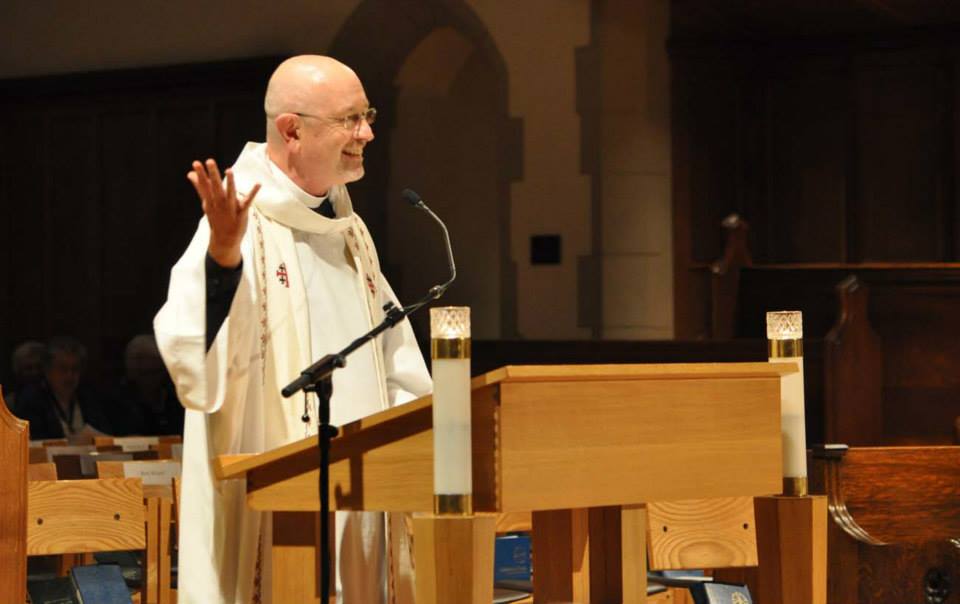
During his tenure as cathedral dean, Peter lived through the Stanley Cup riots in Vancouver in 2011. These riots happened not as an outcry against social injustice, but because their favorite team lost a hockey game. And these Canadians—who are normally so polite—absolutely trashed the downtown corridor of their own city.
Windows were broken, cars were burned, and people were hurt. And my friend, along with the rest of the city, was left stunned in the aftermath.
News reporters called them hoodlums and hooligans. The mayor declared that he was going to deal with these troublemakers. Some Canadians even declared that this would be a good time for Canada to bring back the death penalty.
And Peter sat back watching, and he noticed how the worst behavior of those who took part in the riot was bringing out the worst in everyone else.
When asked about it by a reporter, he said that the city’s response to the rioters could be more creative than simply throwing them in jail. He said that justice, in this scenario, was more about healing the community than punishing the offenders.
So Peter joined with others to lead a restorative justice initiative in Vancouver after the Stanley Cup riots. Through this process, victims and offenders willingly sat down together. Victims were heard, and offenders were held accountable—not just through punishment, but through working with others to restore the community they had damaged by their actions.
Peter led this movement as a priest in Christ’s Church. He stepped up because he believed—and still believes—that the gospel of Christ and the way of Jesus have the power to change lives and save sinners like you and me.
Kindred in Christ, we will eventually come to the fulfillment of all righteousness that Christ talks about in today’s Gospel. But we’re not going to get there by simply punishing the right people or making those punishments severe enough that they learn their lesson.
We’re going to get there by deepening our relationships with one another—by taking time to listen and understand those who are different from us.
We’re going to get there by remembering that justice doesn’t come from a loaded gun, but from an empty tomb.
That is the gospel that Jesus Christ demonstrated in his time on this earth and continues to demonstrate in his Church today.
May we ever be faithful to this gospel, as we have received it.
Amen.

 Hopping Hadrian's Wall