
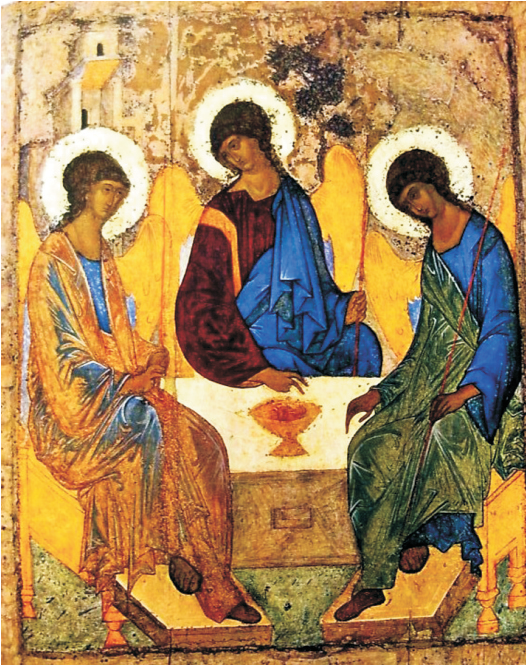
Is Ketchup a Smoothie? A Sermon on (Not) Understanding the Holy Trinity

Sermon for Trinity Sunday

Service Bulletin:

There are several different kinds of knowledge.

First, there’s book smarts, like knowing that tomatoes are a fruit and not a vegetable.

Then there’s practical wisdom, like knowing that it’s not a good idea to put tomatoes in a fruit salad.

And then there’s philosophy, like wondering whether that means ketchup is technically a smoothie.

Today, we’re going to be talking about that third kind.

Today, we celebrate Trinity Sunday, conventionally known in the Episcopal Church as “associate rector appreciation Sunday” because this is the week that senior rector’s most often take as their vacation. They would much rather leave the explanation of complicated and abstract concepts to those younger clergy who have more up-to-date seminary training. Since we don’t have an associate rector in our parish, and I failed to accurately calculate the week of my vacation, this enviable task has now fallen to me.

So, instead of building up to a conclusion, I’m going to cut straight to the chase. Here’s the main thing I’m going to say about the mystery of the Trinity:

If you think you understand the mystery of the Trinity, you do not understand the mystery of the Trinity; if you do not understand the mystery of the Trinity, you understand the mystery of the Trinity.

Got it? Good. Amen. Let’s all get out of here before the Methodists get the good lunch tables at the diner.

Of course, the problem is that this little riddle leaves us right back where we started, so we end up going around and around until our heads fall off… and that’s the point of the whole thing.

The mystery of the Holy Trinity is the primary Christian concept of God. According to the historical documents of the Anglican theological tradition, “we worship one God in Trinity, and Trinity in Unity, neither confounding the Persons, nor diving the Substance” (The Creed of St. Athanasius, BCP 864). The three Persons of the Godhead are “of one substance, power, and eternity” (Articles of Religion, BCP 867). Don’t worry, I can hear all of you mentally checking out, as we speak.

This is why I started with my main statement: If you think you understand it, you don’t understand it; if you don’t understand it, you understand it. It’s like wondering whether ketchup is a smoothie. The question itself supposed to break your brain, not to break it down, but to break it open and leave you slack-jawed in awestruck wonder at the unknowable mystery of ultimate reality.

The doctrine of the Trinity is not explicitly outlined in the Bible. It gradually came together, over the course of several centuries, as the greatest minds of the early Church contemplated their experience of God. Beginning with the monotheism of the Jewish tradition, the earliest followers of Jesus realized that they were, in some way that they couldn’t understand, experiencing the very presence of the God of their ancestors through this individual human being. How was that even possible? They had no idea; they just experienced it to be true. And then, just as mysterious, they continued to experience this Jesus as a living presence in the midst of their community after his death. How was that even possible? They had no idea; they just experienced it to be true. Their knowing had neither the categorical certainty of book smarts nor the effectiveness of practical wisdom. Their knowing was a knowledge of the heart: more like falling in love than solving a math problem. As the philosopher Blaise Pascal famously said, “The heart has its reasons of which reason knows nothing.”

After almost three hundred years of contemplation, the bishops of the early Church finally settled on the mystery of the Trinity as their non-answer to a question that, by its very nature, can never be answered. Whenever some innovative theologian claimed to have solved the mystery, the bishops of the Church were quick to stand up and pronounce that answer as a heresy, not because they thought that they had a monopoly on the truth, but because they believed that the main thing is to keep the question open.

If you think you understand the Trinity, you do not understand the Trinity; if you do not understand the Trinity, you understand the Trinity.

I love this central commitment of our faith tradition. We don’t claim to have the answers to ultimate questions. We sit in awestruck wonder before the mystery of reality. This is why I like to say that I couldn’t be a Christian, if I wasn’t also an agnostic.

The ultimate unknowability of the mystery of God affords Christians a certain playfulness, when it comes to expressing that mystery in various ways. The language of our tradition tends to default to language that is very personal, very masculine, and very hierarchical. Most of our prayers use words like “Father” and “Lord” to describe the mystery of God, but the witness of our sacred Scriptures point to a wide array of metaphors for expressing our faith in God.

In addition to the exclusively masculine language of Father, the Bible also describes God as a “Mother” (Isaiah 66:3). In addition to the hierarchical language of Lord, the Bible also describes God as a “Servant” (Luke 22:27). In addition to the numerous personal metaphors for God, the Bible also describes God as a “Mighty Rock” (Psalm 62:7), “Living Water” (John 7:38), “Rushing Wind” (Acts 2:2), and “Consuming Fire” (Hebrews 12:29). As I mentioned in a previous sermon, Jesus even compares himself to a chicken in Matthew 23:37.

Therefore, kindred in Christ, since the Bible itself gives us such a wide array of metaphors for the Divine, and since the bishops of the early Church were so doggedly committed to keeping open the question of God’s unknowable nature, we too ought to remain open to exploring a wide variety of metaphors for God.

God is with us always and in all things. Therefore, let us also look for her, for him, for them, for it, always and in all things. How is God like a cloud or a tree? How is God like a chair or a bookshelf?

Jesus, in his parables, often pointed to agricultural metaphors that were common to the everyday experience of ordinary people, when describing the realm of the divine. For Jesus, the realm of the divine was like a woman baking bread (Matthew 13:33), like crops growing in a field (Mark 4:26-29), like a merchant trading in the marketplace (Matthew 13:45-46), like a small seed growing into a great tree (Matthew 13:31-32). This is not an exhaustive list, by any means.

I want to encourage you today to be playful in the many ways that you imagine God to be present in your life. The language we use about God matters, not because we have to be careful to get it right, but because we cannot get it wrong. Everything is potentially a symbol of God, yet nothing fully encapsulates the mystery. Whenever we try to put God in a box, whether that box is Pope-shaped, Bible-shaped, Church-shaped, man-shaped, or colored white, we commit the sin of idolatry and close ourselves off to the great mystery of the divine.

God is with us always, and in all things, therefore let us keep open the question of what God truly is. Let each of us remain humble in our own conceptions of God and tolerant of the expressions of others. As brothers, sisters, and siblings, let us stand side-by-side, following the example of the Bible and the early Church, and maintain a posture of awestruck wonder before the divine mystery that is beyond our understanding.

The Question is the Answer

Krishna revealing his universal form to Prince Arjuna.
Image found at bhagwangiriji.com

Isaiah’s vision of God’s glory.
Image found at artloversonline.imagekind.com

Listen to this sermon at fpcboonville.org

Isaiah 6:1-8, John 3:1-17

Today, the first Sunday after Pentecost, is Trinity Sunday: the holiday in our church calendar when we’re supposed to talk about the Trinity.  Trinity is our name for the traditional Christian idea that we worship one God in three persons: Father, Son, and Holy Spirit.  God is three.  God is one.  That’s the textbook Sunday school answer.  Are you confused yet?  Is your head hurting?  Good.

I had lunch this week with my friend, Mother Linda Logan, the priest at Trinity Episcopal Church, and she joked that Trinity Sunday is typically the Sunday when most clergy try to schedule their vacations.  Who can blame them?  The idea of the Trinity is so bizarre and abstract, it’s hard to preach about in a way that feels relevant to everyday life.  Alas, I seem to have miscalculated this year because my vacation doesn’t start until next week.  Don’t worry though, I’ve given it some serious thought this week and I think I’ve found a way to spice it up.

You see, people didn’t always think of the Trinity as an academic theological concept.  There was a time when people would literally start riots in the streets about it.  They said that, during the early 4th century, you couldn’t even ask a baker about the price of bread without getting into an argument about theology.

The debate got so heated that the Roman emperor, Constantine (himself only a recent convert to Christianity), convened a conference of bishops at his lake house in a town called Nicaea.  They argued back and forth ad nauseum until the emperor decided that enough was enough and promptly put his foot down in favor of the position that we now refer to as the Trinity.  Shortly thereafter, the Nicene Creed was adopted as a trophy for those who had won the debate.  Needless to say, it’s not a very noble beginning for this idea that most orthodox theologians now regard as central to the Christian religion.

Obviously, you won’t find the Trinity mentioned anywhere in our scripture readings for today (because it hadn’t been invented yet).  The idea of the Trinity, as such, does not appear anywhere in the Bible.  Nevertheless, most Christians for the last 1,700 years have kept the Trinity as their main idea about who God is and how God works.  Something about the mystery in this incomprehensible puzzle has compelled Christians to hold onto the Trinity for almost two millennia.

Mystery is a troubling word for folks in the modern era.  We’re not so good at mystery.  Modern people much prefer concrete facts and figures.  We like being able to find the answers and solve the problems.  To the modern mind, then, the Trinity is infuriating.  By its very definition, it can’t be figured out.

Ever since the Enlightenment in the 18th century, our species has learned how look farther and deeper into the nature of the universe than our ancestors ever dreamed of.  We have accomplished feats of strength and intelligence that boggle the imagination.  Looking through his telescope at the moons of Jupiter, could Galileo ever have imagined that we would one day send spacecraft to see them up close?  Yet, in spite of all our achievements, human beings have also managed to discover new ways to systematically inflict death and destruction on each other with ruthless efficiency.  Hitler’s holocaust, two world wars, and the nuclear arms race have opened our eyes to that reality. Reason has not purged the animal from our collective being as we had hoped.  Indeed, if it weren’t for the baffling presence of mystery, our species would have given up hope long ago.

Thankfully, there remains something within our subconscious minds that spurs us on toward an encounter with that which is unknown and unknowable.  We get the sense that, in the darkness of ignorance and uncertainty, we are not alone.  Our scripture readings from this morning, while they mention nothing of the Trinity, have quite a bit to tell us about mystery.  In each passage, someone comes face-to-face with the infinite mystery of the divine and is permanently transformed by it.

In the first reading, the Jewish prophet Isaiah has an ecstatic vision of God’s glory.  The prophet tells his readers how his senses were overwhelmed,

I saw the Lord sitting on a throne, high and lofty; and the hem of his robe filled the temple. Seraphs were in attendance above him; each had six wings: with two they covered their faces, and with two they covered their feet, and with two they flew. And one called to another and said: “Holy, holy, holy is the Lord of hosts; the whole earth is full of his glory.” The pivots on the thresholds shook at the voices of those who called, and the house filled with smoke.

I love the dramatic imagery in this story.  It reminds me of a similar passage in a classic Indian poem called the Bhagavad Gita or “Song of the Lord”.  In this poem, a prince named Arjuna is having a philosophical chat with his chariot driver named Krishna.  Slowly, it dawns on the prince that there is more to this chariot driver than meets the eye.  Krishna, it turns out, is actually a divine messenger who was sent to teach the prince eternal wisdom.  At one point in the story, Krishna allows Prince Arjuna to see his true form:

with many mouths and eyes, and many visions of marvel, with numerous divine ornaments, and holding divine weapons.  Wearing divine garlands and apparel, anointed with celestial perfumes and ointments, full of all wonders, the limitless God with faces on all sides.  If the splendor of thousands of suns were to blaze forth all at once in the sky, even that would not resemble the splendor of that exalted being.  Arjuna saw the entire universe, divided in many ways, but standing as One in the body of Krishna, the God of gods.  Then Arjuna, filled with wonder and his hairs standing on end, bowed his head to the Lord and prayed with folded hands.  (Bhagavad Gita 11.10-14)

I love how similar these visionary experiences are, even though they come from very different cultures and religions.  In both stories, human beings are left standing in awe before the eternal mystery.  In Isaiah’s story, the one that Christians are more familiar with, even the angels cover their eyes and sing, “Holy, holy, holy”.  That word, holy, is one that we use in church a lot.  People use it outside of church too, sometimes combined with an expletive, in order to express amazement.  No one is more famous for doing this than Burt Ward, who played Batman’s sidekick Robin in the 1960s TV series.  Robin had all kinds of unique exclamations: “Holy Hallelujah, Batman!  Holy Fruit Salad, Batman!  Holy Uncanny Photographic Mental Processes!”  Holy was Robin’s catchphrase.  Given the startling nature of what Isaiah and Arjuna were experiencing in their respective visions, I can just imagine Robin standing beside them, shouting, “Holy, holy, holy, Batman!”  But, in Isaiah’s case, it was the angels who were saying it.

The word holy, as we tend to use it, typically means sacred or blessed.  However, on a more general level, it literally means special or different.  Something is holy when it is other than what one would expect.  Therefore, it is entirely appropriate for Robin to use it as an exclamation when he is caught off guard (which seems to happen a lot).  In the Isaiah passage, it seems that even the angels are amazed at the appearance of God’s glory in the temple.  They repeat “holy” three times as a way of communicating ultimate emphasis: it’s not just holy, it’s not just holy holy, it’s holy holy holy!  Special, special, special!  Different, different, different!  Amazing, amazing, amazing!  If we’re not caught off-guard by God’s presence like Isaiah, if we aren’t filled with wonder with our hairs standing on end like Arjuna’s, then we’re not really paying attention.

In our New Testament reading this morning, Jesus intentionally confuses a religious scholar named Nicodemus.  The latter comes to Jesus in private with an honest question: “Rabbi, we know that you are a teacher who has come from God; for no one can do these signs that you do apart from the presence of God.”  And what does Jesus do?  Does he take this opportunity to clarify himself and maybe even start a theology class?  No, he alienates Nicodemus and leaves him with even more questions than he started with.  Beginning with a cryptic statement, “You must be born from above” (or “born again” as some translations say), Jesus finishes with an outright insult: “Are you a teacher of Israel, and yet you do not understand these things?”  The philosopher in me feels indignant on Nicodemus’ behalf!  Can’t Jesus see that this is an honest and intelligent person who is simply trying to make sense of things in his own mind?  But rational understanding is not what Jesus is after in his conversation with Nicodemus.

Instead, Jesus seems to be giving Nicodemus a koan.  For those who are unfamiliar with that term, a koan is a Zen Buddhist riddle that cannot be solved by rational thinking.  Zen masters will often give their students a koan to fuel the students’ meditation and spur them toward enlightenment.  The most famous Zen koan is one we’ve probably all heard before: “What is the sound of one hand clapping?”  If you immediately started thinking about your hand just now, then you don’t get it.  When it comes to the koan, if you can answer the question, then you haven’t answered the question.  Why?  Because the question is the answer.  The question itself is the point of the exercise.  Let it take you beyond the realm of what you think of as normal reason.  Sit with it a while.  Let it free your mind and expand your consciousness.  Only then will you be able to appreciate the mystery.

Neither Isaiah nor Nicodemus knew anything of the Trinity.  That wasn’t yet part of their culture or religion.  The Trinity is a human idea that tries to express the mystery of God as we have experienced it.  Like a Zen koan, the Trinity is a riddle that cannot be solved by rational thinking.  But if we sit with it and meditate on the mystery, we might just find ourselves in the state of holy confusion that some might call enlightened.

In the Bhagavad Gita, Krishna says to Arjuna, “You are not able to see Me with your physical eye; therefore, I give you the divine eye to see My majestic power and glory.”  With that “divine eye”, it says that the prince “saw the entire universe, divided in many ways, but standing as One in the body of Krishna, the God of gods.”  This is not all that far off from Isaiah’s vision, wherein the prophet realized that “the whole earth is full of [God’s] glory.”

If you’re confused about the Trinity, that’s a good thing.  It means that you’re paying attention.  Confusion is the first step on the path toward a free and enlightened mind.

I see confusion as a virtue at this point in the modern age where absolute certainty has become an idol.  We find ourselves these days surrounded by the cacophonous voices of politicians and advertisers, all of whom claim to possess the secret that will bring peace, security, and a successful end to our “pursuit of happiness”.  Vote for this candidate!  Buy that product!  That’s the key to lasting joy!

In this environment, even religion and spirituality themselves become products for consumption.  Fundamentalist preachers and cult leaders assure us that, if you simply sign on their dotted line and accept their dogmas without question, you too can secure your place in heaven for eternity.  In spite of their claims to possess “the truth, the whole truth, and nothing but the truth” as revealed in ancient times, the fundamentalist commitments to absolute certainty and biblical literalism are very recent and modern ideas.  They only came about during the last one hundred years or so as a reaction to developments in science and philosophy that led some to question and/or reinterpret parts of their faith.  Their fear is understandable, but we don’t have to look hard to find the dark side of that kind of religion.  The September 11th attacks and the Jonestown massacre, where almost a thousand people died after willingly drinking cyanide-laced Kool-Aid at their pastor’s insistence, demonstrate what can happen when religious fanaticism goes unquestioned.

Under circumstances such as these, confusion is a virtue that provides us with humility and reverence for the mystery of it all.  The spiritually enlightened mind is one that can comfortably say, “I don’t know!”  Zen masters call this “beginner’s mind”.  Taoist sages call it “the uncarved block”.  Jesus called it “faith like a child”.

When it comes to the koan of the Trinity, there is no answer because the question is the answer.  The question leads us to confusion, confusion leads us to humility, humility leads us to reverence, and reverence leads us into a deeper experience of that great eternal mystery wherein we begin to see “the entire universe, divided in many ways, but standing as One” and “the whole earth… full of [God’s] glory.”  Only then can we truly join with prophets, angels, and saints from every tribe, tongue, people, and nation under heaven who forever sing: Holy, holy, holy!  Amazing, amazing, amazing!

Faith in Doubt

Annunciation, by He Qi (2001)

One of my favorite things about our crew at St. James Mission is the theological diversity among those present and the willingness they all have to explore the tough questions of faith and reality.

This week’s Bible study happened to fall on March 25th, which is the Feast of the Annunciation.  It comes every year, exactly nine months before Christmas.  (I guess that means Jesus wasn’t a premie!)

We reflected on Luke 1:26-38, which can be read by clicking here.

What the people of our community noticed most was Mary’s faith in accepting the angel’s invitation.  Some people remarked that they long for that kind of faith.  They want to respond to God in that same kind of instinctual and immediate way.

The next logical question to explore has to do with the definition of faith itself.  What does it mean to “believe in God”?  One woman was honest (and brave) enough to admit that she had trouble accepting the idea that Jesus was literally born of a virgin (i.e. without a biological father contributing his portion of the DNA), but that she too wanted to share in Mary’s faith.  This is a bold thing to say in the middle of worship.  I was elated to hear someone speak so openly about doubt.  What’s even better is that I believe this person, in her honest doubt, was able to draw out certain truths from this text that would have otherwise remained unspoken.  Truthfully, I think this text readily lends itself to a definition of faith that transcends an acceptance of certain facts and cuts deep into our souls.

If faith is simply a matter of acknowledging established church doctrine, then Mary herself fails the test immediately.  We read that she too was ‘perplexed’ and we see that she began by questioning the angel’s proclamation: “How can this be, since I am a virgin?”  If doubt truly is the opposite of faith, then it’s helpful to know that we who doubt stand with the Blessed Virgin herself in the company of the faithless.

However, I believe that true faith is something that encompasses doubt and welcomes it as a partner in the journey.  Mary is unafraid to show her cognitive noncompliance with the royal decree of heaven.  Even in the presence of an angel, she has the cojones to shake her fist at the sky.  And the ironic thing is that her challenge of the divine edict did not disqualify her from participating in God’s plan, but confirmed her place in it.

Deep in Mary’s heart, with all its doubt and perplexity, there lived (and still lives, I think) a profound openness toward God.  Her open-mindedness prepared her to accept that truth which reaches beyond mere fact.  It is in the incarnation of that mystery that she takes up her calling as the Theotokos, the God-bearer.

If we say that we too want to share in the faith of Mary, I think it is her openness toward God, not the mere acceptance of church doctrine, that we should pray for.