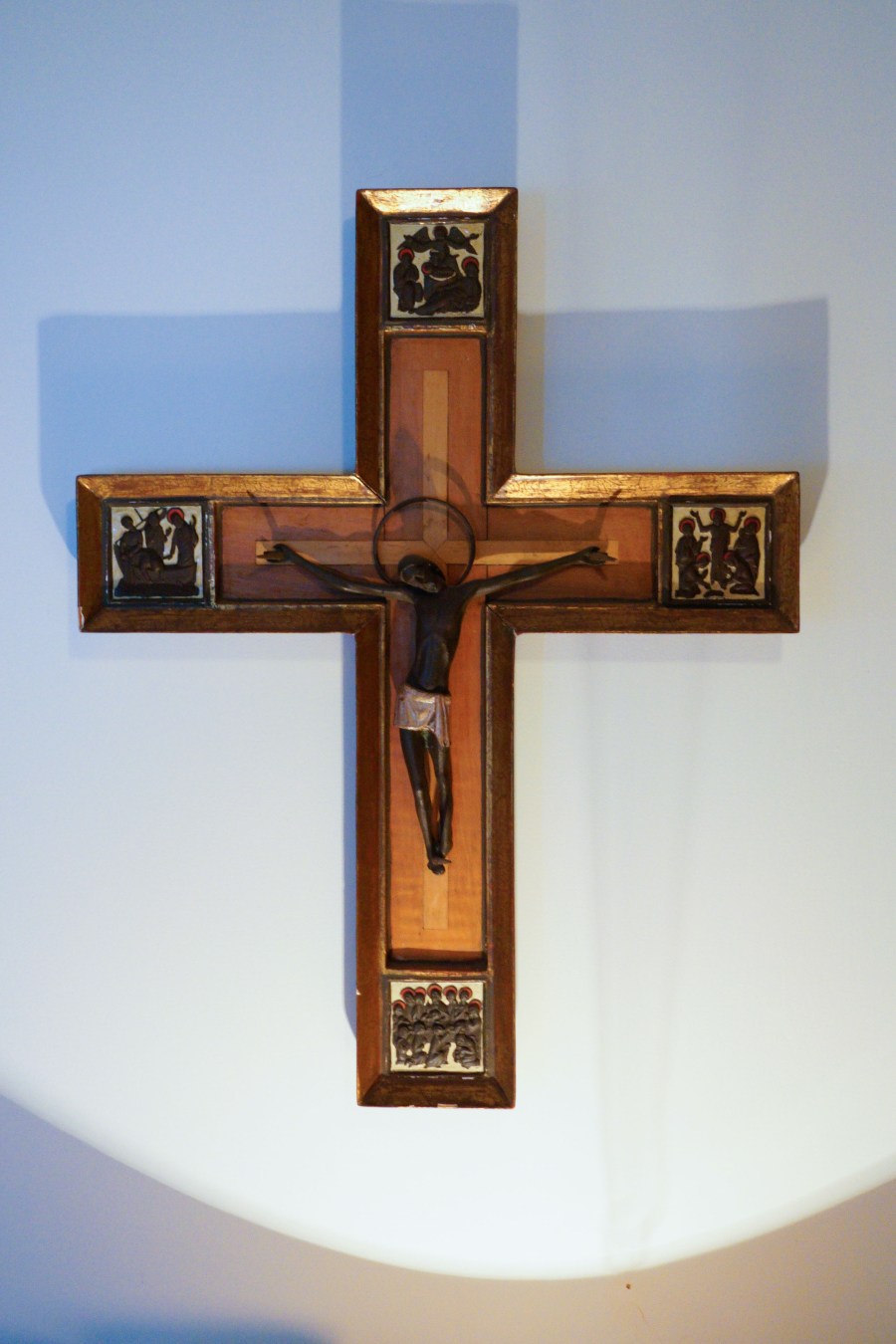
God in the Hands of Angry Sinners

Sermon for Good Friday

John 18:1-19:42

When I was in high school, we had to read a famous sermon called Sinners in the Hands of an Angry God.

It’s a sermon that many people know about—even if you’ve never read it. And it has often come to represent a certain image of God: a God who is angry at sinful human beings, a God whose wrath must somehow be dealt with before we can be saved.

There’s just one problem with that:

When we read the Passion Gospel—as we just did—that is not the image of God we see there.

In this Gospel, Jesus is not handing out wrath.

In fact, one of his disciples tries to do that, and Jesus rebukes him. In an older translation, this is where we get the phrase, “Those who live by the sword shall die by the sword.”

Again and again, Jesus chooses nonviolence.

Compassion.

Forgiveness.

Love—even for those who wish him harm.

That is the image of God we are given on Good Friday.

Andrew Marr, the abbot of St. Gregory’s Abbey—Three Rivers, puts it this way:

“What we see on the cross is not sinners in the hands of an angry God, but God in the hands of angry sinners.”

That is the image of God we are given on Good Friday:

A God who takes on flesh and dwells among us in the person of Jesus.

A God who endures violence… and does not return it.

A God who does not require violence in order to forgive.

A God whose wrath does not need to be satisfied before humanity can be brought back into relationship with God.

Now, the sermon Sinners in the Hands of an Angry God does, in many ways, represent an image of God that has been communicated by the Church for much of its history—at least in the West.

But it is not accurate to the image of God that is revealed in the person of Jesus.

And what we see here instead—God in the hands of angry sinners—is not only something we see in Scripture…

It is also something we recognize because it feels familiar.

If you think back to your own school days, you may remember how this works:

Kids growing up, feeling awkward about themselves—about their bodies, about who they are, about where they fit in the world.

And what often happens?

They find someone else to carry that discomfort.

Someone who is different.

Someone who doesn’t fit the mold.

Someone who can be singled out.

And that person becomes the scapegoat.

All of the insecurity, all of the fear, and all of the confusion gets projected onto that one person.

And that person is bullied… excluded… sometimes even tormented.

But what’s really happening is that everyone else’s insecurity is being acted out on them.

And this isn’t just something kids do.

We know that the politics of the locker room can become the politics of the boardroom.

Too often, people don’t grow out of this.

They continue to project their own self-hatred onto others.

They continue to bully.

They continue to enact violence—sometimes physical, sometimes emotional, sometimes systemic—in order to make themselves feel more secure.

That is the way of the world.

But it is not the way of God.

And we are reminded of that every year on Good Friday.

Because what we see here is a God who says:

“I am not here to overpower you.

I am not here to force you into submission.

And if this is what you need to do—if you need to reject me, if you need to harm me—then I will not resist you.”

“I will offer myself willingly.”

That is the God we meet in Jesus.

A God who is willing to be handed over into the hands of angry sinners.

A God who bears our sins—our fear, our violence, our self-hatred—and responds not with retaliation, but with love.

And if this is who we believe God to be…

Then there is a response that God calls forth from us:

We are called to go out into the world and look for those who are being scapegoated.

Those who are excluded.

Those who are made to carry the weight of everyone else’s fear and anger.

And we are called to stand with them.

In the name of Jesus.

In the name of the God who is love.

And this, as we know, is not the end of the story.

Because today is Good Friday.

And in just a few short days, we will celebrate something more.

We will celebrate the truth that violence does not have the final word.

That hatred does not have the final word.

That God continues to love while falling into the hands of angry sinners.

And that God’s love is stronger than death itself.

But that is a story for another day.

Disarming the Powers: Subverting the KKK

Ignore the misleading YouTube headline. This is a story about nonviolent resistance and the power of love to overcome hatred.
I’ve sat with many civil rights and equality activists who continue to emphasize education and legislation as the key to overcoming injustice. I agree that both are necessary, but the core element that will change hearts is relational proximity. Some criticize him for what he is doing, but the proof is in the results he gets.
“Racism is like cancer: if you choose to ignore cancer, it metastasizes.” -Daryl Davis

Turn the Other Cheek

Today’s sermon from First Presbyterian, Boonville.

The text is Matthew 5:38-48.

Click here to listen to the podcast at fpcboonville.org!

We read this morning from some of Jesus’ most quoted and most ignored teachings.  “Turn the other cheek” and “love your enemies” represent some of the highest moral ideals for Christians (and other admirers of Jesus), but when it comes to actually obeying these commandments, almost all of us will buckle under the pressure.  We reluctantly admit that we don’t believe they will “work” in real life.

Ironically, most of the examples we cite to prove our point are too hypothetical to bear any resemblance to “real life”.  It usually goes something like this: “Suppose an insane maniac breaks into your house in the middle of the night.  Any reasonable person would shoot to kill in self-defense.”  There are several different variations on this theme, but the core principle remains the same.  The problem with this and other hypothetical scenarios is that reality usually involves more variables than can be accounted for in a simulation.

However, we know that violent home invasions do happen in reality.  Let’s leave the realm of the hypothetical and present this problem in terms of an event that actually happened:

Late one night, Angie O’Gorman was rudely awakened by the sound of someone kicking in her bedroom door.  She was alone at the time.  Before she knew it, the attacker was in the room and shouting at her.  She could see his outline as he moved toward her.  It just so happened that Angie slept with a handgun under her pillow, just in case something like this ever happened…

Let me pause the story right there.  In that moment, the end-result of millions of years of human evolution was doing its work inside Angie’s mind and body.  Our biological instincts present us with two options in panic situations: fight or flight.  A person can either try to defend/retaliate or run/hide.  Which is the morally proper response?

Christians have tried to answer this question using Jesus’ teaching as a guide.  Some have said that Christ’s command is absolute and you shouldn’t return violence for violence, no matter what the cost.  Others argue that there must be exceptions to this rule because Jesus never intended for his followers to be doormats while violent people walked all over the innocent.  Which one do you think is right?

Personally, I think they’re both right.  I think Jesus does hate violence, but he also has no desire to see you become a doormat.  I think that Jesus presents Christians with a third option that goes beyond fight-flight.  There’s a theologian named Walter Wink who has written quite a bit on this subject.  This morning, I am heavily indebted to his research.

When Jesus says, “Turn the other cheek,” most people assume that he’s taking the so-called “doormat” position.  They think he’s saying, “You want to hit me?  That’s ok.  You can hit me.  God bless you.  Maybe later we can all hold hands and sing ‘Kum Ba Yah’?”  I think nothing could be farther from the truth of what Jesus is actually saying.  In order to gain a better understanding of what he did mean, we should look closer at some of the details of the text:

Jesus said, “If anyone strikes you on the right cheek, turn the other”.  Look carefully, because it says “the right cheek”.  In the ancient Middle Eastern world, people were more conscious about what hand they used for which tasks.  The left hand was only used for certain “unclean” things.  Even gesturing with the left hand was taboo for Jews at that time.  So, if someone were to strike another person, they would almost certainly use their right hand.

Now, think about this: if I come at you with my right hand (open or closed), which side of your face would it naturally land on?  The left!  The only way to land a blow on the right cheek with the right hand is with a backhand.  A backhanded slap in that time was a very specific gesture.  It was meant as an insult, not an injury.  The higher-ups on the social ladder would use the backhand against their inferiors in order to “put them in their place”.  The only expected response was for the other person to cower in shame.  This backhand slap was a way of demoralizing and dehumanizing another person.

So, what effect would “turning the other cheek” have in that situation?  Well, it would make it impossible for someone to reach your right cheek with a backhand.  Your attacker can still hit you, but only with a fist.  And in that society, only social equals hit each other with fists.  So, Jesus is saying, “If you’re going to hit me, hit me as your equal.”  Jesus is robbing the insult of its power.  Once a victim has stood up and refused to accept humiliation, the rules of the game have changed.  They don’t hit back.  They don’t cower in shame.  Neither fight nor flight is happening here.  Instead, the victim is taking charge of the situation and forcing the attacker to acknowledge their common humanity.  This is Jesus’ third option in action.  “Turning the other cheek” was Jesus’ way of inviting his followers to engage in active and creative nonviolence.  I could make similar explanations of “give your coat” and “go the extra mile”, but time this morning does not permit.

Let’s return to our initial story in Angie O’Gorman’s bedroom.  What went through her mind in that moment, when the attacker was moving toward her?  Well, her gun was under the pillow, but she didn’t think she had enough time to retrieve, aim, and fire it before the attacker reached her.  So she shouted out the first thing that came to her mind.

She asked, “What time is it?”

“Uhh,” the attacker stopped in his tracks and checked his watch, “it’s about 2:30.”

“Oh,” she said, “mine says 2:45.  I hope your watch isn’t broken.  When did you set it last?”

They went back and forth like that for several minutes.  Eventually, when some of the tension had eased, she asked how he had got into the house.

“I broke the glass on the back door,” he said.

“That’s a shame, because I don’t have money for new glass.”

He talked about his own money problems.  They talked for a while after that until Angie felt comfortable enough to ask him to leave.  He calmly said he didn’t want to.  Angie said firmly, “Okay, I’ll get you some sheets, but you have to make your own bed on the couch downstairs.”  He said that was fine.  After that, he went and lay down for the night.  In the morning, Angie made them breakfast and the would-be attacker went on his way.

I’m not presenting Angie’s case as an example of what everyone should do in a home invasion.  Every situation is different in its own complicated way. The truth is that no one really knows how they will react in that situation until they are in the thick of it.  Hopefully, no one here ever has been (or will be) in a violent home invasion, but if you are, know that God understands how people do the best they can with what they have in those situations.  I offer Angie’s story as an actual example of creative nonviolence.  That’s what “turning the other cheek” really looks like.

So, we’ve talked about what Jesus meant and how that might look in our modern world.  Now, I’d like to talk about why “turning the other cheek” is so important.  In short, it’s important that we, as Christians, turn the other cheek (in the way that Jesus meant it) because it is a reflection of how God has dealt with us.

As Jesus said, God causes the sun to shine and the rain to fall on good and evil alike.  God gives these gifts abundantly and generously to all, regardless of what they deserve.  Such is the generous and all-inclusive love of God.

No matter how hard you fight, you can never out-sin God’s love for you.  People have tried for millennia and failed.  God is always ready to turn another cheek.  When God came near to us in the person of Jesus Christ, we struck his face, but he turned the other cheek.  We denied the divinity in him, but he affirmed the humanity in us.  We nailed him to a cross, but he said, “Father, forgive them, they know not what they do.”  We killed him, but he rose from the dead.  We rejected Jesus, but Jesus has rejected our rejection.  Jesus stood his ground and never fought back.  This is the ultimate turning of the cheek.

So, when you do the same for others in the conflicts and crises of your life, you reflect the love that redeemed the world from sin, just like the moon reflects the light of the sun in the midst of the cold, dark night.

So, go out into the world today in the power of that redemptive love.  Turn the other cheek: stand your ground, resist violence without resorting to violence, defend your humanity as you affirm it in your aggressors, love your enemies, and show yourselves to be children of the God who is love and who loved us, even while we were yet sinners.