
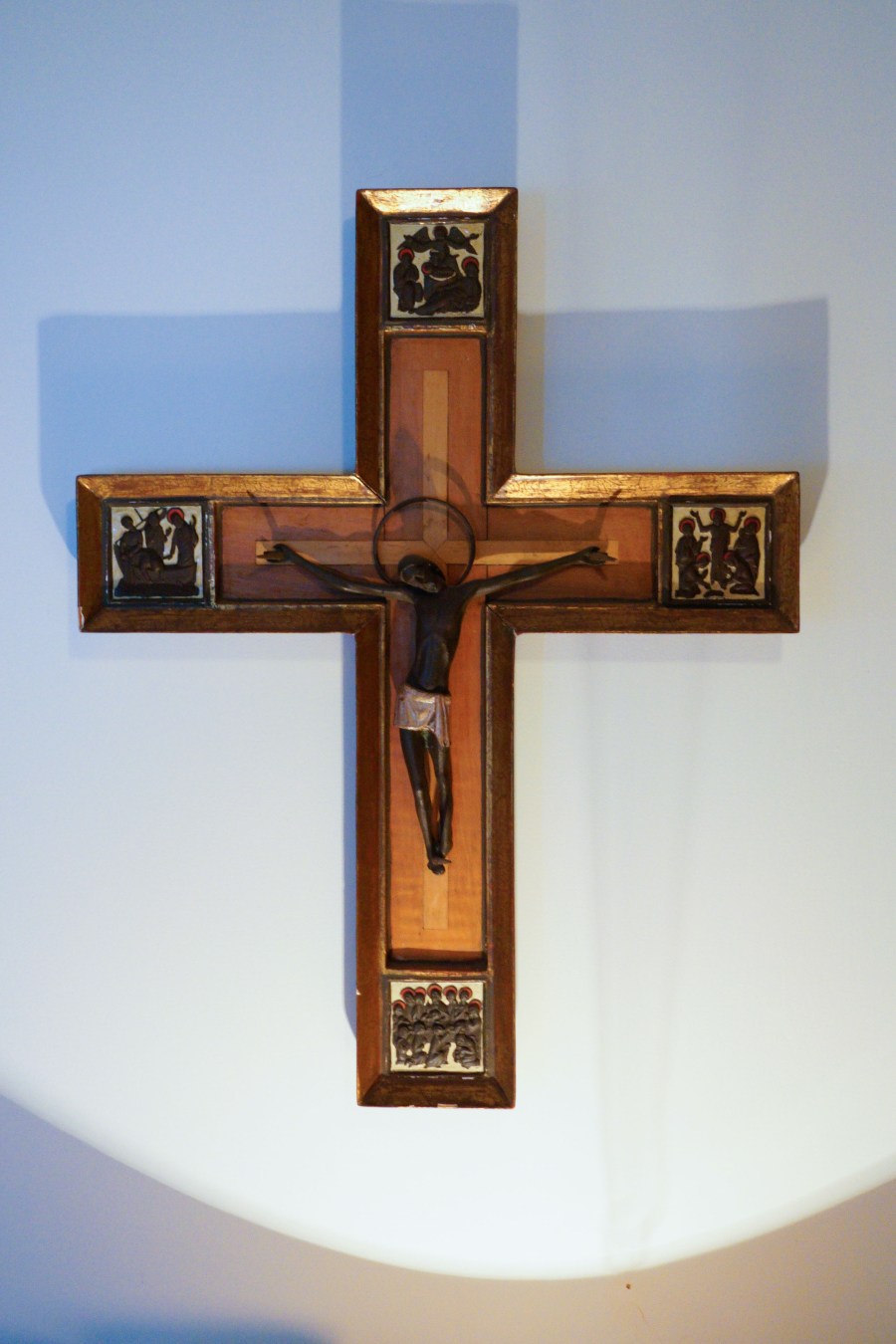
God in the Hands of Angry Sinners

Sermon for Good Friday

John 18:1-19:42

When I was in high school, we had to read a famous sermon called Sinners in the Hands of an Angry God.

It’s a sermon that many people know about—even if you’ve never read it. And it has often come to represent a certain image of God: a God who is angry at sinful human beings, a God whose wrath must somehow be dealt with before we can be saved.

There’s just one problem with that:

When we read the Passion Gospel—as we just did—that is not the image of God we see there.

In this Gospel, Jesus is not handing out wrath.

In fact, one of his disciples tries to do that, and Jesus rebukes him. In an older translation, this is where we get the phrase, “Those who live by the sword shall die by the sword.”

Again and again, Jesus chooses nonviolence.

Compassion.

Forgiveness.

Love—even for those who wish him harm.

That is the image of God we are given on Good Friday.

Andrew Marr, the abbot of St. Gregory’s Abbey—Three Rivers, puts it this way:

“What we see on the cross is not sinners in the hands of an angry God, but God in the hands of angry sinners.”

That is the image of God we are given on Good Friday:

A God who takes on flesh and dwells among us in the person of Jesus.

A God who endures violence… and does not return it.

A God who does not require violence in order to forgive.

A God whose wrath does not need to be satisfied before humanity can be brought back into relationship with God.

Now, the sermon Sinners in the Hands of an Angry God does, in many ways, represent an image of God that has been communicated by the Church for much of its history—at least in the West.

But it is not accurate to the image of God that is revealed in the person of Jesus.

And what we see here instead—God in the hands of angry sinners—is not only something we see in Scripture…

It is also something we recognize because it feels familiar.

If you think back to your own school days, you may remember how this works:

Kids growing up, feeling awkward about themselves—about their bodies, about who they are, about where they fit in the world.

And what often happens?

They find someone else to carry that discomfort.

Someone who is different.

Someone who doesn’t fit the mold.

Someone who can be singled out.

And that person becomes the scapegoat.

All of the insecurity, all of the fear, and all of the confusion gets projected onto that one person.

And that person is bullied… excluded… sometimes even tormented.

But what’s really happening is that everyone else’s insecurity is being acted out on them.

And this isn’t just something kids do.

We know that the politics of the locker room can become the politics of the boardroom.

Too often, people don’t grow out of this.

They continue to project their own self-hatred onto others.

They continue to bully.

They continue to enact violence—sometimes physical, sometimes emotional, sometimes systemic—in order to make themselves feel more secure.

That is the way of the world.

But it is not the way of God.

And we are reminded of that every year on Good Friday.

Because what we see here is a God who says:

“I am not here to overpower you.

I am not here to force you into submission.

And if this is what you need to do—if you need to reject me, if you need to harm me—then I will not resist you.”

“I will offer myself willingly.”

That is the God we meet in Jesus.

A God who is willing to be handed over into the hands of angry sinners.

A God who bears our sins—our fear, our violence, our self-hatred—and responds not with retaliation, but with love.

And if this is who we believe God to be…

Then there is a response that God calls forth from us:

We are called to go out into the world and look for those who are being scapegoated.

Those who are excluded.

Those who are made to carry the weight of everyone else’s fear and anger.

And we are called to stand with them.

In the name of Jesus.

In the name of the God who is love.

And this, as we know, is not the end of the story.

Because today is Good Friday.

And in just a few short days, we will celebrate something more.

We will celebrate the truth that violence does not have the final word.

That hatred does not have the final word.

That God continues to love while falling into the hands of angry sinners.

And that God’s love is stronger than death itself.

But that is a story for another day.

Passionfruit

Image
Image by Taka. Retrieved from Wikimedia Commons.
This file is licensed under the Creative Commons Attribution-Share Alike 3.0 Unported license.

Life gave
what I took
for my own.

I learned
how to seize
with the hands,
how to tear
with the teeth.

I learned
what it felt like
to touch with the lips,
to press with the tongue,
to be surprised by how much
came out
when I broke the surface,
to be covered with sweetness
all over my body.

Now I know.
It’s complicated.

***

What I took
is mine.

I’m learning
how to build
with the hands,
how to hold nails
with the teeth.

Cleaning up
is never
as much fun
as messing up.

Construction
is never
as cathartic
as demolition.

Nails and wood
are not the same thing
as a tree.

They have no power
to give life.

I’m learning
what it feels like
to be covered with sweat
all over my body.

***

What I made
gave life.

It was an accident.
Nobody meant for it to happen
this way.
It just seemed like a good idea
at the time.

The hands that learned
to seize and build.
The teeth that learned
to tear and hold.
The facsimile of a tree.

I wasn’t expecting it
to be alive
when I broke the surface.

I was surprised by how much
came out
and covered me with blood
all over my body.

More forgetting
than learning
this time.

Not taken
for my own,
but given
by another.

The Rest of the Passion: A Midrash

This is a Midrash on the Passion narrative by my good friend Billy Magee, a casino dealer and gambling addiction counselor.

Recent discoveries unearthed during renovations at Vatican City shed new light on the Passion of the Christ and the events leading up to Palm Sunday, the Last Supper, and Good Friday.

According to ancient Aramaic scripts, the events of the Gospels must be re-interpreted in a new light.  When Christ arrived at Jerusalem on Palm Sunday, the real purpose of the visit was to gamble with the Pharisees in the Temple of Herod.  Unknown before the discovery of the aforementioned ancient text, a casino called Solomon’s Mine Casino was located in a secret part of the temple.  Games of chance, played by the Pharisees, other Buffalo Hunters, and their Goombadies, took place 24/7.  These games of chance were overseen by the Solomon’s Mine Gaming Commission (SMGC).

An unknown character, never mentioned in earlier gospels, played an integral part in setting up the game played between Christ and the Pharisees.  This individual, Brunosius Bombatsi, was well-known to the twelve disciples, most of whom were fishermen.  Prior to his move to Jerusalem, Brunosius got his start as the head of the Fish Mongers Local out of Galilee, the predecessor of the future Longshoremen’s Union.  He did so well, that eventually he had all the Fish Mongers locked up from the Sea of Galilee, down the entire River Jordan, to the Dead Sea.

Brunosius had made earlier arrangements with Christ.  The signal they agreed on was this: if a non-ridden ass was in place outside of town, then the game was on!  History tells us the ass was there, and Christ knew all along (after all, he was Jesus Christ and he could foresee things like that.

After the pomp and ceremony of his entrance into the city had concluded, Christ and Brunosius covertly entered the temple and were escorted by SMGC to Solomon’s Mine Casino.  This was centuries before cards were invented, so the game of choice was the dreidel.

Brunosius, who had connections with the SMGC, made special arrangements so that this four-sided gaming device had a lamb as one of its choices, rather than the traditional four-letter configuration which was standard at the time (and remains prevalent to this day).  The Buffalo Hunters and Pharisees had a meeting to agree upon this alteration of the Dreidel at Brunosius’ request and the game was set.

Christ arrived at the gaming table with Brunosius and the table limit was discussed.  The Buffalo Hunters wanted a 2,000 shekel table max, big stakes in those days, but Christ wanted a no-limit game (after all, the sky is the limit in his eyes).  After much winging, whining, and gnashing of teeth by the Pharisees and Buffalo Hunters, it was finally agreed upon that the game was no-limit (unheard of in those days).

The Buffalo Hunters’ only concern was that this Christ character had only a pair of sandals and a robe.  Besides, he showed up on a borrowed ass.  Who was going to front the money? Brunosius, who was good friends with Marius Strobolini (the Pharisees’ credit host), used his open credit line to back Christ with 100,000 shekels.  The game started.

Christ kept spinning lambs and the Buffalo Hunters were perplexed.  At one point, they had the gaming commission use a micrometer on the dreidel to make sure it was on the square.

“Come on,” said one Buffalo Hunter, “Does this guy walk on water?  It’s a 4 to 1 shot.  He’s got to lose sooner or later.”

Christ never lost, and after the smoke cleared, he had beaten them out of 900,000 shekels (a tidy sum in those days).  To add insult to injury, Brunosius had Marius comp Christ full room, food, and beverage for twelve at a private dinner house called The Upper Room on Thursday night.

The Buffalo Hunters called for a rematch.

“I ain’t gonna be around for it,” Christ replied, “I have to see a man about a cross in a few days.  I have souls to save and places to go, but thanks for the action.”

The Pharisees were incensed, livid, and wanted revenge.  One of them named Mordecei said, “I got the answer.”  He knew a guy named Judas who got carved up pretty good casting lots with the Sardinian Centurions (“They stuck him like a pig!”).  To make a long story short, Judas had to get a loan from a shylock called Akim from the West Bank in order to square with the Sardinians before they broke his legs.  “He needs the cash,” said Mordecei, “Besides, his name is Judas, for Christ’s sake!  He would sell out the Messiah himself for 30 pieces of silver, given half a chance.” So Mordecei and the two other Pharisees, Yehuda and Yoshi, all duked in a sawbuck and the deal was set.  Judas flipped Christ and the rest is history.

After wining and dining at The Upper Room, which later became known as The Last Supper, a few of the disciples went to the Mount of Olives for some fresh air.  While they were dozing and sleeping off their lavish meal, Christ quietly woke Simon Peter and gave him the winnings from the game.  He told Peter in strict confidence that was to proceed to Rome, preach the Good News, and build a church upon a rock.  The winnings were to be used as seed money for the future church.

Copyright 2010, William Magee.  Reprinted with the author’s permission.