
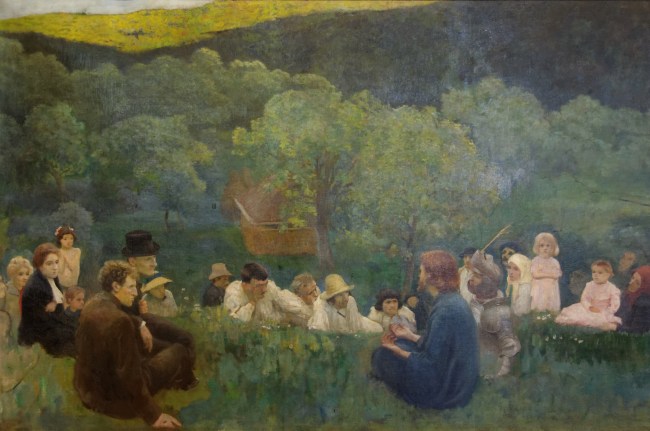
Redefining Success

Image
Károly Ferenczy [GFDL (http://www.gnu.org/copyleft/fdl.html) or CC-BY-SA-3.0-2.5-2.0-1.0 (http://creativecommons.org/licenses/by-sa/3.0)%5D, via Wikimedia Commons

Introduction

What would you say are the marks of a successful church?

Here are some of my ideas for North Church:

  • We’re going to court some billionaire investors. Not donors, but investors. We want to incentivize their giving by promising a lucrative return. Once we have their money, we’re going to make use of it.

  • First of all, because we need to keep them happy (so they’ll keep sending us money), we’re going to turn our upstairs balcony into a skybox where our wealthiest members can observe the service in comfort, with leather recliners and a full wait staff serving champagne and caviar.

  • For our music ministry, we’re going to hire a full-time, paid, professionally trained choir (we already have the best organist in Michigan, so we won’t need a new one of those). Our contemporary worship team will get brand new, state-of-the-art AV equipment.

  • We’re going to get TV cameras so our service can be broadcast live via satellite around the world.

  • We’ll get paid endorsements from celebrities like Derek Jeter (add Christina Hendricks and George Clooney for sex appeal), who will tell everybody how great North Church is.

  • And finally, we’ll need to protect all this new stuff, so we’ll need to get a security force to guard the church. And I’m not thinking just some smiling, helpful rentacops either… I’m talking about SWAT team gear with assault rifles: I want such an overwhelming display of power that nobody will even THINK about messing with our church.

If we had all of those things (i.e. money, fame, and power), we would be a successful church, right? Wrong.

Blessedness

Jesus’ definition of the word success is different from the one accepted by the rest of the world. The world has a very self-centered definition of success, but Jesus presents us with a God-centered definition of success. The word he uses is blessed, which can also mean successful or lucky when you take away the spiritual side of it. That word blessed, by the way, comes from the Latin beatus and is where we get get the word Beatitude from. Blessedness, from the God-centered perspective of Jesus, is quite different from the world’s self-centered idea of success.

Blessed are the poor in spirit, for theirs is the kingdom of heaven.”

The world sees wealth as a sign of success: the Armani tux, the Vera Wang dress, the Italian sports car, the yacht, and the mansion. The world looks at people who have those things and calls them successful/lucky.But Jesus says, “Blessed are the poor in spirit, for theirs is the kingdom of heaven.” The kingdoms of this world (governments, corporations, institutions) cater to the desires of the haves, but the kingdom of heaven (Jesus’ vision of an ideal society) will serve the needs of the have-nots. On the day when God’s dream for this world comes true, no more will Senators and CEOs vote to give themselves raises and go on vacation while the people whose jobs they cut sleep in shelters and line up outside soup kitchens. That’s not going to happen anymore.

Blessed are those who mourn, for they will be comforted.”

The world looks at people who seem to be happy and calls them “successful.” Today is Super Bowl Sunday, the one day a year when people watch TV just as much for the commercials as they watch it for the program. How many people plugging products in those commercials will be average-looking folks, looking bored, and saying, “Meh, I guess this product is okay…”? Not very many, I think. TV commercials are full of beautiful, smiling people who are excited to tell you all about how a particular cleaning solution changed their lives forever. They want us to believe that we’ll be as beautiful and happy as they are if only we buy what they’re selling. The world says that happy people are successful people, but Jesus says, “Blessed are those who mourn, for they will be comforted.” Jesus invites us to not buy into that “cult of happiness.” Jesus doesn’t want us to turn away from the pain of this world, he wants us to look at it and do something about it. That’s what compassion is: Showing up with food or clothes, visiting the shelter, the drop-in, the hospital bed, the courtroom, and the prison cell. That’s the kind of love Jesus showed us and it’s the kind of love he wants us to show others. Wherever there’s pain, there’s Jesus, so that’s where we should be too.

Blessed are the meek, for they will inherit the earth.”

The world says that successful people are tough-minded alpha-dogs who stand their ground and don’t compromise. Those are the big-shots who end up in running the show. The world puts them in charge of things. But Jesus says, “Blessed are the meek (i.e. gentle, flexible), for they will inherit the earth.” I like this one because I read a book by a couple of biologists last year that talks about how competition is not the only driving force behind evolution. They make the case that cooperation plays just as big a role in the ongoing development of life. When God’s dream for this world comes true, the ones in charge will be the ones who know how to work well with others and value relationships more than ideologies.

Blessed are those who hunger and thirst for righteousness, for they will be filled.”

The world believes that truly successful people lack for nothing. They have everything they could ever want. They benefit from the way things are. Insulated by wealth and power, they don’t sense the urgency of the situation or feel the need to challenge the system. But Jesus says, “Blessed are those who hunger and thirst for righteousness (i.e. justice, fairness), for they will be filled.” That last part is especially ominous because history has shown, time and again, that poor people will not stay quiet and submissive forever. If the leaders will not change the system, the people will change the leaders. Jesus has been proven right more than once: “The first shall be last and the last shall be first.”

Blessed are the merciful, for they will receive mercy.”

The world says that successful people know how to give as good as they get. If you hit them, they hit you back. They make an example of you so that others know not to mess with them. That’s the politics of power. But Jesus says, “Blessed are the merciful, for they will receive mercy.” Real power, according to Jesus, comes from knowing that you could rip your enemies to shreds but choosing not to. What’s more is that mercy is contagious: it comes back to you. It stops the cycle of violence from going around and around and escalating until the situation is out of control. The United States and the Soviet Union spend the latter half of the twentieth century with nuclear missiles pointed at each other in the doctrine of Mutually Assured Destruction (MAD). But then the Cold War ended, not with a mushroom cloud, but with a party: people singing and dancing as the Berlin Wall came down. The doctrine of MAD-ness did neither side any good in the end.

Blessed are the pure in heart, for they will see God.”

The world says that successful people are savvy: they know how to read between the lines and close the deal. They’re street-smart; they have guile. Successful people know how the game is played and stay two steps ahead of the competition. These savvy, successful people are sure to see great big dividends on their investments. But Jesus says, “Blessed are the pure in heart, for they will see God.” Savvy, street-smart people see the world for what they can get out of it, but they’re missing a whole other dimension of reality. Those who see the world like Jesus does get to see the hand of God at work in creation. These blessed folks know that they’re not alone and that life has meaning. I like to compare this one to the scene in Star Wars when Han Solo is laughing at Luke Skywalker as he trains to be a Jedi Knight. Luke says, “You don’t believe in the Force, do you?” Han replies, “Kid, I’ve flown from one side of this galaxy to the other, and I’ve seen a lot of strange stuff, but I’ve never seen *anything* to make me believe that there’s one all-powerful Force controlling everything. ‘Cause no mystical energy field controls *my* destiny. It’s all a lot of simple tricks and nonsense.” Han is savvy but Luke is pure in heart. Luke is learning how to see the world through a different set of eyes and so, as Obi-Wan Kenobi said about him, he’s taking his “first steps into a larger world.”

Blessed are the peacemakers, for they will be called children of God.”

The world defines success by winning. Whether it’s trophies on the shelf or notches on the bedpost, the world wants to know about your conquests. This was especially true in ancient Rome, where the empire was built on the doctrine of Pax Romana: world peace through global conquest. They believed that Roman order would prevail over the barbarians of the world by the mighty hand of Caesar. And Caesar himself was worshiped and given a very special title: “The Son of God,” Sol Invictus, “the Unconquerable Sun.” But Jesus says, “Blessed are the peacemakers (not the conquerors), for they will be called children (lit. ‘sons’) of God.”

Blessed are those who are persecuted for righteousness’ sake, for theirs is the kingdom of heaven.”

Finally, the world says that respect is a measure of success. They say a good name is as good as gold. If people listen to what you say, you’re successful. If you get invited to the White House to advise the President on a matter, you’re successful. The world says it’s good to be admired and respected. Those who possess the kingdoms of this world are accorded respect, whether they deserve it or not. But Jesus says, “Blessed are those who are persecuted for righteousness’ sake, for theirs is the kingdom of heaven.” Notice the parallel with the first beatitude. God’s ideal world belongs to the have-nots, the disrespected, the ones without a voice, and those who suffer and die for standing up and speaking out for what’s right. When God’s dream for this world comes true, these are the people we’ll be listening to, not the flattering bootlickers who only tell powerful leaders what they want to hear. We need people of conscience who will “speak the truth in love” to the powerful ones in charge. That’s what prophets do, but they’re almost never listened to or given the respect they deserve. Nevertheless, Jesus calls them “blessed” and commands us to keep doing it.

Conclusion

Jesus redefines success. He takes the world’s self-centered idea of success and replaces it with his own God-centered idea of blessedness. In the mind of Christ, success is not a blessing and blessing does not look like success. God’s blessing is upon the poor and oppressed peoples of this world, the ones without a voice, the ones who weep in the night, and the ones who are literally starving for change. God’s blessing is upon the gentle, the compassionate, the pure in heart, and the peacemakers.God’s blessing is upon those who face the pain of this world and do what they can to make a difference. God’s blessing is upon those who are a blessing. And so it is that I say to you:

May God bless you and make you a blessing, this day and every day. AMEN.

The Religious Counterculture: An Open Letter to Religious Liberals

This is an interesting article that I have mixed feelings about.  On the one hand, I am fully with the author in her call for a radical, committed, active, counter-cultural, and fully liberal practice of faith.  Those of us who go by this label absolutely have to get away from the idea of diluted civil religion that only serves as the chaplain to the dominant society.  We have to get away from defining ourselves by what we don’t believe.  We have to re-engage with our traditions, our sacred texts, regular spiritual practice, and active involvement in our faith communities.

On the other hand, the author seems to be calling for the kind of rigid legalism that caused many of us to flee from more conservative expressions of faith.  Am I to believe that liberal religion should now mean pulpit-pounding, rule-making, and fear-mongering over issues environmental rather than pelvic?  No thank you.  As one who has endured the guilt and fear within fundamentalism, I can testify that it doesn’t work.  It creates self-righteous, Pharisaical bigots.  We would become the mirror image of the fundamentalisms we judge: compromising compassion and integrity for the sake of our own narrow-minded agenda.

What’s more is that the author’s stated end for these means is the increase of “political power” and “butts in the pews”.  I don’t share these goals.  An increase in attendance might be a by-product of a community’s spiritual growth, but it should never be an end in itself.  The loss of political dominance in society is a blessing, in my opinion.  It seems that almost all religious communities tend to be at their worst when they are on top of the heap.  That’s when they tend to stagnate, persecute others, and generally sow the seeds of their own destruction.  The marginalization of liberal religion has placed us in a position to actualize James Luther Adams’ vision of “the prophethood of all believers.”  Small, committed communities of believers working in solidarity with each other have the power to change the world at the grassroots level.

What we need, in my opinion, is a fundamentally different way of relating to the Sacred.  We must start from the place of radical grace and acceptance that extends from the inside out to include all beings (even fundamentalists).  This, I believe, is the good news of liberal religion that has the power to transform and liberate.

That being said, the author’s core point is one that I’m on-board with.  This article is very much worth the read, even where one disagrees with it.

Reblogged from Huffington Post:

by Rev. Ana Levy-Lyons

If you look at any of the traditional markers of religiosity, we religious liberals are less religious than the conservative or orthodox. Liberal Jews tend to not keep kosher; liberal Muslims tend to not pray five times a day; liberal Christians have been known to have premarital sex. As religions have liberalized and modernized over the years, communal religious practices have fallen away and religious fervor has cooled. This may seem obvious and inevitable, but when you think about it, there is no necessary correlation between the substance of a person’s theology and the amplitude of her religiosity. We religious liberals have erroneously forged this correlation and, beyond just making us the butt of jokes, this has really cost us.

Click here to read the full article

Are Liberals Too “Special” to Go to Church? (Reblog)

Reblogged from Religion Dispatches:

New research from psychologists from the New York University suggests that the desire to feel unique can undermine consensus, cohesion, and mobilization—at least in political contexts.

My hunch is that this may extend to religious contexts as well.

Chadly Stern and colleagues reported in the journal Psychological Science in November 2103 on the findings of a study on “truly false uniqueness” and “truly false consensus” among political liberals, moderates, and conservatives.

The study looked at two things. First, the researchers considered the degree to which participants over- or underestimated their sense that their beliefs were the same as those of others in the same political grouping (liberal, moderate, conservative). Second, the team measured the degree to which participants in the study were motivated by a desire to feel unique versus a desire to feel the same as others in their group.

Overall, Stern, et al found that “liberals underestimated their similarity to other liberals, whereas moderates and conservatives overestimated their similarity to other moderates and conservatives.”

Click here to read the full article

The Journey of Transformation

Image
Nicolas Poussin [Public domain], via Wikimedia Commons

I think it’s a funny coincidence that this Sunday is the week when we remember the baptism of Jesus in the river Jordan because I got to have a very “baptismal” moment earlier this week when I showed up to work on Thursday and discovered “rivers of living water” coming out of a broken pipe in the kitchen downstairs.  I’m thankful to report that the repair crew told me it looks like I found the problem and acted on it quickly enough that the damage isn’t too bad, but the whole affair made me want to throw my hands up in the air and cry out, in the words of our Jewish ancestors: “Oy vey!”

Speaking of Judaism…

One of my favorite things about Matthew’s gospel is the way that it is so rooted in Jewish tradition.  The author, who was probably a Jewish Christian living in the first century, wants to demonstrate to the readers that Christianity stands in continuity with traditional Judaism.  Matthew goes to great lengths to identify the story of Jesus with the story of Israel and he does it in two ways:

First, by quoting liberally from the Hebrew Bible (Christians sometimes refer to it as the ‘Old Testament’).  In fact, that happens in today’s reading: When Jesus is baptized and is coming up out of the water, the text says the heavens were opened to [Jesus] and he saw the Spirit of God descending like a dove and alighting on him. And a voice from heaven said, “This is my Son, the Beloved, with whom I am well pleased.”

This is actually a quote from two different verses in the Hebrew Bible.  When the author does this, it’s kind of like someone singing one line from an old, familiar song (e.g. “Here she comes, just a-walkin down the street, singin…”).  The familiarity immediately triggers memory and makes the audience perk up and go, “Oh yeah, I know that one!”

The other way that the author connects the story of Jesus with the story if Israel is by dropping lots of little hints in the text that remind the audience of famous stories from Israel’s history.  For example: At the beginning of the book of Exodus, there is an evil king (Pharaoh) killing baby boys.  In Matthew’s gospel, another evil king (Herod) is doing exactly the same thing.  Later in Exodus, Moses brings God’s message (the Ten Commandments) to the people of Israel from the top of Mount Sinai.  And what’s the name of Jesus’ most famous message in Matthew?  The Sermon on the Mount.  In Exodus, before the people of Israel can enter the Promised Land, they must wander in the wilderness for forty years.  As Jesus begins his ministry, he fasts and prays in the wilderness for forty days and forty nights.  This is not just a series of coincidences.  They are intentional.  Once again: the author of Matthew’s gospel is trying to identify the story of Jesus with the Israel.

Just one more example, and it’s the one I really want to talk about today:

At the very beginning of Jesus’ ministry, he is baptized by John in the Jordan River.  This is another one of Matthew’s hints.  As Jesus begins his ministry, he passes through the waters.  In the same way, the people of Israel “passed through the waters” on the way from slavery in Egypt to freedom in the Promised Land.  Again, this is no coincidence.  Matthew is setting Jesus up as a kind of “New Moses” who leads God’s people from slavery to freedom.  The Christian journey of salvation, according to Matthew, is one where those who follow Jesus through the waters of baptism are liberated from slavery to sin and set free to live the life of the kingdom of heaven on earth.

Speaking in terms of (some of) the Ten Commandments, the Christian journey of salvation is one that takes us from violence to peace, from lust to love, from lies to truth, from greed to giving, and from envy to gratitude.  It’s a journey of personal transformation and baptism is the symbol of our agreement to take that journey with Jesus.  In the sacrament of baptism, we make a promise to ourselves, to each other, and to God that we will follow Jesus into a new way of living, just like the people of Israel followed Moses out of Egypt, through the waters of the Red Sea, and (eventually) to the Promised Land.  And it’s not a journey that we take on our own.  We travel by Christ, with Christ, and in Christ.

Here’s what I mean by that:

First of all, this journey of transformation is initiated by Christ.  Christians see Jesus, not just as an historical figure who taught some important ideas 2,000 years ago, but as a living presence who is involved in our lives today.  We believe that the person of Christ is the revelation of the heart of God to humanity, which is to say that, in Christ, God reaches out to us, meets us, and gets the divine hands dirty with the blood, sweat, and tears of this world.  When we are lost, Christ finds us and brings us home; when we are blind, Christ opens our eyes; when we are ignorant, Christ teaches us; when we are sick or wounded, Christ heals us; when we are dead inside, Christ brings us back to life again.  In the midst of the brokenness of this life and the selfishness of our hearts, while we are still hostages in Egypt, Christ shows up, liberates us from the slaveries of the past, and enables us to make a new beginning.  The journey of transformation is initiated by Christ.

Second, the journey of transformation is sustained with Christ.  We do not travel alone.  Christ guides us through the Word of God in Scripture and feeds us in the sacrament of the Lord’s Supper.  The Spirit of Christ empowers our spirits and gives us strength to keep walking the path.  The love of Christ fills our hearts and picks us up when we stumble and fall on the road.  Christ walks beside us and promised never to leave us alone until the journey is through.

Finally, the journey of transformation is completed in Christ when we begin to love like Jesus loves.  That’s ultimately where all this is going; that’s the main principle underlying each of the Ten Commandments: Love.  Jesus said as much when he said that you could sum up all the commandments of the Bible with, “Love God with all your heart and love your neighbor as yourself.”  It’s all about love.  St. Irenaeus, one of the early fathers of the church, famously said that, in the incarnation of Christ, “God became what we are so that we might become what God is.”  And what exactly is God?  According to 1 John 4:16, “God is love, and those who abide in love abide in God, and God abides in them.”  Love is who God is, therefore love is who we are.  Love is where we’re going in the end, therefore love is all that matters.  Love is the heartbeat of the cosmos and the foundational law of the universe, which is where we find the strength to say to one another, Sunday after Sunday:

I love you, God loves you, and there’s nothing you can do about it.

Be blessed and be a blessing!

COMMENTARY: Church shouldn’t be this hard (Reblog)

Reblogged from the Washington Post

After 36 years of serving churches as a pastor and consultant, I came to a startling conclusion the other day.

Not startling to you, perhaps. I might be the last person to get the memo. But the conclusion drew me up short.

My conclusion: Religion shouldn’t be this hard.

An assembly that exists to help people shouldn’t be so willing to hurt people — by declaring them worthless, unacceptable, undesirable or strangers at the gate.

Click here to read the full article

Don’t Call Us Marxist Because We Critique Capitalism — Call Us Christian

Don’t Call Us Marxist Because We Critique Capitalism — Call Us Christian

Great defense of Pope Francis’ statements about poverty, plus a bonus introduction to one of my all-time favorite theologians: Walter Rauschenbusch… and it’s written by his great grandson, Paul Brandeis Rauschenbusch

It is commonly agreed that for the first time in human history we can put an end to extreme poverty if we have the economic, political, moral and spiritual will to do it. Let’s do it.

In the meantime, if you are Christian and someone calls you a Marxist just because you are questioning why extreme poverty persists in era of such extravagant wealth, know that you are in good company — because Jesus did it first.

The Cross Was His Throne

Image
By Mauricio García Vega (Mauricio García Vega) [CC-BY-SA-3.0 (http://creativecommons.org/licenses/by-sa/3.0)%5D, via Wikimedia Commons

“This is the King of the Jews.”

That’s what the sign at the top of the cross read.  The irony was not lost on those who saw it, nor was it lost to history.  Kings were usually crowned while sitting on thrones, not hanging from crosses.  But this Jesus was a different kind of king.  For him, the cross was his throne.

In the ancient world, it would have been unthinkable for a cross to serve as a throne.  Crucifixion represented everything that was the opposite of kingship.  Kings were blessed but crucified people were cursed.  Kings were honored but crucified people were ridiculed.  Kings were dressed in flowing robes but crucified people were stripped naked.  Kings were beautiful but crucifixion was ugly.  Yet, in spite of this, unbelievably, the cross was his throne.

Crucifixion was not just any old punishment.  A criminal was not crucified for stealing bread or cheating on his taxes.  No, crucifixion was a special punishment reserved for a special kind of criminal.  The criminals crucified with Jesus were what we would now call terrorists.  They were insurrectionists, religious fanatics bent on a violent agenda to overthrow the Roman government.  If one wants to get a clear picture of just how radical it was for Jesus to forgive the sins of the criminal next to him, one should imagine that criminal as Osama bin Laden, because that’s who he most closely resembled.  It was rare for crucified people to be buried in that time because most of them were simply left there to rot: their bones picked clean by birds and eventually scattered across the landscape.  Their families were so ashamed that most would never again so much as speak the name of their crucified loved one.  Most crucified people were utterly lost to history, but not King Jesus.  No, for him, the cross was his throne.

When we look back at Jesus’ life as it is presented to us in the New Testament, it shouldn’t be all that surprising that this King of kings would reign from a cross, rather than a throne.  After all, how did he come into the world?  Did he come riding a white horse with banners unfurled and a terrible swift sword at his side?  Did he appear at Caesar’s palace in Rome saying, “Hey Caesar, I just want to let you know that your days are numbered!”?  Was he born into a wealthy family at the center of the halls of power?  No, he was born in a manger, in a stable, outside an overbooked motel, in a teeny little one-horse town, in a forgotten corner, in a troublesome province, in a distant part of the Roman Empire.  His parents were working-class peasants.  Our Christmas pageants and Nativity scenes have made the story of Jesus’ birth into a sweet, warm fairy tale, but the reality would have been quite different.  He was born in a barn.  Have you ever smelled a barn where animals are kept?  It doesn’t smell very good.  His mother placed him in a manger.  A manger is a place where pig slop went.  It probably wasn’t very sanitary either.  In today’s terms, Jesus’ mother would have given birth in a dumpster behind a Motel 6.  And the shepherds who visited him?  They weren’t very pretty either.  Shepherding was not considered an honorable profession in those days.  They would have been treated with the same indifference and contempt that truckers, janitors, garbage men, and McDonald’s drive-thru workers receive today.  So you see, from the very beginning of Jesus’ life, we can pick up hints that he would not be a king like other kings, so that we wouldn’t be surprised to discover in the end that the cross was his throne.

As he set out into his life’s work, Jesus continued to defy expectations for a respectable monarch.  He held court with tax collectors and sinners.  His royal advisors were fishermen, his treasurer was a thief, and his attendants were prostitutes.  They probably couldn’t have a royal cupbearer because the wine would have run out before the cup ever got to the king.  And they almost certainly didn’t have a court jester because, let’s face it: they were all court jesters in some way.  Based on the company he kept, it’s no surprise that the cross was his throne.

The upstanding citizens of the moral majority and the religious right in his day had nothing good to say about Jesus.  They were the self-proclaimed protectors of traditional family values and Jesus was the biggest threat to their agenda.  He called himself a rabbi, but they knew that no real rabbi would build such a rag-tag, permissive, tolerant, and inclusive community.  Jesus questioned their established theological dogmas.  He reinterpreted the Bible in ways that made them uncomfortable.  He seemed to have little respect for their traditions, so they had little respect for him.  Based on his relationship with the religious leaders of his day, we can see why the cross was his throne.

Finally, we come to the end of his life, the moment his followers had been waiting for, when all that he had been building toward came to its fulfillment.  He rode triumphantly into town on a donkey’s back in a staged fulfillment of a prophecy from the book of Zechariah.  He barged into the temple, flipping over tables, and sent the moneychangers packing.  He said he was about to clean up this town and make his Father’s house into a house of prayer for all nations once again.  His followers were understandably stoked at this new development.  They realized that this was the moment when the King of kings and Lord of lords, the long-awaited Messiah, would ascend his throne and establish the kingdom of heaven on earth.  But what they didn’t realize is that the cross was his throne.

On the day of his crucifixion, his royal robes were stained with his own blood, his crown was made of thorns, and the cross was his throne.

Above his head hung that awful, ironic sign, “This is the king of the Jews.”  From the outside, the whole scene seems like a horrible, macabre parody of kingship.  But here’s the thing: he really was a king.  For Christians, he is the King of kings.  In spite of (or perhaps because of) his unconventional life and ignominious death, Jesus has gone on to touch and inspire more people than any other single person in history.  For those of us who are his followers, who pledge our allegiance to his kingdom of heaven on earth, Jesus is our paradigm: his life provides us with the lens through which we interpret our lives.  As we make our way out into the world, we go as Christ’s ambassadors.  The way in which we represent him to the world should be consistent with the way he himself walked through the world.  And remember: the cross was his throne.

The king who reigns from the cross is fundamentally different from the king who reigns from a throne.  The kings of this world, the powers that be, force their will on others through bullets, bombs, bucks, and ballots.  Let me show you what I mean: when you dive around town, do you try to keep pretty close to the speed limit?  Do you do it because you love America?  Probably not.  Most of us drive the speed limit because we don’t want to get a ticket.  That’s the power of fear.  Private companies get you to buy their products by appealing to your sense of greed, lust, or vanity.  They promise you a better, longer, happier life, but they don’t really care about you.  They just want your money and they will tell you anything you want to hear in order to get it.  That’s advertising.  That’s the power of manipulation.  But Jesus is different.  He doesn’t depend on the power of fear or manipulation as his weapons because the cross is his throne.

Jesus rules the world from within through the power of love.  Love is amazing.  People will do things for the sake of love that they could never be forced into by law or the barrel of a gun.  Love gets new parents out of bed in the middle of the night for 3am feedings.  Love leads partners and spouses to sacrifice time, money, and energy for the sake of the relationship.  Love led Rev. Frank Schafer, a Methodist minister, to put his ordination credentials on the line when he officiated at his son’s wedding to another man, a crime for which he was tried and convicted by the United Methodist Church, just this past week.  Love led Mother Teresa to the streets of Calcutta to care for orphans.  Love led Rosa Parks to defy a racist law on a bus one evening in 1955.  Love led Martin Luther King, Dietrich Bonhoeffer, and Oscar Romero to speak out against injustice at the cost of their own lives.  Love led King Jesus to the cross, and the cross was his throne.

The people all around Jesus at Calvary kept shouting, “Save yourself!  Save yourself!” but Jesus chose to save others instead.  Jesus could have ordered his followers to rise up and kill, but Jesus chose to die instead.  That’s the power of love.  It was love, not nails, that kept Jesus on the cross.  And that’s why the cross, which once signified shame and death, has become for us the symbol of faith, hope, and undying love.  From the cross, the Lord Jesus Christ reigns in our hearts by the power of love and so it is that the cross is his throne.

God of the Living

Image
By Alex Proimos from Sydney, Australia [CC-BY-2.0 (http://creativecommons.org/licenses/by/2.0)%5D, via Wikimedia Commons

I’d like to say a few words this morning on the subject of life after death.

“What happens to us after we die?” is one of those religious questions that people in our culture are accustomed to asking at least once in their lives.  When I taught philosophy at Utica College, I used to give a whole series of lectures on this subject.  I’ve paired down and digested some of those lectures for today’s sermon, so you’re getting a little taste today of what it was like to be one of my students (but don’t worry, there won’t be a pop quiz at the end of church).

There are not a few voices out there today claiming that the whole point of being religious is to secure for oneself a more pleasant afterlife.  But this hasn’t always been the case.

For the ancient Israelites, the problem of life after death was a non-issue.  It’s not that they didn’t believe in it; it’s that they never even thought to ask the question.  For them, the great religious question was not “What will happen to me after I die?” but “What will happen to our people in this life?”  The blessings and curses of the Torah all have to do with Israel’s collective prosperity in this world.

The closest the ancient Israelites got to asking and answering the question of life after death is in their concept of Sh’ol.  Sh’ol is the Hebrew name for the realm of the dead.  They never speculated about what that realm was like.  One’s status in that realm was not dependent upon one’s actions in life.  There was no concept of eternal judgment, reward, or punishment.  For the ancient Israelites, Sh’ol was just “the place where dead people go.”  Modern English versions of the Bible have typically translated Sh’ol as “the grave.”  When people die, they are simply “in the grave.”  Life stops at death.  That’s as far as the ancient Israelites got with the question.

By the time of Jesus, the Jewish people had been influenced by several of the cultures around them.  Many of these cultures had a more elaborate view of the afterlife.  For the first time, that question showed up as a blip on their theological radar.  Jewish thoughts on the matter went on to influence the early Christians in their thinking.  By the time we get to the apostle Paul in the mid to late first century, Christians had come to believe that there would be a day in the future when Jesus would physically return to earth and the dead would be resurrected, raised back to life like Jesus was, physical bodies included.  This was the dominant view of life after death that one finds in the New Testament and in the early church.

As the centuries went by, Christianity became more and more influenced by Greco-Roman culture and less influenced by its Jewish roots.  People started reading some of the great Greek philosophers like Plato, who taught that the mind and the body were separated at the moment of death.  The body dies, but the mind lives on in an ideal realm where it can contemplate goodness, truth, and beauty in their pure forms, unencumbered by the limitations of physical existence.  Christians who read this found it appealing.  Translating Plato’s ideas into Christian terms, they decided that the “ideal realm” was the kingdom of heaven, where God lives.  After our bodies die, they thought, our souls go to heaven where they can see God directly.

This last perspective is the one that has become most prominent in Christianity today, which is interesting for Christians because we say that our faith comes from the Bible, but the belief that people’s souls go to heaven when their bodies die actually comes from Greek philosophy rather than the Bible.  But even within the pages of Bible itself, we can see that there is more than one concept of life after death.

In this morning’s gospel reading, we can see two of these worldviews at war with one another.  On one side, you have the Sadducees, who believed in Sh’ol, the grave: that life stops at death.  On the other side, you have the Pharisees and the Christians, both of whom believed in resurrection.  Luke probably decided to include this story in his gospel as a defense of the early Christian position over and against the Sadducees’ position, but I don’t particularly care about that aspect of the question, right now.

We could sit here all day and speculate about the technicalities of the afterlife (i.e. “What goes where, when, and how?”) but I would rather focus on the questions “Who?” and “Why?” when it comes to life after death.

The “Who?” is God.  In the Bible (Acts 17:28), the apostle Paul quotes the Greek philosopher Epimenides, saying that we “live, and move, and have our being” in God.  Later, in Romans 11:36, Pauls says that all beings are on a journey “from God, through God, and to God.”  So, when we die, in the words of biblical scholar Marcus J. Borg, “we do not die into nothing; we die into God.”  The same God who loved us into existence and loves us and holds us now in life will continue to love and hold us after death.  When we die, we do not wander into the darkness; we are welcomed into the light.  When we die, we are not enveloped by oblivion; we are embraced by eternity.  When it comes to the “Who?” of life after death, the answer is that we put our trust in God, “in whom we live, and move, and have our being,” “from whom, through whom, and to whom are all things,” “the Alpha and Omega, the first and the last,” “as it was in the beginning, is now, and ever shall be, world without end.  Amen.”

When I imagine our return to God at the end of this journey, I like to imagine rain drops falling into the ocean.  When the rain drop hits the surface of the ocean, what does it experience?  In one sense, it ceases to exist; it becomes nothing.  But this isn’t entirely true, because the water molecules that made up that rain drop are still there, they’re just part of the ocean now.  So, in one sense the rain drop becomes nothing, but in another sense it becomes part of everything.  Likewise, when the rain drops of our souls return to the infinite ocean that is God, what will we experience?  Will I still know that I am Jonathan Barrett Lee?  Will you still know that you are you?  I honestly don’t know and I won’t try to speculate or offer you a theory that may or may not later prove to be true.  Any analogy I make right now will most likely fall short of reality, anyway. 

Even my favorite ocean metaphor doesn’t really work because the truth is that we are already living, moving, and existing in and through the ocean of God right now.  We don’t have to wait until we die to experience that.  The infinite ocean of God is already within you and me, and around us in the earth, sky, sea, and stars.

And if the apostle Paul is right in saying that we “live, and move, and have our being” in God and that all things are on a journey “from God, through God, and to God” (and I think he is), then the illusions we create for ourselves of separateness and superiority are nothing more than lies we make up in order to stroke our own insecure little egos.  If we truly realized how loved we are as children of God, we wouldn’t need to make distinctions like “I’m better because I’m white/male/straight/American/Christian and she’s black/female/gay/Korean/Muslim.”  If we really embraced who we are in God, we wouldn’t need to split those hairs (because they’re all growing on the same head).  But because we do live in a world where people don’t know who they really are in God, we do have to spend time rectifying those errors and healing those divisions.  We are called upon by God to participate in what the apostle Paul called “the ministry of reconciliation,” which leads me to my final point: the “Why?” of life after death.

Why do we ask these questions and formulate these theories about life after death?  We do it because we need to know that our efforts on behalf of this “ministry of reconciliation” are not done in vain, but have lasting value.  We need to know that our little stories are part of some Great Story being woven by the ages.  We need to know that life matters and we are not alone.  And as we put our parents, friends, lovers, and children into the ground, we need to hear that there is a love “strong as death” and a passion “fierce as the grave.”  As the lid on that coffin closes, or when we lie in hospital and our breathing becomes more labored as the end draws closer, something within us is screaming.  Something within us feels the urge to sing with that great poet, John Donne:

DEATH be not proud, though some have called thee…

Mighty and dreadfull, for, thou art not so,

For, those, whom thou think’st, thou dost overthrow,

Die not, poore death, nor yet canst thou kill me.

From rest and sleepe, which but thy pictures bee,

Much pleasure, then from thee, much more must flow,

And soonest our best men with thee doe goe,

Rest of their bones, and soules deliverie.

Thou art slave to Fate, Chance, kings, and desperate men,

And dost with poyson, warre, and sicknesse dwell,

And poppie, or charmes can make us sleepe as well,

And better then thy stroake; why swell’st thou then;

One short sleepe past, wee wake eternally,

And death shall be no more; death, thou shalt die.

We feel the urge to sing in the face of death and sing we do.  “Even at the grave, we make our song.”  We sing to remind ourselves that there abides with us a Love that wilt not let us go. 

In defiance, we sing:

I fear no foe with thee at hand to bless,
ills have no weight and tears no bitterness.
Where is death’s sting?  Where, grave, thy victory?
I triumph still if thou abide with me.

In faith, we sing:

O Love that wilt not let me go,
I rest my weary soul in thee;
I give thee back the life I owe,
that in thine ocean depths it’s flow
may richer, fuller be.

O Light that followest all my way,
I yield my flickering torch to thee;
my heart restores its borrowed ray,
that in thy sunshine’s blaze its day
may brighter, fairer be.

O Joy that seekest me through pain,
I cannot close my heart to thee;
I trace the rainbow through the rain,
and feel the promise is not vain
that morn shall tearless be.

O Cross that liftest up my head,
I dare not ask to fly from thee;
I lay in dust life’s glory dead,
and from the ground there blossoms red
life that shall endless be.

Brothers and sisters, I’m here today to tell you what happens after we die.  I’m not here to talk about the “What/Where/When/How?” of life after death.  I’m here to talk about the “Who?” and the “Why?”  The “Who?” is God and the “Why?” is because your life does matter and you are not alone.

So, when your day comes (and it will), whether it comes sooner or later, whether you are old or young, whether it comes suddenly or gradually, whether you are alone or surrounded by loved ones, I give you permission, as you feel yourself fading, to close your eyes for the last time in the peace that comes from the knowledge that “you do not die into nothing; you die into God.”  The God who has loved you in life is the same God who will continue to love you in death.  As you go, you are not enveloped by oblivion, you are embraced by eternity.  You do not wander into the darkness, you are welcomed into the light.

The Real Story (Not Satire)

I’m glad so many folks have read, enjoyed, and shared A Biblical Guide to Debunking the Heterosexual Agenda.

This work is obviously a piece of dark comedy, but like so many good jokes, its humor is based in reality.  We Christians need to be careful about how we use language to express our views to the world.  People are affected by the things we say.  In the case of too many LGBTQ people, our words have led to suffering and death.  How many have closed their eyes for the last time, believing that God would hate and reject them no matter what they did?

Obviously, most liberal Christians reject outright the kind of language and biblical hermeneutics I used in my previous post.  They’ve come to believe that the old interpretations of the Bible are wrong and no longer apply.  These people are the ones advocating for a revision of our churches’ marriage and ordination policies to make room for our LGBTQ brothers and sisters.

There are also many moderate evangelicals who likewise shun the kind of abusive rhetoric used by hate groups like Westboro Baptist.  These moderate evangelicals tend to maintain what they call a “traditional” view of marriage between one man and one woman, but they are also angered by fundamentalists who major on the minors and shove their views down other people’s throats.  These folks are mainly interested in introducing their neighbors to a thoughtful and compassionate version of the Christian faith that helps them grow in their relationship with God.

My challenge to these moderates is to examine the language they use in expressing their views.  To the ears of outsiders, even a moderate defense of heteronormativity sounds like hate speech.  Even more importantly, I urge them to stop and listen to the real experiences of LGBTQ people.  I believe that personal relationships are the primary means through which God reaches and changes our hearts.  If you care enough to speak about these issues, I urge you to speak from the place of relationship.  Let this “issue” become more than an issue: let it take on a name and a face.

No matter what our respective theological, political, or sexual orientations may be, we must remember that the Christian’s first call is to walk through this world like Jesus did.  As Desmond Tutu is fond of saying:

We are the hands and feet of Christ in the world.  God only has us.  God believes in us.

There is only one legitimate spiritual orientation, and that is Love.

Here’s a book worth reading on the subject, no matter what your “position” is:

Love is an Orientation: Elevating the Conversation