Extraordinary Claims Require Extraordinary Evidence

Sermon for the Second Sunday of Easter.

The biblical text is John 20:19-31.

Once upon a time, there was an expecting mother. In her womb, there were twins. These twins, as people often do when they spend a lot of time together, liked to talk about various things. One day, a particularly philosophical question came up. One turned to the other and asked, “Do you believe there’s any such thing as life after birth?”

“Never really thought about it,” the other twin said, “but I highly doubt it. We’ve never seen anything outside of this place. No one who leaves ever comes back. I think that, when the time comes for us to be born, we just go through that passage and cease to exist.”

“I disagree,” the first said, “I mean, you’re right that we’ve never seen anything outside of this place, but just look at these eyes, ears, hands, and feet that we’re growing! Why are we growing them, if we’re never going to use them? I bet, after we go through that passage, we’ll find out there’s a whole world outside that we’ve never seen before. I have no idea what it will be like, but I have a hunch our time in this womb is getting us ready for whatever comes next.

“That’s the most ridiculous thing I’ve ever heard,” said the other. “I bet the next thing that you’re going to tell me is that you’re one of those crazy religious people who believes in the existence of Mom!”

“Well, I don’t think I’m crazy,” the first said, “but, as a matter of fact, I do happen to believe in Mom.”

“Oh, really?” The other said, “Then why don’t you enlighten me, if you’re so wise? I’ve been in this womb for almost nine months, but I’ve never seen a ‘Mom’ or any evidence that convinces me to believe there’s any such thing as life after birth. So then, just where is this hypothetical ‘Mom’ that you supposedly believe in?”

“It’s hard to explain,” the first said, “but I think that Mom is everywhere, all around us. Everything we see in this womb is a part of Mom. So, I guess, it’s kind of like… maybe we’re growing inside of her? You said you’ve never seen Mom, but I think we’ve never seen anything other than Mom. I don’t pretend to have the answer, but I suppose it’s just another one of those things we won’t know for sure until after we’re born.”

There are two things I’d like to point out about this little parable, which I have adapted from Catholic priest and author Henri Nouwen. First of all, neither twin in the story is in a position to know, with any certainty, what the full truth of the matter is. The answers to questions about “life after birth” and “the existence of Mom” are pretty obvious to you and me, who have lived outside the womb for most of our existence, but we can imagine how scary it must have been when we were going through the process for the first time. Even now, uncertainty about “life after death” and “the existence of God” makes us nervous. Maybe someday in eternity, we’ll look back on our earthly lives and laugh at how little we knew back then, but today we can only know what we know, which might give us a little sympathy for those unborn twins and their philosophical questions.

The second detail from that story I’d like us to notice is that the presence of doubt has absolutely no bearing on the twins’ status as beloved children of their mother. She will love them just the same, no matter what philosophical conclusions they draw during their time in utero. In the same way, even the oldest among us are still babies in the eyes of God. Our eternal Mother knows full well that human beings are incapable of answering the biggest questions about reality, so she is able to have sympathy for those who struggle honestly with doubt. Just like those babies in utero, each and every one of us will be loved forever, no matter what we come to believe during our brief time on this Earth.

This means that doubt is not a barrier to faith.

This second fact about Nouwen’s parable of the twins is what I want us to keep in mind, as we turn to look at today’s gospel.

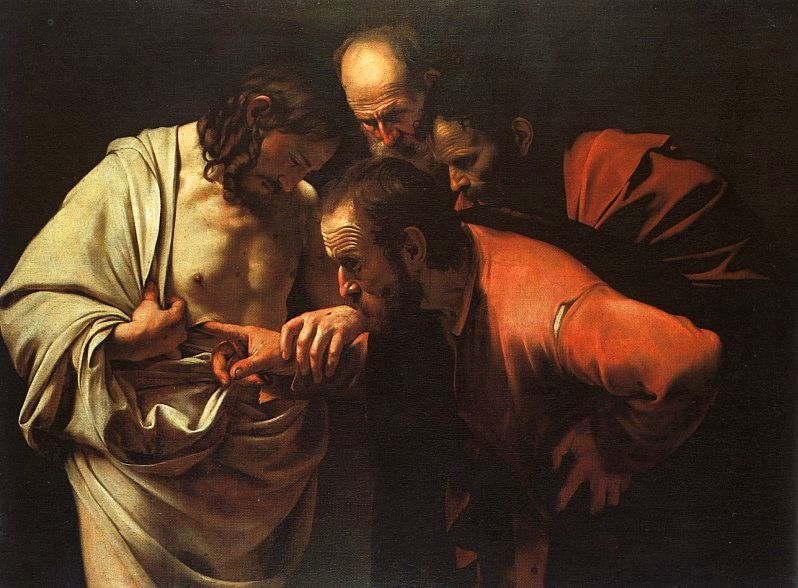
The story of St. Thomas’ encounter with the risen Christ is the most thorough treatment of doubt in the New Testament. Our brother Thomas gets an unfair shake when we use his name to make fun of someone for being “a Doubting Thomas.” After all, Thomas was only doing what any of us would have done, if someone came to us with news that seemed unbelievable. For this reason, I like to think of Thomas as “the patron saint of critical thinkers.” The scientist Carl Sagan famously quipped that “extraordinary claims require extraordinary evidence.” I imagine Dr. Sagan applauding when St. Thomas proclaims, “Unless I see the mark of the nails in his hands, and put my finger in the mark of the nails and my hand in his side, I will not believe.”

The most intriguing aspect of this story is not Thomas’ doubt, but Jesus’ response to it. If John’s gospel had been written by modern Fundamentalist Christians, they probably would have said that Jesus couldn’t appear in the upper room until the other disciples had excommunicated Thomas for his skepticism. If Jesus appeared at all, it would probably be on the far side of the locked door, shouting about how Thomas is a “sinner” and is “going to hell,” if he doesn’t change his mind. But that’s not what actually happens in John’s gospel.

In the real version of the story, the text says, “Although the doors were shut, Jesus came and stood among them and said, ‘Peace be with you.’” Thomas’ doubt, for Jesus, was not a reason to stay away, but a reason to come closer. Thomas’ doubt, for Jesus, was not a reason to offer words of judgment, but a reason to offer words of peace. Jesus doesn’t command Thomas to have blind faith, but gives him the extraordinary evidence he’s looking for.

The presence of this passage in our sacred Scriptures should shape the way we deal with doubts, both our own and those of others. It should help us learn how to accept the process of critical thinking as a necessary part of faith. It should lead us, not to retreat from hard questions, but to advance alongside them.

As Episcopalians, we are blessed with abundant spiritual resources to help us on this journey. The Episcopal Church is part of the Anglican theological tradition. One of the things that makes Anglicanism distinct from some other expressions of Christianity is the way in which we think about our faith. Some other churches see their faith as a monolithic statement by a single and infallible authority. For Roman Catholics, it’s the Pope; for Fundamentalist Protestants, it’s the Bible. But the Anglican theological tradition, as far back as Fr. Richard Hooker in the 17th century, has always viewed Christian theology as a three-way dialogue between Scripture, tradition, and reason.

This way of thinking about our beliefs, sometimes called “the three-legged stool,” means that Episcopalians see our religion as a never-ending conversation. Everyone gets to have a seat at the table, but no one gets to stand on the table and yell at everyone else. Unlike some other religious traditions, Episcopalians do not view their leaders as infallible. We honor our ancestors, but we also believe the Church can be wrong. An interpretation that made sense at one time might stop making sense for future generations. A way of life that seemed just and holy in one century might seem abhorrent in another, and vice versa. This doesn’t mean that “anything goes” in Christian faith and practice, but it does mean that Episcopalians are always open to having a conversation about it.

This understanding of the Christian faith means that Episcopalians can be notoriously hard to pin down when someone asks what our church believes. We frequently disagree with each other, sometimes passionately. The late comedian and devout Episcopalian Robin Williams once said, “No matter what you believe, there’s bound to be an Episcopalian somewhere who agrees with you.”

Finally, thinking of the Christian faith as a three-way dialogue between Scripture, tradition, and reason means that The Episcopal Church is a place where you can bring your whole self to church: Protestant and Catholic, conservative and liberal, believer and skeptic. To all these parts of ourselves and each other, the sign outside our churches around the country proclaims the message loud and clear: “The Episcopal Church welcomes you!”

Whoever you are, whatever you believe, however you identify, and wherever you are on your spiritual journey, you are welcome in this sacred space. That is the message that Jesus proclaimed to St. Thomas in today’s gospel. That is the message that The Episcopal Church seeks to embody every day, as it has for hundreds of years. And that is the message that I hope you hear in this sermon today: That you, with all your doubts and fears, are still a beloved child of God, and you are welcome in this place.

Amen.

An Impact Beyond the Intent

Photo credit: Enrique López-Tamayo Biosca, CC BY 2.0 https://creativecommons.org/licenses/by/2.0, via Wikimedia Commons

Sermon for the Fifth Sunday in Lent.

Click here to read the biblical texts.

Back before my wife Sarah and I had started dating, we were in that awkward stage where we were both noticing each other, but neither one had worked up the courage to make a move, so we just kept dancing around the subject. One night, Sarah invited me to a party at her house, and we ended up talking on the couch long after everyone else had left. It was getting late, Sarah reached forward for her drink on the coffee table, I unconsciously stretched, and she accidentally sat right back into the spot where my arm was. Sarah was like, “That was smooth! Can we talk about this?” On the outside, I played it very cool and calm, but on the inside, I was like: “AAAAAAAAAAAAAAAAAAAAAAHHHHHHHHHHHHHH!!!!!!!!!!!!!!”

Anyway… to make a long story short: It went pretty well and we’ve been married for 20 years.

The moral of the story is that our actions sometimes have an impact beyond what we intended them to have. That was certainly the case with St. Mary of Bethany in today’s gospel.

Mary’s anointing of Jesus happens at a very important turning point in the larger story of John’s gospel. Up until this point, Jesus had been dropping hints about his true identity, but from this point forward, he would begin to speak more openly as the story moved toward its climax with his crucifixion and resurrection.

In the chapter just prior to this one, Jesus raised Mary’s brother Lazarus from the dead. This miracle, according to John, was the catalyst that caused the religious leaders to begin plotting to have Jesus killed. As this part of the story begins, Jesus is having dinner at the home of Lazarus, Martha, and Mary. The memory of Lazarus’ death and resurrection was very fresh. Mary would have been deeply moved by the miracle she had just witnessed. Not only had Jesus turned her grief into joy, he had also rescued Mary and Martha from a life of poverty and degradation, which would have absolutely happened to two unmarried women who no longer had a man to speak for them in their patriarchal society. Jesus had saved, not one life, but three lives in his raising of Lazarus from the dead. Mary probably felt that she owed Jesus her life at this point.

As a sign of her gratitude, the text tells us that Mary took “a pound of costly perfume.” The Greek word for “costly perfume” is myrrh, which was used for burial rituals. It is quite likely that Mary had bought this perfume to use for her brother’s funeral, which was no longer necessary, thanks to Jesus. By breaking it open and pouring it on Jesus’ feet, she was expressing her relief and gratitude for what Jesus had done for her and her family.

This, all by itself, would have been a powerful statement, but Jesus gives it an even greater significance that Mary herself could not have known. Jesus says, “She bought it so that she might keep it for the day of my burial.”

Jesus knew, whether through supernatural clairvoyance or just an insightful hunch, that his own death was impending. Mary’s act of devotion meant more than she could possibly have known. Just as Mary honored Jesus with her gratitude, Jesus honored Mary with the knowledge of what her gesture truly meant to him.

The moral of this story is the same as the one I told about my wife and me: Our actions sometimes have an impact beyond what we intended them to have.

Our individual lives are a part of a larger story. Like ripples in a pond, God’s grace expands the meaning of what we do to cosmic significance. If, as Jesus says, even the hairs on our head are numbered, then surely no small act of goodness or kindness goes unnoticed by the God who made the universe.

My favorite modern example of an action that has a greater impact than its intent is the story of Fr. Trevor Huddleston, an Anglican priest who ministered in South Africa in the early twentieth century. Fr. Huddleston was an outspoken activist against the apartheid policies that discriminated against people of color in South Africa. One of the many racist laws on the books at that time was that, whenever a darker-skinned person passed a lighter-skinned person in the street, the darker-skinned person had to step off the curb into the gutter and lift their hat in deference to the lighter-skinned person. Fr. Huddleston, who was himself a lighter-skinned person, thought this racist law was absolutely ridiculous. So, he made it his regular practice that, whenever he passed a person of color in the street, he would step off the curb and lift his hat in a gesture of respect to this fellow child of God. Technically, this was an act of civil disobedience against South African law, but Fr. Huddleston practiced this as an act of divine obedience to the higher law of God, which says that all people are created equal.

One day, Fr. Huddleston was walking down the street and saw a little boy and his mother coming his way. As was his usual practice, he stepped off the curb and lifted his hat in a gesture of respect as they walked by. The boy and his mother were people of color. The little boy asked his mother, “Mummy, who was that man?” And the mother replied, “Son, that man is an Anglican priest, and furthermore, he is a man of God.”

The little boy, telling this story years later, said, “That was the day that I decided I too wanted to be an Anglican priest, and furthermore, a man of God.” That little boy grew up to be Archbishop Desmond Tutu, who helped President Nelson Mandela dismantle the satanic apartheid system that kept God’s beloved children in chains for so many years. It is possible that Fr. Huddleston might have had no memory of that particular day, in which he acted with the same integrity that inspired his actions every day. Like St. Mary of Bethany, Fr. Huddleston could certainly not have known that his simple act of stepping off a curb would have a ripple effect that would eventually lead to the undoing of the twisted system against which he was protesting.

Kindred in Christ, I invite you today to consider how your own simple acts of compassion and courage may have a similar ripple effect on the world in which we live. One never knows when a word of kindness or a gesture of gratitude may have an impact far bigger than its intent. Many such acts are known to God alone, but rest assured that they are known. Jesus says, in his Sermon on the Mount, “When you give alms, do not let your left hand know what your right hand is doing, so that your alms may be done in secret, and your Father who sees in secret will reward you” (Matthew 6:3-4).

Dr. Martin Luther King, in his Letter from a Birmingham Jail, wrote, “We are caught in an inescapable network of mutuality, tied in a single garment of destiny. Whatever affects one directly, affects all indirectly.”

As witnesses of the gospel of Jesus Christ, I want to encourage you this day to speak up whenever one of our siblings in Christ has offered some small word or deed that has impacted your day. It is quite possible that the giver of this gift is unaware of what it meant to you. Be quick to offer thanks to them, and to God for them.

If you are on the receiving end of such recognition, I invite you to listen with ears of your heart, giving thanks to God, who has multiplied the impact of your small gift to mean more than you intended.

Dearly beloved, our lives are not our own and they are not lived alone. It is up to us to enlighten our neighbors with knowledge as they have enlightened us with the love of Christ in their hearts. Who knows whether that grateful acknowledgement might be the very encouragement needed by a weary soul who is secretly despairing of life itself? By adding our small gesture of thanks to the common wealth, we may provide the necessary means by which a life might be saved.

Like St. Mary of Bethany, our actions have an impact far beyond their intent. Let us remember this fact and draw strength from it. May we trust that our lives matter more than we know.

Amen.

There Is More To Faith Than Having It

Sermon for the 3rd Sunday of Easter.

The text is Luke 24:36b-48

There is more to faith than having it.

When we talk about “having faith” we tend to talk about it like it’s an object, as if faith was a thing that we can possess in the same way that I “have a car” or “have a house.” But faith is not an object to be had. Faith is a process. It’s something we do.

I would like to look at this idea of faith as a process through the lens of today’s Gospel reading.

Today’s reading tells the story of Jesus’ biggest resurrection appearance to his disciples, up to this point, in Luke’s gospel. Previously, the women had been to the empty tomb and talked to the young man robed in white. Later on, two disciples on the road to Emmaus had walked and talked with a stranger all day without realizing who he was. And then, when they sat down to rest at the end of their day’s journey, the stranger broke the bread, blessed it, and gave it to them. And suddenly their eyes were opened, and they realized it had been Jesus with them all along. So, these stories were floating around, and the disciples didn’t really know what to make of them.

But then, all of a sudden, Jesus is standing there, in the midst of them, while they’re trying to figure it all out. And he says, “Peace be with you.”

Next, the text says, “They were startled and terrified, and thought that they were seeing a ghost.”

In other words, they were afraid. This corresponds to the first phase of spiritual development: A time that we all go through as kids. One of the big concerns during that time is safety. Kids can’t really protect or provide for themselves, so they frequently live in a state of fear. Jesus here meets the disciples in the midst of their fear. What he offers them is his presence and reassurance.

Jesus says, “Look at my hands and my feet; see that it is I myself. Touch me and see; for a ghost does not have flesh and bones as you see that I have.”

Those of us who are parents or grandparents have probably experienced a kid waking up in the middle of the night saying, “I had a bad dream.” They come and crawl into bed with us, and we put our arms around them and say, “Hey, it’s okay. I’m here. It’s all right. It was just a bad dream.” We are comforting them and calming their fears.

In this first stage of spiritual development, people (especially kids) are looking to simply be comforted. They need to know that we, the grown-ups in their lives, are there for them when they need us. Our job, when it comes to their spiritual lives, is simply to be with them and Tell the Story of our faith.

It would not make much sense if I, when teaching a first-grade Sunday school class, were to say, “All right now children: I want you to take this doctoral dissertation home and come back with a 10-page paper next week!” That’s not the level where our kids are at. When teaching Sunday school to kids, we’re just trying to tell the stories.

For example, in the story of Easter, we tell them how the stone was rolled away and Jesus rose from the dead. We tell them these stories again and again because the stories are how they’re getting exposed to the content of our faith. Later, when they get a little older, there comes a phase, usually around the time when they become teenagers and young adults, when they start to ask questions. If their parents and church family have faithfully given them love and reassurance, they will hopefully know that church is a safe place to explore those questions. This is what we see Jesus doing next with the disciples.

The text says, “While in their joy they were disbelieving and still wondering.”

There’s a lot of very understandable skepticism happening here. That’s why Jesus says to them, “‘Have you anything here to eat?’ They gave him a piece of broiled fish, and he took it and ate in their presence.”

In the midst of their doubt, Jesus is giving them the freedom to explore the questions and examine the evidence. In the same way, our young people are going to ask us some pretty tough questions as they explore their faith and make it their own. They’re going to get us thinking about our own spiritual path in ways that we maybe haven’t before. That’s one of the gifts that God gives to our younger people: To keep us on our toes, so that we don’t get too complacent!

I would call this second stage “Exploring the tough questions.” Let’s go back to that example of the story of the resurrection:

In the first stage of spiritual development, we just told the story. Now, as we come into what scholars call “critical awareness,” we start to examine the evidence for the resurrection and find that it’s kind of ambiguous. We ask, on the one hand, “Do dead people come back to life?” Well, in terms of our own personal experience, most of us would have to say, “No.” So, the story of Easter raises a tough question: “How is this possible?” Our lived experience creates doubt about the story of the resurrection.

On the other hand, historians have uncovered some interesting pieces of evidence that actually point in favor of the resurrection.

First and foremost, historians know that there were several Messianic movements within Judaism, around the time of Jesus. Lots of people showed up claiming to be the Messiah, most often leading some kind of armed revolution. All of these movements, once their leader was either captured or killed, either fizzled out, dispersed, and ceased to be a thing. But that didn’t happen with Christianity. Something happened that kept us together as a movement: some kind of experience that made Christianity different from all these other Messianic movements. The unanimous report of the early Christians is that they kept going and stayed together because Jesus had risen from the dead.

Another interesting bit of evidence is the day on which we worship. Their experience of the resurrection caused the early Christians to shift their primary day of worship from Saturday, the Sabbath, to Sunday, the first day of the week. The day on which they claimed Jesus had risen. And this switch had already been established by the time the New Testament was written.

I like the fact that the evidence for the resurrection is ambiguous. It doesn’t prove or disprove anything. Therefore, we always have to make a leap of faith.

So then, the first stage of spiritual development is all about “Telling the story.” The second stage is about “Exploring the tough questions.” Both of these are critical stages of spiritual growth. We need to go through them, but it’s also important that we not get stuck in them. If we only ever tell the story, and never ask the tough questions, then we fall victim to fanaticism, denying any evidence that challenges our preconceived notions. On the other hand, if we move into asking the tough questions, but never move past that, we can get just as stuck in the stage of skepticism.

We’re left with a ditch on one side of the road and another ditch on the far side. Is there a third way, through the middle of the road? I think there is.

Let’s return to the gospel the story: The next thing the text tells us is that Jesus “opened their minds to understand the scriptures.” Something else needed to happen, some sort of “opening of the mind” into spiritual awareness.

I think this corresponds quite nicely to the difference between truth and fact. Facts can be verified or falsified. But some things can be true without being factual.

A great example is in the story of Romeo and Juliet by William Shakespeare. Romeo stands outside Juliet’s house and says, “What light through yonder window breaks? It is the East, and Juliet is the sun!”

Now, do you think Romeo is trying to say that his girlfriend is a ball of hydrogen undergoing nuclear fusion? That would make no sense. He’s not making a factual statement; he’s speaking truthfully, saying, “The one I love is beautiful, like a sunrise.” If you have ever been in love, you’ve probably felt something similar. Personally, I think my wife’s got a smile like sunshine. I might be biased, but that doesn’t make me wrong! It is a true statement.

That’s the difference between truth and facts. That is what emerges as the gospel says, “Jesus opened their minds to understand the scriptures.” And that’s also what happens as we continue to move forward in our process of spiritual development. We go from telling the story, to asking tough questions, to seeing the truth that is deeper than the facts. I like to call this stage, “Embracing the mystery.”

By embracing the mystery, we acknowledge that there aren’t cut and dry answers to all of our questions. But, at the same time, our questions don’t invalidate our faith. We can hold onto our doubts and hold onto the beauty of the stories themselves, as we retell and re-hear them from a new perspective.

The beauty that comes out of this process is that we can hold two truths together at once. In the Episcopal Church, we do this in almost every aspect of our theology. We have multiple interpretations of our beliefs, some of which disagree with each other.

Let’s return again to the story of the resurrection: We’ve already told the story, explored the tough questions, and examined the evidence. As we embrace the mystery, we find that there are some among us who affirm, in no uncertain terms, that there was indeed an empty tomb on that first Easter Sunday. There are others who might say, “Well, I don’t know if there was an empty tomb or not, but maybe it’s a metaphor for the circle of life? As winter gives way to spring, it’s as if the whole earth is springing to life again. It’s a kind of resurrection.” Others might interpret the story of death and resurrection as a metaphor for our spiritual lives: We die to our selfish way of living and rise to a more God-centered or reality-centered way of living.

All of these different interpretations, if we’re embracing the mystery of the resurrection, can be true in their own way. There are faithful Episcopalians, and Christians of every denomination, who hold on to each of these interpretations. I think it’s really cool that we make room for all of them in this church.

A great example of this diversity of interpretations is The Meaning of Jesus: Two Visions, a book written by Dr. Marcus J. Borg and Bishop N.T. Wright. Both are accomplished biblical scholars. Bishop Wright affirms the more traditional understanding of the resurrection, that there really was an empty tomb on Easter Sunday. Dr. Borg understands the resurrection as a metaphor, but with a deeply spiritual meaning. They’ve written this book together to present their different perspectives in dialogue with each other, as faithful Christians, fellow Anglicans, brilliant scholars, and good friends. (If anyone is looking for future options for the parish book club, The Meaning of Jesus by Wright and Borg would be a really good one.)

Here in the Anglican theological tradition, we see our theology as a dialogue between scripture, tradition, and reason. We see faith, not as something we have, but as a process.

What we see in this morning’s gospel is that Jesus loves his disciples through every stage of this process. He does not berate them or threaten them. He calms their fears, explores the questions, and opens their minds.

As it was with them, so it is with all of us. Wherever you find yourself in this process of faith, whether you’re telling the story, asking the tough questions, or embracing the mystery, I invite you to accept the fact of where you are today. Furthermore, I invite you to accept yourself. Finally, I invite you to accept that you are accepted, just the way you are, and exactly where you are in this journey. Just as Jesus was with his disciples, Jesus is also with you.

Wherever you are in your process of spiritual development: Keep going! Keep telling the story. Keep asking those tough questions. Keep embracing the mystery. The process never ends! And remember: Jesus is with you, loving you all the way.

Amen.

Newness of Life

Easter Vigil sermon.

The text is Romans 6:3-11

Dearly beloved, we gather together this evening to celebrate the mystery of resurrection.

The resurrection of Christ is the central event of the Christian faith. In the season of Easter, we remember how the disciples, in some way that defies rational explanation, experienced Jesus as alive after his crucifixion and death. Many historians over the past two millennia, secular and religious alike, have debated the evidence about what really happened on Easter. What they all agree on, however, is that something significant happened that set Christianity apart from other Messianic Jewish movements of the time (of which there were many) and that the unanimous agreement among the earliest Christians was that Jesus had risen from the dead.

Tonight, I will not presume to settle this longstanding debate about the historical facts. Such questions matter deeply, but I leave the resolution of factual questions to archaeologists, historians, and biblical scholars better equipped and better educated than myself. Christian faith in the resurrection is about more than just picking sides between competing sets of alternative facts.

Resurrection, as I said at the beginning, is a mystery. As such, it is more than an historical event that happened once upon a time in Jerusalem; it is an eternal event that is always happening, in every time and place. That is why I say that we have gathered to celebrate the mystery of resurrection, and not merely commemorate it.

When we celebrate something, we give honor to an event that is also an ongoing reality. When we gather together for a birthday or an anniversary, we don’t just remember a birth or a wedding, we celebrate the ongoing reality of a person or a marriage. The Church does the same thing in our celebration of the mystery of Christ’s resurrection. 

St. Paul elucidates this aspect of celebration in the passage we read tonight from his Letter to the Romans. Paul writes:

Do you not know that all of us who have been baptized into Christ Jesus were baptized into his death? Therefore we have been buried with him by baptism into death, so that, just as Christ was raised from the dead by the glory of the Father, so we too might walk in newness of life.

For if we have been united with him in a death like his, we will certainly be united with him in a resurrection like his.

For Paul, the mystery of the resurrection is an eternal event, in which we all participate. The ritual that makes this eternal event real to us is the Sacrament of Baptism. In Baptism, Paul says, we come to participate consciously in the death and resurrection of Christ. The significance of this conscious participation is primarily ethical, according to Paul. He says, “We know that our old self was crucified with him so that the body of sin might be destroyed, and we might no longer be enslaved to sin. For whoever has died is freed from sin. But if we have died with Christ, we believe that we will also live with him.”

Paul’s presentation of death and resurrection in Baptism is akin to philosopher John Hick’s description of the spiritual journey as “the transformation of human existence from self-centeredness to Reality-centeredness.” According to both Hick and Paul, the spiritual journey of death and resurrection is a paradigm shift of Copernican proportions, in which our fragile egos come to realize that they are not, in fact, the center of the universe. In the mystery of death and resurrection, we come to embrace the reality that our true selves are rooted and grounded in the sacred energy that is eternally giving birth to the cosmos. Our individual selves are temporary manifestations of that energy, like waves on the surface of an infinitely vast ocean. Our true life, as it were, “is hidden with Christ in God”(Colossians 3:3), and this eternal life is one over which death has no final victory.

Dearly beloved, the mystery of resurrection is not limited to a single event in first-century Judea, but has been unfolding from the beginning of time until now, and I have every reason to trust that it will continue to do so in perpetuity. Furthermore, the mystery of resurrection is not limited to Christians, humans, or even planet Earth, but is active in all corners of the universe simultaneously. 

I do not ask you to tonight to put blind faith in these statements, simply because they have been spoken from a pulpit. I invite you to examine the facts for yourselves.

Approximately sixty-six million years ago, an asteroid more than six miles wide slammed into Mexico’s Yucatan peninsula. The impact made a crater 110 miles wide and twelve miles deep, deposited a layer of iridium in soil around the planet, and set off our planet’s fifth mass extinction. Seventy-five percent of all life on the planet, including the dinosaurs, were wiped out by the environmental devastation unleashed by this impact.

There can be no debate about the profound destructiveness of this event, but there is a wonderful and creative aspect to the story that is often overlooked. During the time of the dinosaurs, mammals were small in size and few in number. Tiny shrew-like rodents huddled together in underground burrows in order to avoid the gargantuan lizards that dominated Earth’s surface. 

Unlike the reptiles, natural selection had gifted these little mammals with a powerful new tool in their brains, called “the limbic system.” The limbic system is the part of our brains where emotions are produced. It governs our social relationships and allows us to make more complex judgment calls than the basic survival instincts of our brain stem. Because of the limbic system, mammals were able to care for their young andform bonded family groups. Those little rodents were more to us than just vermin infesting the forest floor; they were our great-great-great grandparents.

When the dust finally settled after the asteroid impact that killed the dinosaurs, our mammalian ancestors cautiously emerged from their underground dens and began to explore the surface the Earth. In time, they evolved into primates with a highly developed neocortex (that’s the computer part of our brains) and, eventually, into humans. 

So, the asteroid impact that caused the death of the dinosaurs also led to the evolution of new forms of life. Because of our cuddly mammalian ancestors and their beautiful little limbic systems, this cataclysmic extinction event opened the door for deeper expressions of love than had ever existed before on planet Earth. And you, the people sitting in these pews tonight, are the direct descendants of those brave and loving creatures. 

Here, in the very fabric of our planet, we discover the mystery of resurrection at work on a timescale that predates the human by millions of years. There is also, in this discovery, a profound harmonization between the scientific story of nature and the biblical story of creation. Dr. Francis Collins writes, “God has now given us the intelligence and the opportunity to discover [God’s] methods… For me scientific discovery is also an occasion of worship” (Time Magazine, August 7, 2005).

Turning from the Christian story of Easter and the scientific story of creation, we can also findthe great mystery of resurrection at work in our lives today. In every life, it is said, a little rain (and not a few asteroids) must fall. Each of us endures moments (or seasons) of crisis, in which we die a little (or a lot) to one way of being and rise to another. Perhaps a job or a relationship has not turned out as expected; perhaps a diagnosis or accident has derailed one’s plans for the future; perhaps a person or community, in whom one had trusted, has utterly betrayed that trust. Even happy events, like weddings and graduations, can be occasions of death for one’s former way of life.

Like most parents, I can remember that there was once a time before I had children, but I no longer have any emotional access to that memory. Since becoming a father, my energy, my time, and (Lord knows) my money are no longer my own. Adapting Paul’s words to my present circumstances, I can definitively testify that the luxury of my formerly child-free life has been “buried with Christ by baptism into death,” but I can also testify that the experience of parenthood has opened my heart to greater depths of love and raised me to “newness of life” in ways that I could never have imagined. In my life as a father, and in my life as a Christian, I must come to admit that I am no longer the center of my own little world. Instead, I am but a speck of dust in company with my fellow specks, orbiting around a much greater center of our being. My self-centeredness has died and been resurrected as wonder and love on a cosmic scale.

This Easter, I invite you to consider the many deaths and resurrections you have endured in your life. I invite you to ask yourself: What are the cataclysms and crises that brought an end to an old way of life for you? What helped you make it through those days? What new insights and perspectives did you gain from those crises that you continue to carry to this day? Finally, looking at the present challenges in your life or the world around you, what new possibilities might be emerging from just below the surface?

As you ask yourself these questions, I pray that the answers you find and the meaning you create will lead you to “newness of life” in the mystery of resurrection. Whoever you are, whatever your personal beliefs or faith tradition may be, and in whatever way is most meaningful to you, may you journey alongside us Christians in the spirit of our Easter proclamation: “Christ is risen indeed! Alleluia!”

The Old Rugged Cross: Rene Girard and the Resurrection of Substitutionary Atonement

Image
St. Martin’s Cross, Iona Abbey. Image by Colin Smith. Retrieved from Wikimedia Commons.


Friends and commentators from all over the theological spectrum have mentioned that I don’t seem to have given susbstitutionary atonement theory its due in my post from earlier this week, The Wrath of God and the Presbyterian Hymnal.

In that post, I leaned heavily on presenting substitutionary atonement as “cosmic child abuse” (an excellent turn of phrase I’m borrowing from Sarah Sanderson-Doughty).  I wrote:

…penal substitution sets up a scenario where Jesus saves humanity from the rage (not the wrath) of an out-of-control, abusive parent.  When all is said and done, the church gathers around a crucifix and hears, “This is your fault.  Look at what you made God do.  You are so bad and dirty that God had to torture and kill this beautiful, innocent person so that he wouldn’t do the same thing to you.  Therefore, you’d better shape up and be thankful or else God will change his mind and torture you for all eternity.  And don’t forget: this is Good News and God loves you.”  If any human parent did that, he or she would be rightly incarcerated, even if the innocent victim was willing.  If that’s what Christianity is, then you can count me out.

Sadly, this (admittedly extreme) depiction accurately portrays substitutionary atonement as it was presented to me by fundamentalist pastors and teachers I encountered in high school and college. 

However, I realize that thoughtful evangelicals and catholics will cringe at my presentation, since they accept the theory, but not in its “cosmic child abuse” form.  For them, it represents the epitome of love and sacrifice.  I remember seeing an art project made by a teenager that showed one person pushing another out of the path of an oncoming car with John 15:13 written across the top: “Greater love hath no man (sic) than this, that a man lay down his life for his friends.”  For them, substitutionary atonement is precisely the opposite of child abuse: it is the ultimate standard of loving sacrifice, established by Jesus himself, to which every parent, spouse, and friend should aspire.

I understand and respect this angle, but I suspect that many of these more informed and compassionate evangelicals and catholics may not realize what is being propagated in their name.  The heresy of “cosmic child abuse” is alive and well in traditional, orthodox congregations and parishes the world over.  Curious outsiders and wounded insiders are being exposed to violent, hateful theology and end up rejecting Christianity at large based on this misrepresentation.  That’s why I think it is incumbent upon liberals, evangelicals, and catholics alike to think well about what their atonement theology does mean to them and then speak up (loud and often) to counterbalance the voices of violence and hate that dominate public media in Jesus’ name.

With that in mind, I thought I might revisit the subject of substitutionary atonement today and present what I think are some of the more positive contributions it might make to the Christian theological project, writ large.  Sections of this article have been lifted and adapted from my reply to a comment on the previous post.

Many of the New Testament passages dealing with substitutionary atonement center around interpreting the significance of Jesus’ crucifixion through the lens of sacrificial worship in Second Temple Judaism. The use of such a schema made total sense as an apologetic strategy in that time and place (much like Anselm’s strategy made sense in feudal Britain).

Jesus, of course, is presented as the priest and the sacrifice that supersede the Temple cult. The temple authorities claimed exclusive access to God through their rituals and institution. The early Christians, on the other hand, used this priest/sacrifice imagery to legitimate their own Christocentric practice while demonstrating its continuity with traditional Judaism. The language of temple, priest, and sacrifice would have helped the gospel make sense to a first century Jewish mind. Obviously, the strategy worked: Christians and Pharisees were the only forms of Judaism to survive the destruction of the Second Temple in 70 CE. This interpretive schema gave Christians the framework they needed to survive without a standing Temple.

The Pharisees, for their part, had the Torah, the synagogue, and the family home as centers for their faith-practice. They went on to complete the Talmuds and form the basis for modern rabbinic Judaism as we know it today. The Sadducees, Essenes, and Zealots all pretty much died out as movements by the end of the second century.

Substitutionary atonement, understood within the cultural context of Second Temple Judaism, makes total sense as a first century apologetic strategy. It’s actually rather brilliant and obviously effective, given the lasting impact it’s had on the development of Christian atonement theory. The scholastic Anselm further developed the idea susbstitutionary atonement in the 11th century as part of his own brilliant and timely apologetic effort.

My only problem with it is when it is used as the primary or only legitimate atonement theory in our day. Such a narrow focus ignores the multiple other models for salvation presented by scripture and tradition. I fear that a one-sided emphasis on individual guilt and forgiveness through substitutionary atonement is unnecessarily handcuffing our evangelistic efforts by ignoring the many ways in which the gospel might be interpreted, preached, understood, and received by people today.

In addition to priest and purifying sacrifice, Christ can also be embraced as a physician for the sick, a liberator for the oppressed, a light in the darkness, food and drink for hungry souls, or a friend for the lonely. My hope is that Christians today might let these many images take root in our imaginations so that we might be inspired to become more faithful and effective witnesses of Christ in word and deed.

Rene Girard is one writer whose work presents, in my opinion, some rich possibilities for understanding the crucifixion of Jesus as a substitutionary sacrifice.  A Roman Catholic scholar of mythology, Girard identifies patterns of mimetic violence at work in the development of religions and societies.

From birth, human beings are presented with models that we are meant to imitate.  This happens on a primal level with one’s parents and siblings.  As societies grow, our caches of models will grow as well.  Post-industrial consumer capitalism in the Information Age presents us with a greater supply of models than any other culture in the history of the planet.

As imitators of models, we compete with one another.  Over time, our competition grows fierce.  The “war of all against all” (thank you, Hobbes) threatens to unravel the fabric of society and return us to primal chaos.

At this point, according to Girard, a scapegoat is chosen: someone at whom the rest of society can redirect the energy of their internal conflict and self-hatred.  The scapegoat is made to bear the blame for this conflict and is summarily sacrificed.

In the wake of the sacrifice, the mimetic conflict is temporarily relieved and the community enjoys a period of relative peace and stability.  Previously blamed for the violence, the scapegoat is now credited as the source of the temporary peace and is deified as a god.  Girard’s theory is that this is how the deities of classical mythology received their identities.  The cycle of violence then resets and repeats itself.

Applying his theory of mimetic violence to his own Roman Catholic theology, Girard presents Jesus as the willing scapegoat.  Jesus deliberately enters into the cycle of mimetic violence with the intention of stopping it.  He is aware of what is involved in that process and embraces the role of scapegoat.

According to this reading of the atonement, Jesus is still “sacrificed for our sins” but the wrath he is appeasing is not the wrath of God, but the rage of sinful, selfish humans.  He substitutes himself in the place of all other scapegoats who endure the unjust violence of society.

In the resurrection, God intervenes to vindicate the scapegoat, unmasking and disarming the patterns of mimetic violence.  Christians, as followers of Jesus the willing and vindicated scapegoat, are called to side with all future scapegoats and end the cycles of violence and exclusion, even if it means being crucified ourselves.

Rene Girard’s theory presents us with a way of unserstanding susbtitutionary atonement that can redeem it as a viable apologetic strategy in this consumer capitalist society, just as Anselm of Canterbury and the New Testament authors used it in their respective eras.

In this Girardian sense, I am able to reclaim substitutionary atonement and “cling to the old rugged cross”.  I see in Christ’s crucifixion and resurrection the end of all hate and violence.  I look forward to a time when all humanity will “exchange [the old rugged cross] one day for a crown” as cycles of mimetic violence come to an end.

Not One Stone: Facing Mortality, Finding Meaning

Wailing Wall and Dome of the Rock at the site where the Jerusalem temple once stood. Image by Peter Mulligan. Retrieved from Wikimedia Commons.

Click here to listen to this sermon on our church’s website

A middle aged man goes to see his doctor for a physical.  At the end of the examination, he asks, “Well Doc, do you think I’ll live to be a hundred years old?”

“Let’s see,” the doctor said, “do you smoke?”

“No,” the man said, “absolutely not.  Never.”

Doc: “OK then, do you drink?”

Man: “Not a single drop in my entire life.”

Doc: “Do you eat a lot of sugary or fatty foods?”

Man: “No way!  I’ve always been very careful about what I eat.”

Doc: “Do you drive very fast?”

Man: “Never!  I always drive 5 miles an hour below the speed limit, just to be sure.”

Doc: “I don’t quite know how to ask this one, but have you had a lot of girlfriends?”

Man: “Absolutely not.  I’m celibate and I’ve been celibate for my entire life.”

Doc: “Then why on earth would you want to live to be a hundred?!”

Why indeed.  You and I live in a culture that has mastered the art of denying death.  Everything from anti-aging cream to plastic surgery is designed to keep us from facing the reality of our own mortality.  Consumer advertising and commercial television keeps us distracted from thinking about death until we absolutely cannot avoid it anymore.  At that point, if we so choose, they can give us drugs that will “make us as comfortable as possible,” effectively tuning us out until our bodies stop functioning.  Our culture’s goal, it would seem, is to first ignore and finally numb the dying process so that we won’t ever have to come to grips with it.

Of course, the wisest among us don’t wait until that point to reflect upon their own mortality.  They find their own way to accept it and even make peace with it.  For these people, thinking about death doesn’t have to be something dark or morbid.  In fact, it can give their lives a sense of meaning and purpose.  People who know and accept the fact that they are going to die live with a conscious awareness that they have a finite amount of time on this earth and it’s up to them to make the most of it.

If you knew that you only had a week, month, or year to live, how would you choose to spend that time?  What do you want your life to stand for?  When other people look back at your life, what would you want them to remember about you?  These are the questions that a wise person asks in the face of mortality.

When we accept that this life will not last forever, we realize that it cannot be an end in itself.  Like the man in the joke, we have to ask ourselves: what’s the point of living to be a hundred years old if all you’re going to do is eat Brussels sprouts?  The truly wise among us realize that life cannot last forever, therefore the truly wise among us also realize that each life must be lived for something larger than itself.  Every mortal life, it seems, is a means to an end.

In spite of our culture’s death-denying attempts to distract or numb us, each of us has probably known, met, or heard about at least one person who made his or her mortal life meaningful by dedicating it to something larger than himself or herself.  We tend to respect or admire such people when we meet them.  Their examples might even inspire us to look more deeply at our own lives, face our mortality in new ways, and discover meaningful possibilities within us that we hadn’t noticed before.  It’s a beautiful thing when that happens.

However, it’s at this point that our cultural programming kicks back in and tends to shut us off toward the next step in our development.  Our culture is so individualistic that we don’t even think about the larger social bodies of which we are a part.  We tend to stop with ourselves and not notice how it is that an awareness of mortality applies to larger realities.

People are mortal.  We know that.  We accept that fact, at least theoretically, even if we choose to ignore it for our entire lives.  However, not many of us stop to think about other things that share our mortality.  These things might last much longer than we do, but they too will one day fade from existence.  Families are mortal.  Surnames and lineages come to an end through a lack of offspring.  Churches and other faith communities are mortal.  There comes a point when dwindling membership and a lack of funds causes an institution to close its doors.  The same thing is true of entire religions at large.  There are very few people on this planet who continue to worship the gods of Mount Olympus in the same way that they were worshiped by Greeks in centuries past.  Nations are mortal.  The Roman Empire was once the dominant superpower in the world, unlike anything else that had come before it.  Where is the great Roman Empire today?  Buried under the rubble of history and preserved in ruins frequented by tourists in Bermuda shorts.  Species are mortal.  Dinosaurs no longer roam the earth like they did 65 million years ago.  Finally, even the planets and stars are mortal.  One day, our very own sun will burn up all of its hydrogen fuel and explode into a violent supernova, momentarily becoming the brightest star in some distant sky.

If coming to grips with our own individual mortality is difficult, accepting the mortality of families, churches, species, and stars feels almost impossible.  Yet, the same truth applies to these larger mortal beings that first applied to mortal human beings: it is in facing mortality that we find meaning.

Let’s look at this idea in relation to this morning’s reading from Mark’s gospel.  The story opens as Jesus and his disciples are leaving the great Jerusalem temple, the epicenter of Jewish worship in the first century CE.  Jesus, as usual, is walking away from yet another fight with the established religious leaders of his day.  In the previous chapter, chapter 12, you can read about Jesus butting heads with representatives from almost every major Jewish sect and community: Pharisees, Sadducees, Herodians, and temple scribes.  The conflict between Jesus and the organized religion of his day had reached such a boiling point that Jesus, in his frustration, was about ready to give up on it.  When this morning’s passage opens with him leaving the temple, he’s not just out for a stroll, he’s right in the middle of storming out in a huff.

It’s at this point that Jesus’ disciples, in their usual tactless and somewhat dimwitted manner, decide to stop and admire the lovely architecture of this religious icon and national monument of Judaism.  They say of the temple, “Look, Teacher, what large stones and what large buildings!”  Jesus is unimpressed.  He says, “Do you see these great buildings? Not one stone will be left here upon another; all will be thrown down.”

He’s talking about mortality of the temple: this central symbol of religious and national identity for the Jewish people.  They were under the impression that this sacred building would stand forever under divine protection.  For them, the temple was immortal.  It was an end in itself as a center of worship.  The idea had never occurred to them that it might not be there one day.

As it turns out, Jesus’ prediction was spot-on.  The Jerusalem temple, like any human being, was mortal.  It was eventually burned to the ground by the Romans during an uprising in the year 70 CE.  It was never rebuilt.  The site where it once stood is now occupied by the Dome of the Rock, one of the most sacred places in Islamic religion.

The destruction of the temple was unthinkable to the average Jew, but to Jesus it was inevitable.  The wisdom of Jesus did not stop with an awareness of his own individual mortality, but extended to embrace the mortal and finite nature of all things.  Just as it was for individuals, so it is for temples, religions, countries, species, planets, and stars: to face mortality is to find meaning.

If our great struggle in life is limited to ensuring the continued existence of particular people, places, institutions, or things, then we have already doomed ourselves to failure.  Nothing lasts forever.  We need to accept that.  What Jesus said about the Jerusalem temple, we could say about anything: ““Do you see these? Not one stone will be left here upon another; all will be thrown down.”  All things are mortal.

The sooner we realize this truth, the sooner we can get on with the business of asking the really important questions about existence in reality.  Concerning our individual selves, we can ask: “What am I living for?  What will people remember about me when I’m gone?  What will be my lasting contribution to the world around me or the universe as a whole?  What is the meaning of my life?”

We can ask these same questions about our mortal families or this mortal country.  The day will come when the United States, like the Roman Empire, will only exist as a chapter in a history book.  Accepting the inevitability of this fact, we need to ask ourselves as Americans: “When that day comes, what will that chapter say?”

As Christians, we can also ask these same questions about our church, our denomination, and our religion as a whole.  We need to get over this ego-centric idea that God will protect and preserve us from our own collective mortality.  Just look at the way Christianity itself has changed over the last two thousand years.  We shouldn’t kid ourselves into thinking that the Christianity we practice is identical in faith and form to the Christianity practiced by the Apostle Paul or St. Augustine of Hippo.  We identify ourselves as Presbyterians, but if John Knox and John Calvin (the founders of Presbyterianism) were sitting in this church right now, they would be horrified by much of what they would see.  Likewise, if a Christian from the year 2412 were to time travel into this sanctuary right now, that person’s faith would likely seem so foreign to us that we wouldn’t even want to call it ‘Christian’ at all.  Just as Paul and Calvin have shaped us, our faith will shape the future long after we are gone and the pressing crises of our era have ceased to be relevant concerns.  What will be our lasting contribution to that future?

Finally, as members of this church, I think we need to ask these questions about our mortal congregation.  This little church has been in Boonville for over two hundred years.  We take great pride in our history and our building.  Maintaining the integrity and beauty of this place is a chief concern for many people in this room.  But all of us together need to hear Jesus saying to us what he said about his own temple: “Do you see these great buildings? Not one stone will be left here upon another; all will be thrown down.”  This place, this building, and this congregation are all mortal.  They will not last forever.  “All will be thrown down,” as Jesus said.  If our only motivation in coming here week after week is to keep the doors open and the lights on, then we’ve already failed.  We’re like the man in the joke at the beginning of this sermon: we have no reason to live for another hundred years.  Wise individuals live with a conscious awareness of their inevitable death and then adjust their lives accordingly, so as to make them as rich and meaningful as possible.  It is no different with wise churches.

This church will die eventually.  Whether it’s in ten years or another hundred years, it will happen.  We need to remember that.  We need to embrace that truth for ourselves so that we, as a church, can make the most of the time we’ve been given right now.  Knowing that this church will one day die and “not one stone will be left here upon another,” we need to ask ourselves, “Why are we here?  What is this church living for?  What will be our lasting contribution to the life of this community after our doors are closed and our lights shut off forever?  What is the meaning of our life together, as a church?”  Those are the real questions that we need to be asking, not just once for a special project or a mission study, but continually.  We need to set these questions before our eyes like a carrot dangling in front of a horse during a race.  These are the questions that need to drive us, propel us, or perhaps lure us forward into the future.

As we explore these questions within the conscious awareness of our church’s impending death (whenever that will happen), I believe we’ll start to see a slow-motion miracle in progress.  Even as we are facing and embracing death, I believe that we will also start to experience a kind of resurrection.  It’s been my experience and observation that the most vibrant, active, and growing churches are the ones who have found their reason for being, the meaning of their existence, outside themselves.  These churches are passionate about spiritual growth and community service.  Their members gather together, Sunday after Sunday, not to maintain what they have, but to seek what they desire.  There is a yearning deep within such people for “something more.”  They are hungry for silence, prayer, scripture, and sacrament.  They long to deepen their connection with the sacred mystery of divine love.  This love, in turn, leads them out, away from the church and into the streets of this community where love demands to be shared with hurting people through compassionate word and deed.  This is my vision of a church that faces mortality and finds meaning.  When the day comes that “not one stone will be left here upon another,” such a church will live on in a state of resurrection, even if our doors are closed, our lights shut off, and our roof caved in.  Even then, even if our church dies, it will live.

As a church, as individuals, as a country, and as a species, may we be people who live with a consciousness of death.  May we face mortality and find meaning.  In the midst of these piles of rubble, where stones have been thrown down from the broken remnants of our sacred temples, may we walk together the path of our own, continual, slow-motion resurrection, following in the footsteps of the Living Christ, the Risen One in our midst, the faithful friend who abides with us and guides us on our way.

Bone

Re-blogged from the United Church of Christ’s Stillspeaking daily devotional.

Original source:

http://www.ucc.org/feed-your-spirit/daily-devotional/bone.html

Excerpt from Ezekiel 37:1-14

“The hand of the Lord came upon me, and he brought me out by the spirit of the Lord and set me down in the middle of a valley; it was full of bones…I prophesied as he commanded me, and the breath came into them, and they lived, and stood on their feet, a vast multitude.”

Reflection by Quinn G. Caldwell

Here’s what the story says: dry bones are not the final state of things.  Death will not win.  Here’s what it says: life wins.

Here’s what it doesn’t say: that they were human bones.  Or that those bones went back together in their original order.  Or that the bodies at the end were the same as the bodies in the beginning.

We tell this story as if it’s only about humans, as if we’re the only species God loves enough to waste the energy on.  But this is the God that notes the fall of every sparrow, right?  Surely God noted the fall of every pterodactyl.  Surely, God noticed the fate of the hominid Australopithecus afarensis just as fully as he does that of the hominid Homo sapiens.

99% of all the different species that once lived are now extinct.  And yet, the place is full of life.  Why?  Because God does not let extinction win.  The dinosaurs go down to bones and molecules, and the mammals rise up to take their place.  Homo habilis goes extinct, and up rises Homo sapiens.  One very particular Homo sapiens goes down to dust, and rises up the King of Heaven.

Death happens, but so does resurrection.  Extinction happens, but so does evolution.  And if our bones fit together differently when we walk out of the valley than when we walked in, maybe that’s not so bad.  I mean, you’re better looking than Paranthropus boisei any day.

Prayer

For evolution, thank you.  For resurrection, thank you.  For not giving me a protruding brow ridge and shallow brain pan, thank you, thank you, thank you.  Amen.

Where Is He Now?

Acts 1:1-11

Click here to listen to this sermon at fpcboonville.org

Shirley Temple now

Do you ever watch those TV documentaries that follow the lives of celebrities from days gone by and ask, “Where are they now?”  I must admit that I find them fascinating.  Obviously, some of them are more fun to watch than others.  It’s always sad to hear about those who get swallowed up by fame and lose themselves in an ocean of drugs and revelry.  But then there are those who somehow manage to outlive their own fame.  Many of them go on to lead perfectly normal lives with spouses and families.  Others go on to do even bigger and more important things than when they were in the limelight.

My favorite example of this kind of celebrity is none other than the unforgettable Shirley Temple.  Shirley was the sweetheart of the silver screen in the 1930s and is still the youngest person to ever receive an Academy Award.  What most people don’t know is that, since then, Shirley Temple has had an illustrious career as an American diplomat.  She was a delegate to the United Nations and the Ambassador to both Ghana and Czechoslovakia at different points in her life.  All in all, I’d say that she’s had a pretty successful post-show-business career!

It’s kind of the same way with Jesus.  Today, we’re celebrating Christ’s Ascension into heaven where he “sitteth on the right hand of God the Father Almighty”, according to the Apostles’ Creed.  The Ascension represents the early Christian church’s way of answering the question, “Where is he now?” when it comes to Jesus.  After all, they claimed that he had risen from the dead, so they had to have some kind of response ready when people asked, “Well, if he’s really alive, why then can’t we see him?”  So then, the Ascension, on one level, is kind of a cheap cop-out.  But, on another level, it expresses a truth that goes much deeper than mere historical fact.

The Ascension is kind of a hard topic to write a sermon about.  It’s so abstract and mythical-sounding that it’s hard to pull anything useful or relatable out of it.  Have you ever seen a Jewish rabbi come back from the dead and then fly off into the wild blue yonder like Superman?  I can’t say that I have.

Biblically speaking, we read about the Ascension in two different places in the New Testament: at the end of Luke’s Gospel and at the beginning of the Acts of the Apostles.  This is more appropriate than you might think because Luke and Acts are actually related to each other.  They were probably written by the same author(s).  Acts follows Luke like the sequel to a blockbuster movie.  The first movie (Luke) tells the story of Jesus’ life.  The second movie (Acts) picks up right where the first one left off and tells the story of what happened in the early church immediately after Jesus’ earthly lifetime.  The Ascension event serves as a kind of fulcrum or turning-point between these two stories.  Jesus continues to be an important and active presence in the book of Acts, but, like Shirley Temple, much of his most important work takes place after he exits the spotlight.

The Ascension represents an expression of the earliest Christian belief that Jesus is more than an historical figure who lived two thousand years ago.  For Christians, Jesus is a living reality and an icon of the divine (which is a fancy way of saying that Jesus shows us what God is like).  This amazing person who worked as a carpenter and rabbi in Nazareth during the first century is, when seen from the Christian perspective, the king of the universe and the revealer of all that is sacred.

Jesus holds an iconic, even cosmic, status for us Christians.  What does it mean for us to hail him as the ascended king of the universe who “sitteth on the right hand of God the Father Almighty”?  There are many who say that, as king of the universe, Jesus is in charge of every little event that happens.  It’s easy to see why people might think this when things are working out for the better (e.g. during times of prosperity, happy coincidences, and chance encounters with opportunity).  But this same idea becomes a big problem when we think about things like disease, disaster, and death.

Do these events fall under the sovereign rule of King Jesus?  Some say yes.  They try to comfort suffering people with pithy phrases like, “God is in control” and “everything happens for a reason.”  If you’ve ever heard someone say that to you in the middle of a crisis, you’ll know how much it doesn’t help.  In fact, it’s downright offensive.  Phrases like that do more to comfort the speakers than the hearers.  It’s something people tell themselves in order to dismiss the suffering of others.

So, when I think about Jesus as king of the universe who reigns in power at the right hand of God, I don’t think of him controlling everything that happens in this world.  If we believed that, we would have to blame Jesus for a whole lot of horrible things that happen.

If we believed that, we would end up asking the very question that the story of the Ascension was meant to answer: Where is he now?

When we get that cancer diagnosis: Where is he now?

When we lose a job: Where is he now?

When accidents and disasters happen: Where is he now?

When children are made to suffer and die: Where is he now?

That’s why the idea of Jesus as “the king of the universe who controls everything” is so unsatisfying for me.  It leaves me asking the very question it was meant to answer.

When I think of Jesus as ruler over the cosmos, I think of him ruling from within rather than without.  The throne of the risen and ascended Christ is not on some cloud in an alternate dimension, but within our own hearts.  The power of Christ is the power of persuasion rather than coercion.  Christ works with our free will, not against it.  When we, as Christian people, freely follow Jesus and choose to live our lives in accordance with his spirit and words, the risen Christ lives and reigns in us.  The spirit of Christ is embodied again in us.  This is what it means for the risen and ascended Christ to rule from within rather than without, by persuasion rather than coercion.

Where is Jesus now?  Jesus is in you.  Christ lives and reigns in you.

When people are suffering, Jesus is in those who work to offer comfort and relief.  Even when the pain is too great to be healed by human hands, the spirit of Jesus is alive in those who sit by the bedside or on the other end of the phone, holding hands, listening, and offering the comfort of companionship so that those who suffer don’t have to do so alone.  That’s where Christ lives and reigns in power today and his work continues, long after he has physically left the spotlight.  That’s where his kingdom comes “on earth as it is in heaven”.

We are the ones who must be Christ’s hands and feet in this world.  Our risen Lord and Savior sets his throne in our hearts.  Will we pledge our allegiance to his kingdom?  Will we walk through our life in this world as he did: doing justice, loving kindness, and walking humbly with our God?

Will we prize our citizenship in Christ’s kingdom of heaven-on-earth above every other conviction and commitment?  Will we take risks that put as odds with the interests of the powers-that-be?

If we can do that, we will learn what it means to worship the risen and ascended Christ who “sitteth on the right hand of God the Father Almighty”.

I would like to close by sharing with you a prayer that I love.  It was attributed to St. Francis of Assisi, although he probably didn’t write it himself.  It’s quite famous, so you may have heard it somewhere before.  If you feel stirred by what we’ve talked about here today, if you find yourself asking “Where is he now?” in relation to Jesus, and you want to experience the risen Christ as a living reality and not just an historical figure, I invite you to join your heart with mine in praying this prayer:

Lord, make me an instrument of your peace. Where there is hatred, let me sow love. Where there is injury, pardon. Where there is doubt, faith. Where there is despair, hope. Where there is darkness, light. Where there is sadness, joy.

O Divine Master,grant that I may not so much seek to be consoled, as to console; to be understood, as to understand; to be loved, as to love. For it is in giving that we receive. It is in pardoning that we are pardoned, and it is in dying that we are born to Eternal Life. Amen.

A Tale of Two Strangers

Happy Earth Day!

This week’s sermon from Boonville Pres.

Click here to listen at fpcboonville.org

Luke 24:13-35

“We had hoped.”

Those were the stinging words that reverberated within the hearts and minds of the disciples in the days following Jesus’ crucifixion.

When John the Baptist first pointed to Jesus and said, “He’s the one we’ve been waiting for, the one whose sandals I’m not worthy to untie: the Lamb of God,” they had hoped.

When Jesus preached his first sermon in his home synagogue in Nazareth, he read those inspirational words from the book of the prophet Isaiah: “The Spirit of the Lord is upon me, because he has anointed me to bring good news to the poor,” they had hoped.

When he then started his sermon with the words, “Today this scripture has been fulfilled in your hearing,” they had hoped.

When they saw him make good on that promise, bringing sight to the blind, food to the hungry, and good news to those who had never heard anything other than bad news, they had hoped.

When Jesus told them to get ready, because the new reign of heaven-on-earth was at hand, they had hoped.

When he rode triumphantly into Jerusalem and kicked those corrupt money changers out of God’s house, the sacred temple, they had hoped.

But then, the pounding force of a Roman hammer driving twisted spikes of iron through flesh and wood put a sudden and bloody end to their hoping.  They heard Jesus recite lines of ancient poetry about being forsaken by God.  At the bitter end, he had pathetically muttered, “It is finished,” just before giving up his fight for life.  And he was right: it was finished.  It was over.  Three years of their lives wasted on this cult leader who died in disgrace.  Perhaps he would be remembered as the David Koresh or Jim Jones of his day.  They would be lucky to escape with their lives and slink back to their families in shame.  They had hoped.  Look what it got them.

Such was the state of mind of the two disciples who shambled slowly down the road on that Sunday afternoon.  They probably hadn’t eaten or slept much in the few days prior.  What’s the point of eating when all food has lost its taste?  One might as well be eating ashes.  Getting out of bed probably felt like working out with lead weights strapped to your arms, legs, and head.

Emotionally, they probably oscillated between feeling nothing at all and that sickening sensation of a knot in the gut that makes its way up to your throat and finally threatens to burst out through your eyeballs.  These folks were heartbroken.

Most of us will experience real heartbreak at some point in our lives.  It might come with the loss of a relationship or a job.  It might stem from the regret of a missed opportunity.  It might come from a serious diagnosis with a poor prognosis, the death of a parent, spouse, or child, or with what Howie Cosell used to call “the agony of defeat.”  Whenever and however it comes, real heartbreak is undeniable and unforgettable.

For these two disciples of the late Jesus, walking down a lonely road on a hot Sunday afternoon, heartbreak had come with the dashing of their highest aspirations against the concrete of imperial power and religious corruption.  They were probably just beginning to formulate a plan of what to do next when, suddenly, they realized that they were not alone on the road.

A stranger met them as they walked along the road between Jerusalem and a town called Emmaus.  In an attempt to join the conversation, the stranger politely asks about the topic.  The question literally stops the disciples in their tracks.  It’s like they can’t even bring themselves to answer the question directly.  The subject is just too painful.  Finally, one of them answers the original question with another question: “Are you the only stranger in Jerusalem who does not know the things that have taken place there in these days?”  I take that to be another way of saying, “Well, y’know…” in hopes that the stranger won’t ask them to finish the sentence.

Unfortunately for them, the stranger keeps pressing.  He asks them, “What things?”  Eventually, they open up to this stranger about the grief in their broken hearts.  “We had hoped,” they tell him, “that he was the one to redeem Israel.”  The stranger listens, talks back, and engages them in conversation as they walk along.  They talk about Jesus, they talk about faith, and they talk about the Bible.  It seems like this stranger became a real pastor to them in their moment of deepest heartbreak.  He was there for them.  They didn’t know him from Adam’s housecat, but they felt safe (or at least desperate) enough to allow him to take part in their pain and shame.  Later on, those disciples would talk about how their hearts were “burning within [them]” as the stranger walked and talked with them.

Before they knew it, the group had arrived at Emmaus.  The two disciples had reached the place where they were going, but the stranger kept walking.  They looked at the sun going down in the distance.  It would be dark and cold soon.  Traveling at night could be dangerous.  They saw an opportunity to give back to this stranger a little bit of what he had given to them: hospitality.  Maybe they even thought about what Jesus had once taught them: “Truly I tell you, just as you did it to one of the least of these who are members of my family,you did it to me.”  They called out to their new friend as he walked away, “Hey!  It’s getting dark outside.  Stay with us tonight.  It’s the least we can do.”  The stranger agrees.

Later that night, at dinner, this mysterious stranger “took bread, blessed and broke it, and gave it to them.”  And just then, in that moment, something happened.  They couldn’t explain it.  Maybe one of them caught a glimpse of a scar on the stranger’s wrist as he reached for the loaf of bread.  Maybe it was the sound of the stranger’s voice as he blessed and broke the bread, just like their dead friend had done only a few days prior.  Maybe it was something deeper than that.  Whatever it was, something happened.  In that moment, the text of Luke’s gospel tells us that “their eyes were opened.”  They squinted across the table at the stranger in the dim and flickering lamplight and then, just for a split second, they saw something that almost made their broken and burning hearts jump right out of their chests because, in that moment, they could have sworn (as impossible as it sounds) that they were looking into the eyes of Jesus!  And then, just as quickly as it came, it was gone.  The moment was over, but the experience had shaken them to their core.

This startling and disturbing encounter led them to go back to Jerusalem and their fellowship of broken-hearted disciples.  Much to their surprise, others among the group reported having similar experiences.  They didn’t know what to make of it all.  They just shared their stories with one another.  And then, in the while they were doing that, it happened again: that sense of peace and the experience of the presence of Christ in their midst.  He wasn’t dead and gone.  He was alive and with them.  They had seen him in the eyes of a stranger who had walked with them on the road and broken bread with them at home.  With eyes wide open and hearts on fire with passion, they realized that the brutality of the centurion’s hammer had not beaten the hope out of them permanently.  They had hoped.  They were still hoping.  In some way that defies explanation, hope was alive in them: opening their tear-filled eyes and setting their broken hearts on fire.

I believe the power of Christ’s resurrection is available to each of us in this Easter season.  In the midst of our heartbreak, whatever its cause, hope still has the power to open our eyes and set our hearts on fire.  There are many ways in which this can happen.  Taking a hint from today’s New Testament lesson, I want to focus on one way in particular that this might happen: Resurrected hope has the power to reach us through the presence of the stranger.

We meet all kinds of strangers in life: the random strangers we meet on the street or at the store, the strangers we think we know but don’t really (do any of us really understand our spouses, parents, or children?), then there are those strangers we don’t physically meet but whose lives are connected to ours in some way (think about the people who grow our food, make our clothes, or construct our cars), and then there are those strangers who aren’t even human: the plants and animals who share this planet with us.

There are two ways of recognizing the risen Christ in the many strangers who live around us.  First, there are those strangers who help us in some large or small way.  We saw this happening in today’s New Testament lesson as the stranger walks alongside the two disciples and gets them to open up about their broken hearts.  He was there for them in a time when they were at the end of their rope, dangling over a deep, dark chasm of despair.  He brought them back from the brink and set their broken hearts on fire with his words of hope.  The text of Luke’s gospel tells us that this stranger was the risen Christ, coming to meet them on the road.  How many times have you been blessed by a kind word, a listening ear, or a shoulder to cry on?  Have you ever been in a situation where a simple visit, a card, or a casserole, given as a symbol of love, meant the whole world to you?  In such moments, the risen Christ is present with us, igniting a fire in our broken hearts and rekindling hope.

Second, we recognize the risen Christ in those strangers who we get to help.  We saw this happening as well in today’s reading.  As the stranger in the story prepares to wander into the night, the disciples seize their opportunity to offer Christ-like hospitality.  Their eyes were later opened to the truth that it was actually Christ that they were welcoming into their home.  This is eerily similar to what Jesus told them would happen:

I was hungry and you gave me food, I was thirsty and you gave me something to drink, I was a stranger and you welcomed me, I was naked and you gave me clothing, I was sick and you took care of me, I was in prison and you visited me… Truly I tell you, just as you did it to one of the least of these who are members of my family, you did it to me.

Today is the third Sunday in the season of Easter.  We are celebrating today as Compassion Sunday.  We give thanks for the particular ministry of a group in our church: the In His Name Women’s Mission Society.  Among the many other ministries that they support locally and globally, In His Name sponsors a little girl named Gladys, who lives in Guatemala, through an organization called Compassion International.  Compassion International is a faith-based group that provides food, water, medical care, and education to over 1.2 million kids in 26 countries.  In His Name’s sponsorship of Gladys is part of the mission of this church.  In a small but very important way, we get to demonstrate to her the compassion of Christ in our hearts.  But, in an even bigger way, Gladys is Christ to us.  Through Gladys and so many other children in need, Christ calls us to make a difference in this world.  Whatever we do for them, we do for Christ.

Finally, today also happens to be Earth Day, where we give thanks for the abundance of creation and pledge ourselves to work for its healing.  I believe we can celebrate the presence of the risen Christ in these our fellow creatures in the natural world.  In this age of mass pollution and global warming, we can no longer afford to limit our religious and spiritual vision to the well-being of human beings alone.  We are part of an interdependent web of life that connects us to all forms of life on this planet.  We must respect this life and care for it.  But we must also remember to celebrate and enjoy it.  As this spring speeds quickly into summer, get yourself outdoors into God’s green earth.  Let the presence of the risen Christ in nature ignite your heart and open your eyes again.  Relearn what it says in the book of Isaiah: that “heaven and earth are full of [God’s] glory.”  Let this celebration of resurrected glory inspire us to care for our planet and its creatures.  As the preacher Tony Campolo once said, “Every time a species goes extinct, a hymn of praise to God is silenced.”  These strangers (the animals, plants, and the Earth itself) are also members of Christ’s family.  Whatever we do for them, we do for Christ.

Christ is alive and comes to meet us in the guise of strangers: those we help and those who help us.  All of these strangers are connected to us and I believe we have the capacity to see and serve the risen Christ living in each of them.  They are Christ to us and we are Christ to each other.  Whatever we do for each other, we do for Christ.  This Easter, may the risen Christ rekindle hope in you by setting your broken heart on fire and opening your eyes once again.

Resurrection People

Click here to listen to this sermon for free at fpcboonville.org

Acts 4:32-35

Today, as many of you may or may not know, happens to mark the 100th anniversary of the sinking of the RMS Titanic.  The story of the Titanic is one of the most well-known tragedies of the 20th century (I am, of course, referring to the actual ship and not the movie… although the movie was pretty bad).  I am proud to say that I was a Titanic enthusiast long before the film came out.  I was just a little kid in 1985 when the wreck was discovered by Robert Ballard, the legendary ocean explorer.  When I was learning to read, my mother bought me a copy of a kids’ book called Titanic… Lost and Found!  Later on, my very first “grown up book” was The Discovery of the Titanic by Robert Ballard.  I even own a small piece of coal that once sat in Titanic’s boiler room.  It was recovered from the wreck site at the bottom of the ocean.

In addition to the popularity of James Cameron’s blockbuster film, I think there are many reasons why the story of the Titanic continues to haunt our collective memory and imagination.  One could easily call it a “multi-faceted tragedy.”  On the one hand, it is a story of foolish human arrogance: unwavering faith in “progress” and technology that led to calling the ship “unsinkable,” even though it obviously was not.  On the other hand, it is a story of human vanity.  Titanic’s builders used the cheapest and most brittle of low-quality iron in their construction of the ship’s hull.  They preferred to spend their money on lavish decorations like gold-gilded dinner plates and the magnificent grand staircase that we saw in the movie.  Some scientists have theorized that, had the ship’s hull been made of sterner stuff, it might not have buckled as badly after striking the iceberg.  The ship would still have gone down, but it would have happened much slower and allowed more time for rescue ships to arrive and save lives.  But, in my mind, the greatest tragedy of the Titanic is that it is a story of human prejudice.  Great pains were taken to maintain the distinction between the upper and lower class passengers on the Titanic.  They were not allowed to mix under any circumstances.  There were still many in that day who believed in the inherent superiority of upper class people over others.

These class distinctions were maintained, even after Titanic received her fatal blow from the ice berg.  The crew shut iron gates in the hallways to keep the lower classes below deck.  As a result, people in steerage were blocked from getting to the lifeboats.  Meanwhile on deck, lifeboats for first class passengers were being lowered only half-full.  Apart from the crew, most of those who died on the Titanic were from the lower classes.  This, to me, is the single most tragic fact of the Titanic disaster.  It represents an almost total breakdown in human community.  Artificial distinctions and privileges were maintained, even in a life-or-death situation.  I can’t think of anything else that takes us farther away from what God intends for us as a human family.

It’s easy for us to sit here this morning, look back in time, and shake our heads at their prejudice.  We think we’ve evolved beyond that.  In some ways, we have: most folks these days have dropped the overt sense of aristocratic pedigree that once dictated social relations in Europe and North America.  But, in other ways, we in 2012 are still very much as our ancestors were in 1912.  We still like to categorize ourselves and write each other off for being different from one another.  Some of our distinctions are obviously trivial, such as preference in music or sports.  Other distinctions, like those involving politics and religion, seem to bear more momentous weight in the public sphere.

Looking at the bitterly divided state of things in our society and world today, it seems to me that we too are guilty of maintaining artificial distinctions and privileges among ourselves, even in the face of dire consequences.  Folks seem only too willing to write one another off as “those people” and forego the gentle arts of communication, coexistence, and compromise.  Even after one hundred years, it seems that we have not yet learned our lesson.

I believe the sacred scriptures of our religion offer us an alternative vision for human community.  We read this morning in our passage from the book of Acts a very different scene from the one described on the deck of the Titanic in her final hours.  We are told that the members of the early church were “of one heart and soul.”  So deep was their commitment to God and one another that they abdicated their rights to private property.  Yet, we are also told, “there was not a needy person among them.”  I don’t know about you, but to me, that sounds a whole lot more like a hippie farm than a church!

In the midst of this “experiment with socialism,” the text tells us that there is something else going on that is of paramount importance to the church’s identity.  It says that they “gave their testimony to the resurrection of the Lord Jesus.”  Somehow, this singular activity of testifying to the resurrection was central to everything else that was going on in their community.

What I find interesting is that the text of Acts doesn’t tell us what they said.  It doesn’t tell us how the apostles and early Christians testified to the resurrection.  To be sure, this is something that Christians continue to do to this day.  Some folks try to “testify to the resurrection” by constructing historical and scientific arguments for the likelihood that Jesus got up out of his tomb and walked the earth again.  Some folks simply tell the story over and over again (like this church does at Easter).  But the most important way that people (back then as well as now) “testify to the resurrection” is in the way they live.

When I look at that beautiful depiction of the early church, sharing what they have, meeting peoples’ needs, and generally being a community “of one heart and soul,” I am struck by that community’s similarity to Jesus’ vision of the kingdom of heaven-on-earth, where “the last will be first” and “the greatest among you will be the servant of all.”  The powers-that-be of Jesus’ time were threatened by his message.  The crucifixion was their final “no” to everything that he was and did.  But the resurrection was God’s resounding “yes” that trumped the world’s “no.”  Truly, where God is concerned, love is stronger than death.  In this chapter of Acts, we have a community where people dared to love like Jesus did.  Their daily lives served as indicators that Jesus’ dream was coming true and that the life of Christ was alive in them.  Their lives together served as a living testimony to the resurrection of Jesus.

This reminds me of the words to an old gospel hymn:

He lives, He lives, Christ Jesus lives today!
He walks with me and He talks with me

Along life’s narrow way.
He lives, He lives, salvation to impart!
You ask me how I know He lives:
He lives within my heart.

You and I have not had the privilege of physically walking and talking with the historical figure, Jesus of Nazareth, as the early apostles did.  However, we are not therefore excused from the task of testifying to his resurrection.  We, who claim to be his followers in the world today, give testimony to the world through the presence of the risen Christ in our hearts.  When we allow that Christ-like love to have its way in our lives, it does something inside of us.  It puts us back in touch with the true meaning for our lives and the center of the universe.  We experience Christ, not as an historical figure who lived two millennia ago, but as a living and breathing presence in our midst today.  Like the hymn says, “He lives within our hearts.”

There is another hymn that communicates this same idea.  We sang it as our opening hymn this morning.  Did you catch the lyrics?

They cut me down and I leapt up high,
I am the life that can never ever die!
I’ll live in you if you live in me,
I am the Lord of the Dance, said he.

Earlier in that same hymn, it says, “I am the dance and I still go on!”  Your life is a testimony to the presence of the living Christ in you.  Wherever faith conquers fear, Christ is alive!  Wherever equality dissolves prejudice, Christ is alive!  Wherever selflessness conquers selfishness, Christ is alive!  Wherever opposing individuals or groups sit down together to seek peace and understanding, Christ is alive!  God’s resounding “yes” trumps the world’s final “no.”  Wherever these dreams become reality in our lives, we show the world with our lives that Christ is a present and living reality, not just some inspirational figurehead confined to the annals of history.  Christ is the dance we dance.  Christ is the undying life within us.  How do we know he lives?  He lives within our hearts!  Just look at our lives and see!

This is good and empowering news for us, but it also bestows a great responsibility upon us.  We need to ask ourselves on a regular basis whether the lives we live, as individuals and as a church, are proclaiming a message of resurrection to the world.  We need to ask ourselves if we are living as resurrection people.  Are we practicing what we preach?  The great American poet and essayist, Ralph Waldo Emerson, once said, “Don’t say things. What you are stands over you the while, and thunders so that I cannot hear what you say to the contrary.”

There are all kinds of big and little ways that we can live as resurrection people.  Some of us will change the world with our testimony.  Most of us will not.  All we can do, according to theologian William Stringfellow, is “live humanly in the midst of death.”  Our little deeds of compassion and care must carry the light for us.  We, through our actions, can create a small community of kindness around us that has the potential to outlast the empires of history.  The Christian church began as a small, persecuted sect in the shadow of the Roman Empire.  Yet, here we are, Christians still celebrating, worshiping, and caring together, centuries after the fall of Rome.  The presence of the risen Christ in us is stronger and more enduring than the dominating force of empire.

Then again, we never know what kind of impact our small acts of kindness might have on the world at large.  There is a story of a young black boy and his mother walking down a city street in South Africa during the reign of Apartheid.  There was a law then that black folks had to step aside when white folks passed their way on the sidewalk.  As this mother and son were walking along, they encountered a white man walking the other way.  As he drew near, the boy was shocked to see the white man step aside and lift his hat as they passed by.  The boy asked, “Mummy, who was that man?”  His mother replied, “That man was an Anglican priest and furthermore he is a man of God.”  The little boy would later say, “That was the day I decided that I wanted to be an Anglican priest and furthermore a man of God.”  That little boy grew up to be Archbishop Desmond Tutu, the pastor to a nation who helped to peacefully dismantle Apartheid and usher in a new era of equality for his country and set an example to the world.  Who could have predicted that his calling would be inspired by one small, illegal act of kindness and respect given one day on a street corner?  Christ is alive!  Christ is risen indeed!

I’d like to close with another story from the Titanic.  In the midst of all the arrogance, vanity, and classist inhumanity of that tragic story, there is the noble tale of Fr. Thomas Byles.  He was a Catholic priest on his way to officiate at his brother’s wedding in the States.  During the night, he was twice offered a space in a lifeboat, but gave it up to other passengers both times.  He said he would stay on board so long as there was a single soul in need of his ministrations.  He heard confessions and said prayers.  The last time anyone saw him alive, he was saying the rosary on deck, surrounded by a crowd of Catholics, Protestants, and Jews.  There, in the desperation of that moment, distinctions between race, class, ethnicity, and religion were all erased.  It seems that only grace remained once the gravity of the situation set in.  I find it amazing that, even there, in the midst of this great tragedy, a small group of people encountered the eternal mystery of God together in ad hoc community.  Even as they walked together through the valley of the shadow of death, their lives “gave testimony to the resurrection of the Lord Jesus, and great grace was upon them all.”