The Adoration of the Outsiders

Eliza_Codex_24_Ethiopian_Biblical_Manuscript_a
Ethiopian Biblical Manuscript. Public Domain. Retrieved from Wikimedia Commons.

A few years ago, there was a big to-do about this book (and subsequent movie), The Da Vinci Code. I won’t get into the particulars of the plot, suffice to say that it provoked a lot of big, emotional reactions from people everywhere.

On the one hand, a lot of church-folks were offended by the ideas it presented, which didn’t exactly mesh with what we had learned as kids in Sunday School. On the other hand, a lot of folks from outside the church were really excited about the book because they thought it revealed a picture of Jesus that was bigger than the one presented by traditional Christianity.

I even had one friend who said, “I knew it! The Vatican has known about this stuff all along, they’ve just kept it hidden and locked up in some secret vault so that the rest of us won’t find out about it.”

Well, I don’t think I’d put much stock in that particular theory… or in the book’s ideas about the historical Jesus (The Da Vinci Code is a work of fiction after all), but I do find the whole phenomenon extremely fascinating from a sociological point of view.

During the peak of the book’s popularity, Jesus Christ was once again on the cover of popular, secular magazines. Books were being written (and read) about him. For a brief cultural moment (and not for the first or the last time), everyone was talking about who Jesus is and what he means to the world. It was a really interesting thing to behold.

And here’s what stood out to me in that conversation:

People feel drawn to Jesus. They want to be connected to him somehow, even if they never darken the door of a church or call themselves Christians. Jesus means a lot to people. There are few, even in the non-religious world, who speak negatively about Jesus or the things he said and did. Most secular criticism is directed, not at Jesus himself, but at us Christians (and what we have done in his name).

In this morning’s gospel reading, we read about a group of people, the wise men, who also felt drawn to Jesus. Like the readers of The Da Vinci Code, these people came to encounter him from outside the bounds of conventional, orthodox, institutional religion.

In the time of King Herod, after Jesus was born in Bethlehem of Judea, wise men from the East came to Jerusalem, asking, “Where is the child who has been born king of the Jews?”

To begin with, these wise men were not Jewish. The text of Matthew’s gospel simply says they were “from the east”, which probably means they came from Persia (the part of the world we now know as Iraq and Iran). They wouldn’t have known anything about the Bible or Jewish customs. They had probably never been to a synagogue service in their life.

So then, how did they come to be aware of this miraculous birth?

“For we observed his star at its rising, and have come to pay him homage.”

They were astrologers. They studied the stars and interpreted their movements as messages from heaven. We have astrologers today who do similar work, but most of it is for entertainment via 1-900 numbers. In the ancient world, astrology was generally accepted as a form of science. Kings and generals would have depended on the predictions of astrologers for guidance.

The message these particular astrologers were discerning from the stars was that something significant was happening in the Jewish homeland. A royal baby was being born. Matthew doesn’t say why, but something in these astrologers’ hearts was stirred enough that they felt compelled to go and pay their respects to the new baby.

So, they did what any reasonable person would do: bring gifts of congratulations to the royal palace in the capital city: Jerusalem. These wise men, Persian astrologers, felt drawn to Jesus, even though they had no idea where to go or what to do when they got there.

King Herod and the Jewish leaders, on the other hand, didn’t fare much better. Even though the astrologers had gotten a little turned around, at least they were aware that something important had happened. The astrologers’ arrival woke the Jewish leaders up to what they had forgotten or neglected in the midst of their own self-important agendas.

When King Herod heard this, he was frightened, and all Jerusalem with him; and calling together all the chief priests and scribes of the people, he inquired of them where the Messiah was to be born.”

The astrologers’ questions sent the theologians and seminary professors scrambling for answers. As it turned out, the answer they were looking for was in a tiny, little, forgotten village:

“They told him, “In Bethlehem of Judea; for so it has been written by the prophet: ‘And you, Bethlehem, in the land of Judah, are by no means least among the rulers of Judah; for from you shall come a ruler who is to shepherd my people Israel.'”

The arrival of these outsiders and their questions woke the Jewish religious scholars up to those parts of their own country and their own faith that they had neglected for too long. At this point, Herod and the religious leaders have an opportunity before them. Their eyes have been opened to the Messiah’s birth. They now have the chance to step outside their own selfish, little worlds and become part of what God is doing on earth. Is that what they do?

“Then Herod secretly called for the wise men and learned from them the exact time when the star had appeared.”

Instead, there is a reactionary pushback against this news of the Messiah’s birth. The powerful ones are secretly plotting and scheming, not so that they can be part of what God is doing in the world, but so that they can keep their power and maintain their privileged positions in Israel. Those who have power want to keep it, even if that means going against the very essence of what defines them as a people. They would do anything, even kill the Messiah, to maintain their illusion of power and control.

Herod is so delusional, so drunk with power, that he even starts ordering these foreign wise men around like they were his own subjects or property:

“Then he sent them to Bethlehem, saying, “Go and search diligently for the child; and when you have found him, bring me word so that I may also go and pay him homage.””

The irony here is that he is the one who is dependent on them. He would have no knowledge of this situation if it wasn’t for their pagan, foreign practice of astrology. Yet the wise men are the ones who respond with open hearts and minds. They came to pay their respects because they felt drawn by the heavens. All these secret, back-door deals combined with biblical hermeneutics and seminary professors probably seemed pretty strange to them. In the end, it seems like they (rightfully) disregarded everything Herod and the religious scholars had just taught them:

“When they had heard the king, they set out; and there, ahead of them, went the star that they had seen at its rising, until it stopped over the place where the child was.”

Does the text say that the wise men set out to follow the biblical scholars theologically correct directions? Or does it say that they went back to following what they already knew?

The answer is the latter, of course. The wise men basically took the Bible and theological training and threw it out the window. They didn’t know about all that Jewish stuff, nor did they want to. They knew about stars. So, when they set out again (probably more confused than when they arrived), they went back to working with what they knew.

One might think that such pagan backsliding would lead the wise men down the path of sin and deception. Surely, they would be lost forever in the desert, never to find the newborn king.

But that’s not what happened. The text tells us that the star “stopped over the place where the child was.” Get this: by following what they knew, they ended up exactly where they were supposed to be.

They set out on this journey in search of Jesus, and lo and behold: they found him (in spite of the so-called ‘advice’ given by powerful figures and religious leaders). And what was their reaction when they found him?

“When they saw that the star had stopped, they were overwhelmed with joy.”

Their hearts were more open than the hearts of those who had spent their lives studying this stuff.

“On entering the house, they saw the child with Mary his mother; and they knelt down and paid him homage.”

Despite their unorthodox methods and status as religious outsiders, the wise men ended up exactly where they were supposed to be: with Jesus. Their faith did not look anything like conventional Jewish faith, but it proved to be more real and more authentic than the faith of those people who were supposed to have all the answers.

I wonder whether the same thing might be true in the world today?

It seems to me, based on what I saw during The Da Vinci Code’s popularity, that there are a lot of people in this world who feel drawn to Jesus, but want nothing to do with the church or institutional Christianity. To be honest, I can’t blame them. We Christians have a lot to repent for when it comes to representing Jesus to the world. We have often attached his name to our own projects and agendas, but rarely have we acted in a way that is consistent with his Spirit. I think that is what it really means to “Take the Lord’s name in vain”: When we talk about him, but don’t act like him.

Meanwhile, those wise souls who are diligently searching for truth and love in Jesus are driven to look elsewhere because the church has done such a poor job of pointing the way to him. In those circumstances, I am not at all surprised that God is willing to reach out take hold of people’s hearts using things like astrology, science, philosophy, or other religions. I have met atheists who have a closer relationship with God than some Christians (even though the atheists would never use that name: God).

The good news in this is that God is willing to reach out to us human beings using any means necessary. As my seminary roommate was fond of saying, “God will broadcast on any antenna you put up.” Only God knows those hearts that truly seek after God. And, as Jesus himself promised: “Those who seek will find”… he never says they have to seek God in a particular way.

The challenge given to us then is this:

Are we open to what God is doing in the world? Are we open to the fact that God might show up in the least expected way, or in the least expected place? When we encounter others who might be seeking God in ways that seem foreign or unorthodox to us, do we have the faith to trust that God is working in their lives (as well as ours) to bring us all to that place where we can worship Jesus together?

Just like the wise men, these outsiders have precious gifts to bring to the table. Will we work with them and help them to open their treasure chests so that these gifts can be offered to Jesus and shared with the world?

God is inviting us Christians to open our hearts, minds, arms, and doors to those outsiders to the faith who bring unconventional gifts to the table and seek God in unorthodox ways. The question that God sets before us is not “Do we approve of them (or their strange methods)?” or even “Do we welcome/accept/tolerate them in our midst?”

The question is: “Will we travel to Bethlehem with them?”

Will we seek Jesus together as companions in life’s journey? Someone else’s journey might not look exactly like yours and that’s okay. Will we be open to the gifts that others bring to the table? Will we let those gifts challenge our structures of privilege and power? Will we let them change the way we think about church and “the way it’s always been” or the way we think it should be done?

These outsiders come to us, not because we have something they need, but because God has led them to us and called all of us to seek Christ together.

So then: Let’s get going.

Doubting Thomas

Retrieved from http://en.wikipedia.org/wiki/Doubting_Thomas#mediaviewer/File:Caravaggio_-_The_Incredulity_of_Saint_Thomas.jpg

Religion, for me, has always been an exercise in pain management.

And faith has always been a struggle.

My friends and family all must have the spiritual gift of patience, seeing how they’ve walked with me through each new crisis of faith and theological discovery: Evangelical, Charismatic, Catholic, Anglican, Presbyterian, Universalist, Liberal, Benedictine… it seems like I’m always dipping my toes into another tributary of the great Christian river. I’ve never quite felt at home.

As such, I feel like today is a holiday for Christians like me: the Feast of St. Thomas. Thomas, colloquially referred to as ‘Doubting Thomas’, is famous for his struggle with faith after the resurrection: “Unless I see the mark of the nails in his hands, and put my finger in the mark of the nails and my hand in his side, I will not believe.”

But just as surely as he lagged behind his fellow apostles in believing the truth of the resurrection, he also charged ahead of them when it came to confessing the divinity of Christ: he was the first to address Jesus as “My Lord and my God!”

In my experience, a faith that is open to struggle often ends up being deeper and wider than a faith that simply accepts what it is given without question. I wonder whether Thomas would have had his insight into Christ’s divinity had it not been for his struggle with Christ’s resurrection?

For people like Thomas and me, faith is always an open-hearted struggle, not because we are stiff-necked unbelievers, but because we so desperately want to see Jesus.

Including and Transcending

Mark 1:1-8, NRSV

The beginning of the good news of Jesus Christ, the Son of God.

As it is written in the prophet Isaiah,

“See, I am sending my messenger ahead of you,
who will prepare your way;
the voice of one crying out in the wilderness:
‘Prepare the way of the Lord,
make his paths straight,’”
John the baptizer appeared in the wilderness, proclaiming a baptism of repentance for the forgiveness of sins. And people from the whole Judean countryside and all the people of Jerusalem were going out to him, and were baptized by him in the river Jordan, confessing their sins. Now John was clothed with camel’s hair, with a leather belt around his waist, and he ate locusts and wild honey. He proclaimed, “The one who is more powerful than I is coming after me; I am not worthy to stoop down and untie the thong of his sandals. I have baptized you with water; but he will baptize you with the Holy Spirit.”

Have you ever experienced yourself (or some part of your life) as completely and totally unacceptable? Something that, if it were known publicly, would cause you so much shame that you’d probably just go ahead and spend the rest of your life hiding under your bed, eating Cheetos? I think we all do.

We all have some parts of our life that we think about and go, “If anyone ever knew about this, they’d never speak to me again!”

A lot of the time, we don’t even like to think privately about the fact that these parts of ourselves exist.

And, even though we believe theologically that God knows everything and God’s love is unconditional, a part of us is still terrified that even God would look away in from us in disgust if such a thing became known.

And so we hide… whether we’re under the bed eating Cheetos or covering ourselves with fig leaves like Adam and Eve in the book of Genesis, we ashamed and afraid of being exposed, so we hide these parts of our lives.

Looking at our gospel text this morning, the narrator (who is named ‘Mark’ by tradition) opens his story with the announcement that this is “the beginning of the good news of Jesus Christ, the Son of God.”

But the story is not just Jesus’ story alone: Right here, at the beginning, the narrator goes to great lengths to demonstrate how the story of the gospel includes parts of all different stories.

First of all, there is the Jewish story. This is not surprising, especially since Jesus and his earliest followers were all Jewish. So, it makes perfect sense that the story of Jesus would have a particularly Jewish feel to it: Jewish memories of the past, Jewish hopes of the future.

We can see Mark intentionally including those elements in the way he tells Jesus’ story:

For example, there is his use of the word Christ. Contrary to popular opinion, Christ is not Jesus’ last name. Christ (Christos in Greek) is a Greek word that translates the Hebrew word Mashiach (Messiah). The English translation of both of these words is Anointed. It refers to a part of the ritual for crowning kings in ancient Israel when a prophet or a priest would pour olive oil on the head of the new king. This anointing was a sign that the person in question was God’s choice as leader. In Jesus’ time, this idea had developed into a national hope for a coming king who would liberate the Jewish people from occupation by the Romans. So, by calling Jesus the Anointed (i.e. Christ, Messiah), Mark is including the Jewish story (with all of its memories and hopes) in Jesus’ story.

There’s another way that Mark makes this connection:

It’s not with Jesus himself, but with this other important figure: John the Baptist. When Mark introduces John, he spends a great deal of time describing what John is wearing – “Now John was clothed with camel’s hair, with a leather belt around his waist, and he ate locusts and wild honey.”

These are all very important visual cues that Mark is giving his readers, but we 21st century people are likely to miss them, since we’re not from the same culture as Mark’s readers. However, we can get an idea of what he is talking about: If I were to use visual cues to describe a fat man in a red suit coming down a chimney, who do you think I would be talking about? Santa Claus!

We recognize those visual cues because they are deeply embedded in our own culture. In the same way, Mark is giving his audience visual cues about John the Baptist by describing what he is wearing. When he says that John is “clothed with camel’s hair, with a leather belt around his waist, and eating locusts and wild honey,” people in his culture would immediately recognize that as the prophet Elijah, whose return to earth was supposed to foreshadow the coming of the Messiah, God’s anointed king.

Mark reinforces this idea by quoting a verse from the book of the Jewish prophet Malachi:

“See, I am sending my messenger ahead of you, who will prepare your way.”

That’s all that Mark quotes, but if we kept reading in the book of Malachi, we would quickly come to this verse in the same section – “Lo, I will send you the prophet Elijah before the great and terrible day of the Lord comes.”

Again, we encounter this idea of Elijah preparing the way for the Messiah, God’s anointed king. Between these visual and verbal cues, Mark is actually laying it on pretty thick that John the Baptist is Elijah, so when John says, “The one who is more powerful than I is coming after me,” Jewish readers would get really excited, because that means that the promised Messiah is about to come. And we, as Christians, believe that’s exactly what happened when Jesus appeared on the scene.

So again, Mark is including these Jewish memories and hopes in his presentation of the Christian gospel. The Jewish story is part of Jesus’ story.

But wait, there’s more:

Mark doesn’t just include the Jewish story in Jesus’ story, he includes the Roman story as well. This is really surprising. After all, the Romans were pagans who didn’t worship Israel’s God at all. Also, they were foreigners: an invading army that was occupying the lands of Judea and Galilee. One would certainly not expect the story of the Jewish Messiah to also include the memories and hopes of pagan foreigners, but it does.

Mark begins Jesus’ story by calling it “the good news” (euangelion), which is also where we get the word “gospel” from. The term was not initially a religious term, but a Roman political one. An euangelion was an imperial proclamation that a royal child had been born, that a new emperor had ascended the throne, or that Caesar was victorious over his enemies.

Also, Mark refers to Jesus with the title Son of God. These days, we’re used to that title being applied to Jesus, but in Roman times, it was a title reserved for Caesar alone. By using the terms euangelion and Son of God, Mark is intentionally including elements of the Roman story in Jesus’ story. He’s saying that the gospel of Jesus Christ is not just for the Jews; it’s good news for the whole world.

However, even as the gospel of Jesus includes elements from these other Jewish and Roman stories, it also transcends them.

First of all, using Roman imperial images to refer to Jesus sets him up as another authority figure who will compete with the power of Rome. When the early Christians proclaimed, “Jesus is Lord!” they were making the dangerous and subversive implication that “Caesar is not.” That, to a large degree, is why the Roman Empire perceived Christians as a threat to national security and subsequently hunted and executed them.

The Caesars of Rome had a particular agenda that they were advancing: the Pax Romana. Their goal was to achieve world peace through conquest. They would impose Roman order over the face of the entire world under the leadership of Caesar. The dangerous claim of Christians is that they would achieve the same goal, but Jesus (not Caesar) would be the head of the global household. Also, the Roman vision was “peace through conquest” but the Christian vision was “conquest through peace.” The harmony of creation would be restored, not by imposing order from without, but by nurturing peace within. The Pax Christi (Peace of Christ) reigns in the hearts and minds of Jesus’ disciples by the power of God’s love, not by the power of the sword. The story of Jesus includes, but also transcends, the Roman story.

In the same way, the story of Jesus includes, but also transcends the Jewish story. The Jewish idea of the coming Messiah was that of a revolutionary leader who wields political and military power to liberate the Jewish homeland from foreign occupation and usher in a Jewish golden age of national security, prosperity, and fidelity to the Torah of Moses.

But the gospel of Jesus is much bigger than that. The gospel of Jesus is not just a Jewish story; it includes the Gentiles and all the nations of the world (even the Romans). So, just as it was with the Roman story, the story of Jesus includes, but also transcends, the Jewish story.

When it comes to our lives, I think the same principle applies. The Christian gospel includes, but also transcends our personal stories.

Nothing is left out: all that you have, all that you are, everything that has ever happened to you, and everything you’ve made happen is part of what God is doing in your life.

This is a message of total acceptance. You are loved and accepted, radically and unconditionally, by God. God loves you, not just in spite of your mistakes, faults, character flaws, quirks, and wounds, but with them. God loves you, just as you are. Full stop. No exceptions. God’s love for you is an act of free, radical, and sovereign grace. There’s nothing we can do to earn it or lose it. As the theologian Paul Tillich was fond of saying, “All you can do is accept that you are accepted.”

Like you hear me say every week: God loves you and there’s nothing you can do about it. This is a powerful truth (which is why I make a point of saying it every week). If we were to let the significance of this truth sink into our souls, it would change the way we live our lives. I dare say that it would even change the world.

The story of Jesus’ work in your life includes all parts of your own personal story. Nothing is left out. Christ looks at every part of your life (no matter how bad) and says, “I can work with that!” Nothing ends up on the cutting room floor, as it were. Total acceptance. Total inclusion.

And just like the Roman story and the Jewish story, even as every element of our personal stories are included in the story of the gospel in our lives, every element of our personal story is also transcended.

Nothing is left out. Just as Christ looks at every part of your life (no matter how bad) and says, “I can work with that,” Christ also looks at every part of your life (no matter how good) and says, “Let’s work on that.”

God loves us just as we are, and loves us too much to let us stay that way. When I was a kid, there were recruitment videos for the U.S. Army that called soldiers to “Be all that you can be.” But Christ is calling us to be more than that.

One of my favorite hymns in our new hymnal is “O Love That Will Not Let Me Go.” The second verse of that hymn addresses this subject of transcendence and transformation directly:

O Light that followest all my way, I yield my flickering torch to thee;
my heart restores its borrowed ray, that in thy sunshine’s blaze its day
may brighter, fairer be.

By including, but also transcending, all the various elements of our personal stories, Christ is calling us to a destiny that is bigger and more magnificent than we can possibly imagine. Just like the Transformers, there is “more” to us “than meets the eye.” Jesus is calling us up into that “more.”

What does it look like? Well, the answer is complicated.

We know that each person is unique. We believe that each person is made in the image of God. Therefore, it stands to reason that each person will reflect the image of God in their own unique way.

Christ is calling you to be more than you are now, but never calls you to be what you are not. God’s calling on your life will not look exactly like God’s calling on someone else’s life. Whatever you’re called to be, you’re not called to be exactly like them.

It’s like stained-glass windows in a church: each one is different from all the others; each one is hand-crafted by a master artist. But when the sunlight shines through them, it is the light of the one and only sun.

In the same way, our lives and callings in Christ will look very different from one another. We come with our own unique gifts and struggles. When the light shines through us, it shines differently, but it is the one Light of Christ: including and transcending all the various parts of our personal stories and making them part of the one Great Story: the Gospel of Jesus Christ, the Son of God.

The Long Journey Home

One of the highlights of my college experience was Spring Break 2002, when I got to spend 10 days in Romania on a student mission trip. While there, we led evangelistic services in churches and cultural halls, visited orphanages and psychiatric hospitals, played and prayed with the people who lived there, and handed out packages of gifts prepared by volunteers through an organization called Samaritan’s Purse.

The trip was sponsored by the church I attended at the time: a non-denominational charismatic church in western North Carolina. Our pastors told us they had seen some pretty amazing things happen on these trips in the past, especially as they were praying for sick people. The Bible calls them ‘signs and wonders’ while most modern people refer to them as ‘miracles’. They told us the kinds of stories we had only read about in the Bible: blind people suddenly being able to see for the first time, injured people throwing their crutches up into the air and then dancing home.

I thought to myself, “Hey, that’s something I want to see!” I wanted to have direct, personal experience with the kinds of phenomena I had only read about in the Bible. But then it didn’t happen. I watched, I waited, I prayed, but it still didn’t happen.

When I go back and read my personal journal from that week, I’m kind of embarrassed at how obsessed I was with the idea of witnessing a miracle. It’s pretty much all I wrote about, even though I was on the other side of the world, leaving my home country and seeing real poverty for the first time, hearing another language, meeting people whose lives were very different from my own. I got to drive around the back corners of post-Communist, Eastern Europe, far off the beaten-path carved out for tourists. I woke up to the sound of Orthodox monks chanting in a church across the lake from the hotel where we stayed in Bucharest. I got to spend St. Patrick’s Day in Vienna, visiting a Gothic cathedral and drinking really good, dark beer with a bunch of singing old men in a hole-in-the-wall pub that had first opened its doors in 1435… decades before Native Americans discovered Christopher Columbus lost at sea.

I met a Baptist family in the city of Galati, who had transformed their home into a refuge for young men who had been turned out of the orphanage on their 18th birthday with no educational or occupational prospects for the future. This family welcomed these guys into their home, helped them learn enough to get a job, and incorporated them into the life of their church. This same family welcomed us as well and put out a delicious spread of hors d’oeuvres for our group of loud, whiny, and tired American college students who had driven in from several hours away and hadn’t had much to eat that day. We sang Amazing Grace together around that table, in English and Romanian… I think that moment the closest to heaven I’ll ever get in this life.

I even flew over the Alps, for crying out loud, the ALPS: one of the most majestic mountain ranges in the world. If it was miracles that I wanted to see, I was surrounded by them; I just didn’t have the eyes to recognize it the time. I was too obsessed with a particular idea of a miracle as a supernatural event that violates the normal laws of physics or biology. What I think I was looking for during that week was some kind of absolute assurance for my faith. I wanted to know beyond a shadow of a doubt that God is real and God loves me.

I think a lot of people are looking for that kind of absolute assurance these days. I think it’s one of the main reasons why people get caught up in cults or other kinds of religious fundamentalism. There is so much to be uncertain about in this life; they just want something to hold onto, so they look for it in paranormal phenomena, mystical experiences, sacred texts like the Bible or the Qur’an, theological systems like Calvinism, religious institutions like the church, or authoritative leaders like the Pope or David Koresh.

Faith is hard. It’s a long journey home. Just like Moses and the Israelites leaving Egypt and traveling to the Promised Land through the barren wilderness, it’s a winding journey that takes a lifetime.

People naturally look for something to hold onto in that journey. We’re looking for something to help us keep going when the going gets tough, which is why we so often stumble into problems like cults, fanaticism, and fundamentalism. We’re looking for something concrete that we can put our faith in, some kind of absolute assurance that God is with us and will be faithful to love us all the way home.

That was the inner need that drove the Israelites in the book of Exodus to build a Golden Calf. They had already experienced God’s presence and power in their lives: God had already led them, by the hand of Moses, out of Egypt, across the Red Sea, and into the wilderness on their way to the Promised Land.

But now they were at a crossroads, camped out at the foot of Mount Sinai. Moses had disappeared over a month ago in a thunderstorm at the top of the mountain and, by Moses’ own orders, they weren’t even allowed to send a rescue mission to go look for them. After 40 days with no contact, they didn’t know if he was alive or dead.

So they said to Aaron, Moses’ brother, “Hey, we’ve been patient but enough is enough. We need to face the fact that Moses is probably never coming back. So, we want you to take command and the first thing we need you to do for us is give us some kind of absolute assurance, something we can believe in, something we can hold onto while we make this long, hard journey to the Promised Land.

So Aaron did what he could, given the circumstances. Someone in my profession might say that he was just trying to be a good pastor and meet his people’s spiritual needs. He took up an offering of gold, the very best they had to offer, and melted it down. Then he constructed the image of the Golden Calf from it and presented it to the people saying, “Here! This is your absolute assurance that we will make it to where we’re going… These are your gods, O Israel, who brought you up out of the land of Egypt.”

And the people were delighted. They were unified, inspired, and motivated. Even Moses, with all his signs and wonders, hadn’t been able to give them something so clear and concrete. This was a God they could understand; this was something they could look to in the hard times, not some mysterious presence that could never be seen or touched. This was their “blessed assurance.”

The problem is that it was all a lie. In the eyes of God, their assurance, their absolute certainty, was nothing more than an idol: a graven image, made by human hands, to which they were bowing down in place of God.

God gives us many things, but certainty isn’t one of them. Absolute certainty, especially when it comes to the divine mystery, is idolatry. As it says in the Ten Commandments:

You shall not make for yourself an idol, whether in the form of anything that is in heaven above, or that is on the earth beneath, or that is in the water under the earth. You shall not bow down to them or worship them; for I the Lord your God am a jealous God.

God had no desire to fit inside any box that can be made by human hands, be it a literal box, a statue, a building, an institution, a book, a theological system, or any other Golden Calf we can imagine with our minds and construct with our hands. The basic motivation behind religious fundamentalism, whether it leads people to fly airplanes into buildings or picket funerals with offensive signs, is idolatry. These people, who often have the loudest voices calling others back to “worship the one, true God,” are the very same people who have bowed their knee to a graven image: a god who fits inside of a box, a god we can wrap our heads around, a god we can see and touch, and ultimately a false god who is not worthy of our worship.

Whether the format is Pagan, Muslim, or even Christian, any God we can fully understand is unworthy of our worship.

But this divine mystery doesn’t leave us much to hold onto. Once again, we find ourselves with the Israelites: camped out at the foot of Mount Sinai, facing a long and difficult journey that we don’t expect to complete in this lifetime. We need something to hold onto. We need some kind of assurance, even if it isn’t absolute assurance. And Moses (who is not dead) knows this about us. And so he pleads with God on our behalf.

In today’s reading, God gives Moses two things: a mission and a promise. The mission is simple: “Bring up this people.” God wants Moses to guide his people home, to the Promised Land (which is always referred to as ‘up’ in Israelite geography). And God’s promise to Moses is this: “I know you by name, and you have found favor in my sight.”

These are good words, powerful words, and they reflect the truth of God’s reality and God’s disposition toward Moses and the people. But Moses follows with a very reasonable concern: what might be an appropriate alternative to the Golden Calf? What kind of assurance can we, as God’s people, hold onto in this journey? Moses says, “Now if I have found favor in your sight, show me your ways, so that I may know you and find favor in your sight.”

He’s saying, in essence, “God, I believe that what you’re telling me is true, but how will I know?”

God replies, “My presence will go with you, and I will give you rest.”

And again Moses puts the question to God, “But how will I know?” He says, “For how shall it be known that I have found favor in your sight, I and your people, unless you go with us?”

And God repeats again the very first thing he said to Moses, “You have found favor in my sight, and I know you by name.”

And Moses says, “Okay, God. Show me… Show me your glory, I pray.”

And God says, “I will do the very thing that you have asked… I will make all my goodness pass before you.”

“But,” God says, “you cannot see my face; for no one shall see me and live.” God gives Moses what he asks for, but also doesn’t give it. God’s face, the fullness of divine mystery, is too big for anyone to handle. We can’t wrap our minds around it… our heads would explode. Moses has asked the impossible: he simply can’t see God’s face. But that doesn’t mean he gets nothing.

Moses has a direct experience of God, just not the one he asked for. God says, “I will make all my goodness pass before you… See, there is a place by me where you shall stand on the rock; and while my glory passes by I will put you in a cleft of the rock, and I will cover you with my hand until I have passed by; then I will take away my hand, and you shall see my back; but my face shall not be seen.”

Moses doesn’t get to see God’s face, but he does get to see God’s back. He has an experience, just not the one he asked for. It’s something less than the full experience of divine glory (which he couldn’t handle anyway).

Moses seeing God’s back reminds me of a parable that originated somewhere on the Indian subcontinent and is told and retold in many different religious traditions:

Six blind men decide to find out what an ‘elephant’ is, so they set out to examine one by feel. One touches the trunk and says, “An elephant is like a great snake.” Another touches an ear and says, “An elephant is like a great flap of leather.” Another touches the side and says, “An elephant is like a great wall.” Another touches a leg and says, “An elephant is like a great pillar.” Another touches the skull and says, “An elephant is like a great boulder.” And the last one grabs the tail and says, “An elephant is like a great rope.”

Now, which one has it right? All of them. And which one has it wrong? All of them. Each blind man is having some kind of true experience of an elephant, but none of them is experiencing the full reality of ‘elephant-ness’.

Just as it was for these six blind men and the elephant, and as it was for Moses seeing God’s back and not God’s face, so it is with us and our experience with God.

Just like Moses on the mountain, God’s back is all we get to see in this life. The only thing that spiritual experiences, the Sacraments, the Bible, theology, and church can do is, when they are at their best, express God’s reflected glory in an indirect and incomplete way. These things are all good as means to an end, but they are not ends in themselves. They point us to God, but they cannot replace God.

There is no such thing as absolute assurance or certainty in this life. We cannot see the face of God, but only the back. Faith does not come with a money-back guarantee, there is always a risk. We will always have to take that ‘leap of faith’ in order to believe.

When we do (take that leap), it changes the way we see the world. The brilliant physicist Albert Einstein once said, “There are only two ways to live your life. One is as though nothing is a miracle. The other is as though everything is a miracle.”

Through the eyes of a faith that dares to risk believing, everything becomes a miracle. The whole universe is able to reflect the glory of God’s back. Everything can be a metaphor for God.

In church, we tend to use the most well-known biblical image for God, “Our Father,” but did you know that the Bible also refers to God as a Mother? Also in the Bible:

  • God is honored as a king, yet humble as a shepherd;
  • God is powerful as a warrior and weak as a baby;
  • God is bright as light, yet ‘cloaked in darkness’;
  • God is one and God is three;
  • God is a rock, God is the wind, God is a river, God is a fire, and God is a star.

All of these are valid, biblical images for God, but none of them captures the fullness of the divine mystery. To paraphrase Rev. Forrest Church, “God is present in each of these things, but is also greater than all of these things.”

Anything and everything communicates something of God to us. Not the fullness, but a part; not the face, but the back.

Can we see it? Do we choose to see it with the eyes of faith?

If we let them, all things can point us back to God, their Source. In order to see it, we must trust (have faith) in the promise, God’s word to Moses: “I know you by name, and you have found favor in my sight.” In other words, “I’m here, I’m with you, and I love you.”

This is all the assurance we have in this life. Indeed, it’s all we need for the long journey home.

Michaelmas

"Virgin's Monastery (benedictine nuns), Petrópolis, Rio de Janeiro State, Brazil05" by Cláudio Pastro ; foto de Eugenio Hansen, OFS - Own work. Licensed under Creative Commons Attribution-Share Alike 3.0 via Wikimedia Commons - http://commons.wikimedia.org/wiki/File:Virgin%27s_Monastery_(benedictine_nuns),_Petr%C3%B3polis,_Rio_de_Janeiro_State,_Brazil05.JPG#mediaviewer/File:Virgin%27s_Monastery_(benedictine_nuns),_Petr%C3%B3polis,_Rio_de_Janeiro_State,_Brazil05.JPG
“Virgin’s Monastery (benedictine nuns), Petrópolis, Rio de Janeiro State, Brazil05” by Cláudio Pastro ; foto de Eugenio Hansen, OFS – Own work. Licensed under Creative Commons Attribution-Share Alike 3.0 via Wikimedia Commons

Outside. Beside.
Closer than expected.
Too close for comfort.

Gestures and visions.
Function, not nature.
Here, not there.

Grabbing my attention
directing it back:
Beside. Inside.

Height to height,
glory to glory,
deep calls out to deep.

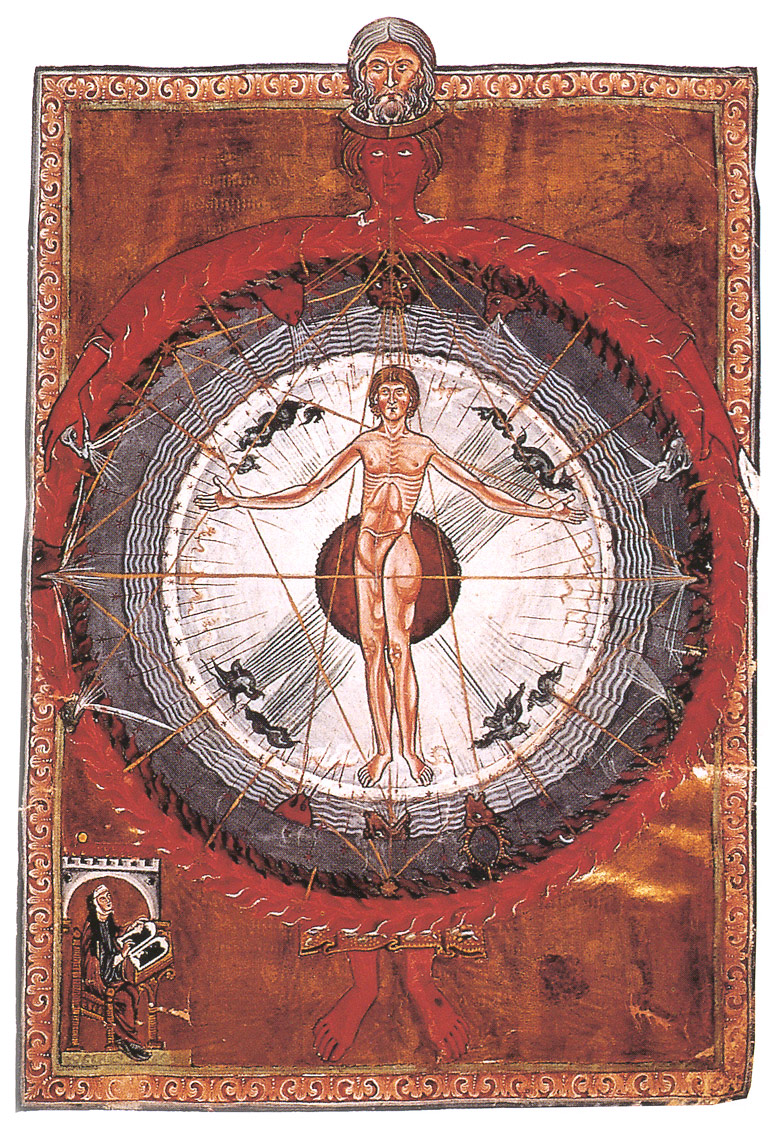
St. Hildegard von Bingen, Doctor of the Church (1098-1179)

St. Hildegard von Bingen was a Benedictine nun, visionary mystic, community leader, scientist, writer, and musical composer.

On this, the day of her memorial, I can do no better than to let her speak in her own words, interspersed with illustrations from her writings (whose production she supervised personally). All quotes are borrowed from the Spirituality and Practice website.

Images are borrowed from Wikimedia Commons.

While you meditate, I invite you to listen to this music, which she composed…

Holy persons draw to themselves all that is earthly. . . .
The earth is at the same time mother,
She is mother of all that is natural,
mother of all that is human.
She is the mother of all,
for contained in her
are the seeds of all.

God hugs you.
You are encircled by the arms
of the mystery of God.

Good People,
most royal greening verdancy,
rooted in the sun,
you shine with radiant light.

Humankind, full of all creative possibilities, is God’s work. Humankind alone is called to assist God. Humankind is called to co-create. With nature’s help, humankind can set into creation all that is necessary and life-sustaining.

Faithful Wounds and Tough Love

Today’s first reading at the Office of Vigils was from Jonah 1:11-17.

Nevertheless, the men rowed hard to bring the ship back to land, but they could not, for the sea grew more and more stormy against them.

I love the story of these sailors at the beginning of the book of Jonah. So gentle and humane are their spirits that they would even defy the pronouncement of divine judgment for the sake of their fellow human being. It reminds me of my own approach to life and ministry: Let theology be flexible; only let me care well for those entrusted to me.

Generally speaking, I think we need more people like these sailors in today’s world, where relationships are often sacrificed on the altars of ideology: opponents are demonized, gay and lesbian children are kicked out of homes by their parents, and friendships are ended (or never begun) because two people see the world differently. Where are kind souls who would risk their own lives (or their theologies) for others’ sake?

Nevertheless, there comes a moment in the development of relationships where it becomes impossible to go on, to grow as human beings in relationship, unless we risk confrontation and have the courage to tell one another the bad news.

This takes an incredible amount of trust between all parties if it is to work well.

St. Benedict writes in chapter 69 of his Rule:

Care must be taken that no monk presume on any ground
to defend another monk in the monastery

This sentence is written for those people who have made a lifelong commitment to one another in the intentional community of a monastery. Such commitment is not made lightly and only comes after an extended period of formation in the novitiate. People who have reached the point of professing permanent vows have presumably built enough trust with one another (and their superiors) to engage in the difficult work of truth-telling. We should be able to say the same about marriage, parenthood, and a handful of other relationships in life.

Rescuing (Benedict calls it “defending”) one another, so that our loved ones never have to experience any pain or hardship can sometimes short-circuit God’s work in their lives. There are trials we must endure if we are to grow as human beings and we must be able to trust God and a few others to help us work through them, rather than avoid them.

Faithful are the wounds of a friend,” goes the old saying in Proverbs 27:6 (KJV). Speaking the truth in love is an icky-tasting medicine. It should be used like a surgeon’s scalpel: as rarely as possible and only with great care by one who has earned the right to be heard.

The sailors on Jonah’s ship reached the point where they could not go on any longer. Like the addict who has “bottomed out”, they had to make a choice between drastic action or death. After a final prayer, they did what had to be done: they tossed Jonah overboard.

As it turns out, this hard act of trust had salvific implications, not only for their physical lives, but their spiritual lives as well. They came away from this encounter with a deepened reverence for Yahweh. Likewise, the sailors’ willingness to do the hard thing opened up the possibility for Jonah to fulfill his own destiny. The doom he feared did not come upon him: Jonah was rescued (albeit in the most disgusting way possible) and he went on to be the vessel of Ninevah’s deliverance from destruction. An entire city was saved because of the sailors’ willingness to let go and cast Jonah overboard.

Do we have that kind of faith in God and each other? Are we willing to do the hard thing and “speak the truth in love” (Eph. 4:15) when necessary?

Many who participate in Alcoholics Anonymous or other 12 Step groups have learned that kind of trust through their sponsors and the power of the group. Tough love makes recovery possible.

I learned it from a trusted mentor when I was in college. He loved me enough to back me up against a wall and tell me some hard truths when I needed to hear them. He did not employ this technique often or lightly. He did not do it just to “be right” or for the sake of his own ego. He earned the right to be heard by me. Faithful were the wounds of this friend.

Pregnant With God

By Urmas Haljaste (Own work) [CC-BY-SA-3.0 (http://creativecommons.org/licenses/by-sa/3.0)%5D, via Wikimedia Commons

I beheld the fullness of God in which I beheld and comprehended the whole of creation, that is, what is on this side and what is beyond the sea, the abyss, the sea itself, and everything else.  And in everything that I saw, I could perceive nothing except the presence of the power of God, and in a manner totally indescribable.  And my soul in an excess of wonder cried out: “This world is pregnant with God!”  Wherefore I understood how small is the whole of creation – that is, what is on this side and what is beyond the sea, the abyss, the sea itself, and everything else – but the power of God fills it all to overflowing.

-St. Angela of Foligno (1248-1309)

Passage retrieved from http://datinggod.org/2010/10/01/the-world-is-pregnant-with-god/

The Journey of Transformation

Image
Nicolas Poussin [Public domain], via Wikimedia Commons

I think it’s a funny coincidence that this Sunday is the week when we remember the baptism of Jesus in the river Jordan because I got to have a very “baptismal” moment earlier this week when I showed up to work on Thursday and discovered “rivers of living water” coming out of a broken pipe in the kitchen downstairs.  I’m thankful to report that the repair crew told me it looks like I found the problem and acted on it quickly enough that the damage isn’t too bad, but the whole affair made me want to throw my hands up in the air and cry out, in the words of our Jewish ancestors: “Oy vey!”

Speaking of Judaism…

One of my favorite things about Matthew’s gospel is the way that it is so rooted in Jewish tradition.  The author, who was probably a Jewish Christian living in the first century, wants to demonstrate to the readers that Christianity stands in continuity with traditional Judaism.  Matthew goes to great lengths to identify the story of Jesus with the story of Israel and he does it in two ways:

First, by quoting liberally from the Hebrew Bible (Christians sometimes refer to it as the ‘Old Testament’).  In fact, that happens in today’s reading: When Jesus is baptized and is coming up out of the water, the text says the heavens were opened to [Jesus] and he saw the Spirit of God descending like a dove and alighting on him. And a voice from heaven said, “This is my Son, the Beloved, with whom I am well pleased.”

This is actually a quote from two different verses in the Hebrew Bible.  When the author does this, it’s kind of like someone singing one line from an old, familiar song (e.g. “Here she comes, just a-walkin down the street, singin…”).  The familiarity immediately triggers memory and makes the audience perk up and go, “Oh yeah, I know that one!”

The other way that the author connects the story of Jesus with the story if Israel is by dropping lots of little hints in the text that remind the audience of famous stories from Israel’s history.  For example: At the beginning of the book of Exodus, there is an evil king (Pharaoh) killing baby boys.  In Matthew’s gospel, another evil king (Herod) is doing exactly the same thing.  Later in Exodus, Moses brings God’s message (the Ten Commandments) to the people of Israel from the top of Mount Sinai.  And what’s the name of Jesus’ most famous message in Matthew?  The Sermon on the Mount.  In Exodus, before the people of Israel can enter the Promised Land, they must wander in the wilderness for forty years.  As Jesus begins his ministry, he fasts and prays in the wilderness for forty days and forty nights.  This is not just a series of coincidences.  They are intentional.  Once again: the author of Matthew’s gospel is trying to identify the story of Jesus with the Israel.

Just one more example, and it’s the one I really want to talk about today:

At the very beginning of Jesus’ ministry, he is baptized by John in the Jordan River.  This is another one of Matthew’s hints.  As Jesus begins his ministry, he passes through the waters.  In the same way, the people of Israel “passed through the waters” on the way from slavery in Egypt to freedom in the Promised Land.  Again, this is no coincidence.  Matthew is setting Jesus up as a kind of “New Moses” who leads God’s people from slavery to freedom.  The Christian journey of salvation, according to Matthew, is one where those who follow Jesus through the waters of baptism are liberated from slavery to sin and set free to live the life of the kingdom of heaven on earth.

Speaking in terms of (some of) the Ten Commandments, the Christian journey of salvation is one that takes us from violence to peace, from lust to love, from lies to truth, from greed to giving, and from envy to gratitude.  It’s a journey of personal transformation and baptism is the symbol of our agreement to take that journey with Jesus.  In the sacrament of baptism, we make a promise to ourselves, to each other, and to God that we will follow Jesus into a new way of living, just like the people of Israel followed Moses out of Egypt, through the waters of the Red Sea, and (eventually) to the Promised Land.  And it’s not a journey that we take on our own.  We travel by Christ, with Christ, and in Christ.

Here’s what I mean by that:

First of all, this journey of transformation is initiated by Christ.  Christians see Jesus, not just as an historical figure who taught some important ideas 2,000 years ago, but as a living presence who is involved in our lives today.  We believe that the person of Christ is the revelation of the heart of God to humanity, which is to say that, in Christ, God reaches out to us, meets us, and gets the divine hands dirty with the blood, sweat, and tears of this world.  When we are lost, Christ finds us and brings us home; when we are blind, Christ opens our eyes; when we are ignorant, Christ teaches us; when we are sick or wounded, Christ heals us; when we are dead inside, Christ brings us back to life again.  In the midst of the brokenness of this life and the selfishness of our hearts, while we are still hostages in Egypt, Christ shows up, liberates us from the slaveries of the past, and enables us to make a new beginning.  The journey of transformation is initiated by Christ.

Second, the journey of transformation is sustained with Christ.  We do not travel alone.  Christ guides us through the Word of God in Scripture and feeds us in the sacrament of the Lord’s Supper.  The Spirit of Christ empowers our spirits and gives us strength to keep walking the path.  The love of Christ fills our hearts and picks us up when we stumble and fall on the road.  Christ walks beside us and promised never to leave us alone until the journey is through.

Finally, the journey of transformation is completed in Christ when we begin to love like Jesus loves.  That’s ultimately where all this is going; that’s the main principle underlying each of the Ten Commandments: Love.  Jesus said as much when he said that you could sum up all the commandments of the Bible with, “Love God with all your heart and love your neighbor as yourself.”  It’s all about love.  St. Irenaeus, one of the early fathers of the church, famously said that, in the incarnation of Christ, “God became what we are so that we might become what God is.”  And what exactly is God?  According to 1 John 4:16, “God is love, and those who abide in love abide in God, and God abides in them.”  Love is who God is, therefore love is who we are.  Love is where we’re going in the end, therefore love is all that matters.  Love is the heartbeat of the cosmos and the foundational law of the universe, which is where we find the strength to say to one another, Sunday after Sunday:

I love you, God loves you, and there’s nothing you can do about it.

Be blessed and be a blessing!

Dysfunctional Religion Versus a Spirituality That Builds Intimacy and Community (Reblog)

Interesting thoughts from a psychologist on spirituality.

Reblogged from Huffington Post:

I’ve come to see healthy spirituality as one that opens us to greater intimacy and connection. A genuine spiritual path is not about living in our heads and clinging to beliefs weaved by our security-seeking minds. Sure, our beliefs and values can guide us and remind us of how we want to live, such as being kind to people and respectful toward living things. But the juiciness of spiritual life lies in how it connects us to ourselves, others and life itself.

Click here to read the full article