As a culture, we have to be taught the language of descent. That is the great language of religion. It teaches us to enter willingly, trustingly into the dark periods of life. These dark periods are good teachers. Religious energy is in the dark questions, seldom in the answers. Answers are the way out, but that is not what we are here for. But when we look at the questions, we look for the opening to transformation. Fixing something doesn’t usually transform us. We try to change events in order to avoid changing ourselves. We must learn to stay with the pain of life, without answers, without conclusions, and some days without meaning. That is the path, the perilous dark path of true prayer.
–Richard Rohr, Everything Belongs, p. 45-46
Tag: spirituality
Gravity
We had to cancel Sunday service at North Church this past Sunday, so I’m posting this sermon from Rev. Tamara Lebak of All Souls Unitarian Church in Tulsa, OK.
‘Gravity’ was already my favorite new movie of the year and Rev. Tamara’s sermon exponentially deepens my appreciation of its artistry and meaning. This sermon will appeal to lovers of science, spirit, and art, no matter what their ‘theological orientation’ may be.
I’ve said before on multiple occasions that Rev. Tamara and her colleague at All Souls, Rev. Marlin Lavanhar, are (to put it bluntly) the finest preachers I have ever heard. This message is worth every minute of your time that it takes. So pour another cup of whatever makes you feel spiritual and sit back for “one hell of a ride,” as they say in the film…
Don’t Call Us Marxist Because We Critique Capitalism — Call Us Christian
Don’t Call Us Marxist Because We Critique Capitalism — Call Us Christian
Great defense of Pope Francis’ statements about poverty, plus a bonus introduction to one of my all-time favorite theologians: Walter Rauschenbusch… and it’s written by his great grandson, Paul Brandeis Rauschenbusch
It is commonly agreed that for the first time in human history we can put an end to extreme poverty if we have the economic, political, moral and spiritual will to do it. Let’s do it.
In the meantime, if you are Christian and someone calls you a Marxist just because you are questioning why extreme poverty persists in era of such extravagant wealth, know that you are in good company — because Jesus did it first.
Praying Toward Yes

I pray. Regularly.
That probably won’t surprise anyone. I’m a minister, after all. Praying is kind of in my job description.
I’ve observed that there are a lot of misconceptions out about what prayer is and how it “works” (for lack of a better term). When I mention the fact that I pray, I sometimes get funny looks from my skeptical friends who immediately imagine me writing letters to Santa and being good all year so that the new bike I wanted will be under the tree on Christmas morning. They imagine me constructing an argument at least somewhat similar to the following formula: “I follow Religion X and prayed to Deity Y for Event Z to happen. Event Z happened, therefore Deity Y must exist and Religion X must be the one true religion.”
But none of that bears any resemblance to how or why I pray. For me, prayer is not an exercise in crossing items off my wish-list, justifying the exclusive validity of my religious tradition, or proving the existence of a supernatural God. I could have none of those things and still maintain a robust prayer life.
I’m going to borrow a few ideas from others and then add a few of my own in order to express what it is that prayer means to me and why I still do it. My sources will be listed at the end of the post. I hoping to present prayer in terms that are relatable, even to those who do not believe in my concept of God (or any god whatsoever). In order to keep it simple, I will summarize each of the five types of prayer with a single-syllable word. Each new word builds progressively off the last one. The five words are:
Wow, Thanks, Oops, Help, Yes and they correspond roughly to the five traditional types of prayer: Adoration, Thanksgiving, Confession, Petition, and Oblation.
Wow. The prayer of Adoration. This is where prayer begins: with the felt sense of awestruck wonder at life, the universe, and everything. I mean, have you seen this place? It’s amazing. We’ve got protons, nebulae, the Big Bang, quantum mechanics, evolution, trees, mountains, sunsets, sex, Van Gogh, Shakespeare, Mother Teresa, single malt scotch, and the Beatles. If you’re not saying “Wow” to life at some level, then you’re not really paying attention. All of this stuff is really here and it’s connected. The atoms of my body were forged in the furnaces of stars: I am stardust. My DNA shares the same basic structure as the DNA of a Tyrannosaurus Rex, even after 67 million years. I am part of everything that exists within and around me. I wouldn’t be who, what, or where I am today if it hadn’t been for others. Others could say the same about me. We are real, we are here, we are connected, and we are part of each other. We are caught up in the great mystery of existence. We don’t understand how that works or why, but we experience it nonetheless. In the Christian tradition, we personify this all-encompassing, interconnecting mystery and name it “God.” Prayer begins when we step back and take the time to consciously place our little lives in this larger context.
Thanks. The prayer of Thanksgiving (obviously). Reflecting on the experience of awestruck wonder, I feel glad, even privileged, to bear witness and take part in reality. I am here and I am alive. More than that, I am healthy, I have enough food and a place to stay, I have known love. It could have been otherwise. The universe didn’t owe me that much; it is a gift, and for that gift I feel grateful.
Oops. The prayer of Confession. This is where things start to get dicey. I mean, wonder and gratitude are understandable, but sin? Confession? C’mon, are you serious? You might be wondering if we’re back to the image of Santa Claus at the North Pole, making his list and checking it twice, putting coal into the stockings of the naughty kids who masturbate and/or eat shellfish. The answer is no, we’re not going back to that. However, I still think there’s a place for sin and confession in one’s prayer practice.
The experience of wonder tends to elicit, not only gratitude, but also an awareness that we are not as we should be. Nowhere is this more apparent than in those times when we are awestruck by those “great souls” whose courage, wisdom, and compassion have inspired the world. Mother Teresa on the streets of Calcutta, Galileo at his telescope, Jesus forgiving his executioners, and Rosa Parks refusing to get off the bus. My life, by comparison, seems awfully shallow and self-absorbed. My awe at these heroes and heroines reminds me of what is lacking in myself. Confession is simply the practice of honestly facing and naming this lack while also experiencing the desire to change, grow, and actualize the potential within us.
Help. The prayer of Petition. This is probably the most well-known type of prayer. This is the part where we pray for stuff or people. It’s not a cosmic vending machine or Christmas list, although lots of folks seem to treat it that way. I think you can tell a lot about people based on what they pray for. People whose prayers are primarily concerned with their own ego-centric needs and wants tend to be somewhat less enlightened than those who turn their attention toward the needs of others. In our prayers of Petition, we continue to hold our lives in the context of the whole, just as we do in the prayer of Adoration. From that place of awareness and perspective, we speak what is on our minds. Standing before the infinite expanse of the Big Picture, do you still think it is critically important that your next car is a Lexus? Does it really matter whether Attractive Person X agrees to go out with you? It’s good to name these things because naming them brings our issues out into the open, where we can hopefully realize how silly our worries are in the grand scheme of things.
However, there are some things that certainly do matter in that context. Some things really are that important. For example, I cannot begrudge a person who prays for strength to overcome an addiction or endure chemotherapy. That stuff is hard and, if it were me, I would take any help I could get, placebo or otherwise. Sometimes we pray that we would be more patient, loving, courageous, or compassionate. This is where we let prayer change us as well as our circumstances. We take the lack we experienced in those “Oops” moments and focus our intentionality on growing as human beings. The desire to be a better person is often the first and most critical step on the journey to being a better person.
Finally, there are those prayers of Petition that we make on behalf of the world at large. When you see the news reports about missile strikes and suicide bombers, do you ever stop and pray for peace? In a world where 30,000 people die daily from malnutrition, do you ever pray that the hungry would be fed? Do you pray for sick people to get well? Do you pray for justice and goodwill among our leaders? Saying these prayers may not actually bring an immediate end to these problems, but they do sometimes lead us to make a beginning within ourselves. The intention we express in prayer toward the issues that disturb us often lead us to “become the answer to our prayers.” Sometimes, we eventually find ourselves in a position to take action and make a meaningful difference in the world. Which leads me to our last type of prayer:
Yes. The prayer of Oblation. This is the prayer where we offer ourselves to the service of something beyond our own little ego-centric lives. We say “Yes” to service, justice, compassion, and making a difference. This is where we embody in our lives that which we have admired in our heroes and heroines and lacked in our own lives. The same capacity for goodness that was in Jesus, Buddha, and Rosa Parks exists also in us. Christians call it the Spirit of God, living in our hearts; others might just call it human potential. Call it whatever you like, I don’t care. Whenever you step outside yourself and into the service of others, when you volunteer at the shelter, when you bring that casserole to a grieving friend, when you call your senator’s office, when you pick up a sign and march on the picket line, you are praying the prayer of self-offering. Whenever you come to the “Yes” in the process of inner transformation that begins with awe and moves through gratitude, confession, and petition, you begin to do in your life what Jesus and others did in theirs. In your own small way, you become Jesus. And that, in the end, is what prayer is really about: getting to “Yes”, following the path of awestruck wonder that leads to the transformation of yourself and your world. That’s why I pray and that’s how I do it.
Bibliography
Anne Lamott. Help, Thanks, Wow: The Three Essential Prayers.
Shane Claiborne & Jonathan Wilson Hartgrove. Becoming the Answer to Our Prayers: Prayer for Ordinary Radicals
http://bycommonconsent.com/2009/11/20/thanks-gimme-oops-wow-a-guide-for-prayer/
The Book of Common Prayer, Catechism.
Inheritance and Invention: Flannery O’Connor’s Prayer Journal
Reblogged from the New Yorker:
The journal is chiefly an interior one, a record of a Christian who hoped the rightful orientation of her own life would contribute to righting the orientation of the world. O’Connor yearns for prayer to come effortlessly, even while exerting great intellectual effort to understand and induce it. “Prayer should be composed I understand of adoration, contrition, thanksgiving, and supplication and I would like to see what I can do with each without an exegesis.” Confessing that her mind “is a prey to all sorts of intellectual quackery,” she asks for a faith motivated by love, not fear: “Give me the grace, dear God, to adore You, for even this I cannot do for myself.”
Turn Aside

Consuming, consumed
Unassuming, assumed
And so, beyond consumption
And so, breaking all assumptions.
In stillness, an explosion
In silence, a voice
Chain reaction
Isness.
Thousands of miles, even millions
Millennia, maybe forever
Light and color in the mind
Take off your shoes.
Let them go
Let them be
Ice irradiated
Becomes humble
And some of it fell on me.
The Real Story (Not Satire)
I’m glad so many folks have read, enjoyed, and shared A Biblical Guide to Debunking the Heterosexual Agenda.
This work is obviously a piece of dark comedy, but like so many good jokes, its humor is based in reality. We Christians need to be careful about how we use language to express our views to the world. People are affected by the things we say. In the case of too many LGBTQ people, our words have led to suffering and death. How many have closed their eyes for the last time, believing that God would hate and reject them no matter what they did?
Obviously, most liberal Christians reject outright the kind of language and biblical hermeneutics I used in my previous post. They’ve come to believe that the old interpretations of the Bible are wrong and no longer apply. These people are the ones advocating for a revision of our churches’ marriage and ordination policies to make room for our LGBTQ brothers and sisters.
There are also many moderate evangelicals who likewise shun the kind of abusive rhetoric used by hate groups like Westboro Baptist. These moderate evangelicals tend to maintain what they call a “traditional” view of marriage between one man and one woman, but they are also angered by fundamentalists who major on the minors and shove their views down other people’s throats. These folks are mainly interested in introducing their neighbors to a thoughtful and compassionate version of the Christian faith that helps them grow in their relationship with God.
My challenge to these moderates is to examine the language they use in expressing their views. To the ears of outsiders, even a moderate defense of heteronormativity sounds like hate speech. Even more importantly, I urge them to stop and listen to the real experiences of LGBTQ people. I believe that personal relationships are the primary means through which God reaches and changes our hearts. If you care enough to speak about these issues, I urge you to speak from the place of relationship. Let this “issue” become more than an issue: let it take on a name and a face.
No matter what our respective theological, political, or sexual orientations may be, we must remember that the Christian’s first call is to walk through this world like Jesus did. As Desmond Tutu is fond of saying:
We are the hands and feet of Christ in the world. God only has us. God believes in us.
There is only one legitimate spiritual orientation, and that is Love.
Here’s a book worth reading on the subject, no matter what your “position” is:
Let’s (Not) Make a Deal
Do you ever feel like everyone wants a piece of you and maybe there’s not enough to go around?
You and I live in a transactional society where everything is quid pro quo: there’s no such thing as a free lunch, you get what you pay for, and you pay for what you get. This, obviously, is how we do business: a product or service is offered at a fair price that both parties agree on, the exchange takes place, and both parties go their separate ways. Ostensibly, this is also how we do government: public officials are elected to their positions for a term of service wherein they are authorized to exercise a certain amount of political power over the populace in exchange for their promise to protect the well-being of those they serve.
So, in sectors public and private, our society runs on the idea of transactions. Life, it seems, is one big game of Let’s Make a Deal. There are some people who find that thought appealing. Ayn Rand, for example, is a Russian philosopher whose work is often read and quoted admiringly by members of the so-called Tea Party movement. She believed that people are selfish by nature and self-interest is the only correct way to make decisions in life. Charity, compassion, goodness, love, and God are all ridiculous ideas, according to Ayn Rand. For her, self-interest is the only good and life is one big business transaction.
Personally, I would have a hard time living my life that way. Business transactions are necessary, useful, and good for those times in which they are appropriate, but they become toxic when the principle of self-interested exchange is applied to the whole of life. There are times in life when we are called upon to make sacrifices for which we will reap no material reward. Likewise, we would not be who we are, what we are, and where we are today if it hadn’t been for others who sacrificed for us and gave freely without any thought of seeing a return on their investment.
At the end of the day, when my energy is spent from all my wheeling and dealing, I need to know that I can lean on something deeper and more meaningful than a contract drawn-up in the name of mutual self-interest; I need to lean on some everlasting arms; I need to know that the amazing grace that has brought me safe thus far, through many dangers, toils, and snares, will also lead me home; I need to feel that the house of my soul is built, not on the shifting sands of self-interest, but on the solid rock of Love that is without condition, proviso, or exception.
In our gospel reading this morning, Zacchaeus found that kind of Love, or more accurately: Love found him. Zacchaeus, we know, was a tax collector. We talked about them last week. Tax collectors were some of the most hated people in ancient Israel. First of all, they were traitors: Jews working for the occupying Roman government. Second of all, they were liars: they overcharged people on their taxes and kept the extra for themselves. So, it would have been quite a shocking moment to Rabbi Jesus’ devoutly Jewish audience when he singled out the local tax collector in his search for a place to stay.
This gesture from Jesus was a bold, symbolic statement. Sharing someone’s home in that culture meant that both parties welcomed and accepted each other as family, without question. Zacchaeus had done nothing in the way of belief or behavior to deserve such public affirmation from Jesus. Those respectable folks in the crowd probably wondered whether Jesus realized the kind of message he was sending. How were sinners like Zacchaeus ever supposed to learn their lesson if they didn’t experience the full sting of rejection from God-fearing society?
That’s the way their minds worked: they had a transactional relationship with their religion. They gave obedience to the laws of the Torah in exchange for inclusion in the life of society. They were shocked and offended at the thought that Jesus, as a rabbi and potentially the Messiah, might offer such a radical gesture of acceptance without first requiring that Zacchaeus repent of his old, scandalous ways.
But Jesus doesn’t ask that of Zacchaeus. He commits an act of civil disobedience and direct action against the morals and values of his culture: Jesus offers acceptance first. He asks nothing of Zacchaeus. There is no transaction happening here, no business deal.
This flies in the face of most traditional religious wisdom (Jewish and Christian), which says that repentance comes first, then forgiveness. Most folks think that God needs people to do, say, or think certain things before they can reap the rewards of heaven, eternal life, or acceptance in the church community. However, Jesus seems to take the opposite approach in this passage. He doesn’t ask Zacchaeus about how many times he’s been to synagogue in the last year, he doesn’t ask about which commandments he had broken or whether he was sorry, Jesus doesn’t even ask whether Zaccheaus believed in him as the Son of God and Messiah. Jesus simply accepts him as he is.
The amazing thing is that this makes all the difference. In the light of such unconditional love, which he had probably never experienced before in his entire life, Zacchaeus becomes a changed man. Something about that kind of grace made him want to pay it forward and pass it on. Jesus accomplished in one gesture of grace what so many others couldn’t do through years of judgment.
Can you imagine what it would be like if we ran our churches this way?
When I talk to people who don’t come to church about why they’re not interested in Christianity, they often (but not always) express some kind of faith in God and respect for Jesus, but most of them say that they are turned off by hypocritical Christians who are judgmental toward those who don’t believe or behave like them. In our culture so full of business transactions at every level, people are longing to experience a God and a church who will love them unconditionally and accept them as they are.
This, more than anything else, is the greatest gift we have to offer the world as Christians. We can follow in the footsteps of Rabbi Jesus, who wasn’t afraid to rise above the culture wars of his day and even go beyond the letter of the Bible in the name of love. Christ’s is a love that will not wait for you to get your act together and will not let you go once it gets hold of you. In contrast to conventional, transactional religious wisdom, the deep, deep love of Jesus offers grace and acceptance first, only then does it call forth transformation from within.
When that change comes, it will not look like simple observance of a set of commandments. Like Zacchaeus, your life will begin to overflow with the kind of radical grace and generosity that was once shown to you and you will make your way out into the world, proclaiming the good news to everyone you encounter: “I love you, God loves you, and there’s nothing you can do about it.”
Be blessed and be a blessing.
We Are

We are,
here and now,
in Trinity.
We are
the image of God,
from whom,
and through whom,
and to whom are all things.
We are
the body of Christ,
who is above all,
and through all,
and in all.
We are
the temple of the Spirit,
in whom we live,
and move,
and have our being.
In the isness
of I Am,
we are.
The Most Durable Power
Another treat for the anniversary of ‘I Have A Dream’. This is one of my favorite preachers, Rev. Tamara Lebak, Associate Minister at All Souls Unitarian Church in Tulsa, Oklahoma. If you only listen to one sermon today, make it Dr. King’s, but if you listen to two, make this the next one.
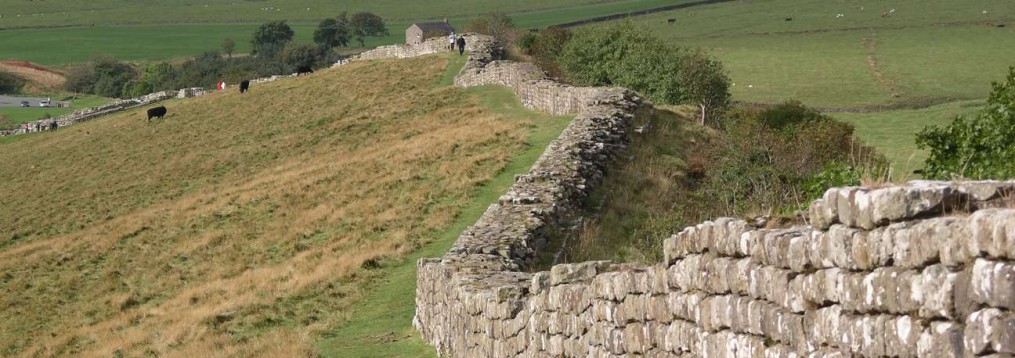
 Hopping Hadrian's Wall