A New Story

Sermon for Easter 3

Luke 24:13–35

Stories are how human beings make sense of the world. We do it all the time. We can’t help ourselves. It’s just how our brains are made.

From the earliest days of human history, children would sit around the campfire with their elders and ask, “Why are things the way they are?” And the elders would tell a story.

Across cultures and religions, one thing is always true: we tell stories.

And if I were to ask you who you are, you would tell me the story of your life.

Stories are how we make meaning.

Now, the most interesting stories are the ones where things don’t go according to plan. That’s where the good stuff happens.

Nobody wants to see a movie with no conflict. There’s no plot.

When that happens, we tend to fall into three kinds of stories:

The fix-it story,
The forget-about-it story,
And the figure-it-out story.

The fix-it story is the one we prefer. Something goes wrong, but we come up with a plan and get things back to the way they ought to be. And a lot of the time, that works.

But sometimes it doesn’t.

Sometimes there are situations we simply can’t fix, no matter how hard we try.

And that’s when we fall into the forget-about-it story.

When everything falls apart, we sit in the ashes and say, “Forget about it. What’s the point?”

But if we don’t give up entirely, if we keep going, we may begin to enter another story: the figure-it-out story.

This is the story that doesn’t fix the problem, but doesn’t give up hope either.

Out of the ashes of the old story, something new begins to take shape—a meaning we didn’t expect, a kind of good we never saw coming.

Not because the suffering was good, but because something real can still emerge within it.

I saw this often in my work as a hospice chaplain.

People would come to me after being told there was nothing more the doctors could do for them.

At first, many of them were living in that forget-about-it story—grieving the life they could no longer return to.

And my work was simply to walk with them.

I would ask about their lives, and I would listen.

And slowly, something would begin to shift.

As they told their stories, they began to see them differently.

They thought about the people they wanted to thank. The people they needed to forgive. The love that had shaped their lives.

And those final weeks or months often became deeply meaningful.

Not because anything was fixed, but because they were finally able to see what mattered.

That journey—from fix-it, through forget-about-it, to figure-it-out—is exactly where we find the two disciples in this morning’s Gospel.

They had hoped that Jesus “would be the one to redeem Israel.”

But things didn’t turn out that way.

Instead of victory, there was a cross.

And when Jesus died, it seemed like all their hopes died with him.

That was the end of their fix-it story.

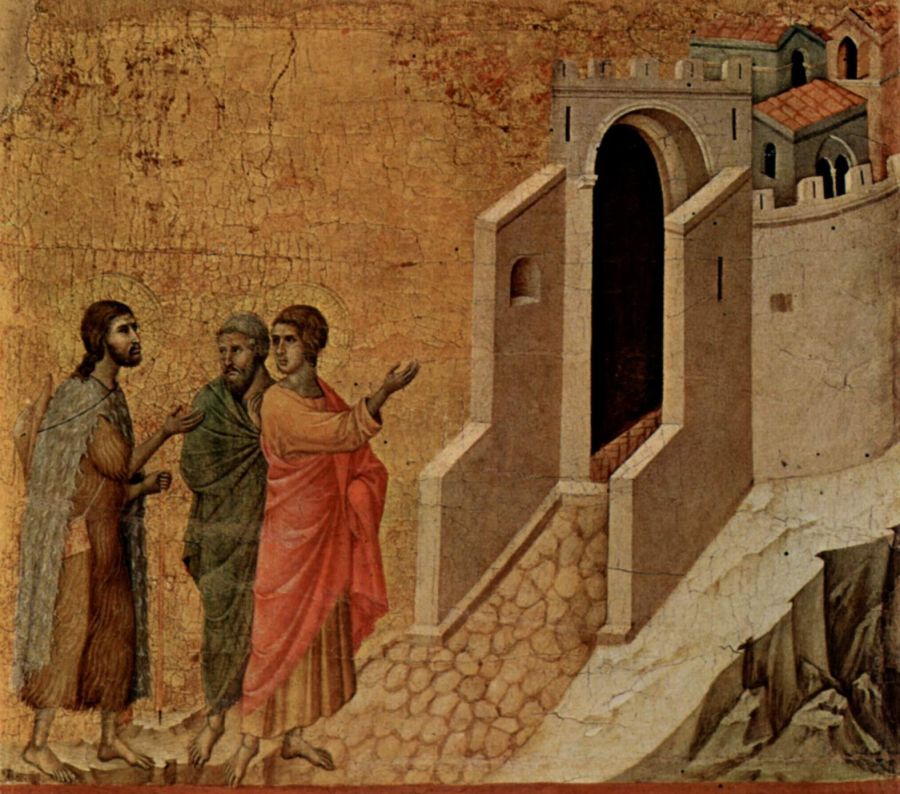
So when the stranger meets them on the road to Emmaus, they are living in the forget-about-it story.

“They stood still, looking sad.”

They say, “We had hoped that he would be the one to redeem Israel.”

And Jesus just listens.

And then he begins to reinterpret their story.

He shows them that suffering was not the end of the story, but somehow part of it.

And something begins to stir.

They say, “Were not our hearts burning within us while he was talking to us on the road?”

That’s the beginning of the figure-it-out story.

But it isn’t complete until they reach the table at the end of their journey.

There, Jesus takes bread, blesses it, breaks it, and gives it to them.

And suddenly, their eyes are opened.

They recognize him.

The story doesn’t go back to what it was, but reveals something deeper than they had ever imagined.

And then… just like that, he’s gone.

But Jesus is still there, in the blessed and broken bread.

And that’s when they run back to Jerusalem to tell the others.

Kindred in Christ, that same journey is the one we take every time we come here.

We come from weeks that did not go as planned, carrying burdens we cannot fix.

Sometimes we sit here wondering if any of this really matters.

And yet, here, our stories are reframed.

In the reading of Scripture.
In the prayers.
In the breaking of bread.

Sometimes, our hearts burn within us.

And sometimes, our eyes are opened.

We learn to see Christ here, in this bread and this wine, so that we can learn to see Christ everywhere else.

And we go back out into the world to tell the story:

That Christ is alive.
That he meets us in the middle of our stories.
And that somehow, even now, our stories are being drawn into the greater story of God.

And so, as we go back out into the world this week—a world where life rarely goes according to plan, and some problems are just too big to be fixed—when we are tempted to throw up our hands and say, “Forget about it,” I want to invite you to keep holding on.

Keep walking that road to Emmaus.
Keep listening to each other’s stories.
Keep trying to figure it out.

Trust that Christ is with you in the midst of the mess, working not to take things back to the way they were, but to bring forth a new story from the ashes of the old.

Go forth into this world, transformed by the power of Scripture and Sacrament.

And proclaim, not only with your lips but with your lives, the good news:

That the Lord is risen indeed. Alleluia.

Telling Stories

This week’s sermon from North Presbyterian, Kalamazoo.

Click here to read the biblical text

Sermon text

One of the funnest (and funniest) parts of Thanksgiving dinner is when family and friends start sharing stories around the table. They often start with something like, “Remember that time Uncle Harvey…”

In our family, my wife and I have one that we never get tired of telling the kids. It’s the classic story of “How I met your mother… twice.”

I first met Sarah at a student conference in western North Carolina in the summer of 1999. We had a nice chat on a group hike, established that we had a mutual friend, shook hands, and parted ways. Four years later, I was getting onto a bus in Vancouver, Canada, having just moved there to begin seminary. The woman across the row from me struck up a conversation. We had a nice chat, established a mutual friend, and… suddenly both of us had a major case of déjà vu.

As it turns out, she was the very same person I had talked to four years prior. When life gives you a second chance like that, you take it. We began dating less than a month later and married before the end of graduate school.

People love to tell family stories like this, especially during the holidays, because they help to give our lives a sense of meaning and purpose. In a world that often seems so random and out-of-control, these stories give us a hunch that there is some other Will working itself out through our existence. They remind us that we are not alone in this universe and that life itself is meaningful and good. We never get tired of telling or hearing them.

Of course, these stories don’t just exist in our families. They are a major reason why we come to church. The Bible itself, even though it is a collection of many different stories, tells one Big Story that continues to shape and change our lives today.

The biblical story is that the infinitely loving God of the universe created the world and called it Good. When we humans, in our selfishness, turned away from God and each other and fell into slavery to sin, God did not abandon us. After centuries of reaching out to us through prophets and sages, God took on flesh and came to dwell among us in the person Jesus Christ. When we refused to listen to Jesus and tried to silence him by the violence of crucifixion and death, God summarily rejected our rejection by raising Jesus from the grave. Now, we who are baptized into Christ share the healing power of his resurrection and function with the world as his Body, his hands and feet, on earth until he comes again in glory. On that day, the dead will rise and the whole creation will be made new, as God originally intended, and governed with divine justice and mercy.

This is the story we Christians tell ourselves each Sunday in church. We hear it in the Scriptures and see it in the Sacraments. We leave the liturgy each week, fed with the Body and Blood of Christ, and are sent out into the world to be the Body of Christ. It cannot be understated just how important that mission is in this world, where life often seems so empty and meaningless.

Jesus talks about this Christian story in today’s gospel reading. Like any good story, this one has a beginning, a middle, and an ending. Today, Jesus is talking to us about the ending.

He starts by undermining two thousand years of Christian speculation about the end of the world. Look in the Religion section of any bookstore, and you will find multiple books claiming to have figured out the scoop on when and how the end times will take place. But Jesus says in this passage, “But about that day and hour no one knows, neither the angels of heaven, nor the Son, but only the Father.”

St. John Chrysostom, a bishop in the early Church, agrees with Jesus on this. He wrote that human beings “should not seek to learn what angels do not know.” Jesus does not give his followers any “insider information” on the end of the world. What he asks of them is far more difficult.

What Jesus asks of Christians is that we “stay awake” and “be ready” for history to reach its conclusion. This is important. Life on this planet often feels chaotic, empty, and meaningless. To the eyes of a person without faith, it seems like a random series of events that are just happening. Without a sense of purpose in life, we are wont to slip into a mindless pursuit of pleasure and avoidance of fear.

In Jesus’ mind, this state of existence is not unlike the condition of the world immediately before the great flood of Noah. He says, “For as in those days before the flood they were eating and drinking, marrying and giving in marriage, until the day Noah entered the ark, and they knew nothing until the flood came and swept them all away, so too will be the coming of the Son of Man.”

Another way of saying this is that it was “business as usual” for everyone until the moment when the rain began to fall. They were so caught up in their little plans and schemes, they didn’t realize that God’s great story was in the process of unfolding all around them. When the moment of truth came, they were not ready.

Jesus reminds us that the world does not revolve around us. The universe will not stop its ordinary operation to accommodate our plans, however great we think they may be.

The good news is that God has an even greater plan, and we are invited to play a part in it. Jesus invites us today to reorient our lives around God’s vision for the world. God’s dream is to renew the face of the earth so that it reflects the harmonious beauty that God intended for it to have at the beginning. God dreams of a world where the hungry are fed, the sick are healed, strangers are welcome, and sinners are forgiven. Jesus often referred to God’s dream as “the kingdom of heaven”. It is the one thing around which he oriented his entire life and ministry.

The work of the kingdom of heaven has been going on since the dawn of time. It began in earnest with the incarnation, life, death, and resurrection of Jesus Christ. It continues today through Christ’s Body on earth, the Church, and will draw to a conclusion at some unknown point in the future. It is God’s dream and Jesus is inviting us to be a part of it. We come to church each week and tell each other these stories in order to be reminded that this universe is no accident, and our lives are no random series of events.

This week, we begin the liturgical season of Advent, as we prepare to celebrate that beloved moment in God’s story when Jesus Christ, the Word of God, “took on flesh and dwelled among us.” But it is also a time when we look forward to Christ’s second coming at the conclusion of history. It is a time when we are invited to reorient our lives around the divine vision of a renewed creation, the vision for which Jesus lived, died, and lives again in us.

In this coming holiday season, let us not get caught up in our cultural patterns of materialism and greed. Let us also avoid the backward-looking nostalgia for the “good old days” of Christmases past. Let us instead look within and around us for the work that Christ is giving us to do in this world today. Finally, let us look forward to the day when God’s story finishes with a happy ending and all of creation joins in the song of unending praise to its Creator, Redeemer, and Sanctifier.

Let us pray.

“O Come, Desire of Nations, bind all peoples in one heart and mind; bid envy, strife, and discord cease; fill the whole world with heaven’s peace.” Amen.