
Sermon for the fifth Sunday of Easter
Click here to read the biblical texts.
Breakdowns lead to breakthroughs.
That is a tenet of faith in which I wholeheartedly believe. I believe it because I have lived through it on multiple occasions.
One such occasion occurred when I was about thirty years old and still serving as a pastor in my previous denomination. A local news station in upstate New York, where I lived at the time, wanted to interview me on their morning show because they had heard that I was a clergyman who supported equal marriage rights for couples of the same gender. I gladly did the interview and went home.
Later that night, the hate comments started to appear on the internet. All kinds of people were calling me a “heretic” and a “false prophet.” Some said I should be stripped of my ministry credentials. A rescue mission, where I had been a regular guest preacher for years, called to inform me that I had been banned from speaking in their chapel ever again.
I realized in that moment, as I was hearing so many angry voices shout Bible verses at me, that my understanding of the Bible had shifted dramatically from the perspective I had been raised with. I had come to appreciate the Bible as a collection of voices, reporting on their spiritual experiences, and pointing our way to God, but I no longer “believed in the Bible” as the absolute and infallible authority on historical and doctrinal matters. The people lobbing these hateful comments in my direction believed the Bible to be something fundamentally different from what I believe it to be. Therefore, I could no longer consider myself to be a member of their ideological tribe.
This realization threw me into a mental tailspin. If I no longer believed the Bible to be the literal “word of God,” then what did I believe? Could I still call myself a Christian? Did I even believe in God? Was my faith dying because I had sold out to secular fads, instead of clinging to spiritual truths? These were questions that kept me up at night.
Thankfully, I had a wise spiritual director who guided me through my crisis of faith by listening without judgment and recommending good books like The Dark Night of the Soul by St. John of the Cross. Through my director’s companionship, I came to realize that my faith was not dying, but evolving. I was eventually able to say, “Yes, I am still a Christian, and yes, I believe in God,” even though I now understand both of those things in very different ways than I had before.
That was one of my many breakdowns that later led to a breakthrough. Your personal breakdown might be similar, but then again, it might be very different. I think particularly of my many friends in recovery from addiction who had to “hit rock bottom” before they finally got sober. I think of those who have lost jobs, relationships, or health, through no fault of their own, but simply because life doesn’t always turn out as planned.
In moments like these, it’s very normal and understandable for struggling people to look at life and see only the chaos of disaster and tragedy. Even if the chaos isn’t impacting you personally, it’s easy to simply watch the evening news and wonder, “What is this world coming to?”
I think that’s a great question to ask, so long as we don’t presume the answer before we’ve even finished asking the question: “What is this world coming to?”
Scientists have the beginning of an answer to that question. Many of them have noticed that the universe, over the course of its 13.8 billion year history, seems to be moving in the direction of increased complexity and cooperation. In the beginning, there was only physics. Immediately after the Big Bang, there were lots of elementary particles, which later formed into atoms. Atoms bonded together to form molecules, giving rise to the science of chemistry. On this planet (at least), chemical reactions gave rise to the emergence of biological life in the form of single-celled organisms. Life then evolved to the point of more complex organisms, that had brains. Brains evolved to the point of developing consciousness. Human consciousness developed to the point of organizing itself into small groups. Those small groups organized themselves into large, complex societies with laws, technology, medicine, and artistic expression.
It is, of course, undeniable that the course of history has often been meandering, with many fits, false starts, and backsliding along the way, but if we take a step back to look at the big picture of the universe, we can see objects and organisms organizing themselves into increasingly complex patterns of cooperation. Cosmologist Brian Swimme says, “Four billion years ago, the earth was molten rock; now it sings opera.”
Scientists, by virtue of their profession, do not claim to know for certain whether this evolution of complexity, from atoms to opera, is the result of random chance or intentional design. Their job is just to describe what they see, but humans can’t seem to stop themselves from asking the question. Our brains are neurologically hardwired to search for patterns of cause and effect. When that search for a cause takes us past the limits of pure reason, we naturally begin to engage our imaginations and speak the language of the heart.
About a hundred years ago, there was a paleontologist named Pierre Teilhard de Chardin, who studied the evolution of life in great detail. It just so happens that Teilhard was also a Jesuit priest. He undertook his own search for truth with the head of scientist and the heart of a mystic.
When science could not answer Teilhard’s burning questions about life’s origin and destiny, he found himself meditating on Revelation 21:6, which we heard this morning in our second reading, “I am the Alpha and the Omega, the beginning and the end.”
It seemed clear to Teilhard that “Alpha,” the first letter in the Greek alphabet, was meant to refer to God as the creator of the cosmos. But what did the text mean by saying that God is also the “Omega,” which is the last letter in the Greek alphabet?
Meditating on this question through the lens of his Catholic faith, Teilhard came to believe that, just as the universal Church comprised members from “every tribe, language, people and nation,” so the entire universe itself was being drawn toward eventual unity in the cosmic Body of Christ.
We naturally ask the question in chaotic times, “What is this world coming to?” For Teilhard, with his scientific mind and mystical heart, the answer was, “Christ.” The Church, in his mind, is only the beginning of the unity that will eventually incorporate the entirety of human society, planet Earth, and even the cosmos itself. This, for Teilhard, is what it means to believe that God is both “the Alpha and the Omega, the beginning and the end.”
For us, as people of faith and people of science, it is no small task to trust that the universe is headed in this direction. As we have already noted, there are setbacks and disasters that threaten to overwhelm us with chaos. Moreover, the entire project is so huge that we cannot possibly complete it under our own power.
Today’s reading from the Revelation to St. John paints a picture of the end of history as a beautiful garden city where all things are made new and death is forever swallowed up by life. Our psalm this morning develops that idea even further, envisioning a symphony of praise that incorporates, not only all people, but plants, animals, and cosmic forces as well.
Do we dare to believe in this utopian vision? If so, then how on earth do we get there?
Obviously, the task is too big for us to complete ourselves. We human beings cannot do much to affect the progress of distant stars and galaxies. After all, we even feel helpless to resolve the problems that beset us on this “tiny blue dot” called planet Earth.
So, what can we do and how do we do it? There’s more than one answer to that question, but I think Jesus starts us down the right path when he says in today’s gospel, “Just as I have loved you, you also ought to love one another” (John 13:34).
Obviously, this is a very general statement, even vague, if we leave it undeveloped at the level of pious words and sentimental feelings. But love, as those know who have tried to do it, is always simple but never easy. Love only exists at the level of concrete action. As finite beings, we cannot adequately love the entire universe, but we can make a difference at the local level in the way we treat ourselves, one another, and our fellow creatures on earth. Through our acts of love toward one another, our love for the universe and God takes on flesh and becomes a concrete reality. In short, we love God through our neighbors.
This is the secret to transforming breakdowns into breakthroughs that inch the universe closer to its final destiny of unification in the Body of Christ, as Teilhard understood it.
This love asks much of us. It continually takes us outside of our comfort zones and challenges our previously-held assumptions. We can see the early Christians doing just this in today’s first reading, taken from the Acts of the Apostles. In this passage of Scripture, St. Peter is being called on the carpet by his fellow leaders in the early Church. Up to that point, Christianity had been an entirely Jewish movement. But now, a group of Romans, led by Cornelius the Centurion, had become interested in following the way of Jesus and even began to have mystical visions and other kinds of spiritual experiences. St. Peter saw this happening and decided to go ahead and baptize these non-Jews into the Church, even though that had not first converted to Judaism. It was a controversial decision on St. Peter’s part that almost split the church. After much discussion and debate, the Church decided to extend the boundaries of love to include all people, no matter what their culture or ethnicity of origin. I imagine the council’s eyes going wide with wonder after they heard Peter’s story and said, “Then God has given even to the Gentiles the repentance that leads to life” (Acts 11:18). They had realized, in a flash of spiritual insight, that God’s arms are big enough to embrace the whole world.
Kindred in Christ, we live in a world that often seems to be on the brink of tearing itself apart. I don’t want to minimize the pain that comes with the question, “What is this world coming to?” But I do want to encourage you with the faith that trusts that this universe is indeed going somewhere good. In the language of science, it is proceeding toward patterns of ever-increasing complexity and cooperation. In the language of our faith, the whole creation is being drawn to unity in the cosmic Body of Christ. We cannot get there on our own, but each of us can do our part to love one another as Jesus loves us, and so build up a new world from the ashes of the old.
Amen.

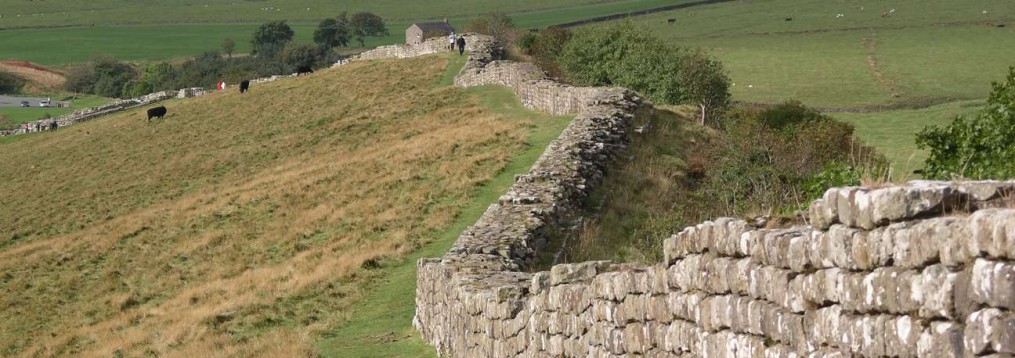
 Hopping Hadrian's Wall