
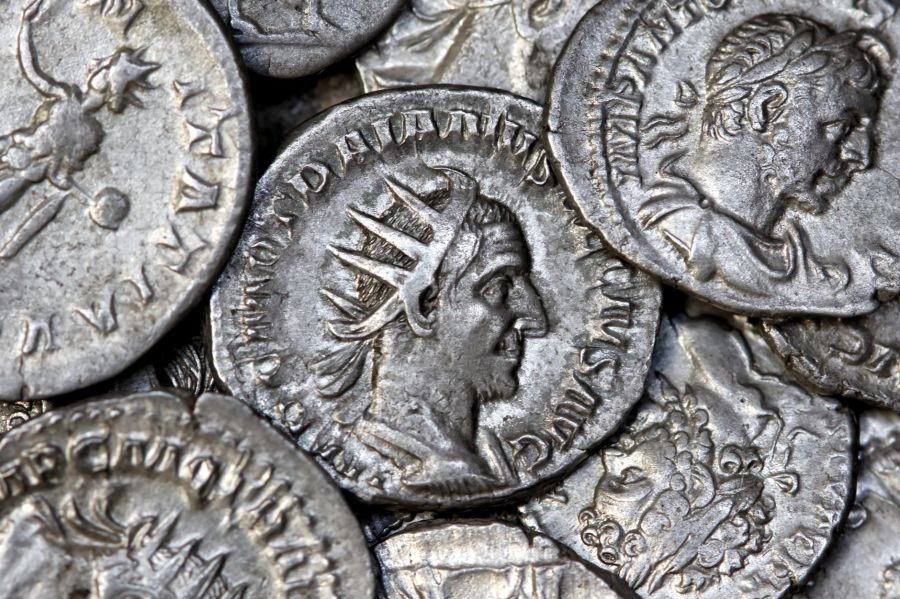
Radical Amazement

Sermon for Proper 24, Year A

Matthew 22:15-22

“Render unto Caesar those things that are Caesar’s, and to God those things that are God’s.”

Familiar words. They are frequently cited as a reference to the separation of church and state. There’s only one slight problem with that: Separation of church and state are not what Jesus was talking about.

In Jesus’ time, there was no separation of religion and politics, where Caesar had the political sphere, God had the religious sphere, and they both staid in their respective lanes. Religion was a political affair, as we can see in the complicated relationships that happened with the religious leaders, living under occupation by the Roman Empire. Also, politics was religious, especially insofar as Caesar himself claimed to be “the Son of God.”

The concept of separation of church and state is a modern one and a good one. I wholeheartedly support it, because it protects the church from the state and the state from the church, but it’s not what this passage is about.

We default to old habits, like associating this passage with the separation of church and state, because it’s easier to let challenging questions can become comfortable answers. And that’s pretty similar to what is actually happening in today’s Gospel.

Richard Rohr is a spiritual writer who said, “Religion is, ironically, often the safest place to hide from God.”

It seems counterintuitive. We ask, “Isn’t religion how I connect with God? I come to church, receive the sacraments, read the Bible to hear from God, and pray for guidance from God.”

But sometimes, speaking only for myself, I read the Bible, not to learn and grow, but to prove that I’m right.
And sometimes I pray, not because I’m looking for guidance, but because I’m looking for permission.
Sometimes I listen to someone I disagree with, not to understand that person’s perspective, but so I can make up my next argument in advance.
And sometimes I ask questions, not to explore the truth more deeply, but to set a trap for someone else. That’s exactly what the Pharisees and Herodians were doing to Jesus in today’s Gospel.

The trap starts with flattery. They say, “Teacher, we know that you are sincere, that you teach the Word of God in truth, and you show deference to no one. So tell us, is it lawful to pay taxes to the emperor or not?”

This was a question to which there was no good answer. If Jesus had said, “no, don’t pay taxes to the emperor,” then they could say, “Aha, we’ve got you! You are causing sedition and treason. You are trying to rise up against Rome, so we can get Pontius Pilate to come and kill you.”

But if he had said, “Yes,” then they could say to their Jewish neighbors, “See? He’s not really one of us!”

If Jesus had said Yes or No, it would have been a bad answer, but Jesus is a pretty smart guy. He sees what they’re doing and calls out their hypocrisy.

Hypocrisy, in this case has a very specific definition. It’s not just somebody who fails to live up to their ideals. Because that applies to every single one of us in this room.

In this case, the Pharisees and Herodians are hypocrites because they are telling the truth in the service of a lie. They are not interested in seeking truth; they’re interested in what they think the truth can do for them. They’re using the truth. That’s the hypocrisy that Jesus is calling out in today’s gospel.

He says, “Okay, I’ll play. Show me the coin used for the tax.”

So they bring him the coin. He holds it up and says, “Whose image is this?”

And they say, “It’s Caesar’s image.”

That’s the moment when Jesus reversed the trap on them. Caesar’s face was on the coin, but Caesar himself, as a human being, was made in God’s image. So, whose image was really on that coin? God’s. That’s how Jesus exposed their hypocrisy.

Jesus demonstrated how the religious authorities were failing to recognize the image of God. So, when He says, “Render unto to Caesar what is Caesar’s,” He is really saying, “Let Caesar have this silly little coin if he wants it, but give to God what is God’s.”

What belongs to God?
You. Me. Everything. The universe.

That’s how Jesus avoids their trap and exposes their hypocrisy for what it is. The coin may bear Caesar’s image, but Caesar himself, along with you, me, and everyone else, bear God’s image. Jesus exposed the hypocrisy of the religious authorities, but the good news is that he keeps engaging with them.

He keeps posing these uncomfortable questions in order to get them to look below the surface fights over religion and politics. He says, “I want you to see the presence of God in all of this.” That is true spiritual insight.

When we look at the world through those eyes, we discover that we don’t have to craft a fancy image for ourselves. Because we already bear the image of God. We don’t have to earn it, and we can’t lose it. No matter how good or how bad we are, as persons, the Imago Dei is simply there.

And so Jesus, yes, does expose their hypocrisy, but the good news is that exposure does not lead to rejection, but healing.

I experienced a little bit of that this week while I was preparing this sermon.

I started reading and praying through the text, like I usually do, and I was thinking about all the people I don’t like. I thought, “They’re all hypocrites with ulterior motives!” I was going to come up with all kinds of witty examples to prove their hypocrisy.

But then I started looking a little deeper. I stopped looking at their motives and started looking at my own. I was crafting a sermon that was all about pointing the finger at “those hypocrites over there,” so I was falling into the same trap that the Pharisees and Herodians fell into.

Sometimes, when I’m reading an article, I check to see whether the author is part of my ideological “club.”

Sometimes, I assume the negative intentions of another person before I’ve really heard them out.
Sometimes, like the Pharisees and Herodians in this passage, I might technically tell the truth about something, but do it in a misleading way. It might be true to the letter of the truth, but not to the spirit of the truth.
I came to this passage, looking to point my finger at people I don’t like, but I ended up pointing at myself. That was painful, but it was also healing.

Because, even in that mistake that I was making, I was still loved. I am still made in the image of God.
All the people I love are still made in the image of God.
All the people I don’t like are still made in the image of God.
And that’s true, whether I want to admit it or not.

But if I can embrace that truth, I can grow, even though that growth is sometimes painful.

What it requires is that I have the humility to admit when I’m wrong and the courage to see the image of God in someone with whom I disagree.

When Jesus presented these questions and exposed the hypocrisy of the Pharisees, the text tells us that they were “amazed.”

Amazement is amazing. Rabbi Abraham Joshua Heschel said, “To be spiritual is to be amazed.”

For a brief moment, Jesus’ question opened up their horizons, giving them an opportunity to look deeper, to see the true meaning of who they are, and experience the true meaning of their lives in this world.

The tragedy is that they were not willing to stay that amazement.
The text says, “When they heard this, they were amazed; they left him and went away.”
That’s a tragedy for them and a warning for us.

We occasionally will have moments where tough questions are able to open our minds and hearts. If we can stay in that moment of radical amazement, letting the questions break us open, then the possibility of transformation begins.

We have an opportunity to see the presence and image of God in ourselves and in everyone around us: The inherent beloved-ness, “the dignity of every human being,” as we say in our Baptismal Covenant.

What this opportunity requires of us is that we stay in the difficult questions long enough to be amazed, and stay in the amazement long enough to be changed.

As you go out into this week, I encourage you to be open to the challenging questions that come your way. Be open to radical amazement at the most ordinary things. Let that amazement change you from the inside out, so that you can know yourself, and everyone else, to be utterly unique reflections of the image of God.

Not Even One Stone

I delivered this sermon this morning just after announcing to the congregation our session’s decision to leave our building and move our church’s ministry to a new physical location after almost a century at the corner of Burdick & Ransom. I don’t think it was a coincidence that today’s gospel reading in the lectionary is the story of Jesus predicting the destruction of the Jerusalem temple. Some weeks, the Holy Spirit makes more work for me…

The text is Mark 13:1-8.

If you knew that you only had a week, month, or year to live, how would you choose to spend that time? What do you want your life to stand for? When other people look back at your life, what would you want them to remember about you? These are the questions that a wise person asks in the face of mortality.

The truly wise among us realize that life cannot last forever, therefore the truly wise among us also realize that each life must be lived for something larger than itself. Every mortal life, it seems, is a means to an end.

Each of us has probably known, met, or heard about at least one person who made his or her mortal life meaningful by dedicating it to something larger than himself or herself. We tend to respect or admire such people when we meet them. Their examples might even inspire us to look more deeply at our own lives, face our mortality in new ways, and discover meaningful possibilities within us that we hadn’t noticed before. It’s a beautiful thing when that happens.

As it is with individuals, so it is with groups of people. These groups might last much longer than we do, but they too will one day fade from existence. Families are mortal. Surnames and lineages come to an end through a lack of offspring. Churches and other faith communities are mortal. There comes a point when dwindling membership and a lack of funds causes an institution to close its doors. Nations are mortal. The Roman Empire was once the dominant superpower in the world, unlike anything else that had come before it. Where is the great Roman Empire today? Buried under the rubble of history and preserved in ruins frequented by tourists in Bermuda shorts. Finally, even the planets and stars are mortal. One day, our very own sun will burn up all of its hydrogen fuel and explode into a violent supernova, momentarily becoming the brightest star in some distant sky.

If coming to grips with our own individual mortality is difficult, accepting the mortality of families, churches, species, and stars feels almost impossible. Yet, the same truth applies to these larger mortal beings that first applied to mortal human beings: it is in facing mortality that we find meaning.

Let’s look at this idea in relation to this morning’s reading from Mark’s gospel. The story opens as Jesus and his disciples are leaving the great Jerusalem temple, the epicenter of Jewish worship in the first century CE. Jesus, as usual, is storming out in a huff after yet another fight with the established religious authorities.

It’s at this point that Jesus’ disciples, in their usual tactless and somewhat dimwitted manner, decide to stop and admire the lovely architecture of this religious icon and national monument of Judaism. They say of the temple, “Teacher, look! What awesome stones and buildings!”

Jesus is unimpressed. He says, “Do you see these enormous buildings? Not even one stone will be left upon another. All will be demolished.”

He’s talking about mortality of the temple: this central symbol of religious and national identity for the Jewish people. They were under the impression that this sacred building would stand forever under divine protection. For them, the temple was immortal. It was an end in itself as a center of worship. The idea had never occurred to them that it might not be there one day.

As it turns out, Jesus’ prediction was spot-on. The Jerusalem temple, like any human being, was mortal. It was eventually burned to the ground by the Romans during an uprising in the year 70 CE. It was never rebuilt. The site where it once stood is now occupied by the Dome of the Rock, one of the most sacred places in Islamic religion.

The destruction of the temple was unthinkable to the average Jew, but to Jesus it was inevitable. The wisdom of Jesus did not stop with an awareness of his own individual mortality, but extended to embrace the mortal and finite nature of all things. Just as it was for individuals, so it is for temples, religions, countries, species, planets, and stars: to face mortality is to find meaning.

If our great struggle in life is limited to ensuring the continued existence of particular people, places, institutions, or things, then we have already doomed ourselves to failure. Nothing lasts forever. We need to accept that. What Jesus said about the Jerusalem temple, we could say about anything: “Do you see these enormous buildings? Not even one stone will be left upon another. All will be demolished.” All things are mortal.

The sooner we realize this truth, the sooner we can get on with the business of asking the really important questions about existence in reality. Concerning our individual selves, we can ask: “What am I living for? What will people remember about me when I’m gone? What will be my lasting contribution to the world around me or the universe as a whole? What is the meaning of my life?”

The day will come when we, along with our families, our church, and our country, will only exist as a chapter in a history book. Accepting the inevitability of this fact, we need to ask ourselves: “When that day comes, what will we want that chapter say?”

As a congregation, we’ve been asking ourselves some very hard questions this year. We’ve been participating together in the New Beginnings assessment and discernment process. Throughout this process, the biggest and most pressing question we’ve had to ask ourselves is: “What is the church?”

Is the church a building? Is it an institution?

Or is it a community of people on a mission? A community of people, called together by Jesus Christ, living together in Christ, and following Christ into the world to live that mission?

Our final answer has been that third option: the church is a community of people on a mission.

Because we believe this, we have been able to make a bold new decision this week. We have decided to leave the building where we have worshiped for almost a century in order to continue the ministry of our church in a new location. The session, the presbytery, and I are currently working together on the details, and we will call a congregational meeting in a few weeks to let you know what the plan is.

This new move is not a death, but a resurrection.

We are not doing this because the church is dying; we are doing this because Jesus is alive.

We are honoring the heritage of the ministry that has been passed down to us, not by preserving it, but by continuing it.

We are doing this because:

“The Spirit of the Lord is upon [us],
because the Lord has anointed [us].
He has sent [us] to preach good news to the poor,
to proclaim release to the prisoners
and recovery of sight to the blind,
to liberate the oppressed,
and to proclaim the year of the Lord’s favor.”

We are doing this because Jesus said:

“I’ve received all authority in heaven and on earth. Therefore, go and make disciples of all nations, baptizing them in the name of the Father and of the Son and of the Holy Spirit, teaching them to obey everything that I’ve commanded you. Look, I myself will be with you every day until the end of this present age.”

Our ancestors in the faith (and in this church) believed this, I believe it, and the session believes it. Brothers and sisters, do you believe it?

Let’s go follow Jesus.

The Old Rugged Cross: Rene Girard and the Resurrection of Substitutionary Atonement

Image
St. Martin’s Cross, Iona Abbey. Image by Colin Smith. Retrieved from Wikimedia Commons.


Friends and commentators from all over the theological spectrum have mentioned that I don’t seem to have given susbstitutionary atonement theory its due in my post from earlier this week, The Wrath of God and the Presbyterian Hymnal.

In that post, I leaned heavily on presenting substitutionary atonement as “cosmic child abuse” (an excellent turn of phrase I’m borrowing from Sarah Sanderson-Doughty).  I wrote:

…penal substitution sets up a scenario where Jesus saves humanity from the rage (not the wrath) of an out-of-control, abusive parent.  When all is said and done, the church gathers around a crucifix and hears, “This is your fault.  Look at what you made God do.  You are so bad and dirty that God had to torture and kill this beautiful, innocent person so that he wouldn’t do the same thing to you.  Therefore, you’d better shape up and be thankful or else God will change his mind and torture you for all eternity.  And don’t forget: this is Good News and God loves you.”  If any human parent did that, he or she would be rightly incarcerated, even if the innocent victim was willing.  If that’s what Christianity is, then you can count me out.

Sadly, this (admittedly extreme) depiction accurately portrays substitutionary atonement as it was presented to me by fundamentalist pastors and teachers I encountered in high school and college. 

However, I realize that thoughtful evangelicals and catholics will cringe at my presentation, since they accept the theory, but not in its “cosmic child abuse” form.  For them, it represents the epitome of love and sacrifice.  I remember seeing an art project made by a teenager that showed one person pushing another out of the path of an oncoming car with John 15:13 written across the top: “Greater love hath no man (sic) than this, that a man lay down his life for his friends.”  For them, substitutionary atonement is precisely the opposite of child abuse: it is the ultimate standard of loving sacrifice, established by Jesus himself, to which every parent, spouse, and friend should aspire.

I understand and respect this angle, but I suspect that many of these more informed and compassionate evangelicals and catholics may not realize what is being propagated in their name.  The heresy of “cosmic child abuse” is alive and well in traditional, orthodox congregations and parishes the world over.  Curious outsiders and wounded insiders are being exposed to violent, hateful theology and end up rejecting Christianity at large based on this misrepresentation.  That’s why I think it is incumbent upon liberals, evangelicals, and catholics alike to think well about what their atonement theology does mean to them and then speak up (loud and often) to counterbalance the voices of violence and hate that dominate public media in Jesus’ name.

With that in mind, I thought I might revisit the subject of substitutionary atonement today and present what I think are some of the more positive contributions it might make to the Christian theological project, writ large.  Sections of this article have been lifted and adapted from my reply to a comment on the previous post.

Many of the New Testament passages dealing with substitutionary atonement center around interpreting the significance of Jesus’ crucifixion through the lens of sacrificial worship in Second Temple Judaism. The use of such a schema made total sense as an apologetic strategy in that time and place (much like Anselm’s strategy made sense in feudal Britain).

Jesus, of course, is presented as the priest and the sacrifice that supersede the Temple cult. The temple authorities claimed exclusive access to God through their rituals and institution. The early Christians, on the other hand, used this priest/sacrifice imagery to legitimate their own Christocentric practice while demonstrating its continuity with traditional Judaism. The language of temple, priest, and sacrifice would have helped the gospel make sense to a first century Jewish mind. Obviously, the strategy worked: Christians and Pharisees were the only forms of Judaism to survive the destruction of the Second Temple in 70 CE. This interpretive schema gave Christians the framework they needed to survive without a standing Temple.

The Pharisees, for their part, had the Torah, the synagogue, and the family home as centers for their faith-practice. They went on to complete the Talmuds and form the basis for modern rabbinic Judaism as we know it today. The Sadducees, Essenes, and Zealots all pretty much died out as movements by the end of the second century.

Substitutionary atonement, understood within the cultural context of Second Temple Judaism, makes total sense as a first century apologetic strategy. It’s actually rather brilliant and obviously effective, given the lasting impact it’s had on the development of Christian atonement theory. The scholastic Anselm further developed the idea susbstitutionary atonement in the 11th century as part of his own brilliant and timely apologetic effort.

My only problem with it is when it is used as the primary or only legitimate atonement theory in our day. Such a narrow focus ignores the multiple other models for salvation presented by scripture and tradition. I fear that a one-sided emphasis on individual guilt and forgiveness through substitutionary atonement is unnecessarily handcuffing our evangelistic efforts by ignoring the many ways in which the gospel might be interpreted, preached, understood, and received by people today.

In addition to priest and purifying sacrifice, Christ can also be embraced as a physician for the sick, a liberator for the oppressed, a light in the darkness, food and drink for hungry souls, or a friend for the lonely. My hope is that Christians today might let these many images take root in our imaginations so that we might be inspired to become more faithful and effective witnesses of Christ in word and deed.

Rene Girard is one writer whose work presents, in my opinion, some rich possibilities for understanding the crucifixion of Jesus as a substitutionary sacrifice.  A Roman Catholic scholar of mythology, Girard identifies patterns of mimetic violence at work in the development of religions and societies.

From birth, human beings are presented with models that we are meant to imitate.  This happens on a primal level with one’s parents and siblings.  As societies grow, our caches of models will grow as well.  Post-industrial consumer capitalism in the Information Age presents us with a greater supply of models than any other culture in the history of the planet.

As imitators of models, we compete with one another.  Over time, our competition grows fierce.  The “war of all against all” (thank you, Hobbes) threatens to unravel the fabric of society and return us to primal chaos.

At this point, according to Girard, a scapegoat is chosen: someone at whom the rest of society can redirect the energy of their internal conflict and self-hatred.  The scapegoat is made to bear the blame for this conflict and is summarily sacrificed.

In the wake of the sacrifice, the mimetic conflict is temporarily relieved and the community enjoys a period of relative peace and stability.  Previously blamed for the violence, the scapegoat is now credited as the source of the temporary peace and is deified as a god.  Girard’s theory is that this is how the deities of classical mythology received their identities.  The cycle of violence then resets and repeats itself.

Applying his theory of mimetic violence to his own Roman Catholic theology, Girard presents Jesus as the willing scapegoat.  Jesus deliberately enters into the cycle of mimetic violence with the intention of stopping it.  He is aware of what is involved in that process and embraces the role of scapegoat.

According to this reading of the atonement, Jesus is still “sacrificed for our sins” but the wrath he is appeasing is not the wrath of God, but the rage of sinful, selfish humans.  He substitutes himself in the place of all other scapegoats who endure the unjust violence of society.

In the resurrection, God intervenes to vindicate the scapegoat, unmasking and disarming the patterns of mimetic violence.  Christians, as followers of Jesus the willing and vindicated scapegoat, are called to side with all future scapegoats and end the cycles of violence and exclusion, even if it means being crucified ourselves.

Rene Girard’s theory presents us with a way of unserstanding susbtitutionary atonement that can redeem it as a viable apologetic strategy in this consumer capitalist society, just as Anselm of Canterbury and the New Testament authors used it in their respective eras.

In this Girardian sense, I am able to reclaim substitutionary atonement and “cling to the old rugged cross”.  I see in Christ’s crucifixion and resurrection the end of all hate and violence.  I look forward to a time when all humanity will “exchange [the old rugged cross] one day for a crown” as cycles of mimetic violence come to an end.

Not Just Another Pretty Picture

Much like the underwater Jesus picture I posted yesterday, this is just another lovely image that I found somewhere online.  I don’t remember where, which means it was probably Facebook.

What you see behind the church is what I like to call “the best view in the galaxy”.  You’re looking out across the galactic core of the milky way.  This is our neighborhood.  It is the slightly larger speck of dust within which the speck of dust that the speck of dust that we specks of dust inhabit revolves around rests.

I’ll leave you to unpack that sentence at your leisure.

I also really like the church in the foreground.  Something about it resonates with where I am in relation to my own spirituality right now.  About a year ago, I made a conscious decision to start verbalizing a shift that had been slowly happening for almost a decade.  The traditional metaphysics of orthodox evangelicalism have ceased functioning as part of my internal theological process.

These days, I consider myself a “recovering evangelical”.  Not because all evangelicalism is evil, but because I can’t handle it responsibly.  I know of many evangelicals who manage to live intelligent, compassionate, and healthy lives within that tradition.  For whatever reason, I could not.

In it’s place, I’ve adopted the label “liberal Christian”.  Some might also justifiably call me a “progressive Christian”, but I prefer the “liberal”.  I’ve written about that choice of words elsewhere on this blog.  I love my church, as well as the Bible, and the symbols & rituals of Christianity.  Jesus continues to be a ubiquitous and central presence in my life, although I’m still figuring out how to articulate exactly what that means to me.

What I like about the above picture is its composition.  The church sits in the foreground but off to the side.  The big picture is the galaxy itself, of which the church is a part.  In the same way, the Christian tradition continues to be a part of my big picture.  It’s a big part, a dominant part, and the part in which I live, but it’s still just a part.

I’ve recently come to accept a series of possibilities that would have scared the hell out of me only a few years ago: There may come a day when Christianity ceases to be a living religion on this planet, a day when the human species goes extinct, a day when this planet is no longer capable of supporting organic life, and yet another day when the sun itself goes dark.

Jesus once told his disciples, “You see all these, do you not? Truly I tell you, not one stone will be left here upon another; all will be thrown down.”  He was speaking of the great Jewish temple in Jerusalem.  His disciples thought that the temple and the nation of Israel were eternal institutions that would outlive history itself.  God would never allow these things to be destroyed.  Alas, the disciples were wrong.  I can hear Jesus uttering these same words in relation to my congregation, my denomination, my country, my religion, my planet, my solar system, and my galaxy, ad infinitum.

“You see all these, do you not? Truly I tell you, not one stone will be left here upon another; all will be thrown down.”

Some parts last longer than others, but everything is is only a part of everything, and it’s all mortal.  This wisdom of Jesus empowered his followers with the faith they needed to survive the razing of their ancestral home.  They were ready for the Diaspora because they believed that, come what may, God would never be thrown down.

These days, I’m settling into a deeper trust that, even though my best ideas about God (including the word itself) will one day pass out of existence, the reality to which that word refers never will.

WWJD?

For those who are uninformed about what Occupy Wall Street is all about, read this article first:

http://www.foxnews.com/opinion/2011/10/14/understanding-occupy-wall-street/

Taken from a Facebook discussion, here’s why I think this joke is relevant:

Let’s look at the setting: The Temple. It’s a fair bet to say that it was in the outer court of the Temple, most likely in the Court of the Gentiles, which is the only section …of the Temple where non-Jews were allowed to worship (it reminds me of the balcony in my wife’s church, where slaves were segregated out and forced to sit apart from the rest of the congregation back in the day). The money-changers came in and set up their business in that section, forcing people to exchange foreign coin for Temple shekel (because the former had images of ‘foreign gods’ on them) in order to buy animals for sacrifice. I should add that this was done for profit.

It’s no accident that Jesus quotes Isaiah 56:7 on his way in: “My house shall be called a house of prayer for all people”. This comes from a larger section of Isaiah where the prophet describes how non-Jews will be welcomed as part of God’s people. God’s wants to be known as the one who “gathers the outcasts”. Going back to Isaiah 2:1-5, God’s ultimate goal is to make Jerusalem into a multi-cultural center for education in agriculture, nonviolence, and spiritual enlightenment.

Jesus knew all of this and was angry that the powers-that-be had taken the one small place that non-Jews had in the Temple (the one place that could fulfill the divine vision), and had taken it away from them in order to keep their profit-making machinery going. Jesus intended to give it back.

So, without the approval of the authorities, he set up an unlawful occupation of the Temple courts. Every day for that last week of his life, Jesus and his followers gathered in that section to teach and learn. He was fulfilling Isaiah’s vision to make Jerusalem a multi-cultural center for education in agriculture, nonviolence, and spiritual enlightenment. The powers-that-be questioned his authority and tried to shut it down, but were unsuccessful. In the end, the text tells us that this was the point where they started the conspiracy to have Jesus killed. He was too much of a threat to their power.

Occupy Wall Street isn’t a perfect reflection of this action. I’m not arguing that it’s particularly Christian in nature. However, it’s appropriate to note the similarities between the two: A powerful populist movement of marginalized people (i.e. “freaks and geeks”) sets up an illegal occupation of a symbolic power-center in protest against profiteering schemes that rob people of their God-given rights.

To the extent that this works, the authorities lash back with violence and death (hence the crucifixion). Or, as Gandhi put it: “First they ignore you, then they laugh at you, then they fight you, and then you win.”