

Your Faith Has Made You Whole

Sermon for Proper 23, Year C

Click here for the biblical readings.

Navigating the diverse world of religious beliefs can be an enlightening, if tricky, experience, even when one is already an active participant in a particular faith community. Visiting another community for the first time can feel disorienting. Up until last week, I had been to Protestant, Catholic, and Orthodox church services. I had visited a synagogue and even served as a guest preacher in Unitarian Universalist services, but until recently, I had never been to a mosque.

That changed a little over a week ago when I attended Friday prayer services at the American Muslim Society of Coldwater with my friend, Pastor Scott Marsh, of the Coldwater United Methodist Church. Pastor Scott and I meet regularly for mutual support and to discuss joint ministry opportunities in service to the wider Coldwater community.

One concern that we share is for our Muslim neighbors in our beautiful city, most of whom are also Yemeni immigrants. In spite of the fact that there are differences of skin color, religion, and language between these, our neighbors, and the predominantly light-skinned, Christian, and English-speaking population of Coldwater, Pastor Scott and I wanted to send a message of friendship and support from the Christian clergy of this town.

We were concerned that the negative and hostile rhetoric against immigrants and Muslims that seems to predominate in present-day news media was causing our neighbors to feel unsafe and unwelcome in our community. What we discovered instead surprised us greatly, but I will return to that in a moment.

What I want to emphasize right now is the sense of awkwardness that Pastor Scott and I felt as newcomers in a religious space, even though both he and I are trained professionals in the sphere of religion. For once, we did not stride into the room with the confidence of leaders, but with the tentativeness of visitors. We were unaccustomed to the practice of taking off our shoes at the door. We didn’t understand a word of the sermon or the liturgy, which was entirely in Arabic. We were vulnerable outsiders, cut off from the usual trappings of familiarity that make us feel comfortable in the religious spaces where we lead.

This experience of isolation and fragmentation is common in modern society. We, the people of the digital age, for whom the traditional structures of faith and family seem to be eroding away in the relentless stream of data that comes through the internet, are frequently left feeling like strangers in a strange land. We feel cut off from the sources of meaning that sustained our ancestors for generations. In the wake of constant change, this sense of alienation is understandable—and it relates directly to today’s gospel.

In the story that we read this morning, Jesus encounters a group of similarly alienated people. The text tells us that they were lepers, although that term is a bit of a misnomer. Leprosy, in the modern sense, refers to a condition known as Hansen’s disease, but in the ancient world it could refer to one of any number of infectious skin diseases that required those who suffered from them to be quarantined from the general population. Their isolation from the rest of society was not a matter of moral purity but of public health.

The Torah required that people suffering from skin disease keep their distance from everyone else and loudly announce their condition whenever an uninfected person drew near. This was the isolated state of the ten people whom Jesus encountered in today’s reading. Moreover, the reading particularly focuses on one person who was even more isolated than the rest because he was a Samaritan—and thus regarded as a heretic and a half-breed by his Jewish neighbors.

So this person, like many of us in the modern age, was cut off from all the familiar sources that gave life meaning in the ancient world. These ten people, and this one Samaritan in particular, cried out to Jesus for mercy from the depths of their isolation and despair.

Jesus, in turn, reconnected them to the roots of their tradition, where they might find meaning. He said, “Go, show yourselves to the priest.” And the text says that as they went, they were made clean. This was all well and good for most of them, but not for the Samaritan. For him, there was no option of showing himself to the priest because he was not Jewish but a Samaritan, and thus unable to enter the temple and complete the ritual of purification prescribed by the Torah.

So what was he to do? He did the only thing he could think of—he turned around, returned to the presence of Jesus, fell at his feet, and thanked him. Upon seeing this, Jesus asked a very interesting series of questions. He said, “Were not ten made clean? But the other nine—where are they? Was none of them found to return and give praise to God except this foreigner?”

I find those to be very interesting questions. Upon hearing them, many of us consider them to be rhetorical questions. The answer, we think, is obviously no. No, no one but this foreigner returned to give praise to God. But that doesn’t sit well with a careful reading of the text.

After all, Jesus had told the ten to go show themselves to the priests, hadn’t he? Presumably, they were doing exactly what Jesus had asked them to do—visiting the priests in the temple and giving thanks to God for their healing, as prescribed in the Torah that their ancestors had followed for generations. The only reason one of them came back to thank Jesus personally was because that person was legally unable to enter the temple under the traditional laws of the Torah.

What I wonder is whether Jesus’s question was not rhetorical but authentic. What if he actually wanted us to consider where the other nine had gone? What if Jesus wanted to show us that there is more than one way to give thanks to God when we are grateful for the good things that God has done for us? What if the diversity of praise is the very thing that Jesus wants to highlight for us in today’s gospel?

Kindred in Christ, I believe that is exactly what is happening in today’s reading. After asking these three poignant questions, Jesus turns to the Samaritan ex-leper and says, “Get up and go on your way. Your faith has made you well.”

The first thing I notice about this sentence is the part where Jesus says, “Go on your way.” It reminds me of the Fleetwood Mac song from the 1970s: You Can Go Your Own Way. He doesn’t tell the Samaritan to convert to Judaism or to start following the laws of the Torah. He says, “You can go your own way.”

And immediately after this, I find it most fascinating that he refuses to take credit for his own miracle. He doesn’t say, “I have made you well.” He says, “Your faith has made you well.” He gives credit not to the giver of the gift but to the receiver. Isn’t that interesting?

To me, that says that Jesus isn’t interested in building a name for himself because Jesus doesn’t have an ego to bruise. I mean, come on—the guy works a miracle and then refuses to take credit for it. Who does that? Only the kind of person who is more interested in helping people than getting credit for it.

Jesus said to the man, “Your faith has made you well.” And there’s something else that’s interesting to me about that. Our translation, the New Revised Standard Version, renders that last phrase as “Your faith has made you well,” but other translations have rendered it differently. Some say, “Your faith has saved you,” or “Your faith has healed you.” But this is one of the very rare instances where I think the 17th-century King James Version actually renders it best. The King James Version says, “Thy faith hath made thee whole.”

And I really like that, because that’s what faith actually does for us. Whether or not faith can cure people of physical ailments or preserve their immortal souls for bliss in the afterlife, faith, we know, has the power to make us whole.

Humans are meaning-making machines. Evolution has hardwired us to look for patterns and connections in the world around us. When we see two unrelated events that seem to be related to one another, we instinctively look for some kind of causal connection between them. We can’t help it—it’s just the way we were made.

Our faith is not a system of beliefs that we cannot prove scientifically, but the means through which we are able to put together the fragmented pieces of our lives into one coherent whole. Like Jesus said to the man in today’s gospel, our faith makes us whole.

Kindred in Christ, that is the good news coming to us through today’s gospel. That is how we can take the fragmented parts of our life and the alienated people in our society and weave them together into one coherent unit—not because we look alike or talk alike or pray alike, but because we have been brought together into one family by the God who loves us all, regardless of our skin color, or ethnic background, or language, or even our religious beliefs. Our faith has made us whole.

When Pastor Scott and I went to the mosque on the Friday before last, we entered that building as strangers and outsiders. We didn’t speak the language. We didn’t share their specific beliefs. And these two white guys didn’t even look like anyone else in that room. But I want to tell you how we received a welcome of radical hospitality and joy and love. We got a tour of the beautiful new facility that they are building for the worship of God and for service to our community.

They spoke to us about members of their faith community who have been in Coldwater longer than either Pastor Scott or I have been on this earth. Kindred in Christ, I want to tell you today, with both embarrassment and joy, that Pastor Scott and I went to that mosque to extend hospitality, but instead we received it. We went there to offer welcome, but instead we were welcomed.

They surrounded us with the loving arms of Allah, which is simply the Arabic word for God. Friends, Pastor Scott and I learned something that day. We discovered, like the Samaritan in today’s gospel, that our faith has made us whole—not an Episcopal faith, or a Methodist faith, or a Muslim faith, but faith in that mystery which transcends all names and categories, including the categories of existence and nonexistence. Faith in God, or Allah, or love, or any other name that you may choose to give this mystery.

It was faith that brought us together. It was faith that united us across the boundaries of our many differences. It was our faith that made us whole.

Amen.
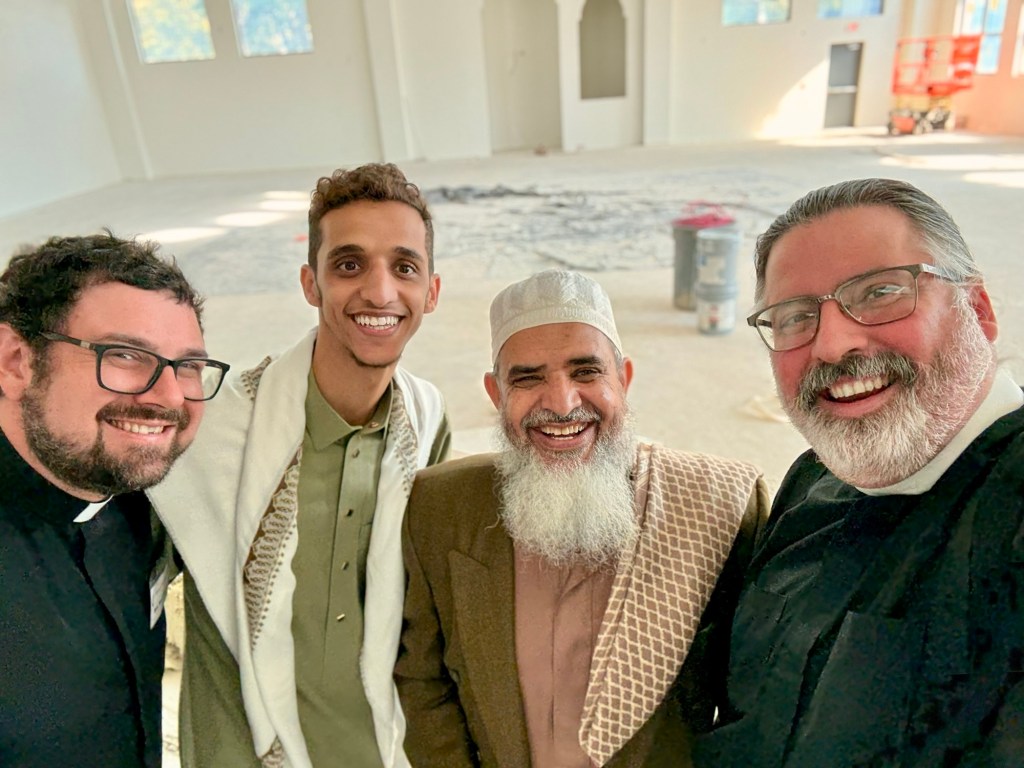
Fr. Barrett, Pastor Scott, Dr. Ali, and a longtime member of AMS Coldwater (also named Ali)

The Deeper Yes

I find it to be a matter of common sense that you and I live in a fragmented world. We’re divided and scattered. Relationships are broken: between nations and neighbors, between races and religions, between partners and parties. Why, we’re even fragmented within ourselves: doing what we don’t want to do and unable to do what we most deeply want to do, as we heard St. Paul say in this morning’s reading from his letter to the Romans. We’re fragmented. Things are complicated. We don’t quite know what to make of it. We’re lost and we need to find our way again. We need to get our bearings, so to speak. We need context: we need to understand where it is that we are, how we got here, and how we can get to where we ought to be as individuals, as families, as communities, and as nations. This is the state of our generation on planet earth: fragmented, lost, Paul calls us “wretched.”

Into this maelstrom, enter Jesus. To quote Paul once again: “Who will rescue me from this body of death? Thanks be to God through Jesus Christ our Lord!” And Jesus shows up in our gospel reading this morning with his usual wit and insight that cuts to the core of who we are and lays our souls bare for the healing. Here, Christ the great physician (Doctor Jesus) is practicing a kind of spiritual surgery in order to get inside us and expose what we are so that we might become what we ought to be.

And his surgeon’s tools, the scalpel and forceps he uses to simultaneously wound and heal his patients, are twofold: Questions and Stories. Anytime Jesus asks a question or says “Let me tell you a story…” smart people will head for the hills because they know it isn’t going to be pretty. And in today’s passage, Jesus does both. He asks his listeners, “To what will I compare this generation?”

He’s making a comparison: using the rhetorical art of analogy to provide insight and context. He’s showing us how to recognize the patterns of thought and behavior that we have become so unconsciously accustomed to by force of repetition and reinforcement by societal values.
And here is his comparison: “It is like children sitting in the marketplaces and calling to one another”.

Children sitting in the marketplaces. Can you imagine anything more out of place? What if the New York Stock Exchange on Wall Street had an annual “Bring your kids to work Day”? What would it be like to have kids playing games and chasing each other around the trading floor? What would it be like to have a bunch of whiny babies throwing temper tantrums on the floor of the U.S. House of Representatives? It would be chaotic and disruptive. They would constantly be under foot. Nothing could get done.

“Children sitting in the marketplaces and calling to one another”. According to Jesus, that’s the fragmented state we’re in as individuals and as a society. We’re tripping over ourselves, getting in our own way, and disrupting the divine plan with all sorts of mindless chaos and petty selfishness.

Jesus said that we’re “calling out to one another.” What is it that we’re calling out? “We played the flute for you, and you did not dance”.
That’s an interesting one to me, especially in this consumerist, hedonistic, entertainment-addicted society. The world is always “playing the flute for us” in one way or another, isn’t it? We are bombarded with advertisements from the moment we get up in the morning to the moment we close our eyes at night. Every single product and service promises a long and happy life, but none can actually deliver on that guarantee. Sensationalist media headlines are specifically designed to get our attention and provoke a reaction from us. They force our emotions out of us by making each new experience faster, funnier, sexier, scarier, or more intense than the last one. They keep us on the hook. The world plays the flute and we are expected to dance like puppets.

What else are we, as a society of “children in the marketplace” calling out to each other? “We wailed, and you did not mourn.”

This one is the mirror image of the last disruptive cry. Once again, the world is trying to provoke a reaction from us, trying to throw us off of our spiritual center of gravity. But this time, they’re using pain instead of pleasure, the stick instead of the carrot. If you follow current events (from either the right or the left), you’re probably familiar with this “wailing” tactic: there’s no such thing as a small problem in Washington. When is the last time you can remember either Republicans or Democrats sitting down together around a piece of proposed legislation and saying, “I guess we have a few minor disagreements about this bill” or “I’m sure we can figure out some kind of compromise”? Does that ever happen? No. Every little problem is an apocalyptic crises. Every opponent is a demon and every ally is an angel. It’s all just another form of sensationalism and manipulation.

When the world isn’t playing the flute for us, it’s wailing at us. It wants to provoke a reaction in us so that we’ll keep on playing these little games and sending our money to the big shots on Wall Street, or in Washington, or in Hollywood. Their game is simple: if we play, they win.
So, what’s the solution? Don’t play. That’s what Jesus said. He said: “John came neither eating nor drinking”.
Here Jesus is speaking, of course, of his cousin, St. John the Baptist. John was a prophet: the greatest of prophet who ever lived, according to Jesus. John was kind of like a monk: he lived a very simple, ascetic life in the desert and people would come to be baptized and listen to him teach.

The thing about John the Baptist is that he didn’t play the world’s game. He said “No” to the flutes and “No” to the wailing. He didn’t participate. He boycotted. He was a resistor. He was a fiery preacher who wasn’t afraid to call a spade a spade. He criticized the religious establishment and he called out political leaders.

And what did the dominant powers-that-be do to him? They demonized him. They arrested him. In the end, they killed him.

His experience reminds me of the Civil Rights movement: people marching in the streets, speaking truth to power, boycotting the bus system, sitting in at lunch counters. They said “No” to racism, segregation, and inequality. Like John, many were arrested and some were killed. They too were demonized with the worst possible insult one could think of in the 50s and 60s: “Communist.”

If St. John the Baptist had lived during the 1960s, they would have called him a Communist too. John said “No” to the world’s childish games and they said, “He has a demon.”

Saying “No” is an important step in the prophetic ministry. We have to do it if we ever hope to regain our moral and spiritual footing in this life. We have to say “No” to what the world is offering in order to say a deeper “Yes” to what God is offering us instead. And what is that deep “Yes” that we are called to say with our whole hearts?

Jesus shows us: “The Son of Man came eating and drinking”. Notice the dichotomy with John’s ministry: “John came neither eating nor drinking” (he said “No”) but “The Son of Man (Jesus’ favorite name for himself, it really just means “human being”) came eating and drinking” (Jesus is saying “Yes”).

Jesus, if you remember, got his start by working with John in his ministry. John baptized Jesus and Jesus’ message, in the early days of his ministry, is almost indistinguishable from John’s: Both of them baptized people and told them to “repent and believe the good news, for the kingdom of heaven is at hand.”

But then a shift began to happen after John was arrested and killed. Jesus branched out on his own and took the movement in a new direction. As John himself said, “He (Jesus) must increase and I must decrease.”

Rather than disengaging from society and staying out in the desert, Jesus ventured back into the city streets. He got involved in people’s lives, loving without judgment. He scandalized the dominant powers of this world in a different way: by practicing such open acceptance, he defied their nicely defined ideological categories and the boxes into which they so conveniently put people and God.

As a result, they reduced him to the lowest common denominator and called him “a glutton and a drunkard, a friend of tax collectors and sinners.” Ironically, they couldn’t be more right. The reality of God’s love in Christ was far deeper and broader than they could imagine. Jesus envisioned a community where all people would be welcome at heaven’s table, not just those who passed theological or ethical muster. This was more than the powers of this world could handle. They just couldn’t imagine sharing heaven with such pathetic riff-raff.

During this time, the disciple’s eyes were gradually opened to the truth that this Son of Man is also the Son of God. The Church, after reflecting on this reality for centuries, came to affirm that Christ is both “fully human” and “fully divine”. The theological term for this is Incarnation – the belief that God has taken on flesh, that through Christ, God is present with us in the very stuff of this universe. Therefore, the stuff of this universe is sacred. Christ is the Alpha and Omega, the beginning and the end, the Source from which all things come and the Destiny toward which all things are going.

In Christ, the universe itself finds healing and wholeness. Our broken world is fragmented no more. We are free to eat and drink once again, having overcome the clatter of this world’s childish wailing and flute-playing. We are now able to approach life with new eyes, the eyes of faith, strengthened by Christ’s Word and Sacraments, which point us back to the deeper truth of hidden wholeness beneath the fragmented surface of the world. All things come from Christ and return to Christ by way of Christ.

With that knowledge, we are able to put our worried minds at ease and our weary souls at rest, as Jesus himself said, “Come to me, all you that are weary and are carrying heavy burdens, and I will give you rest. Take my yoke upon you, and learn from me; for I am gentle and humble in heart, and you will find rest for your souls. For my yoke is easy, and my burden is light.”

Glimpses of Wholeness

Image by Cassie J.  Retrieved from Wikimedia Commons.
Image by Cassie J. Retrieved from Wikimedia Commons.

Have you ever look at a dog and really seen it in its total “dogness”?  A dog is quite miraculous when you really see it…

Never mind dogs.  What about a bird, or a cat, or a tree, or a flower, or a rhinoceros?!  They are all quite miraculous really.  When you really look at one, you can hardly believe it exists; there it is, this perfect thing, just being what it is, complete in itself.  Any imaginative child could have dreamed up a rhinoceros, or an elephant, or a giraffe.  But  they didn’t get here as the product of a child’s imagination.  The universe is spinning these dreams.  They come out of the universe, as do we.

Dr. Jon Kabat-Zinn, Full Catastrophe Living, p. 153-154