Touching the Place Where It Hurts

Today’s sermon from North Church…

northchurchblog's avatarNorth Presbyterian Church

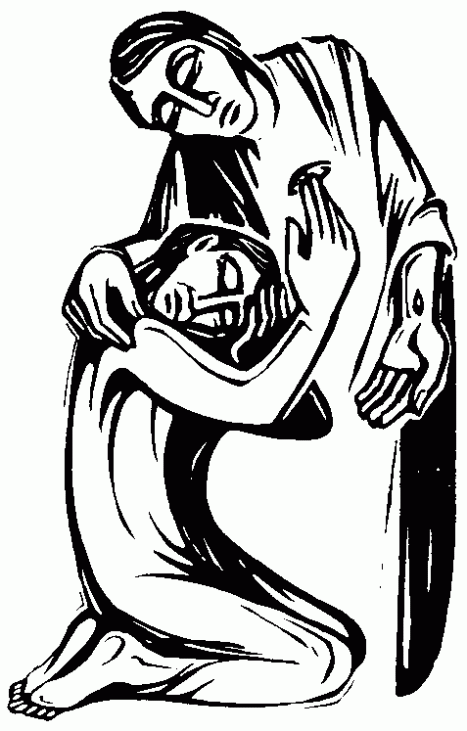
Image Image from http://www.cruzblanca.org/hermanoleon/byn/rc/ev3pa27.gif

So, we’re talking about Thomas today. The Bible calls him the Apostle Thomas: one of the few who knew Jesus in the flesh and was sent to bring the gospel to the ends of the earth.

Church tradition calls him St. Thomas: if the legends are true, Thomas traveled as far east as India, where he founded a church. The New Testament is silent on his fate and history is inconclusive, but it’s worth noting that when Vasco da Gama made his expedition to India in 1498, he discovered an already vibrant Christian church in the area, claiming to have been founded by Thomas himself.

But the name that Thomas is most remembered for is the nickname people give him when they read today’s gospel story: Doubting Thomas. It’s a big joke, right? People call you a ‘Doubting Thomas’ if you don’t believe some outlandish claim they…

View original post 2,038 more words

Passionfruit

Image
Image by Taka. Retrieved from Wikimedia Commons.
This file is licensed under the Creative Commons Attribution-Share Alike 3.0 Unported license.

Life gave
what I took
for my own.

I learned
how to seize
with the hands,
how to tear
with the teeth.

I learned
what it felt like
to touch with the lips,
to press with the tongue,
to be surprised by how much
came out
when I broke the surface,
to be covered with sweetness
all over my body.

Now I know.
It’s complicated.

***

What I took
is mine.

I’m learning
how to build
with the hands,
how to hold nails
with the teeth.

Cleaning up
is never
as much fun
as messing up.

Construction
is never
as cathartic
as demolition.

Nails and wood
are not the same thing
as a tree.

They have no power
to give life.

I’m learning
what it feels like
to be covered with sweat
all over my body.

***

What I made
gave life.

It was an accident.
Nobody meant for it to happen
this way.
It just seemed like a good idea
at the time.

The hands that learned
to seize and build.
The teeth that learned
to tear and hold.
The facsimile of a tree.

I wasn’t expecting it
to be alive
when I broke the surface.

I was surprised by how much
came out
and covered me with blood
all over my body.

More forgetting
than learning
this time.

Not taken
for my own,
but given
by another.

Bartimaeus’ Empowerment

Image
William Blake [Public domain or Public domain], via Wikimedia Commons

Today’s gospel reading from the Daily Lectionary introduces us to Bartimaeus, a blind panhandler healed by Jesus in the final days before his crucifixion (Mark10:46-52). When he heard that Jesus was passing by, Bartimaeus started raising his voice, calling upon Jesus to do that which he was meant to do as King David’s anointed heir: liberate his people from oppression. The Temporarily Able-Bodied (TAB) people in the crowd wished this disabled nuisance and general drain-on-the-economy would just shut up and go back to being invisible.

But Jesus, for his part, stopped the parade and listened to the shouts that everyone else wished they weren’t hearing. Begrudgingly, the general public acknowledged to Bartimaeus that his appeal for freedom had been heard.

And when Bartimaeus finally did gain an audience with David’s heir, what happened? One would think that the chosen liberator would know exactly what to do on behalf of an uneducated societal reject. However, that’s not the route that Jesus took:

The Liberator wanted to hear Bartimaeus speak for himself.

Instead of prescribing, Jesus asked what he could do to help. And when the big, miraculous moment came, the Liberator refused to take credit. Instead, Jesus chalked up Bartimaeus’ newfound wellness to that which was already within him.

What kind of anointed Liberator is this?

Are we seeing clearly?