Sermon for the Tenth Sunday after Pentecost.
Click here for the biblical readings.
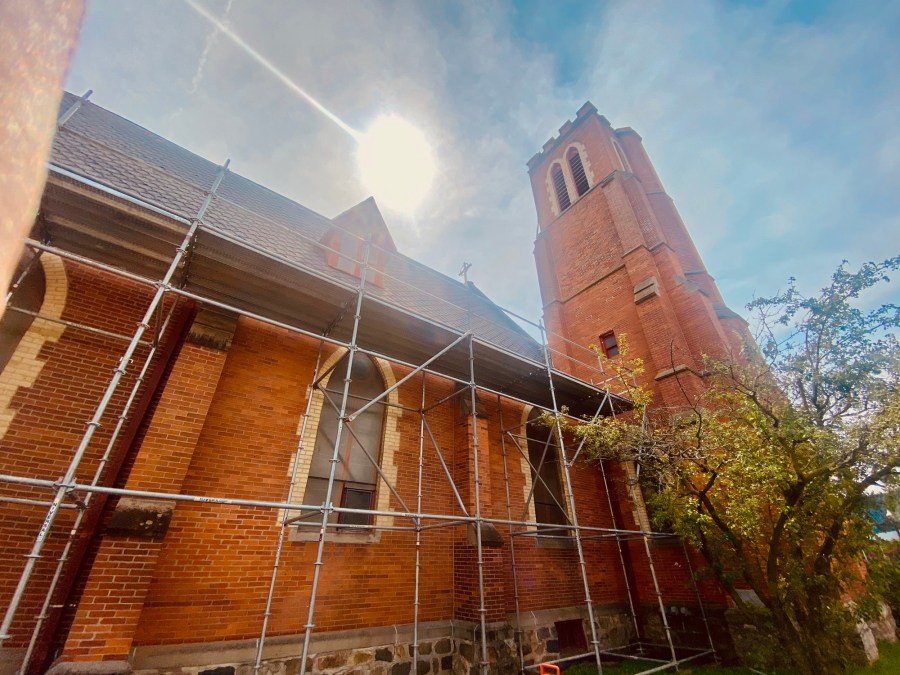
If you’ve been at the church building at all for the past couple of weeks, you’ve probably noticed that things have been a little different: You can see the scaffolding and the workers walking around on top of it. You can hear the sound of hammers and machinery. I’ve received multiple phone calls from people asking where to park or which entrance to use. There is no getting around the fact that this roof restoration process has been disruptive to our normal routines, as a church.
And yet… it’s absolutely necessary. Our building is more than just a lovely addition to the downtown historic district; this building is a tool that God has lent our church, so that we can do the work of ministry: Loving and serving our Coldwater neighbors in the name of Christ. Restoring the roof is practicing good stewardship over that which we have borrowed from God, just like we might take extra good care of a car or a book that we had borrowed from a friend.
Nevertheless, the process of caretaking has been especially disruptive to our normal routines for these past few weeks…
People tend to not like disruption in their daily routines. It’s inconvenient (we are creatures of habit, after all). It gets in the way of our plans (although, as they used to say, “If you want to give God a good laugh, tell him your plans”).
Disruption can come to our lives in many forms: the loss of a job, the breakup of a relationship, accidents, illness, or death. Sometimes, it’s even a happy occasion, like getting married, having a baby, graduation, or retirement. It’s good stuff, but it’s still disruptive to our regular routines.
As creatures of habit, we tend to see disruption as a problem and peace as a solution, but Jesus (in today’s gospel, at least) seems to see it the opposite way.
Jesus asks his disciples, “Do you think that I have come to bring peace to the earth?” And then, he answers his own question, “No, I tell you, but rather division!”
Now, this is where we might say, if we were present at this conversation, “Now wait just a minute, Jesus! Aren’t you supposed to be the Prince of Peace? At Christmastime, aren’t we supposed to say, ‘Peace on Earth and goodwill to all’?”
And Jesus would respond, “Yes, but what exactly do you mean by ‘Peace’?”
Peace is a good thing, but it is often misunderstood by those who would rather settle for normalcy than challenge the status quo. We sometimes try to “keep the peace” by avoiding uncomfortable conversations, inconvenient truths, and important decisions. That kind of “peace” is no peace at all, according to Jesus. That kind of (so-called) peace is toxic.
Dr. Martin Luther King, Jr. said that peace, “is not the absence of conflict, but the presence of justice.” Justice, as Dr. King meant it, is fair and harmonious relationships between people. It has less to do with punishment and more to do with what St. Paul meant by the word “righteousness” in his epistle to the Romans. Peace, as Jesus meant it, is what happens when people address old patterns of behavior, become aware of unconscious habits of thinking, and seek to make amends for the mistakes of the past. Peace upends our lives and refuses to leave us as it found us. Peace asks something of us. Peace, as Jesus Christ intends it, is disruptive.
That’s why Jesus says, in today’s gospel, that he has not “come to bring peace to the earth… but rather division.” Jesus disrupts our false illusions of peace in order to bring us closer to true peace, which can be found in right relationships between God, our neighbors, and ourselves. Sometimes, disruption is necessary in order to bring us into the good life that God intends for us.
Here’s the thing I want us to carry away from this sermon today:
When Jesus stirs up the dust in our lives, it’s not to tear us down; it’s to make us stronger, so we can join him in building something even better.
The mess in our lives, just like the mess in our church building this week, is not a sign of failure; it is a sign of God at work.
I have found this principle to be true in my own life:
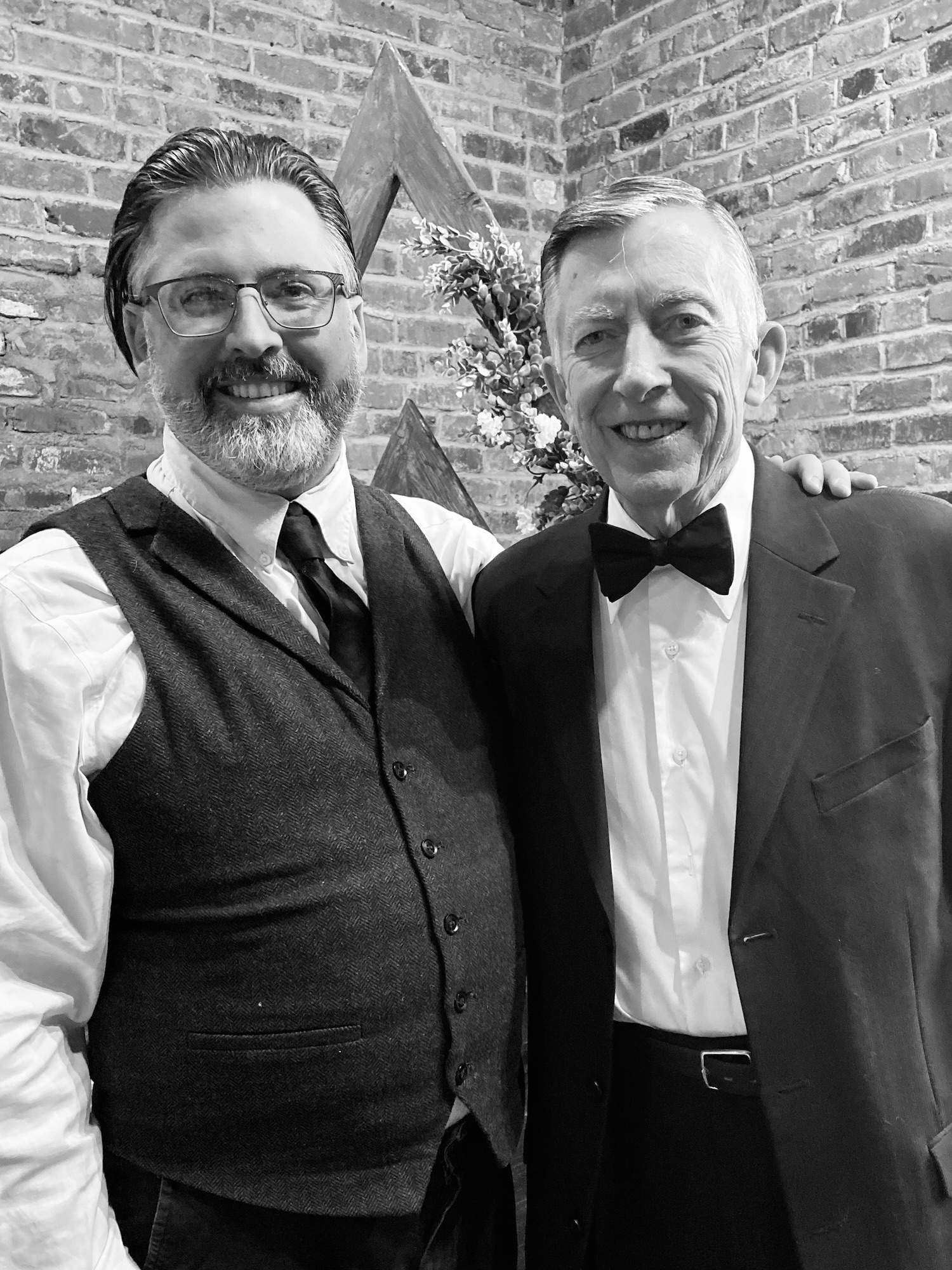
When I was a kid, my Uncle Hutch was a spiritual leader in our family. He was a United States Army chaplain who served in the first Gulf War and later as a commercial chaplain for truck drivers in South Carolina. He is a very tall, wise, and kind-hearted man who I have always looked up to, both literally and figuratively.
Whenever we would gather at his house for Thanksgiving dinner, Uncle Hutch would lead the prayer. Whenever someone in the family was getting married, Uncle Hutch would officiate the service. Whenever one of us needed spiritual counsel, we would call Uncle Hutch.
In recent years, Uncle Hutch’s health has begun to decline. Now in his eighties, his spirit is stronger than ever, but his physical body is showing the inevitable signs of age. As this has happened, without anyone making an official proclamation, I have noticed the family roles that were previously assigned to Uncle Hutch now gradually falling to me.
I have to admit that this prospect is daunting. First of all, I am keenly aware that my personal views on various matters differ somewhat from those of my family. Lastly, and far more significantly, how could I possibly fill the shoes of a man of God that I have admired since the day I was born?
The task seems impossible to me.
When I called my Aunt Faith to ask permission to share this story today, she told me that none of us can ever “fill the shoes” of another person. The best we can do is to “follow in their footsteps” in our own particular way, even if our way differs somewhat from the way in which the original person would walk it.
The shift in family roles has certainly been disruptive, to say the least, but I must also admit that it has led to some of the most deep and honest conversations with my family that I have ever had. Whenever significant events happen, good or bad, I have become the one that my family members call to seek comfort and advice. I still don’t feel up to the challenge, but I try my best to meet it to the best of my limited ability. I can only trust God’s Holy Spirit to fill in the blanks where my personal wisdom is most definitely lacking.
It is in moments like these that I ask the age-old question, “What would Jesus do,” or, secondarily, “What would Uncle Hutch do,” to respond to the problems that are presented to me.
The shift in family roles has most definitely been disruptive to my felt sense of peace, but I can also see how it has been part of God’s work in the life of my family.
Kindred in Christ, I put it to you today that the disruptions in our lives are not problems, but the very solutions that we have been seeking to the questions that beset us. The God we believe in, revealed through the person of Jesus Christ, is a God who asks tough questions and leads us through the desert of conflict, in order to bring us to the true peace that consists of right relationship between God, our neighbors, and ourselves.
Let us not shy away from tough questions and gravitate toward easy answers, but sit in the tension that leads to “the peace that passeth all understanding.” Let us hang upon our hearts a sign that says, “Pardon our dust” while we wait in the confidence that God is not done with us yet, but is still working to bring us to the fullness of peace in Christ Jesus our Lord.
As a tangible sign of our faith in God’s work in our lives, I would like to invite to the front of the church Mr. Mike Woodhouse, manager of Sheriff Goslin Roofing Company, and any members of his crew who are present with us today.
These people have been hard at work on the roof of this historic building. I would like to introduce them to you so that you can thank them and join me in a special blessing over their work, as well as a prayer for their safety while they lovingly restore the roof of this building.
Let us pray.
Loving God, you have gifted these workers with the skill and the will to work for the restoration of this church building, which you have lent to us for the purpose of continuing the work of Jesus Christ on this Earth, by loving you with our whole heart, soul, mind, and strength, and loving our neighbors as ourselves. In Christ’s most holy Name, we bless the labors of these workers and pray for their safety from dangers seen and unseen, that the goodness they create with their hands may be matched by the sincerity of our hearts. We ask these things and bless these workers in the Name of the Father, and of the Son, and of the Holy Spirit. Amen.
Kindred in Christ, these workers are a symbol to us of the good work that God is doing in each of our lives. May each and every one of us come to acknowledge this work and bless the disruptions, not as a problem to be solved, but as the means through which God is bringing each of us, in our own time, to the fullness of peace that can be found in Jesus Christ our Lord.
Amen.
 Hopping Hadrian's Wall
Its been a disruptive season to be sure. Thanks for the encouragement my man. It was quite timely today.