
Today, I’d like to take the DeLorean back to 1998 and share with you this recently rediscovered gem from my college years. Sadly, the religiously self-involved 19 year old version of me was unable to appreciate how deep this song is. If you’re in college now, you’re too young to remember when this came out.
Author: J. Barrett Lee
A Feast for All People
 I grew up on the border between Durham and Chapel Hill, North Carolina. These towns are both major international centers for medical research and educational advancement, but that’s not what they’re known for. No, the main thing that Durham and Chapel Hill are known for is college basketball. The college basketball rivalry between the Duke Blue Devils and the UNC Tarheels is one of epic proportions. Every year, these teams battle each other with bitter ferocity. No matter the outcome of the game, everyone knew to steer clear of Franklin Street in downtown Chapel Hill. The next morning, it would be completely trashed. Everyone in town had their team, whether they were interested in basketball or not. You were either a Carolina fan or a Duke fan. There was no two ways about it. If we knew a family where one child went to Duke and the other went to UNC, we called it a broken home. People in Durham and Chapel Hill go crazy over their college basketball. Even at church, you could always tell when the NCAA Final Four was happening because the place would be empty. I guess people know where their priorities lie. It’s kind of crazy when you think about it: two towns divided and their streets trashed, all because one team managed to throw a ball through a hoop more often than the other team. People divide themselves over the strangest little things.
As many of you know, this Tuesday is Election Day and we can expect a lot of divisive language around that subject as well. Like many of you, I am looking forward to being rid of all the yard signs, the sloganeering, the attack ads, the mudslinging, and the propaganda trying to convince me that one candidate is a savior while the other one is a demon. Election season makes me miss those good old days when TV commercials weren’t trying to save the country; they were just trying to get you to spend money you don’t have to buy junk you don’t need.
What bothers me about the rhetoric in these ads is the way it makes us seem so hostile and feel so divided against one another. If one were to accept everything in these ads at face value, one might think that this country was on the brink of another Civil War. But we know that’s not the case. In spite of everything, a rare and remarkable thing will happen this Tuesday: people will line up peacefully and politely to cast their votes and shape the future of this country. There will be no bombs or rifle fire. The loser of this presidential election will not face execution. The supporters of the losing party will not be rounded up, exiled from the country, or imprisoned in forced labor camps. That isn’t going to happen here on Tuesday. There are places in this world where such things do happen, even today. Voting, in some countries, is an exercise in taking your life into your hands. There are some countries where transitions in government happen only once a generation, when the incumbent president is either arrested or assassinated. Thankfully, that doesn’t happen here. We live in a place where political change happens frequently and peacefully. So, I think we should be careful before using violent and slanderous labels like ‘cult leader and ‘socialist’ when we’re describing a candidate whose views we disagree with. Jim Jones and David Koresh were cult leaders, Mitt Romney is not. Joseph Stalin and Mao Tse Tung were socialists, Barack Obama is not. Real cult leaders and socialists have slaughtered millions in the name of religion and ideology. Neither of these candidates has done such a thing. Therefore, it is morally offensive to call them these names. Whatever your views and however you vote, do it with peace and goodwill in your heart. Inoculate yourself against the toxin of incivility that poisons our public discourse. However you vote, vote with love in your heart. That’s what it means to vote as a Christian.
We human beings seem to have an innate tendency toward division and hostility. It doesn’t just come out during election years and sporting events. We divide ourselves over race, religion, gender, nationality, and beer preference. It seems that there’s something inside each and every one of us that longs to belong to some kind of community. As they say, “birds of a feather flock together,” so we often organize ourselves into small groups with others who look like us, talk like us, dress like us, think like us, vote like us, and worship like us. We do this because we feel lost in the cosmos. We perceive ourselves to be, in some sense, alone in this world. Above all, we fear the ultimate loneliness of death, which threatens to inevitably swallow us up into dark oblivion. That’s why, in our time here on earth, part of our survival instinct is a herd instinct. We want to fight the darkness, death, and loneliness. So we find some kind of object to rally around as groups: our family, race, sports team, religion, political party, or country. Each group competes with the others to win, to survive in the great contest of existence. On the one hand, we experience a great sense of purpose and solidarity from these groups, but on the other hand, they also form the basis for our hostility and hate toward one another. We think we have to beat the best in order to be the best. Subconsciously, our primal instincts are telling us that our very survival depends on the victory of our little group over its competitors. If the others win, so we think, the darkness, death, and loneliness will conquer us all.
The fact that our species has evolved to think this way is understandable, but still wrong, in my opinion. I think our fear of darkness, death, and loneliness has blinded us to a much deeper and much older truth about who we are and how it is that we’re connected to each other, to the universe, and ultimately to God. I’d like to share with you what I believe about that truth.
Today, we are celebrating the Feast of All Saints. This holiday has been celebrated by Christians for over 1,400 years as a festival to remember heroes of the faith from generations past. In some churches, this remembrance has been limited to a special class of people who have been named “saints” by the ecclesiastical hierarchy. In churches like ours, we use the term “saint” more broadly. Presbyterians have always believed that every person is a saint in his or her own way. Of course, there are always those people who we remember with special fondness and admiration, but we don’t have to wait for some church committee to decide on their spiritual status in heaven. Moreover, we include ourselves in that number. Saints don’t have to be dead people. The Communion of Saints contains all God’s people, living or dead, from every time, place, people, and language. Most importantly of all, we are not admitted to the Communion of Saints because we’ve led some kind of spiritually or morally heroic life. No, we believe that everyone is a saint by God’s grace and God’s grace alone. Not a single one of us has earned our place in the Communion of Saints. Each of us, from the greatest to the least, from the best to the worst, is a member of this worldwide family as a free gift. This community, this family that transcends time and space, is the reality that we celebrate on the Feast of All Saints. This, I believe, is the great and mysterious truth that shows us who we are and how it is that we’re connected to each other, to the universe, and to God.
In our first reading this morning, the prophet Isaiah envisions a time when “the Lord of hosts will make for all peoples a feast of rich food, a feast of well-aged wines, of rich food filled with marrow, of well-aged wines strained clear.” Did you get that? “A feast for all peoples”: an extravagant dinner party where everyone is invited and everyone belongs. This is the vision in the prophet’s heart that he tells us comes from God. This is God’s idea for the human race. Another prophetic soul, writing almost a thousand years after Isaiah, wrote down another, similar vision. We heard from this person in our second reading this morning: “I saw the holy city, the new Jerusalem, coming down out of heaven from God, prepared as a bride adorned for her husband.” A little later on, the seer of this vision describes this mystical city in greater detail. He says, “The nations will walk by its light, and the kings of the earth will bring their glory into it. Its gates will never be shut by day—and there will be no night there. People will bring into it the glory and the honor of the nations.” Did you hear that? “The nations will walk by its light… Its gates will never be shut… People will bring into it the glory and honor of the nations.” Friends, this is just like Isaiah’s vision of the feast for all people. I imagine this city as a multi-ethnic, international dance party. The gifts and treasures of every tribe and culture are on display. Billions gather for an abundant feast prepared by God. In the streets you can hear Swedish and Swahili, you can see white folks and black folks, men and women, Republicans and Democrats, and yes, even Tarheel fans and Duke fans. This is the true nature of our common humanity. This is God’s goal for human history. I see it as a prophetic snapshot of the Communion of Saints.
And there’s more. There is another element found in each of this morning’s readings that factors very highly in this ultimate vision. In Isaiah’s vision, the prophet says, “And [God] will destroy on this mountain the shroud that is cast over all peoples, the sheet that is spread over all nations; he will swallow up death forever. Then the Lord God will wipe away the tears from all faces, and the disgrace of his people he will take away from all the earth, for the Lord has spoken.” In our reading from the book of Revelation, it says, “See, the home of God is among mortals. He will dwell with them as their God; they will be his peoples, and God himself will be with them; he will wipe every tear from their eyes. Death will be no more; mourning and crying and pain will be no more, for the first things have passed away.” And the one who was seated on the throne said, “See, I am making all things new.”” In both of these visions, as well as in our gospel reading where Jesus raises his friend Lazarus from the dead, the power of death is being undone by the power of love. This vision of a city and a feast for all peoples is not some sentimental dream that’s meant to make us feel better, it is the truth that has a power even greater than death itself. This is the truth in which we find ourselves. In the Communion of Saints, we are bound to one another by the unbreakable power of God’s free grace. Not even death can cut those ties. And, for that matter, neither can any of these stupid and pointless divisions we make among ourselves and defend with such violence and hostility. The unbreakable bond of grace exposes such foolishness for what it really is, because it’s completely unnecessary. We team up and fight for “my family/team/party/country/religion” because we falsely believe the notion that fighting for survival will protect us from the darkness and loneliness of death, but we fail to realize that the thing we fear most has already been overcome by bond that can never be broken, a bond that unites us to our enemies and competitors. By God’s free grace, we are all participants in the great Communion of Saints. That is the great, liberating truth we celebrate today, on this Feast of All Saints.
If we could just realize and remember this truth more often, our perspective on this life would be transformed. We could be unfazed and unimpressed by each new hostile attack and defensive reaction. We could learn the art of letting go of what matters less so that we can hold on to what matters more. We could be saints rather than survivors.
Sadly, this world, as it is, doesn’t make it easy for us to trust in the reality of this vision. We need to be reminded of it, which is why we celebrate this holiday once a year, at the beginning of November. We’re also reminded of this truth every time we celebrate the Eucharist, which we are doing this morning. This sacramental feast is a foretaste of Isaiah’s great feast for all people. Gathered around this Eucharistic table with us this morning, present but unseen, are people from every time and place, living and dead, who are bound together in the Communion of Saints by the unbreakable bonds of God’s free grace. If we only had eyes to see, we would see them sharing this meal with us: Jesus, Isaiah, Peter, Paul, Mary, Francis of Assisi, Teresa of Avila, Martin Luther, John Calvin, Irving Beal, Ruth Jones, Bob Brucker, Dick Mahaffy, and Matt Conway: all here, present but unseen, bound to us forever by a force more powerful than death itself: the grace and the love of God.
Martin Luther King on Endorsing a Candidate

The link below connects you to a document preserved electronically by the King Center. It is Dr. Martin Luther King, Jr. responding to multiple requests that he endorse candidates in the 1960 election. Dr. King refused all such requests.
He writes:
The role that is mine in the emerging social order of the south and America demands that I remain non-partisan. This devoid of partisan political attachments, I am free to be critical of both parties when necessary.
He continues:
The best antidote to degeneration of conflict of opinion into maliciousness and violence is statesmanlike, firm, expressions of the moral issues giving active support to proper resolution.
This is not the time to look back, but to look forward. I am full of hope for the future because of the goodwill and concern shown by so many people in Georgia and all over the country.
Now let us use this period for genuine negotiations so that Atlanta can take a step forward toward the society of “wisdom, justice and moderation” which the seal of the state of Georgia and the Constitution of the United States promised.
Click here to read the entire document. Click and drag to move the page.
Your Faith Has Made You Well

Many of you, like me, have probably heard the news these past few weeks about this brave young woman from Pakistan: Malala Yousafzai. Malala is a 14 year old who was shot on her school bus by a Taliban extremist because she had the audacity to go to school. Remarkably, she survived this attack and is currently recovering in the United Kingdom with no signs of brain damage. Her father commented that she has asked for her schoolbooks to be sent so that she can continue her studies while she recovers in hospital.
What’s even more amazing about Malala is that she, at age 14, has already made an international name for herself as an outspoken activist for education and women’s rights in her home country. Desmond Tutu nominated her for the International Children’s Peace Prize. At the age of 11, she began writing a blog for the BBC about life under Taliban rule which she used to propagate her views on women’s education. Her current plan is to return home to Pakistan after she gets well and continue her activism, in spite of the risks.
People the world over have rightly expressed support and admiration for Malala. Here is a young woman who has found within herself the strength to break the chains of oppression and inequality forged by the narrow views of religious extremists in her country. That inner strength: the power to live free, even in the midst of bondage, is what I think of whenever I hear the word “faith”. And that’s why I would not hesitate to say to Malala what Jesus says to Bartimaeus in today’s gospel reading: “Your faith has made you well.”
Before I go on, let me pause and unpack what I mean by that. Obviously, Malala herself has not yet been “made well” in a physical sense after her attack. However, that word in Greek, “made well”, is sozo and is often translated “heal” or “save”. Older translations of this passage read, “Your faith has saved you.” To the ancient Jews, the idea of “salvation” or “being saved” had a lot to do with liberation and “being set free”. So, with that little bit of linguistic and cultural nuance in mind, it would not be much of a stretch at all to read this passage as: “Your faith has made you free.” And that idea would most certainly apply to Malala right now. Her resolve to live free, even in the midst of oppression, has made her free indeed, no matter what those others might say or do to keep her subservient or “in her place”. Malala is free and there’s nothing the Taliban can do to change that. So, I say to her, “Malala, your faith has made you well.”
The figure Bartimaeus in today’s gospel reading comes across as a person similar to Malala in several key respects. First of all, Bartimaeus is a second-class citizen in the society where he lives. When we first meet him, he is seated “by the roadside” as Jesus as his entourage pass by. This is more than just a physical location. It’s meant to tell us something. Bartimaeus is a person who has been “sidelined” or “cast aside” by mainstream society. Social scientists refer to this as being “marginalized” or “placed into the margins” of society’s consciousness. Bartimaeus is a panhandler who, in a world without social services and safety nets, must depend on the kindness of strangers for his daily bread. Can you imagine how belittling and dehumanizing it must have felt for him to have to be grateful and beholden to the well-off benefactors who tossed him a coin, maybe made a sarcastic comment, and then went home to families, servants, and stocked cupboards? That’s the life of a panhandler. Toss aside any romantic notions you might have about riding the rails from California to New York Island like Woody Guthrie. The life of a panhandler, in ancient Judea or in contemporary America, is “solitary, poor, nasty, brutish, and short” (to borrow a phrase from Thomas Hobbes).
The next thing we can see in the text is that Bartimaeus can’t see, he is blind. His disability gives us what is most likely the primary reason for his status as a panhandler. But the most overlooked indicator of his marginalized status is his name, or lack thereof. The text tells us that he is “Bartimeaus, son of Timaeus”. Sounds simple enough, right? Maybe they just called him “Bart” for short? But consider that in Aramaic, the language of first century Judea, the word for “son” is “bar”. Bar Timaeus, Son of Timaeus. So, if he is “Son of Timaeus, Son of Timaeus”, then he is literally a man with no name, no personal identity of his own. Even as an adult, he is still just “Timaeus’ kid”.
Bartimaeus is marginalized because of his disability. Malala Yousafzai is marginalized because of her gender. Each, in his or her own way, knows what it’s like to be cast aside, sidelined, and granted second-class citizenship by the powerful. But the more amazing thing is that each, in his or her own way, has also risen above the chains of marginalization and taken back that stolen human dignity. We already heard about how Malala is doing it through her activism. Let’s look at how Bartimaeus is doing it.
First of all, he calls out. He’s not one of those polite panhandlers who just sits on the sidewalk with his hat out. He yells at you as you go by. If anything, this tactic makes you less likely to want to give him money, except that you’re so freaked out by it that you’ll give him almost anything just to keep from yelling. And let’s take a look at what he’s yelling, exactly. This is no generalized call for alms. This guy knows exactly what is going on and is determined to get in on the action. He yells, “Jesus! Hey, Jesus! Yeah, you! Son of David! Why don’t you come over here and have some mercy on me?!” Now, in the text itself, he just says, “Jesus, Son of David, have mercy on me!” This almost sounds like groveling at first glance, but let’s pull that dense phrase apart, piece by piece. Bartimaeus calls Jesus by name and addresses him as the “Son of David”. This was a messianic title. The anointed one of Israel was said to be a king, descended from the line of old King David: the king who gave the Jewish people their main idea of what an ideal king should be. It’s kind of the same thing as Abraham Lincoln being held up as the model of what an ideal president should be. Furthermore, the phrase “have mercy on me” is not so much a plea as it is a call for a superior to do his or her duty. By saying, “have mercy on me,” Bartimaeus is implying that Jesus owes him something. So, if we were to put this in American terms, imagine the president’s motorcade making its way down a city street where a panhandler has his hat out. As the president’s limo goes by, the panhandler shouts over the notes of Hail to the Chief, “Hey! Mr. President! If you’re so much like Abraham Lincoln, then why don’t come over here and give me my Emancipation Proclamation! You owe me, man!” That’s what this guy Bartimaeus is saying to Jesus as he walks by.
Now, the crowd around Bartimaeus, as we might expect in this situation, is shocked and offended. They’re embarrassed for their city, that the Messiah would receive such uncivil treatment by the dregs of society here. So, they’re telling him to “shut up” and maybe calling him names like “dirty hobo” or “lazy bum”. They want him to keep his place and be grateful for what they choose to give him out of their surplus. But Bartimaeus isn’t listening to them. He’s still shouting. In fact, he starts shouting even louder than before! He shouts so loudly, in fact, that his verbal jabs reach the ears of their intended target, Jesus himself. Jesus stops in his tracks, turns around, and calls Bartimaeus over. Let’s imagine that again in present-day presidential imagery. On CNN, we see the motorcade go by with the panhandler shouting so rudely and people shouting back at him. Suddenly, the president’s limousine slows to a stop, the backseat window roles down, and one of the Secret Service agents runs over. The Secret Service agent says something into his headset and takes a step back. On our TVs at home, all we see is the president’s hand emerging through the car window, pointing directly to the noisy pan-handler, and gesturing for him to approach the car. The panhandler does so, and there’s a remarkable change in his demeanor. He never thought his cries would be heard, he just wanted to vent and get them off his chest while he had the opportunity. After all, there might have been any number of so-called “Messiahs” coming through his town recently, each one promising peace and security to the Jews, but not a single one had ever done a single thing for a lousy bum like Bartimaeus. But this Jesus guy suddenly seemed very different from the others, just by having the nerve to stop and call him over.
Let’s leave our presidential analogy and finish this story in its first century Judean setting. Bartimaeus walks up to Jesus and Jesus asks him, “What do you want me to do for you?” In effect, he’s asking, “What is it that I am supposed to have owed you?” Bartimaeus responds in a very different tone than the one in which he started. He addresses Jesus respectfully as “my teacher” and then pours out the one deepest desire in his heart that had been there so long and yet seemed so impossible to obtain. He didn’t want more money or higher social status. He wanted to receive back the one thing that was taken away by his disability: his human dignity. He wanted the opportunity to live and not just merely survive anymore. He wanted to count as a real person again and not just an object by the side of the road. “My teacher,” he said, “let me see again.” And Jesus gives him exactly what he’s asking for.
But Jesus isn’t done surprising people, yet. He’s still got another ace up his sleeve. When the miracle is done, Jesus refuses to take credit for it, even though he was clearly the responsible party. Jesus says to Bartimaeus, “Go; your faith has made you well.” Jesus claims that Bartimaeus is the one who gets credit for this healing! Where others saw only an offensive and disrespectful panhandler, Jesus saw in Bartimaeus the faith that has the power to change things: the power to bring healing, wholeness, and freedom in the coming kingdom of God. Like Malala Yousafzai, Bartimaeus had the kind of inner strength that allowed him to live freely, even in the midst of oppression and marginalization. He held onto his defiant hope, even in his apparently hopeless situation and so won for himself the prize that seemed so distant and unobtainable. Many have said the same thing of Malala.
What about you? Where do you experience your marginalization, your woundedness? Where have you been sidelined, cast aside, or treated like a second-class citizen? Obviously, none of us in this church has ever been a school-age girl in a third world country or a blind panhandler in first century Judea, but each and every one of us has a place where hurt, loss, rejection, and grief have dug their arrows deep into our hearts and left us bleeding internally. Our polite, success-driven society teaches us to minimize, hide, or ignore these facts about our nature, but I believe that the gospel of Christ empowers us to face those hurts, show them, and use them for the healing of the world. Without those wounds, we would not know what empathy is. We would not know how to care for one another. How would a little child know to bring a crying playmate a soft toy to hug if that first child had never needed comfort from a favorite teddy bear after falling and skinning a knee? We all recognize pain because we have all experienced pain. There is no way to go through this life without being hurt. What each of us has to decide is whether we will hide our pain under a hardened bushel of social propriety and defensiveness or if we will let that pain shine like the light of a city on a hill. Will we face the pain and let it become a fountain of empathy and compassion? That’s the basic principle upon which all self-help support groups work: one person taking his or her experience of pain and putting it to use in helping others through their pain. That’s the only way we humans can find meaning in the midst of so much meaningless suffering in this world: we have to pay attention to how that pain changes us. Does it make us more gentle, more compassionate, more wise, more attentive to others? If so, then we can say that our pain has meaning. If not, then our pain is meaningless and no amount of explanation will ever answer the agonizing question, “Why did this have to happen to me?”
The last thing we hear from Bartimaeus in the gospel comes after he has received his sight. The text says that he “followed [Jesus] on the way.” That’s a remarkable ending. Do remember where Bartimaeus was when we first met him? He was “by the roadside.” Where is he now? He is “on the way.” His experience has been transformed. He’s no longer marginalized. He’s included in the community. He’s not an object anymore. He’s a person now. He’s “on the way.” He probably has no idea where he’s going, but by golly, I bet it’ll be interesting!
Malala Yousafzai also has a future that has yet to be written. No one knows what awaits her when she returns to Pakistan, but she has promised to continue in her fight for women’s education in her country. She has taken her crude and raw experience of pain and marginalization and refined it into fuel for the engine of equality. Thus, her suffering has meaning, no matter how senseless and meaningless its cause was.
What will you do with your pain? Hide it under a bushel or let it shine? Will it fuel your bitterness or your compassion? Will you sit back and do what’s expected by our pain-phobic society or will you stand up, be bold, and find in yourself the faith that empowers you to live freely in the midst of oppression? Find this, and you will hear Jesus saying to you also: “Your faith has made you well.”
“I Am A Convinced Universalist”
William Barclay on Universalism:
I believe that it is impossible to set limits to the grace of God. I believe that not only in this world, but in any other world there may be, the grace of God is still effective, still operative, still at work. I do not believe that the operation of the grace of God is limited to this world. I believe that the grace of God is as wide as the universe.
Thus far, I have been unable to find any thoughts by Reginald Barclay on the topic of universalism.

Is America Indispensable or The Only Hope of the Earth?
Reblog from Patheos.com.
Here is a selective excerpt:
There is no doubt in my mind that both Romney and Obama described America in such religious and exceptionalist terms because they are trying to win the election. As a nation we want to believe that we are special–a source of categorical good in the world. We want to believe that we are the greatest nation in the world, but more than that, that we are making the world a better place…
…My concerns about such glowing descriptions of America is that they assume things about our nation that may or may not be true. And such assumptions keep us from looking at the state of our union with sober judgement and consequently from seeing our weaknesses and failures. As Christians, we ought to hope that America would be a source of good in the world. But it is the height of hubris to assume that we are the greatest nation in the world. As Christians, we ought to be concerned primarily with God’s judgments over and against the judgments of others. And further, we should be very careful in presuming to speak for [God].
It’s Not What You Think…
Keep watching to the very end. Hint: there’s a twist.
His name is Rev. Phil Snider, pastor of Brentwood Christian Church in Springfield, Missouri. Their website is worth a look.
John Wesley on the Upcoming Election
Lifted from Facebook. Thank you, Erin Derr and Hacking Christianity.

Setting Out / Coming Home
In the first pages of his classic book, Orthodoxy, the twentieth century British journalist G.K. Chesterton outlines the plot of a novel he would like to write:
I have often had a fancy for writing a romance about an English yachtsman who slightly miscalculated his course and discovered England under the impression that it was a new island in the South Seas. I always find, however, that I am either too busy or too lazy to write this fine work, so I may as well give it away for the purposes of philosophical illustration. There will probably be a general impression that the man who landed (armed to the teeth and talking by signs) to plant the British flag on that barbaric temple which turned out to be the Pavilion at Brighton, felt rather a fool. I am not here concerned to deny that he looked a fool. But if you imagine that he felt a fool, or at any rate that the sense of folly was his sole or his dominant emotion, then you have not studied with sufficient delicacy the rich romantic nature of the hero of this tale. His mistake was really a most enviable mistake; and he knew it, if he was the man I take him for. What could be more delightful than to have in the same few minutes all the fascinating terrors of going abroad combined with all the humane security of coming home again? What could be better than to have all the fun of discovering South Africa without the disgusting necessity of landing there? What could be more glorious than to brace one’s self up to discover New South Wales and then realize, with a gush of happy tears, that it was really old South Wales. This at least seems to me the main problem for philosophers, and is in a manner the main problem of this book. How can we contrive to be at once astonished at the world and yet at home in it? How can this queer cosmic town, with its many-legged citizens, with its monstrous and ancient lamps, how can this world give us at once the fascination of a strange town and the comfort and honour of being our own town?
I love this passage. For me, it really captures what my own spiritual journey has been like: simultaneously setting out to explore places where I’ve never been before and returning home to the place where I’ve been all along.
This is one of the great paradoxes of spirituality. Authentic spirituality is often characterized by paradox (i.e. truth in apparent contradiction). Christian spirituality in particular is no stranger to paradox: we believe that Christ is both fully divine and fully human, God (as conceived in the Holy Trinity) is both three and one, the elements of Communion are both bread & wine and flesh & blood. Paradox is the air in which we live and breathe. Therefore, it should come as no surprise that we are able to conceive of the spiritual journey as both a setting out and a coming home.
We Christians have often made use of journey imagery as well, especially when it comes to our spirituality. Just think about some of the classics of Christian religious literature: Dante’s Divine Comedy is a fantastical journey through hell, purgatory, and heaven. John Bunyan’s allegory, Pilgrim’s Progress, is the story of a journey. Even in the Bible itself, the Christian life is described as “following Jesus” and those who walk this path are referred to as “followers of the Way”. Keep that in mind when you hear the opening words of today’s gospel reading, which sets the scene for Christ’s encounter with the rich man as Jesus is “setting out on a journey”. The setting for this story is the open road, where people are traveling together toward some other destination.
Where are they going? The text doesn’t say explicitly. The important fact seems to be that they are traveling. However, I think we can understand this journey metaphorically as a symbol of the great spiritual journey. If such is true, then the journey’s destination is implied no less than three times during this passage. It’s described as: eternal life, the kingdom of God, and salvation.
At the beginning, the rich man asks Jesus, “what must I do to inherit eternal life?” Later on Jesus comments, “How hard it will be for those who have wealth to enter the kingdom of God!” Finally, the disciples ask in desperation, “Then who can be saved?”
Eternal life, kingdom of God, and salvation: these three ideas are pretty common to discussions of Christianity. Most of the time, people talk about them in reference to the ideas of immortality and life after death. They would say that we receive salvation so that we can have eternal life in the kingdom of God (a.k.a. the kingdom of heaven).
The afterlife discussion is certainly an important one, but I’m not going to have it here. I think these ideas have a much broader definition and a much deeper application than simply as speculative statements about what happens after human beings physically die. I think the ideas of eternal life, the kingdom of God, and salvation have much more to do with the quality of life we have here and now in this world.
Eternal life, for instance, has less to do with length of days (i.e. life that lasts forever and ever) and more to do with the kind of life one is living. In John’s gospel, Jesus talks about abundant life, which is a similar idea. He’s talking about the life that’s really living and not just surviving or existing. One can see why the rich man might have been interested in discussing this subject with Jesus. After all, he was wealthy, successful, and religious. By anyone’s account, this guy had it all and had it all together. By all accounts, he was an icon of the ideal life for first century Jews. However, this same successful guy knew deep down that he had not managed to silence that inner voice of uneasiness or fill the void of emptiness. He knew that, in spite of his relative comfort and devout observance of tradition, he wasn’t yet living, he was still simply surviving and “getting by” (even though he seemed to be doing a better job at that than most of his peers). The question he brings to Jesus was born out of intense existential anxiety and a hunger for real life.
We can also look at the deeper meaning of the kingdom of God. God’s kingdom is not a place in heaven or on earth, but a way of being in the world. In the words of biblical scholar Marcus Borg, the kingdom of God is God’s vision of what this world would be like if God were allowed to be in charge instead of the powers that be who currently run things. According to Jesus, the kingdom of God is a state of affairs where “the last will be first and the first will be last.” When God’s dream comes true, when God’s vision becomes a reality on this earth, relationships characterized by domination and exploitation are redefined and turned upside down. Anyone who enters into this reality (this way of being in the world) no longer recognizes the artificial and hierarchical distinctions we humans construct along the lines of gender, race, and social class. As the apostle Paul wrote in his letter to the Galatians, “There is no longer Jew or Greek, there is no longer slave or free, there is no longer male and female; for all of you are one in Christ Jesus.” As the old social pecking order is dismantled in the kingdom of God, people begin to recognize one another as family, co-equal brothers and sisters: children of God. With this end-result in mind, it makes sense then that Jesus would advise the rich man, “go, sell what you own, and give the money to the poor, and you will have treasure in heaven; then come, follow me.” Jesus was inviting the rich man to let go of these old status symbols and enter into this new way of being in the world that recognizes the drunken bum sleeping under a park bench as his brother.
Finally, let’s look at the other word that appears in this passage: salvation. This word, more than any other, is most often used to describe one’s religious affiliation and presumed status in the afterlife. Many folks say, “Hallelujah, I’ve been saved!” Some ask, “Have you been saved? Do you want to be saved?” When we use this word in such a limited and narrow sense, we miss the deep nuance implied by its use elsewhere in the Bible. Most often, the word saved refers to deliverance or liberation. For Jewish people (including the apostle Paul and Jesus himself), the central story of salvation is the ancient legend of God, through Moses, liberating the Hebrew people from slavery and genocide in the land of Egypt. In the New Testament, the Greek word Sozo (i.e. save) can also be translated as heal or make well. So, when Jesus goes around healing people, the text literally says that he is saving them from their illnesses. So, when Jesus challenges the rich man to let go of possessions, he is trying to set this man free for a life of real wholeness and well-being. This is what it means to be saved or experience salvation.
So then, let me sum up our new and deeper definition of these three ideas: eternal life, kingdom of God, and salvation. You and I are being set free so that we can experience a new way of being in the world that empowers us to really come alive instead of just surviving.
Eternal life, kingdom of God, salvation: that’s the destination, the end point, of the spiritual journey. But as we said back at the beginning, the setting out is also a coming home. We are only reconnecting with that which is deepest within each of us and has been all along.
This is why, I think, Jesus was able to look at this rich man and “love him”, as the text says. I don’t think Jesus was all that intimidated by the rich man’s reticence to give up his earthly possessions. Jesus didn’t fear for this man because he (Jesus) knew that the answers this man was searching for already existed inside him. The text says that this man “went away” from Jesus, but it never says that Jesus stopped loving him. It says that the rich man was “grieved” at Jesus’ words, but it never says that Jesus did likewise. I like to imagine Jesus quietly smiling as the man walks away, trusting that “for God all things are possible” and slyly knowing that this man’s journey would one day lead him back to the place where he started: with himself.
The rich man in this story, with his life of material success and religious observance, knew an awful lot about having and doing, but very little about being. He came to Jesus with the question, “Good Teacher, what must I do to inherit eternal life?” He felt like he was “lacking” something, but he didn’t know what. Jesus’ advice to this rich man involved a letting go of both having and doing in favor of just being.
It was obviously a letting go of having because Jesus advised him to give away what he owned. Less obviously, it was also a letting go of doing because Jesus asked this person to complete an impossible task. “For mortals it is impossible,” Jesus said, “but not for God; for God all things are possible.” In order for the rich man to let go of having, he will also have to let go of doing. He will have to just “let go and let God,” as they say.
You and I are no different. Like the rich man in this story, we live in a society that trains us to identify ourselves by the things we have and the things we do. We hold on to having and doing and so we forget all about being. As a result, we are slaves to survival. We need to be set free so that we can experience a new way of being in the world that empowers us to really come alive instead of just surviving. We need to experience eternal life, the kingdom of God, and salvation. We need to set aside time to just be, to adopt a regular posture of non-doing and non-having. We need to allow our souls to embark on this incredible journey of simultaneously setting out and returning home.
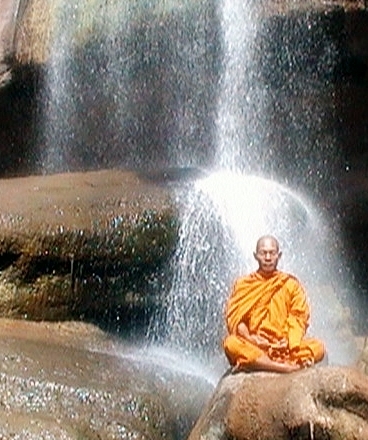
Personally, I have found that the best way for me to adopt a posture of being and non-doing is by setting aside time for regular meditation practice. I can’t say that I’ve fully entered into this peace of being as of yet, but I do feel like this practice has been helpful to me in my journey. Maybe it will be helpful to you as well. There are no special chants or postures in meditation as I practice it. I simply sit upright in a straight-back chair with my hands in my lap and my feet flat on the floor. I let myself become still and quiet to the point where I begin to notice my own unconscious breathing. I focus my attention on the rhythm of my abdomen as it expands and contracts with each breath. Whenever my mind begins to wander, I calmly remind myself to focus on the breath. If I have to do this a hundred times, so be it. I just keep gently redirecting my attention back to my breathing. I try to do this for about twenty minutes or so a day. If you don’t think you have that kind of time or patience, try it for a shorter period. As Dr. Jon Kabat-Zinn says, “Any practice is better than no practice.” If five minutes a day is all you can manage, then go for it. Given time, you just might find yourself longing and ready for more.
Just be. Let go of having and doing. Herein lies eternal life, the kingdom of God, and salvation. This is the whole agenda. It is the beginning and the end of your spiritual journey. That which you seek is already within you.
 Hopping Hadrian's Wall