

Author: J. Barrett Lee
Sometimes, God Calms the Storm; Sometimes, God Calms You
 This week’s sermon from Boonville Presbyterian Church.
Click here to listen at fpcboonville.org
Mark 4:35-41
I’m normally suspicious anytime someone tells me that there are “just two kinds of” anything in this world. I find that reality rarely lends itself to such neat and tidy categories. At no time is this suspicion more likely to be true than when we are talking about relationships. There are all kinds of relationships in this world. Probably about as many different kinds as there are people who have them.
Now, having said that, I’m going to break my own rule. I’m going to look at two different kinds of relationships that people can have with one another: conditional and unconditional.
Conditional relationships are based on something outside the people involved. Something is usually expected of each person involved in the relationship. For example, if you were a boss with an employee who didn’t do the job right and repeatedly showed up to work late with a consistently bad attitude, you probably wouldn’t be inclined to say, “Golly, I bet you’re a nice person with a good heart. This relationship means so much to me, I just can’t fire you!” Would you do that? Of course not. That would be ridiculous. In employer-employee relationships, there are certain expectations that have to be met in order for the relationship to continue. It’s conditional.
But, on the other hand, imagine that your teenage son or daughter comes to you after a bad breakup. “Mom & Dad, so-and-so dumped me and I’m really down about it. Is there something wrong with me? Could anyone ever love me for who I am?” In that moment, no parent in his/her right mind would say, “Golly, I’d really love to be here for you right now, but I am just not impressed with your report card from last semester. Why don’t you bring that C in Chemistry up to a B? Then we’ll talk about who can love you.” Would you do that to your child? No, that would be equally ridiculous (not to mention heartless). Your love for your child is unconditional. There is nothing that child did to earn your love and there is nothing that child can do to lose your love. It’s not based on anything.
We need both kinds of relationships in this world. They’re both good. But it’s really important that we not confuse these two kinds of relationships with one another. A friendly boss is still your boss at the end of the day. That’s just how life works. Likewise, you parents have to help your kids grow up to be healthy and successful people, but that’s still your child at the end of the day (and no bad grade will ever change that fact). We can’t treat our conditional relationships like unconditional relationships. We can’t treat our unconditional relationships like conditional relationships.
Our consumer-oriented culture only knows how to deal with one kind of relationship: the conditional one. Everything comes down to some kind of quid pro quo contract. Most of us believe that unconditional relationships exist, but we don’t have any way understanding or categorizing them in our heads. Our society’s economic style of thinking doesn’t give us the kind of conceptual tools we need to form a mental picture of what unconditional love looks like. The results of this kind of relational confusion are obviously disastrous when we start “keeping score” with our partners or our kids. It starts a never-ending competition where no one wins and everyone loses. The very essence of the relationship gets lost because we’re not thinking of it as the right kind of relationship.
The same thing can happen with our spirituality. A lot of folks in our society tend to look at their personal relationship with God as a kind of quid pro quo contract (i.e. a conditional relationship). They think they can offer God moral obedience, dogmatic belief, or church attendance in exchange for the benefit of answered prayers or an afterlife in heaven. Almost everyone has prayed a prayer like this at some point: “Dear God, help me pass my math test and I’ll promise to stop swearing for a month.” On the one hand, these prayers are great because people are reaching out to connect with God in moments of stress and crisis, which is exactly what we should be doing. On the other hand, they turn our relationship with God into something it’s not: a conditional contract.
We end up with a God who looks more like Santa Claus than Jesus: “he’s making a list, checking it twice, he’s gonna find out who’s naughty or nice.” This kind of God brings us toys in exchange for good behavior. That’s not a very healthy idea of God for us to believe in. We’ll end up fearful of God, nervously glancing over our shoulder, wondering if we measure up to the standard or if we’ll be sent to hell with coal in our stocking.
Another problem with this way of thinking is that it makes the success of our spiritual lives dependent on the success of our material lives. What happens when we pray for a miracle and don’t get the one we wanted? I’ve known many sincere believers who have prayed fervently for the recovery of a loved one from a serious illness, only to watch that person die. “Dear God, heal my wife of cancer and I promise to quit smoking and go to church more often.” What happens to that person’s faith if his/her wife dies anyway? It’s sad to think about, but it happens in the real world. I’ve seen it. Our faith is what we depend on to carry us through these horrible tragedies, so we had better make sure it won’t collapse under the weight of unanswered prayers.
There is a story of a time when Jesus’ disciples missed an opportunity to learn what real faith is all about. This is comforting to me, by the way: knowing that Jesus’ disciples missed the point more often than they got it. It gives me hope for myself. In fact, that’s why I like to read the Bible: it’s the only book I can read and find people more messed up than I am. If God never gives up on them, then I can trust that God will never give up on me.
Anyway, this particular story takes place as Jesus and his disciples were crossing a lake in a boat one day. A bad storm snuck up on them and things were looking pretty grim. They were sure that this was it. All their hard work and sacrifice as disciples was about to go to waste: sucked beneath the mighty waves of the Sea of Galilee. And just where is Jesus while of this is going on, where is the one in whom they had put so much faith? He was taking a nap!
Have you ever felt like that in a moment of crisis? “God, where were you when I got that diagnosis? God, where were you when my loved one died? God, where were you when I got laid off from my job?” I can relate to those disciples in the boat because, sometimes (in my life, anyway), it really feels like God is asleep on the job. I have sometimes asked the very same question that the disciples asked Jesus, “Teacher, do you not care that we are perishing?” Do you not care? That’s the question that bothers us so much in times like that. Does God not care about me? Do I not matter in the grand scheme of things? Does God not exist? Am I all alone in a meaningless world? These are hard questions. In fact, these are the hardest questions a person can ever ask. They are the ultimate questions that give voice to the deepest fears in our hearts.
In this story, the disciples do finally get the miraculous solution they were looking for. Jesus wakes up and calms the storm with his divine power. The hero saves the day. But, after all is said and done, Jesus asks the disciples, “Why are you afraid? Have you still no faith?”
Have you still no faith? Obviously, the disciples had some kind of faith because they knew exactly who to call when the situation got really hairy. They prayed for a miracle and they got it, but they still missed the point. The point is not the miraculous rescue from the storm. That was simply a convenient arrangement of circumstances based on a conditional relationship with God. The point of this story is that God is with us. Jesus, asleep in the stern, is the main image we readers supposed to take away from this story.
God’s presence with you in the storms of life is unconditional. There is no circumstance that God can’t handle. There is no minimum faith requirement for getting “Jesus” into your “boat”. Before, during, and after the storms of life, God is there, holding us all together in the arms of unconditional love. There’s nothing you can do to make God love you any more; there’s nothing you can do to make God love you any less. God loves you and there is nothing you can do about it.
Sometimes, when you face the storms of life, you get the outcome you’re looking for. Sometimes, God calms the storm. But then there are other times, when things don’t work out like we planned, prayed, or hoped. In those moments, God calms you. Whatever the outcome of your circumstances, the important thing to remember is that you are not alone, you matter, God is real, and God does care about you.
Faith, in these circumstances, means trusting in that love and embodying it in the way that we live our lives, so that we, through our love, can become living reminders of God’s love to each other. Where is God when someone you love is going through life’s storms? God is in you. That inner impulse you feel to pay your respects, send a card, bring a casserole, or lend a hand? That’s God. On a larger scale, that still, small voice in your heart that makes you want to speak out against injustice whenever you see God’s children, your brothers and sisters, being treated unfairly? That’s God too.
Whenever you listen to that inner voice and act on it, you are living a faith-filled life. I would even say that you are living a godly life, a spirit-filled life. And, best of all, when you live like that: you are making it easier for someone out there to trust that we are not alone in the storms of life, that we matter, that God is real, and that God cares about us. And that’s what faith is all about.
Moments That Are Bigger Than Themselves
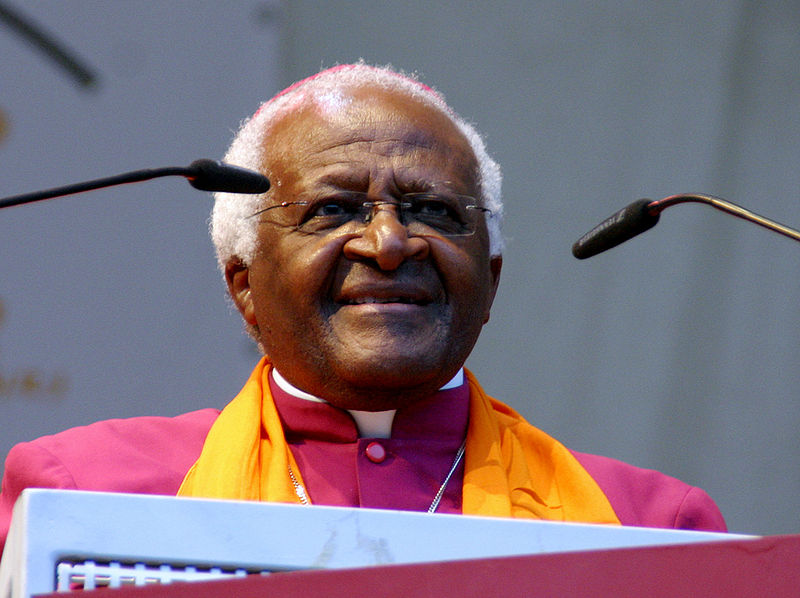
Every now and then, within the typically inane world of late night talk shows, there comes a moment of what Desmond Tutu would call ‘Transfiguration’. In these moments, the glory of grace, meaning, and transcendence is allowed to break thr0ugh into our living rooms. One such moment involved Desmond Tutu himself. Here is his Emmy Award winning appearance on Craig Ferguson’s show.
Longing For Meaning

Last week, I was invited to speak to the Durham Lions Club. This is what I had to say:
On the first day, God created the dog and said: “Sit all day by the door of your house and bark at anyone who comes in or walks past. For this, I will give you a life span of 20 years.”
The dog said: “That’s a long time to be barking. How about only 10 years and I’ll give you back the other 10?’
So God agreed.
On the second day, God created the monkey and said: “Entertain people, do tricks, and make them laugh. For this, I’ll give you a 20-year life span.”
The monkey said: “Monkey tricks for 20 years? That’s a pretty long time to perform. How about I give you back 10 like the Dog did?”
And God agreed.
On the third day, God created the cow and said: “You must go into the field with the farmer all day long and suffer under the sun, have calves and give milk to support the farmer’s family. For this, I will give you a life span of 60 years.”
The cow said: “That’s kind of a tough life you want me to live for 60 years. How about 20 and I’ll give back the other 40?”
And God agreed again.
On the fourth day, God created man and said: “Eat, sleep, play, marry and enjoy your life. For this, I’ll give you 20 years.”
But man said: “Only 20 years? Could you possibly give me my 20, the 40 the cow gave back, the 10 the monkey gave back, and the 10 the dog gave back — that makes 80, OK?”
“OK,” God said. “As long as you’re sure.”
So that is why for our first 20 years we eat, sleep, play and enjoy ourselves. For the next 40 years we slave in the sun to support our family. For the next 10 years we do monkey tricks to entertain the grandchildren. And for the last 10 years we sit on the front porch and bark at everyone.
And that, my friends, is the meaning of life. Now you know.
This, so we’re told, is the meaning of life. But philosophers, thinkers, and wise people from every time, place, and culture have long suspected that’s not true. Something inside of us resists what Shakespeare’s tragic hero, Macbeth, said about the nature and meaning of life:
Life’s but a walking shadow, a poor player,
That struts and frets his hour upon the stage,
And then is heard no more. It is a tale
Told by an idiot, full of sound and fury,
Signifying nothing.
Most of us refuse to believe that life “signifies nothing”. Something within each of us searches for significance. We need to know that our lives have meaning.
I suspect that such a longing for meaning was active in the mind of Melvin Jones, the insurance agent from Chicago who had an epiphany during a lunch group with business colleauges in 1917.
Jones wondered out loud, “What if these men, who are successful because of their drive, intelligence, and ambition, were to put their talents to work improving their communities?”
It wasn’t long before he discovered other like-minded professionals who were asking themselves the same questions. They organized a group that became the first Lions Club. Within three years, they had grown into an international organization.
Then, in June of 1925, Melvin Jones’ vision of community service began to take on flesh as the members of Lions Club International listened to an impassioned plea from that famous icon of American history, Helen Keller. As you all know, Ms. Keller called upon those Lions to become “Knights of the Blind”. Few have ever heard her brief appeal in its entirety, so I would like to share it with you now:
Dear Lions and Ladies:
I suppose you have heard the legend that represents opportunity as a capricious lady, who knocks at every door but once, and if the door isn’t opened quickly, she passes on, never to return. And that is as it should be. Lovely, desirable ladies won’t wait. You have to go out and grab ’em.
I am your opportunity. I am knocking at your door. I want to be adopted. The legend doesn’t say what you are to do when several beautiful opportunities present themselves at the same door. I guess you have to choose the one you love best. I hope you will adopt me. I am the youngest here, and what I offer you is full of splendid opportunities for service.
The American Foundation for the Blind is only four years old. It grew out of the imperative needs of the blind, and was called into existence by the sightless themselves. It is national and international in scope and in importance. It represents the best and most enlightened thought on our subject that has been reached so far. Its object is to make the lives of the blind more worthwhile everywhere by increasing their economic value and giving them the joy of normal activity.
Try to imagine how you would feel if you were suddenly stricken blind today. Picture yourself stumbling and groping at noonday as in the night; your work, your independence, gone. In that dark world wouldn’t you be glad if a friend took you by the hand and said, “Come with me and I will teach you how to do some of the things you used to do when you could see?” That is just the kind of friend the American Foundation is going to be to all the blind in this country if seeing people will give it the support it must have.
You have heard how through a little word dropped from the fingers of another, a ray of light from another soul touched the darkness of my mind and I found myself, found the world, found God. It is because my teacher learned about me and broke through the dark, silent imprisonment which held me that I am able to work for myself and for others. It is the caring we want more than money. The gift without the sympathy and interest of the giver is empty. If you care, if we can make the people of this great country care, the blind will indeed triumph over blindness.
The opportunity I bring to you, Lions, is this: To foster and sponsor the work of the American Foundation for the Blind. Will you not help me hasten the day when there shall be no preventable blindness; no little deaf, blind child untaught; no blind man or woman unaided? I appeal to you Lions, you who have your sight, your hearing, you who are strong and brave and kind. Will you not constitute yourselves Knights of the Blind in this crusade against darkness?
I thank you.
While I was doing my research for this talk today, I was particularly struck by these words from Ms. Keller’s speach: “a ray of light from another soul touched the darkness of my mind and I found myself, found the world, found God.”
She was referring to Annie Sullivan, the teacher who worked indefatigably to help the young Helen Keller live well with her disability. Ms. Sullivan forged a deep connection with Ms. Keller, who would later describe the event mythically as “a ray of light from another soul touch[ing] the darkness of my mind”. And what was the final result? In Ms. Keller’s words: “I found myself, found the world, found God.”
Now, since Lions Club is not a religious organization, you might find it helpful to replace her word, “God”, in your own mind with “that which gives my life ultimate meaning.”
Through the tireless compassion of Annie Sullivan, Helen Keller experienced a deep and profound sense of connection to herself, the world, and ultimate meaning.
It was this deep and profound sense of connection that resonated so powerfully with Melvin Jones and those early Lions. They felt a longing for meaning that they sought to fulfill by serving their communities.
They wanted to be that ray of light from another soul that touched the darkness of someone’s mind so that, together, we all might find a deeper connection with ourselves, the world, and that which gives life meaning.
As we all know, the Lions accepted Helen Keller’s challenge to become “Knights of the Blind”. Generations of Lions Clubs have dedicated their time, talent, and treasure to the treatment and prevention of blindness.
You and I live in a society that desperately needs the light you Lions carry into the darkness. Our culture of consumerism has blinded us to the needs of others. Our ears are deaf to the call of service. We are falsely informed that ultimate meaning can be found in the pursuit of power, profit, and possessions. It’s obvious to anyone who watches TV that we have forgotten the epic words of John F. Kennedy: “Ask not what your country can do for you; ask what you can do for your country.”
This world needs Melvin Jones and his Lions now more than ever. We need to be reminded that the meaning of life can only be measured in what we give, not what we get. So, I encourage you today to continue your work inside Lions Club and out. Helen Keller is still knocking at your door! Will you answer it?
Answer it with your time, talent, and treasure. More than that, answer it with your whole self. Remember what Ms. Keller said: “It is the caring we want more than money. The gift without the sympathy and interest of the giver is empty.”
Through your caring, you are making a better world, not just for blind people, but for yourselves and all of us who long for meaning.
I conclude with the benediction that I give to my church each Sunday:
Go out into the world in peace. Hold on to what is good. Return no one evil for evil. Strengthen the faint-hearted. Support the weak. Help the suffering. Honor all beings. Love and serve, rejoicing in the power of the spirit.
And may the peace that passes understanding keep your hearts and minds in the knowledge and love of that which gives life meaning. Be blessed and be a blessing.
Religious Liberalism 101: A Book Review of Paul Rasor’s ‘Faith Without Certainty’

I haven’t done a book review in a while, but I’ve been reading some good ones. Just yesterday, I finished Faith Without Certainty: Liberal Theology in the 21st Century (Skinner House: 2005) by Paul Rasor, a Unitarian Universalist minister and college professor who currently works as director of the Center for the Study of Religious Freedom.
Enemies and allies of liberal theology are similarly inclined to use the term ‘liberal’ as a synonymn for ‘other’. Until the last year or two, I myself was completely unaware of the historical depth contained within the joint traditions of Unitarianism and Universalism. Knowing only what I’d been told from my evangelical upbringing, I had always thought that Unitarian Universalists (UUs) were ‘loosey-goosey’ and ‘airy-fairy’ liberals who had respect for neither tradition nor truth and adopted an ‘anything goes’ policy in regard to morality and ethics. I would tell jokes like:
Q: What do you get when you cross a Jehovah’s Witness with a Unitarian Universalist?
A: Someone who comes knocking on your door for no apparent reason.
OK, I have to admit that I still chuckle at that one, even though I know it’s not true. UUs are deeply committed to their theology and ethics. If one knocks at your door, you can bet that it’s for a very good reason. What I discovered is that UUs (as well as other religious liberals) are committed to process over content. In other words, they’re more interested in how you live than what you believe. This is beautifully reflected in the UUA’s Seven Principles. I would love to go into greater detail about them here, but that will have to wait for another blog post. The UUA, while it represents the largest organized group of religious liberals, is not the only place where they hang out. There continue to be many of us who try to embody a similar flavor of religion within our respective communities. What matters is that we who identify ourselves with this label (‘liberal’) must be able to simultaneously hold and share a conscious awareness of who we are and what we stand for in a positive sense.
Given the myriad ways that the term ‘liberal’ gets thrown around without being defined, I’m grateful for Rasor’s concise and readable primer that actually digs into the real roots and trajectories of the liberal theological tradition.
If you don’t have time to read the entire book, the first two chapters after the introduction will familiarize you with what it is that religious liberals believe and how we came to embrace those values. Whether you’re out to support or criticize us, it’s important that you know what you’re getting into. Love or hate us for what we are, not what we’re not.
The remainder of the book lays out some of the challenges and frontiers that liberal theology is currently facing in its ongoing development. With the arrival of the postmodern era, liberal religion (as a decidedly modern phenomenon) is reevaluating many of its core commitments (in much the same way that evangelical Christians (another modern movement) are also doing via the ‘Emergent Church’ movement). Hard and fast categories, such as rugged individualism and universal human experience, are being questioned in the light of community, culture, and language.
Rasor is highly critical of his own liberal tradition in relation to issues of race and social class. Despite its value of diversity, liberal religion continues to exist as a predominantly white and middle-class movement. While his criticisms are honest and accurate, I wish that he had spent more time with them. He mentions social Darwinism and the rise of manifest destiny in America, but he says nothing of Eugenics or the Holocaust, both of which were fueled in part by liberal theology. These massive moral failures demonstrate that no one group, however utopian their ideals, is above the human tendency toward self-justified violence and oppression. My primary criticism of Rasor’s book is that it seems to minimize and/or ignore these most prominent failures of liberal religion.
On the other hand, I was highly impressed by Rasor’s distinction between liberal and liberation theologies. These two categories are often associated with one another in the common mind, mainly because of shared emphases on social justice. However, as Rasor observes, they arise from different historical sources, make use of different methods, and emerge with very different values and convictions. Liberation theologians tend to hold scripture and tradition much more closely, even as they criticize and reinterpret them. Not all theological liberals are liberation theologians (and vice versa). One need only look at the sermons of Archbishop Oscar Romero of El Salvador to see his deep commitment to the historical orthodoxy of Roman Catholicism. If anything, I came away from Rasor’s book with an awareness that the construction of a theology that is simultaneously liberal and liberationist would prove to be a most difficult task. Indeed, evangelicals would probably have an easier time of it, given the place they grant to the Bible in their theological systems.
All in all, I highly enjoyed Rasor’s book during my two weeks of vacation. I expect that I will keep it on my shelf and refer to it often as a concise introduction to what religious liberals actually believe.

Drifting
Enjoying my vacation. Cabins and campuses last week. Bookstores and beaches this week.
Here’s a little Andy McKee to simultaneously help you relax and blow your mind this morning.
The Garden of Your Mind
 Fred Rogers can hardly be called an “unsung” hero, but there are few who appreciate how deep were the roots of his wisdom and spirit. He was one of my predecessors in the Presbyterian ministry. He, more publicly than any other Presbyterian in recent memory, embodied the Reformed tradition’s commitments to worldly spirituality and the sacredness of all life. Shortly after his ordination, Mr. Rogers realized that he hated preaching, so he pursued his ministry in the TV studio rather than the church. His message was never explicitly religious, but he communicated the kind of universal spiritual values that continue to shape multiple generations of children. I’m proud to be his posthumous colleague in the Presbyterian Church.
Here’s a wonderfully autotuned video produced by PBS:
I Am Life

I am that great and fiery force sparkling in everything that lives;
in shining of the river’s course, in greening grass that glory gives.
I shine in glitter on the seas, in burning sun, in moon and stars.
In unseen wind, in verdant trees I breathe within, both near and far.
And where I breathe there is no death, and meadows glow with beauties rife.
I am in all, the spirit’s breath, the thundered word, for I am Life.
-Hildegard of Bingen
On the Road Again
Hey there, Superfriends and Blogofans,
For the next two weeks, I’ll be taking my first vacation in two years. I’ll try to keep the new posts and updates coming as frequently as possible, but alas, one is not always within mooching distance of a decent wireless connection.
I’ll be in NC for most of that time: first in the Charlotte area, then Durham, hopefully a brief excursion to Boone, and a trip to the beach. While I’m in the Triangle, you will probably be able to find me any time at the Bojangles on 15-501 or sitting on the floor of the religion section at The Bookshop on Franklin Street. Give a holla.
Barrett
 Hopping Hadrian's Wall