I’ve literally been looking for a copy of this book for years. Then, last Sunday, one of the elders in my congregation handed me one.
I’m looking forward to reading this for several reasons. First, it’s a classic of the Civil Rights Movement. Martin Luther King read it and drew all kinds of inspiration from it. In fact, I can’t help but tell the story of Thurman’s visit to India, where he was granted an audience with Mahatma Gandhi. Gandhi lamented that he didn’t have more opportunity to share his message of nonviolence with America, but he also prophesied that a member of the African American community would one day arise and do so. Shall we say that Gandhi foretold to Howard Thurman the ministry of Martin Luther King?
The second reason why I am excited about this book is because of Thurman’s focus on the person of Jesus. This year, as I have been struggling to work out for myself what a post-evangelical and liberal faith looks like, the Christological question looms large. I don’t want to be an unfaithful friend to Jesus, but any relationship we have must be our own, not dictated or categorized by strict adherence to literal interpretations of creeds and formulae. I find myself drawn to the motto of the Unitarian Universalist Christian Fellowship: “Freely Following Jesus.” Something about that rings true to what I’m trying to do.
The final reason why I am excited to finally get my hands on a copy of this book is closely related to the previous reason. I wonder if God might be currently working in my life to redeem my experience of Protestantism (particularly in its Baptist expressions). Through individual voices like Thurman, King, and Harry Emerson Fosdick and through churches like Wedgewood and Binkley Baptist, I am coming to see a different side of the Baptist tradition than the legalistic fundamentalism I experienced at Cresset Christian Academy. I’m hearing, perhaps for the first time, the voice of freedom in their politics and theology. It’s an inspiring vision. I had a shocking thought the other day: I might even one day consider taking a call from a Baptist congregation (provided that it was more like “Howard Thurman” Baptist than “Jerry Falwell” Baptist).
So, that’s what I’ve got for now…

debwestover's avatarMissional Living

At the brink of the Civil Rights Movement, pastor and writer Howard Thurman released the book Jesus and the Disinherited. Prevalent then and now, the book provides a foundation of reasoning for the need for non-violent movements to fight the oppressive systems that exist. Thurman’s book focuses primarily on the disinherited state of African-Americans at that time in the United States, where segregation was the norm, Jim Crow laws existed, and people’s rights were being disregarded.

Using Jesus as the ultimate example, Thurman discusses how to overcome, in a peaceful manner, the frustration and pain that can develop from being oppressed. Jesus life provides endless examples of how to react to oppressive and controlling systems. He himself was part of a minority group within the Roman Empire, a large dominant and controlling group, and not only was he part of the Jewish minority, he also came from a poor…

View original post 266 more words

The Art of Letting Go

Over in Africa, they have a very interesting way of catching monkeys.  First, they secure a hollowed-out coconut to the end of a line and make a small hole in one end.  Next, they put something small and tasty (e.g. some nuts) inside the coconut.  Eventually, a monkey comes along and realizes that there’s a treat inside the coconut.  It reaches inside to get the treat.  Here’s the catch: the hole in the coconut is only big enough for the monkey’s hand to get through if it is empty.  As long as the monkey is holding onto the treat, it can’t get out.  If the monkey wanted to, it could let go and get away any time.  However, they almost never do that.  Instead, they hang on for dear life, even though it means their death.

Letting go is a hard thing to do.  Just ask parents who have ever dropped a sons or daughters off at college.  You hope that everything you’ve said and done over the past 18 years will be enough to guide them on their way, you draw out the goodbyes for as long as you can, but there’s no stopping that inevitable moment when you just let go, get back into the car, and drive away without them.

Our Buddhist neighbors have a lot to teach us Christians about the art of letting go.  Their entire spiritual path is built around that idea.  They start with the observation that life is full of suffering.  We never suffer, so they say, for the reasons we think we do.  We think we suffer because we lack something we want.  We say things like this: I wish I had a better job.  Why?  So I can make more money.  Why?  So I can buy more expensive things.  Why?  So I can impress this other person.  Why?  So she or he will like me.  And so on and so forth.  Happiness, we think, is always just one step outside of our reach.  We think it lies in some other job, object, or person.  If I could just have that, then I would be happy.

“No,” the Buddha says, “you won’t be.”  Real suffering doesn’t come from your lack of something, but from your desire for it.  If you can learn to let go of that inner urge to always be reaching and grabbing for the next big thing, you’ll find real happiness.  Along the way, you’ll also begin to find out who you really are inside.  We tend to lose sight of that in our endless pursuit of the next big thing.  We get lost in the rat race.  As we learn to let go, we find ourselves again.  The end result of this process is what Buddhists have always called Enlightenment.  All of their rituals and meditation exercises are oriented toward this one goal.  It’s all about letting go.

The art of letting go factors rather highly in this morning’s reading from the gospel according to Mark.  Our story is part of a series of stories that we started talking about two weeks ago on Transfiguration Sunday.  It began with the story of a blind man who Jesus had to heal twice.  After the first time Jesus touched him, he was beginning to see, but everything was still blurry.  After the second time, he could see clearly.  We took this as a kind of metaphor for Peter, one of Jesus’ disciples, who was in the process of learning how to see (in a spiritual sense), but wasn’t quite seeing things clearly yet.

In the section just before today’s passage, Jesus asks Peter, “Who do you say that I am?”

Peter boldly replies, “You are the Messiah.”

Then Jesus begins to explain what it means to be the Messiah.  He tells his disciples that the Messiah “must undergo great suffering, and be rejected by the elders, the chief priests, and the scribes, and be killed, and after three days rise again.”

At this point, Peter steps in and pulls Jesus aside with some friendly advice.  One might say that Peter saw Jesus as the hot new presidential candidate and himself as Jesus’ campaign manager.  Peter’s idea of Jesus as the Messiah (or “Christ”) was very different from Jesus’ idea of himself.  Peter thought the Messiah was supposed to be part political leader, part military revolutionary, and part spiritual guru: Che Guevara meets Barack Obama meets Dr. Phil.  With God on their side, they were supposed to have a meteoric rise to fame and power.

But Jesus, it seemed, had a very different idea of what his life is supposed to be all about.  Instead of fame and fortune, he talked about suffering and rejection.  This really got under Peter’s skin, so he got up in Jesus’ face about it, but Jesus let him have it right back.

“Get behind me, Satan!”  He said, “For you are setting your mind not on divine things but on human things.”  In other words, there’s a bigger story going on than the one you see right in front of your face.  Jesus knew how he fit into that bigger story because he knew who he was as God’s beloved Son.  He would conquer the world, not through violence, but through the power of self-giving love.  This was not an insight he could have had if he had been busy selling out to his culture’s idea of what a Messiah should be.  But Peter, as it turns out, was having a hard time letting go of that idea.  He was holding onto it so tight because he was absolutely convinced that the future security and prosperity of his country depended on it.

Don’t people still do that all the time?  If you flip through the various noise news channels on any given day, you’ll find no shortage of people angrily shouting at each other because everyone is convinced that their idea holds the key to peace and plenty in the future.  Whenever they stop to take a breather, the audience is instantly swamped with commercials for products that also claim to hold the secret to happiness.

We human beings have this crazy tendency to get so caught up in our own egos, ideas, products, and relationships that we forget who we really are inside.  We are God’s beloved children.  Our lives are part of a bigger story that has been going on since the beginning of time and will continue until its end.  Jesus never forgot that truth.  His faith in his identity as God’s beloved Son gave him the strength to resist the temptation to sell out to the popular ideology of his day.  Suffering and rejection didn’t scare him one bit because he knew the great Love at the center of the universe that transcends fear and death.

Today, God is inviting you to enter into a greater awareness of that Love by letting go of your attachment to those things, people, or ideas that compete for your trust.  Jesus says, “If any want to become my followers, let them deny themselves and take up their cross and follow me. For those who want to save their life will lose it, and those who lose their life for my sake, and for the sake of the gospel, will save it. For what will it profit them to gain the whole world and forfeit their life? Indeed, what can they give in return for their life?”

You are invited to participate in the art of letting go and trust in the Love that is stronger than death.  Maybe the thing for you to let go of is an idea, thing, or person.  Maybe it’s an old grudge or crush.  Maybe it’s an unhealthy attachment to work or a cause you believe in.  It can be good things too:  like your attachment to your family, church, or system of beliefs.  Many of these are wonderful things, but they can’t tell you who you are or give you lasting happiness.  Whatever your attachment is, Jesus is inviting you to let it go and rediscover your true identity as God’s beloved child.

It’s not an easy path.  Christians call it “the Way of the Cross” for a reason.  You will have to face your own fear of mortality.  You will have to sacrifice your sense of security.  But the promise, as Jesus gives it, is that you can ultimately save your life by letting go of it.  That’s what faith in the Resurrection is all about.

None of us does this perfectly.  We’re all refusing to let go of something inside that keeps us from embracing who we really are and living the kind of full life that God intends for us.  The good news is that our refusal to let go doesn’t change who we are as God’s beloved children; it only keeps us from recognizing the truth about ourselves.

As I was writing this sermon, I got a message about an old college buddy who passed away quite suddenly this weekend.  Like all such announcements, it reminded me of the fragility of our biological existence.  It also reminded me that the call to let go extends even to letting go of life itself.  God asks a lot from us (everything, in fact).  I compare it to doing a trust fall off the edge of the Grand Canyon, believing that we are held, as the apostle Paul says, by a reality that is higher, deeper, longer, and broader than we can possible imagine.  It is the Love that passes knowledge and the peace surpassing understanding.  When we are called upon to trust and let go, whether it’s letting go of some person, thing, or idea that we’re clinging to for happiness and security or letting go of life itself in our final moments, we journey forward in faith, trusting that we are not wandering into the darkness, but are being welcomed into the light.  We are not enveloped by oblivion; we are embraced by eternity.

(Evolutionary Thoughts) Imperfect World: Feeling Honored to Exist

A prayer by William Cleary in Prayers to an Evolutionary God (p.33):

How can we make sense of a world of so much imperfection, Holy Mystery, Evolutionary God?

Is there “a balm in Gilead” to heal our mystification, on oasis of meaning amid the desert sands of absurdity and heartache?

A shaft of light, of enlightenment, emerges from the evidence of a cosmos-wide evolutionary process wherein trial and error, randomness and improvisation, are the very way of divine creativity.

Open our hearts to hear this news if there is guidance for us here.

Your creation, God of Light, is not so much a battleground as some myths would have it, or a testing place of good against evil, or of nation against nation.

It is fundamentally a colossal flower opening up, a single family tree blossoming and growing, a cosmic symphony unfolding into meaning and elegance, where variance and dissonance are necessary to our evolving process.

This is your beloved world, Enlivening Spirit, and it is an honor to be an imperfect part of it.  Amen.

Unlikely Encounters

It was one o’clock in the morning and I was driving to my home an hour away from the hospital where my wife and son are staying.  I made a pit stop at a Service Area on the New York Thruway that had a McDonald’s.  Having made the initial unexpected trip to the ER during my workday, I was still in my clerical collar.  It just so happened that a busload of Orthodox Jews from Toronto was passing through at the same time.  There was an elderly man in line behind me who obviously spoke English as a second language.  When he tried to buy coffee with Canadian coin, he encountered resistance from the staff behind the counter.  He didn’t seem to understand.

“But the money is good!”

I stepped in and offered to pay.

“Why are you doing this?”

“Just trying to be nice.”

“I don’t like it,” he said in reference to the offered charity.

The cashier suggested that he pay me and I pay her.  That seemed acceptable to him.  He gave me a looney.  I told him I used to live in Canada, so it would be a nice reminder of days gone by.

“Here,” he said as he handed me the coin, “You can keep it as an antique.”

His name is Leo and he is originally from Poland.  He is also a Holocaust survivor.  Although he was only a small boy then, he lost his entire family.  He lives in Toronto now.

I just had to laugh in wonder at the moment: a Holocaust survivor and a Presbyterian minister, both decked out in traditional identifying garb, brought together for the briefest instant of kindness and Tikkun Ha’Olam (‘fixing the world’) by the flowing energies of life, the universe, and God.  I wish I could have sat down and talked with him for longer, but his bus was leaving and he had to go.  We said goodbye and I sat down with my food to listen to the lyrics of the muzak coming over the loudspeakers: “There’s all kinds of people in this world.”

I think I’ll hang onto that looney for a while.

Holding Onto Hope

I lectured on William James in yesterday’s class.  Here’s a passage of his that I like:

Most religious men believe (or ‘know,’ if they be mystical) that not only they themselves, but the whole universe of beings to whom the God is present, are secure in his parental hands.  There is a sense, a dimension, they are sure, in which we are all saved, in spite of the gates of hell and all adverse terrestrial appearances.  God’s existence is the guarantee of an ideal order that shall be permanently preserved.  This world may indeed, as science tells us, some day burn up or freeze; but if it is part of his order, the old ideals are sure to be brought elsewhere to fruition, so that where God is, tragedy is only provisional and partial, and shipwreck and dissolution are not the absolutely final things.

William James, The Varieties of Religious Experience, 1902

The Preacher’s Prayer

A prayer that I wrote for my friend, Rodney Duke, about ten years ago.  Pastors, priests, and ministers: feel free to borrow it for Palm Sunday.

God, may your Holy Spirit ride upon my words into the hearts and minds of this congregation, just as Jesus rode a donkey into Jerusalem; and may that serve as a reminder that you can still use a jackass to reach your people.  Amen.

A Frame of Reference

Here’s an inspiring passage I found in on pages 19-20 in Douglas F. Ottati’s book, Theology for Liberal Presbyterians and Other Endangered Species (Geneva: 2006).

Will the mainline churches in America hold together or split apart?  Will liberal Protestants criticize the excesses and the idols of contemporary American culture but also remain open to the lessons and wisdom that nevertheless seem present in the wider society and culture?  Will liberal Protestants simply disappear?  Will the United States find positive, realistic, and responsible ways to exercise power in a multilateral world?  What shall we say and do about racism, sexism, and homophobia; about urban policy, transportation, and education; about matters of war and peace?  Can we ever become stewards of our natural environment?

These are among the important questions we face.  Nevertheless, for Christians and their communities, the more basic question is this: How shall we center a faithful witness?  The function of Christian theology is to help us answer this question, and I propose that we answer it in a single sentence: We belong to the God of grace.

Once we are clear about this, a number of things follow.  First, we live in assurance, refuse to set limits on the extent of God’s faithfulness, and refuse to exclude anyone from the scope of grace and redemption.  We then work for an inclusive church, support a ministry of reconciliation, and invite everyone everywhere to lay hold of the assurance and confidence that come with the knowledge of a gracious God.  Second, we acknowledge the human fault and, without losing hope, maintain a realistic attitude toward the present age and its daunting challenges.  Finally, we affirm that all people have worth, and we commit ourselves to public practices, policies, and leadership that respect persons, pursue equitable opportunities for the poor, and care for those in need.

We belong to the God of grace.  This simple confession will enable us to interpret the many threats and conflicts and issues and promises of our day in a definite theological frame of reference.

Gospelling Socially

My thoughts were stirred toward the Social Gospel movement by a fantastic guest lecturer in my Philosophy of Religion class this morning.  So, I thought I might post a little from my old historical friend, Walter Rauschenbusch, an early twentieth century Baptist minister whose work I discovered while living in western North Carolina.  He taught at Rochester Divinty School in upstate New York.  It just so happens to be the place where I took my ordination exams for the PC(USA).  What Rauschenbusch had to say in the second decade of the twentieth century continues to ring eerily true in the second decade of the twenty-first, especially in light of the recent frustrations exposed by the convulsions of Occupy Wall Street:

The natural resources of the country are passing into the control of a minority.  An ever increasing number of people are henceforth to live in a land owned by an ever decreasing number.  The means of traffic are the arteries of the social body; every freight car is a blood corpuscle charged with life.  We have allowed private persons to put their thumb where they can constrict the life blood of the nation at will.  The common people have financed the industry of the country with their savings, but the control of the industry has passed out of their hands almost completely.  The profits of our common work are absorbed by a limited group; the mass of the people are permanently reduced to wage-earning positions.  The cost of living has been raised by unseen hands until several millions of our nation are unable to earn even the bare minimum which social science declares necessary for health and decency, and all families living on a fixed income have felt a mysterious and suffocating pressure.

All this was the necessary outcome of our economic system, but it was a sore surprise to most of us when the process began to culminate and we saw the end of our own doings…

…Sin is the greatest preacher of repentance.  Give it time, and it will cool our lust in shame.  When God wants to halt a proud man who is going wrong, he lets him go the full length and find out the latter end for himself.  That is what he has done with our nation in its headlong ride on the road of covetousness.  Mammonism stands convicted by its own works.  It was time for us to turn.

We are turning…

…Were you ever converted to God?  Do you remember the change in your attitude to all the world?  Is not this the new life which is running through our people the same great change on a national scale?  This is religious energy, rising from the depth of that infinite spiritual life in which we all live and move and have our being.  This is God.

Walter Rauschenbusch, Christianizing the Social Order, 1916

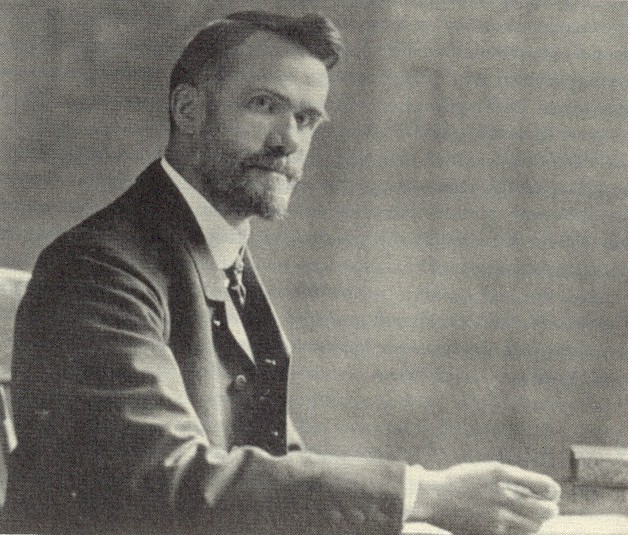
Walter Rauschenbusch (1861-1918)