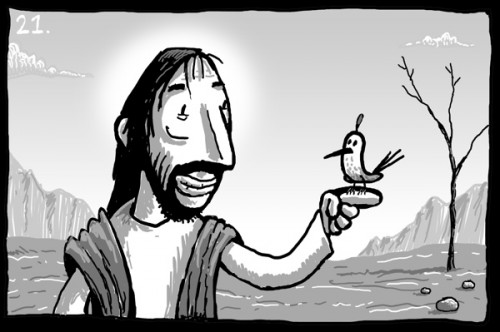
Repent! Think Different.

This morning’s sermon from First Pres, Boonville.

The text is Mark 1:9-15.

Three brothers grow up together in Dublin, Ireland.  When they come of age and go off to make their way in the world, they make a pact: whenever they drink, they’ll always order three pints of Guinness, one for each brother.  One of the brothers settles in New York, where he finds an Irish pub and becomes a regular.  He explains the pact to the barkeep, who always knows to bring him three pints.  Then, one fine day, the man comes in and asks for only two pints.  The barkeep realizes that one of his brothers must have died.

“Condolences,” he says as he brings the pints over, “these are on the house, on account of your loss.”

“What are you talking about?”  He says, “There’s no loss.  I just gave up drinking for Lent!”

I think this guy has the right idea about Lent.  He’s creative!  He’s thinking outside of the box.

Traditionally, this is the season of the church year where they really turn on the guilt.  A lot of people talk about “giving something up for Lent.”  This tradition got started way back in the olden days when new church members (called “catechumens”) would spend several weeks spiritually preparing themselves for baptism on Easter Sunday.  They would pray and fast for extended periods of time, sometimes intentionally going without food for days on end.

Eventually, this practice was extended to all Christians and has been watered down to the point where people symbolically try to break a bad habit or deny themselves some minor luxury, like chocolate, during the 40 days before Easter (as if going without M&Ms for a few weeks was really supposed to be spiritually empowering).  Our scripture readings in church during this time tend to be a little more somber in tone.  For example, Jesus starts his sermon in today’s reading from Mark’s gospel with a call for people to “repent.”

I don’t know about you, but that word (repent) stirs up some very specific mental images for me.  Maybe it’s just because I grew up down south in the Bible Belt, but I have several memories of fiery preachers on street corners with signs that said things like, “Repent, sinner!”

These guys (they were usually male), had a knack for going into great detail about the pains of hell that awaited those sinners who would face the wrath of God on the Day of Judgment.  The only way out, they said, was to repent.  And by repent, they mean: convert to (our version of) Christianity and feel really, really sorry for all your sins.  Do that, and maybe (just maybe) God won’t burn you in hell for eternity.

So, that’s their story.  I think I want to tell a different one.  I think we need to take a good, hard look at that word, repent, and see what it actually means, rather than let some fire-breathing preacher do the job for us.  The word repent in Greek is metanoia, which literally means “to change the way you think.”

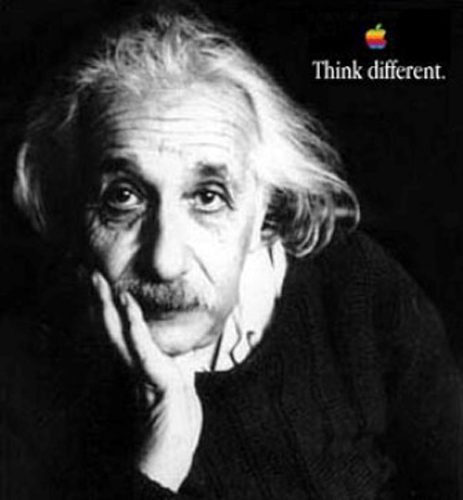
Do you remember that series of advertisements for Apple Computers that came out about ten years ago?  They had pictures of all kinds of original geniuses like Albert Einstein, Jim Henson, Mahatma Gandhi, and Jane Goodall.  And next to each person’s photo was the phrase: “Think Different.”  To me, that’s what the word repent means: “Think Different.”  Think outside the box.  Get creative.  Imagine new possibilities.  “Explore strange, new worlds.  Seek out new life and new civilizations.  Boldly go where no one has gone before.”

So the, what is it that we’re supposed to “think different” about?  Well, the full text of Jesus’ sermon from today’s gospel reading goes like this: “The time is fulfilled, and the kingdom of God has come near; repent, and believe in the good news.”

We’ve already talked about what “repent” means.  What about the rest of it?  As many of you already know, one of my favorite phrases in the entire Bible is, “the kingdom of God has come near.”  A lot of folks like to think of “the kingdom of God” (a.k.a. “the kingdom of heaven”) as a happy place that exists way up on some cloud or in an alternate dimension where people go when they die, but that’s not how Jesus uses the phrase.  Listen to what he says again, “the kingdom of God has come near.”  Another way to translate “has come near” is “is at hand.”  Let’s try something.  If you’ve been hanging out here for a while, you’ve probably done this with me before, but we’ll do it again, just so the message sinks in.  Hold your hand out in front of you and look at it.  Jesus says, “the kingdom of God (heaven) is at hand.”  How far away is heaven?  As close as your own hand.

For Jesus, the kingdom of God is a present reality.  It has to do with this world.  The kingdom of God is Jesus’ vision of what this world would be like if God were allowed to be in charge instead of the powers that be.  In a world where “might makes right,” Jesus has the audacity to stand up and say, “Blessed are the meek, for they will inherit the earth” and “blessed are the peacemakers, for they will be called the children of God.”  Remember the Berlin Wall?  It stood for decades as a symbol of the barrier between democracy and communism.  The powers that be on both sides of that wall had their guns and missiles pointed at each other around the clock.  Do you remember how it came down in a single night in 1989?  It didn’t happen because we Americans scared those Russians away with our big, bad nuclear weapons.  It happened because one East German official mistakenly announced on TV that their borders were now open.  Later that night, as people started lining up at the border, Harald Jaeger, a low-ranking border-guard, made the first decision to open his gate.  People flooded through to the other side.  Within days, the wall was torn down.  Within a year, Germany was reunited.  Two years after that, the great Soviet Union itself was gone.  An entire generation of Americans and Russians was raised to believe that the Cold War would end with a mushroom cloud and the fulfillment of Mutually Assured Destruction.  But it ended with dancing instead of marching, singing instead of marching, and the sound of champagne bottles being uncorked instead of the sound of gunfire.  Who could have imagined such a peaceful resolution?  “The kingdom of God has come near.”

Now, that’s a big-picture example.  I think the kingdom of God comes near to us every day.  Whenever we’re at the pharmacy, café, or supermarket and we look the server in the eye, “the kingdom of God has come near.”  Whenever some jerk cuts you off in traffic and you don’t give him the finger or blow your horn out of spite, “the kingdom of God has come near.”  Whenever two people in conflict sit down together and try their best to work it out, “the kingdom of God has come near.”  Whenever your kid comes home and says, “Mom & Dad, I’m gay,” and the first words out of your mouth are, “I love you,” “the kingdom of God has come near.”  Whenever your spouse is in the hospital and you’re standing by the bed, holding his/her hand and saying, “We’ll get through this,” “the kingdom of God has come near.”

Whenever aging parents agree to let their children hire in-home assistance for them, even though they don’t think they need it, but know that it will put their children’s minds at ease, “the kingdom of God has come near.”

The kingdom of God is a present reality.  It’s Jesus’ vision of what this world could be like.  He calls it “good news” and invites people to “believe in” it.  Have you ever “believed in” something or someone?  Maybe there’s some high school kid who is nervous before that big performance or big game and the coach or teacher says, “I believe in you.”  It’s empowering, isn’t it?  A statement like that can really make a difference in a kid’s life.  And I don’t care how old you are, whether you’re age 9 or 90, we all still need to hear that from time to time: “I believe in you.”  In the same way, you might donate your time and energy to cause you believe in: feeding the hungry, taking care of young kids, or helping underprivileged families have a Christmas.  When you believe in it, you give yourself to it, and that makes a difference.  Jesus called it “good news.”  He invites all of us to believe in that good news: “the kingdom of God has come near.”

And that leads us back to that word, repent.  It’s has nothing to do with guilt or fear.  It has everything to do with thinking outside of the box.  The great scientist Albert Einstein once said, “A new type of thinking is essential if [hu]mankind is to survive and move toward higher levels.”  Jesus is inviting you today to embrace the mystery of imagination and participate in the miracle of creativity.  Think different in order to make a difference.  That’s the “good news” Jesus is inviting you to “believe in” and be part of: the kingdom of God come near, the kingdom of heaven-on-earth.

We pray for it every Sunday:

“Thy kingdom come, thy will be done on earth as it is in heaven.”
Unrest

A fierce unrest seethes at the core
Of all existing things:
It was the eager wish to soar
That gave the gods their wings.

From what flat wastes of cosmic slime,
And stung by what quick fire,
Sunward the restless races climb!–
Men risen out of mire!

There throbs through all the worlds that are
This heart-beat hot and strong,
And shaken systems, star by star,
Awake and glow in song.

But for the urge of this unrest
These joyous spheres were mute;
But for the rebel in his breast
Had man remained a brute.

When baffled lips demanded speech,
Speech trembled into birth–
(One day the lyric world shall reach
From earth to laughing earth)–

When man’s dim eyes demanded light
The light he sought was born–
His wish, a Titan, scaled the height
And flung him back the morn!

From deed to dream, from dream to deed,
From daring hope to hope,
The restless wish, the instant need,
Still lashed him up the slope!

I sing no governed firmament,
Cold, ordered, regular–
I sing the stinging discontent
That leaps from star to star!

-Don Marquis, 1878-1937

Shall I Ever Get There?

The Wanderer Above the Mists, by Caspar David Friedrich, 1817-1818

I am being driven forward
Into an unknown land.

The pass grows steeper
The air colder and sharper
A wind from my unknown goal
Stirs the strings of expectation.

Still the question
Shall I ever get there?
There where life resounds
A clear pure note in the silence.

-Dag Hammarskjöld

Evolutionary Thoughts: Life

It is time to outgrow…

the fear-filled grip of mechanistic consciousness, rigidly clinging to the notion that creation is little more than dead, inert matter in a hostile, brutal, and flawed universe, where the blind forces of natural selection engage us in a battle for survival, and we end up ignorant of the mysterious life-forces that empower us from within and without.

It is time to embrace…

that wild, erotic power for creativity, embedded in the heart of the universe from time immemorial, evoking and sustaining life in a multifarious range of possibilities, revealing a depth of wisdom and purpose that we humans have scarcely begun to acknowledge or appreciate.

Diarmuid, O’Murchu, Evolutionary Faith, p.73

While not directly related, I thought I'd post a photo of a stole that I've been coveting.

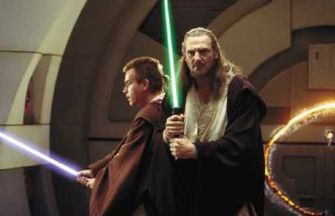
Who Wants To Be A Jedi?

Star Wars as a Modern Myth

Yesterday, I was having a lively after-class discussion with my students in the coffee bar at Utica College.  The topic: Star Wars as a modern myth.

While I have nothing but disdain for George Lucas as a megalomaniac and director, I have to tip my hat to him as one of the most brilliant cinematic storytellers of the 20th century.  He intentionally wrote Star Wars according to the mythical pattern laid out by Joseph Campbell in The Hero With A Thousand Faces.  Campbell applied Jungian archetypes to the study of comparative mythology.  He argued that all the major myths of the world’s religions conformed to a pattern that he called the monomyth.

While Campbell specifically mentions the stories of Prometheus, Osiris, Buddha, and Christ, we can identify the monomythical pattern in the more recent works of L. Frank Baum, J.R.R. Tolkien, J.K. Rowling, and yes, even George Lucas.  Thus, Dorothy Gayle, Frodo Baggins, Harry Potter, and Luke Skywalker are all basically the same character.  What makes Star Wars different from the others is that Lucas was directly inspired by Campbell and intentionally wrote Star Wars as a “modern myth” according to Campbell’s pattern.

The Jedi as a Religion

Given that Lucas intentionally designed Star Wars as a myth, it shouldn’t be surprising that an actual religion has arisen around it.

The Jedi have been objects of admiration by many (including myself).  Part monk, part Samurai, and you get to carry a lightsaber.  Who wouldn’t want to convert?

In fact, you can.  The Universal Life Church will gladly ordain you as a legal minister over the internet and, for the low price of $10.99, you can order a certificate that identifies you as a Jedi Knight.  I’m not kidding.  Click here if you’re interested.

For those who are looking for a little more commitment, check out the Jedi Church website.

Around the time that Revenge of the Sith was released, science fiction legend Orson Scott Card published an article on the Jedi as a religion.  The question that Orson Scott Card asks is, if we take the Star Wars movies as the foundational texts for the Jedi religion, what kind of religion can we expect to emerge?  Are the Jedi, as presented in the films, the kind religious order that we would actually like to see?  Card has some fascinating things to say about it.

Click here to read his fantastic article, No Faith in this Force

Evolutionary Thoughts: Emptiness

More collected tidbits from Diarmuid O’Murchu’s Evolutionary Faith.

The dynamic vacuum is like a quiet lake on a summer night, its surface rippled in gentle fluctuations, while all around, electron-positron pairs twinkle on and off like fireflies.  It is a busier and friendlier place than the forbidding emptiness of Democritus or the glacial ether of Aristotle.  Its restless activity is utterly fascinating!

-Hans Christian von Baeyer

According to this startling new picture, in the beginning was Nothing.  No space.  No time.  No matter or energy.  But there was the quantum principle, which states that there must be uncertainty, so even Nothing became unstable, and tiny particles of Something began to form.

-Michio kaku

Since what people call God is not one being among other beings, not even a discrete Supreme being, but mystery which transcends and enfolds all that is, like the horizon and yet circling all horizons, this human encounter with the presence and absence of the living God occurs through the mediation of history itself in its whole vast range of happenings.  To this movement of the living God that can be traced in and through the experience of the world, Christian speech traditionally gives the name Spirit.

-Elizabeth Johnson

It is time to outgrow…

our anthropocentric desire to measure and quantify every aspect of existence; to dismiss as irrelevant those aspects we cannot measure or control according to our human-made norms; and to attribute primary significance only to that which can be objectively observed and quantified.

It is time to embrace…

the radical openness that characterizes our universe, and the mysterious fullness that inebriates the whole of reality; the seething energy surfacing from the quantum vacuum, forever begetting novelty and vitality in a universe poised for unlimited innovation, creative possibility, and divine exuberance.

Mountaintop Experiences

This morning’s sermon from First Presbyterian, Boonville.

The text is Mark 9:2-10.

Click here to listen at fpcboonville.org

Steve Urkel's unrequited first crush on Laura Winslow made him famous.

Who remembers their first real crush?  C’mon, who doesn’t?  It’s one of the most unforgettable rites of passage in life.  It happened to me in the seventh grade.  Her name was Brooke.  She was funny, pretty, and everything else that a thirteen year old guy could want.  Above all else, what I liked best about Brooke was that she was so very kind.  Those of us who have ever worked with middle schoolers know how rare that is.

It was about that time when the rest of our friends at school were beginning to pair off with one another.  We were goofing off as usual and I joked that we should get together too.  I believe her exact words were, “Yuck, no!”  And we all had a good laugh.  But then… something happened.  It occurred to me that it might not be the worst idea in the world.  In fact, I kind of liked the sound of it.

And that’s when I was initiated into a whole world of “strange new feelings.”  I’m sure you all remember the symptoms: your heart is pounding, you can’t eat, you can’t sleep, you can’t think, and you can’t even breathe.  It seems like they should have some kind of medication for that.  The mental topography of your world gets turned upside down.  Before, all you thought about was: “Where is my locker?  Where will I sit at lunch?  What route should I take to my next class?”  After, all you can think about is: “Where is her locker?  Where is she sitting at lunch?  What route is she taking to her next class?”  It’s a good thing the police can’t read your mind when you have a crush, because I’m sure we’d all be arrested for stalking.

My first crush hit me like a ton of bricks.  Even though we had been friends since we were little, I looked at this person and it was like I was seeing her for the very first time.  I saw my friend in a whole new light.

This morning, we’re celebrating the Feast of the Transfiguration.  We’re remembering a significant moment when some of Jesus’ friends looked up and saw him in a whole new light for the first time.

The story began about a week earlier, when Jesus was traveling through a village called Bethsaida.  On his way through town, Jesus met a blind person.  Everybody knows what happens next: Jesus instantly heals the person, everybody cheers, and a party ensues.  Right?  Wrong.   What happens next is the only time in the four gospels that Jesus doesn’t instantly heal someone.  He has to do it twice.  After the first time, Jesus asks, “Can you see anything?”  The person says, “I can see people, but they look like trees, walking.”  There was some improvement, but things still looked blurry.  So Jesus had to go back and try again.  After the second attempt, the person was able to see.

Immediately after this two-part healing, Jesus and his disciples were traveling along the road between Bethsaida and the next town.  Jesus asked, “Who do people say that I am?”  The disciples tossed around some of the more popular theories, most of them involving reincarnations of prophets from Jewish history.  Then Jesus asked, “But who do you say that I am?”  And Peter, in a moment of insight, declared, “You are the Messiah (the divinely appointed ruler who would liberate Israel from foreign oppression).”  And then, I suppose, the Sunday school teacher must have given Peter a gold star for his theologically perfect answer.

But alas, the glorious thrill of success was short-lived.  In the very next breath, Jesus started explaining that, while Peter was right about the Messiah part, he was wrong about the definition of the word Messiah.  The anointed leader would be a suffering servant, not a conquering king.  I guess the Sunday school teacher had to take that gold star back.

Peter went from spot-on to dead wrong in a matter of minutes.  Like the blind person in Bethsaida, Peter’s eyes were very slowly being opened.  He wasn’t the person he used to be, but he wasn’t yet the person he would become.  He was still somewhere in the middle.  After chewing Peter out for his right-yet-wrong answer, Jesus promised, “Truly I tell you, there are some standing here who will not taste death until they see that the kingdom of God has come with power.”  Did you get that?  Jesus said, “There are some standing here who will not taste death until they see.”  Peter is learning how to see things in a new way.

Fast forward one week.  The very next scene in Mark’s gospel is the passage we read from this morning: the story of the Transfiguration.  Peter, along with James and John, follow Jesus up a mountain on a spiritual retreat.  While they are praying and meditating, they started seeing Jesus in a new way.  The text says that Jesus was “transfigured before them.”  Now, the New Testament was written in Greek, and the Greek word for “transfigure” is “metemorphothe,” which is where we get the scientific term metamorphosis.  Metamorphosis, you may remember, is what we call the process whereby a tadpole becomes a frog or a caterpillar becomes a butterfly.  For Peter, seeing Jesus in this new light was like watching a butterfly emerge from its cocoon and spread its beautiful, colorful wings.  It was a like a thirteen year old boy seeing his childhood playmate become his first crush.  Everything is the same, yet everything is different.  The text says that Jesus’ “clothes became dazzling white, such as no one on earth could bleach them.”

And then, things get really weird.  They notice that there are two other figures standing near Jesus and talking to him: Moses and Elijah.  They were the two of the most prominent prophets in the Jewish religion.  Their appearance meant that Jesus must be important enough to be in the same club as them.  Even though something new and unique was about to happen through Jesus, it would stand in continuity with the heroes who had come before him.  This would have been very important to a Jew in the first century.

In Peter’s mind, an event this big deserved some kind of commemoration.  He said, “Rabbi, it is good for us to be here; let us make three dwellings, one for you, one for Moses, and one for Elijah.”  That’s understandable, isn’t it?  When we have those big moments in life, there’s always a part of us that wishes we could just stay there forever.  I can’t blame Peter for feeling that way, but once again, he is only just beginning to see.

While Peter is getting ready to build a memorial on the site of this event, a thick fog rolls in and obscures everything from view.  Interesting, isn’t it?  This passage is all about learning how to see in a new light, yet right in the middle of it, all this glorious seeing suddenly stops.  And somewhere in the fog, a voice says, “This is my Son, the Beloved; listen to him!”  The mysterious voice in the dark fog said, “Listen!”  Don’t build a memorial.  Don’t stay here with your mountaintop experience.  Just listen.

When the experience was over, Peter and the others walked back down the mountain in a kind of stunned silence.  This whole mountaintop experience had left them with a lot more questions than answers.  Like the blind person in Bethsaida, Peter was still learning how to see.  Unlike the blind person in Bethsaida, things were becoming less clear, not more clear.  Peter just wasn’t quite sure about what to make of it all.

A lot of people have had “mountaintop experiences” of one kind or another.  For some folks, they are sudden, dramatic, and profoundly religious in nature: they feel like they’ve been “born again” or “filled with the Holy Spirit.”  For others, the spiritual awakening happens gradually over time.  These folks come to recognize a growing sense of peace or serenity in their lives that wasn’t there before.  Others find it in their vocation: maybe a job that you were just “meant to do,” or a cause that you deeply believe in.  Some experience it the accomplishment of particular tasks: that perfect moment as you sand the last rough edge off a table you’ve just built, the sight of compiled and sorted data on a computer screen, or the last note of a difficult piece of music that you’ve been rehearsing for weeks.  Maybe for you it comes with the feel and smell of a hot cup of coffee on your back porch in the morning or the sight of the sun slipping slowly over the horizon as your fishing line rests in the water.  All of these mountaintop experiences are sacred, whether we realize it or not.  They are beautiful moments of deep clarity and awareness.  They are a gift.  They open us up to a whole new world that we never thought possible.

But they never last long enough.  Sometimes it seems like a split-second or less and then they’re gone.  Like Peter, we wish we could just build a dwelling and stay in that moment forever.  But that’s just not how it works.  The fog of real life rolls in and we have to walk back down the mountain to where we came from.  But even though the moment can’t last forever, maybe there is some part of it that we can take with us into the rest of our lives.  Maybe we’ll be able to sense that mysterious voice of love calling to us from within the fog and saying, “Listen!”  “Pay attention!”  “This is important!”

If we can heed that advice, if we are truly listening, we’ll find that all of our moments are just as profound as those mountaintop experiences.  Just like the poet William Blake said, you’ll be able “To see a world in a grain of sand, And a heaven in a wild flower, Hold infinity in the palm of your hand, And eternity in an hour.”

We are not alone.  All of life is sacred.  Life itself is meaningful.  Our various kinds of mountaintop experiences can help us to see that truth more clearly, if only we would stop trying to memorialize them and build our dwellings in them, if we would instead listen with the ears of our hearts to what they will teach us, and trust that the light is always shining, even if we can’t quite see it all the time.

Talking to your Dog

Verbal prayers make sense, I think, if you know in advance that talking to God is like talking to your dog.  You say human words to your dog, but he pretty much ignores that in favor of how you smell.  Similarly, whatever divinity there is hears your words of prayer but very likely ignores all you say in favor of the aroma of your heart: your kindness, your compassion – for both your own poor soul and for your have-not brothers and sisters in the world.  But the words of your prayer do matter to you: they give shape to your thoughts; they warm and give color to your soul and spur you to a focused listening.

-William Cleary