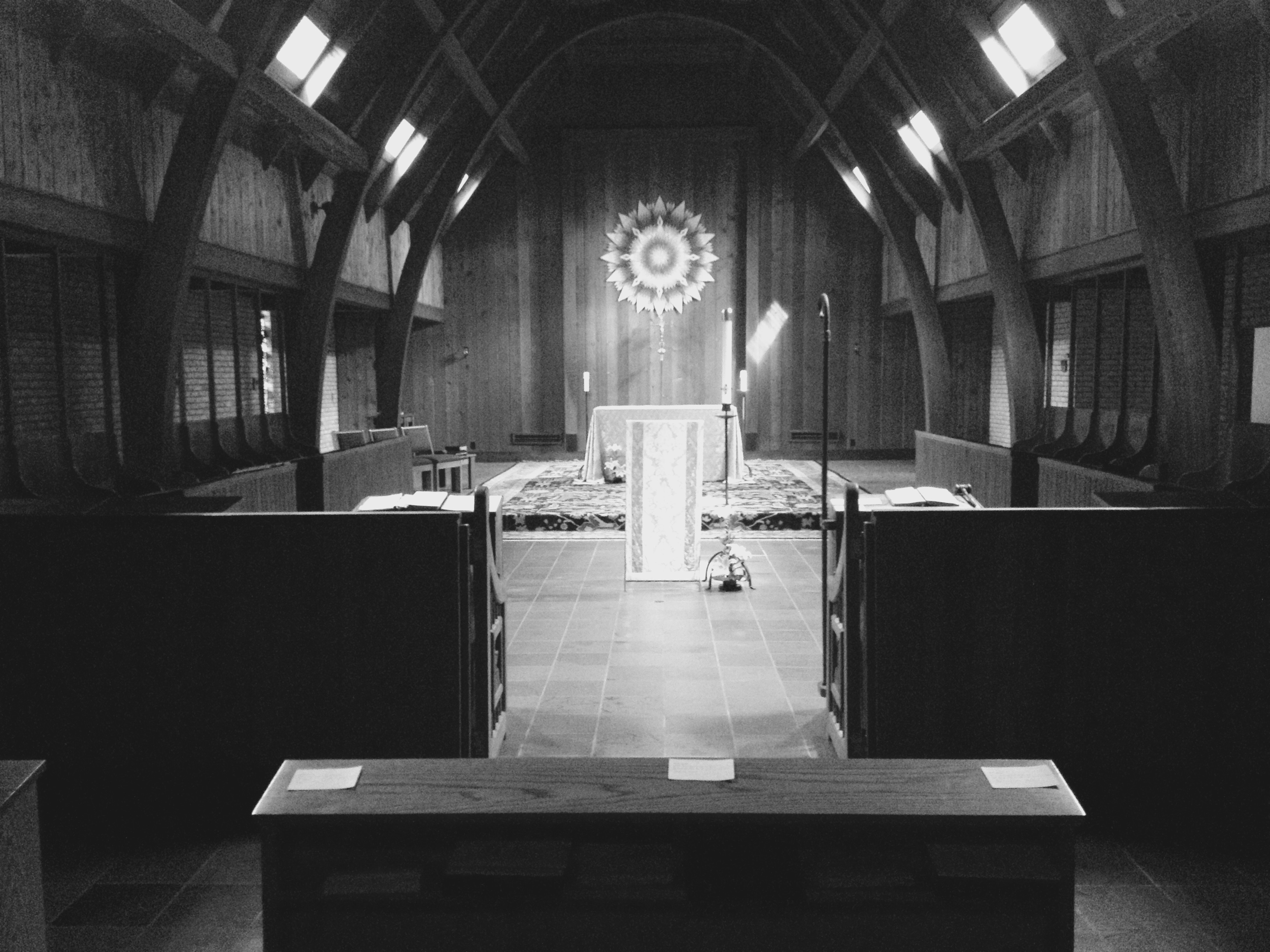
Introducing The Sacramental Imagination

Reblogged from The Anglican Pastor.

The Eucharist is Christianity’s first and ultimate church planting strategy. It’s not just a sentimental moment to recall our Lord’s sacrifice. The Holy Eucharist is the celebration and realization of God reconciling all things through Jesus Christ (2 Cor. 5:19, Col 1:20). If this is true, then our participation in the sacraments also enlists us as midwives, assisting the birth of a fresh movement of God’s work and presence in our lives and our neighborhood. 

Click here to read the full article…

It’s About Relationships…

Today’s sermon from North Presbyterian Church.

The text is Mark 10:2-16.

We’ve got a doozy of a gospel reading this week. I call it one of our “damage control” passages because so many people have been hurt by it, a preacher has to unpack its meaning in order to get a decent sermon out of it.

If today’s gospel was a movie, and I had to give it a parental guidance rating, I think I would have to say it was rated R because of ‘thematic material’. This is a passage that is intended for ‘mature audiences only’. Taking Jesus’ teachings about divorce at face-value can be dangerous, especially if one doesn’t have a clear understanding of what Jesus does and doesn’t mean.

Unfortunately, “taking this passage at face-value” is exactly what Christians have been doing for centuries. This has led to a lot of people being hurt by the church during a time in their life when they needed that fellowship and support more than ever. So, with that in mind, I’m going to begin this morning by stating very clearly what you’re not going to hear from this pulpit on the subject of divorce.

First of all, I’m not going to tell you that, if you get a divorce, you’re going to hell. I don’t believe that. I think you know me well enough by now: that’s not how I roll. Second, I’m not going to tell you that, if you get a divorce, you should be banned from receiving communion or serving the church in an ordained capacity as an elder, deacon, or pastor. There was a time in Presbyterian history when that was the case. But since that time, we have developed an awareness that life and relationships are complicated and don’t always work out like we had hoped. An effective, Christ-like ministry is one that recognizes life’s complexities and leads with grace rather than judgment. Third, I’m not going to tell you that, if you get a divorce, you can never begin another relationship or get remarried and expect that relationship to be healthy and blessed by God. The God I believe in is the God of Plan B and second chances. If that wasn’t who I believed God to be, then I wouldn’t (I couldn’t) be standing in this pulpit today.

If you’ve been told any of those three things before, I want you to tell you today that you’ve been lied to. Getting divorced does not mean you are going to hell; it does not mean you are barred forever from Christian service; it does not mean that you can never again have a healthy, life-giving relationship that is blessed by God.

When Christians tell these lies, they often like to quote passages like the one we just read and sum it up by saying, “See? The Bible says very clearly that divorce is a sin! Therefore, any divorced person is a sinner, and no sinner could ever be called by God for service in this church.”

That’s what they say. And a lot of people get hurt when Christians talk like that.

One of the things I’ve notice about people who use the word sin in this way is that they talk about it in a way that emphasizes the so-called “sins” of other people, rather than their own. Whenever you ask about what’s wrong with the world, they can always answer: “It’s those people! It’s those sinners!”

I call this tendency “The Reality TV Phenomenon.” People watch Reality TV in order to feel better about themselves. No matter how dysfunctional one’s life currently is, chances are that it’s not nearly as messed up as the people on the Jerry Springer Show. It’s a convenient way to feel self-righteous and superior to other people.

Whenever Jesus encountered that kind of attitude, he called it hypocrisy. He would often butt heads with the Pharisees. These Pharisees, like so many fans of Realty TV, had a very precise definition of the word sin that they applied to people outside their religious in-group. They saw themselves as the guardians of morality and family values in their culture. They were upstanding citizens who attended worship regularly and knew the Bible inside and out. If anyone had a trustworthy definition of the word sin, it was them.

These Pharisees approached Jesus with a question on the topic of divorce. Rather than genuinely seeking advice from Jesus, they just wanted to put him on the spot so they could figure out whether his definition of the word sin was as accurate and comprehensive as theirs. But Jesus, as usual, is onto this little game of theirs and isn’t having any of it. He takes their question and raises it “to the next level”, so to speak.

The Pharisees come to Jesus with a question about the legality of divorce. Jesus reframes the question by placing it within the much larger context of relationships. He immediately starts talking about the story of Adam and Eve in the Torah. He talks about who God is and what God is doing. He takes this conversation about the technicalities of the law and turns it into a conversation about the meaning of relationships.

Jesus is arguing here that the Pharisees, with their very precise and thought-out conception of morality, have essentially missed the point. They thought they had this question of divorce already figured out. They thought they already had all the right answers, but Jesus shows them that they haven’t even begun to ask the right questions.

Their definition of the word sin left them feeling pretty self-righteous and superior. It allowed them to place the blame for all the world’s problems on the shoulders of “those other people” whose lives did not conform to socially acceptable norms. But then Jesus comes along and hits them right between the eyes with some hard truth. Even though all their legal ducks were in a row, he told them, they were still not free from the bondage of sin. Jesus was working with a far broader and deeper definition of the word sin than the Pharisees were.

The word sin, I think, has surprisingly little to do with legal requirements and moral laws. I think it has a whole lot to do with the quality of our relationships. Sin is a tendency that exists within all of us, regardless of our moral, legal, or religious status. We all have an inner drive toward selfishness. Therefore, none of us has any right to feel morally or spiritually superior to anyone else, no matter how socially unacceptable or dysfunctional others’ lives may appear to be.

When we try to identify the presence of sin in our relationships, it’s not enough to simply label some behaviors as “sins” while others are “okay”, because even the most apparently righteous actions can be tainted with sin and selfishness. Just look at the Pharisees and you’ll see what I mean. If you look at what they were doing from a legal standpoint, they came away looking squeaky clean all the time. But if you look at how and why they were doing what they did, their self-righteous and judgmental hypocrisy becomes clear. They came to Jesus with a loaded question about a legal contract but left with even bigger questions about the nature of relationships.

With this broader and deeper understanding of sin in mind, let’s revisit that initial question: “Is divorce a sin?”

Does a failed marriage necessarily exclude a person from the benefits of salvation, full-participation in the life and ministry of the church, or God’s blessing upon future relationships? No. Absolutely not.

But, on the other hand, if someone were to ask me whether I think divorce is a product of human sinfulness (i.e. our inner tendency toward selfishness), then I would have to say Yes: our marriages fall apart because of the brokenness and the selfishness that exists in all of us, not just a few.

This way of thinking about sin has significance for all of our relationships, not just marriage and divorce. To illustrate what I’m talking about, let’s look at the Ten Commandments and imagine them, not just as a list of “Thou shalt nots…” but as benchmarks by which we can assess the quality of our relationships (marital or otherwise):

  • You shall not murder:
    • Do we seek to give life to one another or do we suck it away?
  • You shall not commit adultery:
    • Are we faithful to one another or do our hearts belong to something/one else?
  • You shall not steal:
    • Do we willingly share our lives with one another, or do we simply take what we want from each other?
  • You shall not bear false witness:
    • Do we speak the truth about who we are to one another or do we maintain a façade for the sake of appearances?
  • You shall not covet:
    • Are we grateful to and for one another or are we constantly looking over our shoulder at how good everyone else has it?

As we honestly answer those questions, we start to get a general sense of how healthy our relationships are or are not. This can be applied to all relationships, not just the ones between spouses or partners. It works just as well for relationships between parents & children, bosses & employees, siblings, coworkers, friends, you name it.

You can even ask these questions about your relationship with yourself. Who else do we try to hide from more? I think there are a lot of people walking around this world right now in a state of being divorced from themselves. They feel alone and exposed, hiding their deepest fears and covering up their insecurities, even as they’re looking into their own bathroom mirror.

Far more important than particular legal question about divorce is the question of relationships. We selfish and broken people are all reaching out to connect with something or someone outside of ourselves, hoping that we will be able to discover through that connection the meaning of our existence.

As you go back out into the world this week, I want to encourage you to be mindful of how it is that you conduct your relationships with others. Don’t get caught up in these squabbling debates about legalities and technicalities. Instead, do like Jesus does: Raise your own level of awareness in order to ask the harder questions about all your relationships.

May you find on that difficult journey a sustaining sense of connection and meaning in your life that draws you ever closer to the sacred source of all life: the loving God in whom we live, move, and have our being.

Recovering the Good News of Predestination

Fr Aidan Kimel's avatarEclectic Orthodoxy

How can the Church recover the preaching of predestination? The key, I believe, is the recognition that in Holy Scripture predestination is good news. It is not a philosophical conundrum to be solved; it is a form of the gospel to be proclaimed—and specifically, a form of the gospel to be proclaimed to the baptized. No theologian of the Church has seen this more clearly than Karl Barth:

The truth which must now occupy us, the truth of the doctrine of predestination, is first and last and in all circumstances the sum of the Gospel, no matter how it may be understood in detail, no matter what apparently contradictory aspects or moments it may present to us. It is itself evangel: glad tidings; news which uplifts and comforts and sustains. Once and for all, then, it is not a truth which is neutral in face of the antithesis…

View original post 2,048 more words

The Presence in the Absence

J. Barrett Lee's avatarHopping Hadrian's Wall

I don’t know about you, but I sometimes get a bit discouraged when I read the stories and poems of the Bible.  It seems that people back then had a much more immediate sense of God’s presence than we do today.  On almost every page, there are tales of visions, voices, angels, and miracles.  Meanwhile, even the most spiritually-inclined of us today have to rely on powers of reason, conscience, intuition, and imagination when forming our ideas about who God is and how God relates to us.  It’s easy for us to feel left out when we read the Bible because most of us haven’t had the kind of direct and intense mystical experiences described in its pages.  After all, who here has ever walked on water or seen the ocean part in front of them?  My guess is that not many of us have.  If only there was someone…

View original post 1,180 more words

Rich phrases, poignant and powerful

Source: Rich phrases, poignant and powerful

Rich phrases, poignant and powerful

…the Daily Office offers us a chance to pray in union with Christians around the world, and to pray in words made familiar through long repetition.

The Confession, the psalms, the Scripture lessons and canticles, the Apostles’ Creed and the suffrages, the General Thanksgiving and St. Chrysostom’s “golden-tongued” prayer — far from heaped-up words, these are “rich phrases,” poignant and powerful.

There’s not a wasted word in the Daily Office, no needless repetition, no hedging, no hemming or hawing.

We simply pray in the way that our Lord taught us, and his early followers practiced, and the women and men of the desert whetted into sharpness, and the Benedictines rounded and smoothed seven times a day, and the choirs adorned with ravishing melodies, and Archbishop Cranmer organized, and the publishers bound with ribbons between leather covers, and the developers turned into a clean app and website so there’s no barrier to our praying.

So, when you pray … pray like this.

Welcome to Hadrian’s Wall

By Velella (Personal photograph taken by Velella.) [Public domain], via Wikimedia CommonsBy Velella (Personal photograph taken by Velella.) [Public domain], via Wikimedia Commons
By Velella (Personal photograph taken by Velella.) [Public domain], via Wikimedia Commons

Dear Superfriends and Blogofans,

For the past five years, I’ve maintained this blog as The Theological Wanderings of a Street Pastor. I started it as a place to reflect on the out-of-the-box ministry I was doing as Community Chaplain of St. James Mission, a position I left in 2012. Naturally, the shape of this blog has changed since then.

These days, the theological questions that vex me revolve around worship and the intersection of ecclesiastical traditions.

I am the world’s only Anglo-Catholic Presbyterian.

What exactly does that mean?

It means that I am a Presbyterian pastor with a High Church Anglican heart.

A part of me is very Presbyterian:

I believe…

  • The Reformed tradition works with a balanced polity and an even-keeled openness.
  • The Protestant Reformation was a movement of the Holy Spirit in the Church and a much-needed corrective to the abuses and distortions of its time.
  • Biblical literacy is essential to the work of the Church.
  • Ecclesia Reforma, Semper Reformanda (“The Church is reformed, and always being reformed”).
  • Salvation comes by trusting in God’s sovereign grace alone.
  • The royal priesthood of all believers.
  • No earthly authority can claim absolute obedience or infallibility.
  • I see the Holy Spirit at work in my denomination’s leaders and in the whole people of God every single day.
  • It was God’s call that brought me to my current congregation where I get to serve the most amazing group of people as pastor.

Another part of me is very Anglo-Catholic:

I believe…

  • The ministry of the Word by itself, without the Sacraments, leads to the equally dangerous pitfalls of fundamentalism and rationalism.
  • Informed sacramental worship, rooted firmly in the mystery of the Incarnation, should lead Christians naturally into the streets to “seek and serve Christ in all persons.”
  • “The Holy Eucharist [is] the principal act of Christian worship on the Lord’s Day” and not just something extra to be tacked onto the end of the service one Sunday a month.
  • Christ is really, objectively present in the Eucharist.
  • Whatever their form or administrative function, all denominations should retain the office of bishop within the lines of apostolic succession as a visible sign of Christian unity.
  • Fragrant incense, liturgical vestments, and Gregorian chant enhance our worship.
  • It is appropriate and spiritually beneficial to ask the prayers of the Blessed Virgin Mary and all the saints in heaven.

This is the bizarre combination of qualities that I find within myself. I don’t really know what to do with that tension, except to hold it. That’s why I’m writing this blog.

I exist somewhere on the theological border between Anglican and Presbyterian. For those who don’t know church history, Anglicanism is the form of Protestant Christianity that took root in England in the 16th century, while Presbyterianism is the form that caught on in Scotland. The English remained relatively close to their Catholic roots, while the Scots followed the more drastic continental reforms of John Calvin. The spiritual territory I occupy rests squarely between these two traditions. And what ancient Roman edifice marks the long-standing border between England and Scotland? Hadrian’s Wall.

Hence, the new name for this blog.

All of the former articles are still here and available to read. The old domain name still works. It’s the same old blog, but with a new name, a new look, and a whole new set of questions to explore.

The Street Pastor is still wandering and you’re all invited to come along!

Pax Vobiscum,
Barrett
Wandering Street Pastor
Anglo-Catholic Presbyterian

Fr Ken Leech (1939 – 2015)

Tribute to Fr. Ken Leech

stchrysostoms's avatarSt Chrysostom's Church News and Views

FrK 1Fr Ken Leech (b.39), a great priest, prophet and writer in the Church died yesterday in the evening (12th September). We were sorry to learn of the death of this great priest, and friend of St Chrysostom’s.

Ken was born in a working class family in Manchester, and from an early age felt a call to priesthood. He often told how as a young man he came to St Chrysostom’s to attend a vocations conference which set him on the path to become a priest. In 1958, as a student, he went to live in the East End of London. For him that was to be ‘a real turning point,’ he wrote:

The East End has shaped me more than any place. Much of my time there, since 1958, has been involved with fighting fascism, working for decent housing, trying to create communities of resistance and solidarity.

Fr Ken became…

View original post 400 more words

(Reblog) Remembering well: 9/11 reflections from a captain turned priest

Fr. Christian Hawley, an Air Force officer who became an Episcopal priest, has penned this article in remembrance of the terrorist attacks we witnessed on September 11, 2001. This is the best expression I have yet heard of #NeverForget.

Here are the one-liners he uses to form the shape of his article. Reblogged from Ministry Matters.

  • We are never safe.
  • We are never alone.
  • We are never innocent.
  • We are never beyond redemption.
  • Violence begets violence.
  • Sometimes love begets violence.
  • Love anyway.
  • Reconciliation begins within.
  • Be gentle with yourself.
  • Reconciliation can’t be done alone.
  • Be gentle with others.
  • Never forget.
  • Remembering is a process.
  • Christians remember well.

Click here to read the full article

Letting Jesus Disturb Us

“This teaching is difficult; who can accept it?”

That’s what people were saying about Jesus’ sermon. And I think it’s pretty obvious that they didn’t mean it as a compliment. Jesus had just finished rocking their proverbial boats by claiming that the only way to experience eternal life is to eat his flesh and drink his blood.

I can only imagine what the response would have been if members of his audience had been the kind of sensationalistic journalists whose voices tend to dominate the media today: “Jesus of Nazareth endorses cannibalism!” or maybe “Radical leader of suicide-cult initiates followers into vampire ritual!” But Jesus’ listeners seem to have been a little more reserved than present-day news reporters, so they stopped at “This teaching is difficult”.

And who can blame them, really? We hear these words with the benefit of two thousand years of church tradition, wherein our pastors regularly give us bread and wine with the words “This is my Body” and “This is my Blood.” Those words have lost their shock-value for us.

Jesus, in this sermon on the Eucharist from John 6 (which we have been reading this month at church), is intentionally trying to disturb his audience. He deliberately wants them to feel confused and uncomfortable. Why is that? Because being uncomfortable is the best way to grow spiritually.

It’s a common notion that people turn to faith for a sense safety and familiarity in the world. The Communist philosopher Karl Marx believed that people use religious faith as a way to dull the pain of political oppression. That’s why he called religion “the opiate of the masses.” Psychologist Sigmund Freud believed that our ancestors invented God as a way of relieving their anxiety over the capricious and destructive forces of nature. Freud argued that God is a personification of these forces with whom humans can negotiate by means of ritual sacrifice. For both Freud and Marx, the purpose of faith is to ease discomfort in humans. I think many people in our day (religious and non-religious alike) view faith in the same way.

But Jesus seems to be doing the exact opposite of that in today’s gospel reading. If anything, he is making people less comfortable with his preaching. He presents this disturbing image and then does nothing to explain it or mitigate its impact on the hearers.

“This teaching is difficult,” people say.

And Jesus responds, “Good! That means you’re paying attention.”

The only guidance Jesus gives for interpreting his flesh-eating, blood-drinking imagery is this: “It is the spirit that gives life; the flesh is useless. The words that I have spoken to you are spirit and life.”

“Flesh,” in this instance, is Jesus’ way of describing the surface-meaning of his words, whereas “spirit” is the deeper meaning. And he makes it clear that the deeper, spirit-meaning is what he really wants his followers to understand.

But, in order to get there, they have to let themselves become uncomfortable with the language as it stands. Is Jesus really endorsing cannibalism? Does he literally want us to eat his flesh and drink his blood?

Discomfort is the richest soil for spiritual growth in a person’s life. Those who feel safe and comfortable have no reason to question the status quo or dig beneath the surface of life. Those who struggle or live with pain, on the other hand, have no choice but to go deep and ask tough questions. Often, the pursuit of wisdom can only begin in earnest once the pursuit of happiness has failed.

So, Jesus calls upon his followers to embrace the discomfort of what he is saying in order that they might look deep, past the surface-meaning of the words to touch their spiritual meaning.

And how is this message received by its intended audience? Are they willing to go where Jesus is trying to lead them? For most of them, the answer is No. John tells us, “Because of this many of his disciples turned back and no longer went about with him.”

The kind of faith that disturbs is not the kind that brings in the big numbers. Asking people to look deep into the mystery of life will not win you any popularity contests. It certainly didn’t for Jesus. One might even argue that this is Jesus’ most ineffective sermon ever when it comes to church-growth and evangelism.

But Jesus isn’t trying to win any popularity contests, nor is he interested in padding egos with platitudes and certainties. What Jesus wants is for people to grow in their relationship with God and each other. And the only way to do that is to challenge their assumptions and make them uncomfortable.

After the bulk of the crowds have left, Jesus turns to the few who are left and asks them (I imagine with a shaky voice and tears in his eyes), “Do you also wish to go away?”

And Simon Peter is the one who speaks up on behalf of the others, “Lord, to whom can we go? You have the words of eternal life. We have come to believe and know that you are the Holy One of God.”

This is Peter’s great statement of faith, not the declaration itself, but the question beforehand: “Lord, to whom can we go?”

I love it when Peter says this. I consider it to be one of his finer moments as a disciple. He answers Jesus’ question with another question, and a vulnerable one at that. I can hear the trepidation in his voice. He really doesn’t have anywhere else to go. The basis of his faith is not an absolute certainty that provides a sense of safety and security, but a deep trust in his friend that has been born of miles walked together and a sense of helpless desperation. “If Jesus is making me uncomfortable,” Peter believes, “it’s for a very good reason. If I can follow this rabbit-trail to wherever it leads, my hunch is that I will be glad I did.” Peter’s faith is born of personal trust, not absolute certainty. And the evidence of that faith is his willingness to stay in relationship with Jesus, even when the going gets tough and Jesus is being very confusing and disturbing.

This is where faith in Jesus begins to look very different from the conventional faith of polite, civil religion. Just as the purpose of Christian faith is not comfort, but disturbance, so also the process of Christian faith is not absolute certainty, but personal relationship. Jesus doesn’t ask us, “Do you understand me?” He asks us, “Do you trust me?” He doesn’t ask us, “Will you defend my doctrines from the heathen?” He asks us, “Will you love me in the least of these?”

Faith, for the Christian, is a personal journey undertaken with Jesus. Its hallmark is the willingness to keep going, even when Jesus says and does things that are confusing and disturbing. We keep on walking together. We stay in this relationship, not because we don’t have our doubts and struggles, but because we trust that our friend will never lead us astray.

If you’re here this morning and you find yourself struggling with doubt, if there are things about Jesus that make you uncomfortable, I want to invite you to keep walking. I won’t try to resolve those questions for you; I won’t even tell you that you have to figure them out for yourself. Because, at the end of the day, Christian faith is not about arriving at a comfortable answer to our questions; it is about continuing your journey with Jesus and allowing him to lead you from question to question, deeper and deeper into the mystery at the heart of everything.

If you find yourself being disturbed on this journey, it’s a good thing: it means you’re paying attention.

Lex Orandi

FullSizeRender(5)

Here, at long last, is a big project I have been working on this year:

Lex Orandi: An Ordo for the Divine Office based on the Rule of St. Benedict and the Book of Common Prayer (pdf file)

It is not a complete breviary that stands on its own, but a guide for praying the Office in a manner similar to the monks at St. Gregory’s Abbey, Three Rivers.

While not an exact replication of the Liturgy of the Hours at St. Gregory’s, Lex Orandi has been adapted to fit the schedules of people who live outside the monastery, but still want to pattern their prayer life after the Benedictine spirit.

While Abbot Andrew Marr​ and the brothers have helped me in this project and granted permission to reprint select portions of their Office (e.g. the Confraternity Prayers), Lex Orandi is an independent publication that has not been authorized or endorsed by St. Gregory’s Abbey, Three Rivers. Its use is not required.

Thank you to the community of St. Gregory’s Abbey, Three Rivers for your friendship, support, and guidance in this labor of love. It is my joy to make it available online for free to anyone who wishes to use it.