You Are What You Eat: Communion as Living Sacrifice

Sermon for the Feast of the Presentation of Our Lord.

Delivered at St. Mark’s Episcopal Church in Coldwater, MI.

Click here for the readings.

The other day, I realized something unusual about narcissism: It’s the only illness in the world that you’re happy to have.

This is true: Psychologists don’t even do clinical tests for narcissism anymore; they just ask, “Are you a narcissist?” If they say, “Yes,” believe them! That doesn’t happen with any other disease. Can you imagine someone coming back from the doctor like, “What’s got two thumbs and Stage IV Cancer? This guy!” It just doesn’t make sense.

Clinical narcissists, on the other hand, lack the basic self-awareness to realize that their condition is debilitating. They are so pathologically focused on their own needs, they don’t even realize it’s a problem. They act like the biggest jerks while pretending to be the greatest person who has ever lived. They wind up alone when what they really want is to be loved.

Very few people are narcissists at the clinical level, but all of us have that tendency within us. We all have moments of selfishness. So, before I go labeling other people as narcissists, I need to take a look in the mirror and realize: Sometimes it’s me.

What I miss, when I’m acting selfish, is the fundamental truth that I cannot create a full and meaningful life for myself if my only goal is to create a full and meaningful life for myself. My life, and yours, only has meaning when we look at it in context, as one small part of a greater whole. That fundamental truth resides at the heart of today’s gospel.

Today, we celebrate the Feast of the Presentation. In today’s gospel, we heard about the infant Jesus undergoing the Jewish rite of Pidyon Haben, also known as, “Redemption of the Firstborn.” This custom, commanded in the Torah (see Exodus 13, Numbers 3:40-51), serves a reminder to the Jewish people that our lives are not our own, but belong to Adonai our God. Forty days after the birth of a firstborn male baby, the parents would present themselves, with the child, in the Jerusalem Temple. In ancient times, they would offer an animal sacrifice or monetary donation as a symbolic payment for the child, who belongs to God.

When the infant Jesus underwent this ritual, two mysterious elders appeared, Anna and Simeon, who began to proclaim wondrous things about this child’s Messianic destiny as “the consolation of Israel” and “the redemption of Jerusalem.” Joseph and Mary came to present their baby at the Temple, according to custom, but they left with something much greater: confirmation that this baby was the long-expected Messiah of the Jewish people.

Human sacrifice, as we typically understand that term, has never been a normative practice of Jewish or Christian religion. It was fairly common, however, in various cultures during biblical times. When God initially commands Abraham to sacrifice his son Isaac in Genesis 22, it would have seemed normal to people in the Ancient Near East. They would say, “Yeah, that’s what gods do: They demand that you sacrifice your children in exchange for prosperity.” It seemed normal to them. The shocking part of that story, for the people of that time, is the part where Abraham’s God stops the sacrifice before it happens. This would have seemed like a revolutionary new idea to them. Later on, in the New Testament era, St. Paul continued this line of thinking in his epistle to the Romans: “I appeal to you, therefore, brothers and sisters, by the mercies of God, to present your bodies as a living sacrifice, holy and acceptable to God, which is your spiritual worship” (Romans 12:1).

The term “sacrifice,” as understood in the Jewish and Christian traditions, is not about physical killing. The Latin roots of the word, sacra ficia, literally mean “to make holy.” When something is sacrificed, its individual existence takes on new meaning in the context of a greater whole. That is exactly what happened with the infant Jesus in today’s gospel, and it is what happens with all of us when we are called upon to make sacrifices in our own lives.

In our liturgy of the Eucharist, we have a regular part called, “The Offertory.” In some churches, they call it, “passing the plate.” In practical terms, this is where we all chip in to keep the lights on and programs running at the church, but it’s also much more than that. The spiritual meaning of the Offertory is that we are presenting the fruits of our life and labor to the Lord, who is the original source of these good gifts. In some parishes, it is still common practice for the people to say together the words of I Chronicles 29:14 when the Offering is presented at the altar: “All things come of thee, O Lord, and of thine own have we given thee.”

More important than the collection plate are the elements of bread and wine, which are brought to the altar at this time. Wheat and grapes are fruits of the Earth, which have been shaped by human labor into bread and wine. Our monetary offerings are a symbolic addendum to these primary elements. Really, it is the Earth itself, and our own selves, that we place on the altar as a living sacrifice to God. Standing in the place of Christ, the priest receives these offerings, blesses and consecrates them, and offers them back to us as the Body and Blood of Christ, which we then receive into our own bodies. In this act of Communion, we come into a deeper awareness of the true meaning of our lives. Because of the wheat and the grapes, we are in Communion with the Earth; because they have been shaped into bread and wine, we are in Communion with all human labor; because all people are welcome around this altar, rich and poor, black and white, male and female, gay and straight, cis and trans, Republican and Democrat, native and immigrant, we are in Communion with each other; because these consecrated elements are the Body and Blood of Christ, we are in Communion with God.

Dieticians are fond of saying to their patients, “You are what you eat.” This statement is never more true than when you come forward to receive Communion in Church. Whenever I administer Communion, I always give an opportunity for eye-contact (NOTE: Some people are not comfortable with that, and that’s perfectly okay; just know that it’s there, if you want it). I hold up the consecrated host between us and say, “The Body of Christ, the bread of heaven.” Notice that I do not say, “This is the Body of Christ,” but just, “The Body of Christ.” Question: Am I talking about the bread or the person whose eyes I am looking into? It’s intentionally ambiguous. The answer, of course, is, “Both.” You are what you eat.

Through this act of sacrifice, we too are “made holy” and sent forth to be the hands and feet of Jesus in the world. We say, in our Post-Communion Prayer, “Loving God, we give you thanks for restoring us in your image and nourishing us with spiritual food in the Sacrament of Christ’s Body and Blood. Now send us forth a people, forgiven, healed, renewed; that we may proclaim your love to the world and continue in the risen life of Christ our Savior.”

What we receive back, in Communion, is infinitely greater than that which we give up. We offer bread and wine; we receive Christ’s Body and Blood. We offer ourselves; we receive God. Our lives take on new meaning when we set aside our narcissistic desires and see them instead as part of the greater whole.

Kindred in Christ, I invite you this day to consider your lives from a Eucharistic point-of-view. When you gather with your neighbors around this altar to receive the Sacrament, meditate on these words of St. Paul in Scripture: “It is no longer I who live, but it is Christ who lives in me” (Galatians 2:20). “Let the grace of this Holy Communion make us one body, one spirit in Christ” (BCP 372), overcoming our narcissistic tendencies, petty squabbles, and unhappy divisions. May we, through Christ, and with Christ, and in Christ, come to understand our individual lives as parts of the greater whole of God’s life. And, in so doing, may we become the fulfillment of Christ’s prayer, that we all “may be one, as [he and his Father] are one” (John 17:22).

Amen.

Do Whatever He Tells You: A Practical Guide for Turning Water into Wine

Sermon for the second Sunday after the Epiphany, Year C.

Delivered at St. Mark’s Episcopal Church, Coldwater.

Click here to read the biblical passage.

“The key to the perfect wedding day is imperfection.”

That’s the one piece of advice I give to every couple who asks me to officiate their wedding. So long as both parties arrive at the ceremony safely, say their vows in front of an officiant and witnesses, and sign the license, it qualifies as a successful wedding. Everything else is extra. You can bank on some kind of hiccup with the DJ, the catering, or the dress. At my own wedding, the pre-recorded entrance music cut out while my wife was still halfway down the aisle, so she had to walk the rest of the way in silence. It was still a lovely day and a successful wedding.

In biblical times, however, things weren’t so simple. Weddings back then were week-long affairs that involved the entire town. The ceremony was a reaffirmation of the social bonds that held their community together; the couple served as a sacred symbol of God’s covenant with the people of Israel.

Furthermore, wine itself was an important symbol of blessing and joy, so it’s absence would have undoubtedly be interpreted as a bad omen for the new couple.

Running out of wine during such an auspicious occasion would have brought permanent shame on the family. This level of shame, more than mere embarrassment, would lead to the entire family being cut off from the community and not allowed to participate as functioning members of society. The closest thing our culture has to this kind of shaming is when a celebrity gets ‘cancelled’ for acting inappropriately with staff or fans. The difference is that the stakes were much higher: Firstly, because the people involved were regular, working-class folks and, secondly, because the bar for getting ‘cancelled’ was much lower than it is today. The shame of running out of wine at a wedding would have absolutely ruined the family involved.

Knowing this cultural background helps us understand the urgency in Mary’s voice when she informs Jesus, “They have no wine.”

Jesus’ curt response, then, seems shocking: “Woman, what concern is that to me and to you?”

This is a sentence that requires some explanation. At first glance, it sounds rude and dismissive, like a teenager who has just been asked to clean his room (“Ugh… whatever, bruh!”), but a careful examination of the language reveals a very different tone.

First of all, the term “woman” was a term of respect, much like “ma’am” or “madam” would be today. Since our culture uses different words for respect, I would personally not recommend calling your wife, partner, or mother, “woman.” (If you would like to test this hypothesis for yourself, I invite you to do so, and I will happily come to visit you in the hospital afterward.)

Second of all, the comment “what concern is that to me and to you” is meant to be more reassuring than dismissive. If Jesus had been Australian, he might have said, “No worries, mate!” In America, we might say, “No problem. Piece o’ cake!” That phrase is used in other parts of Scripture when a minor issue does not present a barrier to a relationship between two people. In essence, what Jesus is saying here is, “Don’t worry, ma’am. Everything is fine.”

Of course, this response is also shocking, albeit in a different way. Given what we just learned about weddings and wine in ancient Galilee, it would have been perfectly understandable if Mary had said, “What do mean, Jesus?! Everything is not fine! This is a real crisis!” But Mary doesn’t do that. Instead, she calmly turns to the servants and says, “Do whatever he tells you.”

The rest of the story plays out as we read it in today’s gospel. The servants follow Jesus’ instructions and a miraculous transformation ensues. Symbolically, the joy and abundance of life is restored to an even greater level than where it was before.

I’d like to think that I would have the same quiet confidence as Mary during a catastrophe, but I’m not 100% sure that I would. (Then again, maybe that’s why God chose her, instead of me, to be Jesus’ mother.) I’ve been known to indulge in more than my fair share of “doom-scrolling.” Like so many of us, I frequently feel overwhelmed by the crushing pressure of crises, in my life and in the world, that I can do nothing to fix. Mary’s plea to Jesus, “They have no wine,” has often escaped my own lips as a cry for justice, freedom, or hope, sometimes for others and sometimes for myself. When I imagine Jesus telling me, “Don’t worry, sir, everything is fine,” I want to shout back at him, “No it isn’t! We’re in a real crisis, here!”

It is then, when I find myself in times of trouble, that I need Mother Mary to come to me, speaking words of wisdom: “Do whatever he tells you.”

When I hear those words from Mary, I think of the things that Jesus has always told everyone to do: Feed the hungry, clothe the naked, give to the poor, welcome the stranger and the outcast, visit the sick and incarcerated, and love your neighbor as yourself. There is so much wrong in this world that I have no power to fix or control. What I do have power over is my own choices. I can choose to give in to despair and cynicism, or I can choose to be the kind of person that Jesus was by doing the kinds of things that Jesus told me to do.

The popular author (and dedicated Episcopalian) Brené Brown refers to this power-to-choose as “micro-dosing hope.” She says:

“I have no access to big hope right now, however, I am asking myself how I can support the people around me. The people on my team, in my community. How can I make sure that, in the maelstrom of my emotions, I stay committed to courage, kindness, and caring for others regardless of the choices made by others? Doing the smallest next right thing is hard, but sometimes it’s all we’ve got.”

There is a particular community of Christians that has been practicing this principle for more than a millennium: the Benedictine Order of monks and nuns. They were founded in the early sixth century by St. Benedict of Nursia as a community committed to round-the-clock prayer. Every three hours, starting in the middle of the night, they would stop whatever they were doing and chant psalms in the church. Their practice forms the basis for the Daily Offices of Morning and Evening Prayer, which we use in The Episcopal Church today.

The Benedictine commitment to a life of prayer also opened their hearts to the practice of radical hospitality. Whenever strangers would present themselves at the monastery gates, the monks and nuns would welcome them as if it was Christ himself knocking at their door.

Over a thousand years later, the monks and nuns of the Order of St. Benedict continue to live by their rule of prayer and hospitality. In fact, they have a community just 30 minutes away from here by car: St. Gregory’s Abbey of Three Rivers. This small group of Episcopalians has lived by the Rule of St. Benedict since their founding in 1939. [NOTE: Your current rector is an oblate of St. Gregory’s Abbey. If you would like to know what that means, please feel free to ask me after the service or stop by my office sometime.]

[Click here to learn more about St. Gregory’s Abbey, Three Rivers.]

This dual-commitment to prayer and hospitality led the Benedictines to establish sustainable communities with adequate food, shelter, healthcare, and education. The stability of the monasteries made it possible for the Benedictines to preserve the cultural treasures of Western Europe, even as the Roman Empire was collapsing around them.

The entire goal of Benedictine monasticism is to become the kind of person that Jesus was by doing the things that Jesus told people to do. The monks did not set out to save civilization, but the miracle is that they ended up doing so, almost by accident.

This historical example presents us with a possibility for how we too might transform “water into wine” by putting the teachings of Jesus into practice in our own lives. Beyond voting in elections and writing letters to our elected officials (both of which we should absolutely be doing), there is little we can do to directly effect the biggest problems of the world. We can, however, “do whatever Jesus tells us” by putting into practice the things he taught his disciples. We can take care of each other and the most vulnerable people in our community by feeding the hungry, caring for the sick, sheltering the homeless, welcoming the outcast, and loving our neighbors as ourselves. Each of us can choose to be the kind of person that Jesus was.

This, I believe, is the secret for making it through tough times. In the days to come, I pray that each of us (myself included) will understand the reassuring words of Jesus: “Don’t worry ma’am/sir/friend, everything is fine.” I pray that each of us (myself especially) will heed the advice of Mary: “Do whatever he tells you.” I pray, most of all, that we will become the kind of people that Jesus was: Transforming the water of crisis into the wine of hope.

May it be so. And “may the God of peace give us peace at all times in all ways” (II Thessalonians 3:16).

Funeral for Patrick Jones

Click play to listen to an audio recording of the funeral service:

Click here to read the bulletin for the service.

Full text of the homily posted below:

In today’s gospel reading, Jesus says, “Anyone who comes to me I will never drive away.”

This statement is a testimony to the infinite breadth and unfathomable depth of God’s unconditional love. This fact about divine love was the single most important truth in the life of our friend, Pat.

Jesus’ statement begins with that all-inclusive word: Anyone.

Jesus makes no provisos or exceptions to the kind of people who are welcome in his presence. The divine welcome is not limited to any particular ethnic background, gender-identity, sexual orientation, social class, political affiliation, or even religious belief.

Jesus says this particular invitation is addressed to “anyone who comes to me.” Now, this addendum might seem like a barrier to some. People like to talk about having a “come-to-Jesus moment” when they need to face a difficult truth. This is understandable, considering that Jesus is the kind of spiritual teacher who will not let the delusions of powerful people go unchecked. To others, “anyone who comes to me” might sound like it only applies to those who identify as Christians. This too is understandable, but that’s not what Jesus is talking about here.

Jesus’ open invitation seems merely polite, but in fact, it flies in the face of a divided world that would prefer to separate insiders from outsiders, based on any number of artificially-manufactured categories. But Jesus doesn’t play that game. In the words of the late spiritual author Rachel Held Evans, “What makes the Gospel offensive isn’t who it keeps out but who it lets in.” For Jesus, “anyone” means ANYONE!

Think about all the different kinds of people who come to one another, in big ways and small, throughout the course of a day: at work or school, in line at the store, walking down the street, or coming home at the end of the day. According to the sacred Scriptures of the Christian tradition, Christ is present in each and every one of these people we encounter (including the person we encounter in the mirror). Whatever we do unto others is what we do unto Christ himself.

“Come to Jesus” is a phrase that applies, not only to difficult conversations or religious epiphanies, but also to the many ways in which people meet each other in the humdrum of daily life. Jesus understood this, which is why he taught his followers to “love one another as I have loved you.” When we meet one another in an attitude of love, the Christ in us is loving the Christ in them, whether we realize it or not. When we do so, we complete a spiritual circuit that increases the energetic flow of love in the world.

Pat understood this truth at a deeper level than many others care to do. It drove his spirituality and informed his activism for social justice.

Pat once told me a story about his confirmation. For those who may not be Episcopalians, confirmation is a ritual where a young person, after an extended period of study and reflection, “confirms” the promises made by their parents and godparents at their baptism. It’s the Christian equivalent of a Bar Mitzvah in the Jewish tradition. Confirmation is the moment when a young person becomes an adult, in the eyes of the Church, and chooses to follow the way of Jesus as their own spiritual path.

Pat told me that, when the bishop laid hands on his head and prayed for the Holy Spirit to enlighten him, he felt unworthy of undergoing this ritual because he didn’t think he had studied as hard as he should have during his time of preparation. There were questions to which he still had no answers and commitments that he still did not understand. He felt that the bishop must be making some kind of mistake in confirming him, so God would surely intervene and stop the ritual from taking place.

But that is not what happened. Instead, the bishop laid hands on Pat’s head and prayed the traditional prayer:

“Defend, O Lord, this thy Child with thy heavenly grace; that he may continue thine for ever; and daily increase in thy Holy Spirit more and more, until he come unto thy everlasting kingdom.”

What Pat experienced, in that moment, was an unconditional love, which transcended his lack of understanding and sense of unworthiness, yet fully accepted and embraced him anyway. His young mind was unable to fully comprehend this love, so he persisted in his belief that there had been some kind of mistake.

Pat’s doubt and felt sense of unworthiness propelled him into a lifelong journey of spiritual searching and reflection. He spent time in churches and monasteries. He prayed fervently and read books. In time, he decided that what he was learning should propel him into action to make this world a better place, so he marched, worked, and organized to help those who were less fortunate than himself. He loved his family and friends, his wife, sons, stepchildren, and grandchildren, to the best of his ability. As many of us know, he was far from perfect, but his life was driven by a passion to experience and express the depth and breadth of divine love.

I believe that God answered the bishop’s prayer at Pat’s confirmation. When I look at his life, I see a man who was richly defended with heavenly grace, daily increasing more and more in the Holy Spirit. Pat expected to be “driven away” at confirmation because of his unworthiness, but instead he found a Lord and Savior who said to him: “Anyone who comes to me I will never drive away.”

Pat’s favorite theologian, Paul Tillich, wrote extensively about this unconditional love. He says:

You are accepted, accepted by that which is greater than you, and the name of which you do not know. Do not ask for the name now; perhaps you will find it later. Do not try to do anything now; perhaps later you will do much. Do not seek for anything; do not perform anything; do not intend anything. Simply accept the fact that you are accepted!

As his chaplain and pastor for many years, it was my honor to reflect this observation back to Pat before he died, just as it is my very great honor to celebrate his life with all of you today. I pray that, today, in this gathering of remembrance and thanksgiving, each and every one of you would know and feel yourselves to be loved and accepted by the same love that took hold of Pat’s mind and heart.

It does not depend on your faith, understanding, or worthiness to be effective. This love is real, whether you believe in it or not. It is yours, whether you want it or not. This love holds you close to God’s heart with a gentle power that is stronger than the force of gravity, which holds the galaxies together. Whoever you are, whatever you’ve done, and however you believe today, you are loved with a love that will not let you go.

The only thing this love asks in return is that we complete the circuit by loving one another with that same unconditional love.

In memory of Pat, and in the light of this love that embraces us all, I pray that you will love one another today and remember always that you are loved by a love that says, “Anyone who comes to me I will never drive away.”

Love in the Past Tense: Grief Without Shame

Sermon for the Feast of All Saints.

The text is John 11:32-44. Click here to read it.

Here is the video of the entire service. The sermon starts at 32:23.

“Jesus began to weep.”

John 11:35

This brief verse, John 11:35, rendered even more concisely in other translations as, “Jesus wept,” is well-known as the shortest verse in our Bible. For that reason, it was a favorite among students at the Christian high school I attended, where our teachers required us to memorize a Bible verse each week.

As a teenager, I liked this verse because it was short, but today, in my middle age, I have found other reasons to love it. I continue to love John 11:35 (“Jesus wept”) because it puts the grief of our fully divine and fully human Lord and Savior on full display and, thereby, it gives us mere mortals permission to grieve, when we feel the need to do so.

Grief is a tricky subject. We pragmatic Americans tend to think of grief as a problem and grieving as an emotional symptom of said problem. When we operate under this misconception, we try to solve the “problem” of grief by making the “bad feelings” go away. This is why so many well-intentioned friends tend to offer so many problematic platitudes like:

  • They’re in a better place;
  • Everything happens for a reason;
  • Heaven needed another angel;
  • God has a plan;
  • It’s not up to us to question the will of the Almighty;
  • Maybe God is trying to teach you a lesson.

If you’ve ever found yourself in a state of grief, and heard this kind of pseudo-theological drivel spat at you by well-intentioned believers, then you too know just how unhelpful such slogans can be. These kinds of “bumper sticker theology” serve to comfort the minds of the bystanders more than the hearts of the bereaved.

Through my years of service as a hospice chaplain, I have come to realize that the beliefs that “grief is a problem to be solved” and “grieving is a feeling” are fundamental errors. Grief is not a problem; it is a process, and grieving is not a feeling; it is a skill. And frankly, speaking as a fellow pragmatic American, grieving is a skill at which we tend to be very, VERY bad.

If we were to look for a culture that is more skilled at the art of grief than our own, I think we need look no further than the Jewish culture of our Lord Jesus. Jewish culture tends to understand the process of grief better than our own. Our Jewish neighbors have, over the course of several millennia, developed a practical approach to mourning that guides people through the process of grief in a systematic way.

During the first stage of grief, between the death of a loved one and their funeral, Jews recognize that people are in an initial state of shock. The bereaved are exempted from performing many of the commandments of the Torah while they process the loss of their loved one. For the first week after the funeral, they are said to be “sitting shiva,” where they are not expected to go to work, leave the house, or even prepare meals. During this time, friends will visit the family to bring food, sit with them, tell stories, and say prayers. Gradually, after this week of sitting shiva, family members will begin to reintegrate into society. There are certain limitations placed on their activity for the first month and the first year after their loss. After that first year, life has more-or-less returned to normal, but they still pause once a year to remember their loved one on the yahrtzeit, the anniversary of their death. Jewish culture understands, better than American culture, that grief is a process and grieving is a skill that must be taught and can be learned.

In today’s gospel reading, we get to see an example of Jesus sitting shiva with his close friends, Mary and Martha, after the death of their brother Lazarus. What’s amazing about this passage is how Jesus meets each of the sisters where they are, according to their distinct personalities. Both sisters begin their conversation with Jesus in the exact same words:

“Lord, if you had been here, my brother would not have died.”

John 11:32

And then, with Martha, the more practical and intellectual of the two, Jesus engages in a theological discussion about resurrection; with Mary, the more emotional and contemplative sister, Jesus says nothing, but simply weeps.

Though we know, from the rest of the gospel story, that Jesus is about to miraculously raise Lazarus from the dead, that knowledge does not stop Jesus from being fully present with these bereaved sisters in their grief. Jesus knows what he is about to do, but he still takes time to meet people where they are.

The most beautiful thing about the Christian faith is our belief that God, in Christ, has entered fully into the human experience, including our experience of grief and death. Divine omnipotence does not create a stoic barrier between us and our feelings, but allows us to enter into them more fully. Real faith enables us to skillfully navigate the troubled waters of grief, charting a steady course between the way things are and the way they ought to be.

When I, as a hospice chaplain, am invited to the bedside of one who has recently died, I notice how often the bereaved family members feel ashamed of their grief. While I stand silently by, they sometimes say to me, “I’m sorry for crying; I know they’re in a better place and I should have more faith, but I just miss them so much!”

Those are the moments when I, as their chaplain, will break my silence by referring to the very Bible verse that inspired this sermon. I say to them, if they are Christian, “When Jesus visited the grave of his friend Lazarus, the Bible very clearly tells us that ‘Jesus wept.’ If it’s okay for Jesus Christ himself to weep at the death of a loved one, then it’s okay for you to do it too.”

As further evidence for my position on this matter, I would cite St. Paul the Apostle, in his first letter to the Thessalonians, chapter 4, verse 13:

“We do not want you to be uninformed, brothers and sisters, about those who have died, so that you may not grieve as others do who have no hope.”

1 Thessalonians 4:13

St. Paul does not say, “so that you may not grieve;” he says, “so that you may not grieve as others do who have no hope.” Grief is a very good and natural part of human life, even for the life of a Christian. Grief, as I like to say, is simply “love in the past tense.” Others have said that grief is just “love with no place to go.” Grief is not a sin. Grief is not a problem to be solved. Grief is a normal process, which we all must go through. Grief is a natural consequence of love, which our Lord Jesus commands us to do.

Kindred in Christ, I want you to hear today that there is no shame in grief; it is simply “love in the past tense.” If you feel sad because you are working through the process of grief, I want you to know that Christ is with you in your grief and this shortest verse of the Bible, “Jesus wept,” is spoken for you this day.

The grief that you experience might be for a loved one who has died; it might also be because of the loss of a job or the end of a relationship. Your grief might be part of coming out of the closet, because you yourself or someone you love is not the person you thought they were. The grief you experience might even be because of something good, like getting married, having a baby, graduating from school, or retiring from a career after many years of faithful service. All of these events are good things, but each of them also involves the end of a previous identity and way of life.

Whatever the source of your grief is today, I want you to know that it is healthy, normal, and good. Jesus Christ does not stand in judgment over you for your grief, but kneels down in the dirt and weeps with you for your loss.

I pray that you will take this mental image with you into your experience of grief. I pray that it will give you the grace to go easy on yourself while you are going through the process of grief. I pray further that your self-acceptance, and your faith in Christ’s acceptance, will give you the wisdom to have mercy on others who are going through their own process of grief.

Through it all, may the peace of God, which passes all understanding, keep our hearts and minds in the knowledge and love of God, and of Jesus Christ, God’s Son, our Lord. And may the blessing of God Almighty, the Father, the Son, and the Holy Spirit, be amongst us and remain with us always.

Amen.

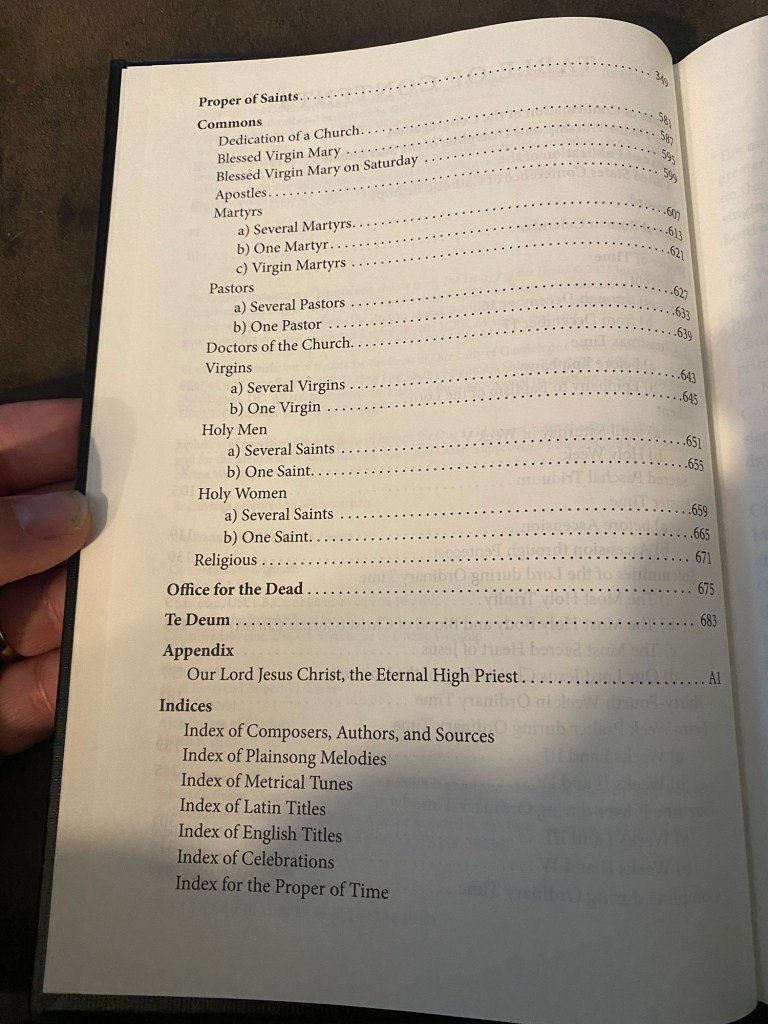
Reviewing The Divine Office Hymnal

I’m taking a deep dive into my church nerdery today. More specifically, I’m diving deep into a particular subset of church nerdery to which I am obsessively devoted: The Divine Office (a.k.a. The Daily Office or The Liturgy of the Hours).

The Divine Office Hymnal arrived in today’s mail. It is part of the Roman Catholic Church’s ongoing update to their Liturgy of the Hours in English. Promulgated by the USCCB in 2022 and published by GIA in 2023.

The hardcover is simple and elegant; the binding is solid.

On the inside, there are sparse illustrations that are lovely and do not interfere with the flow of the music. I particularly like the one on the title page.

The contents include a calendar of saints (Roman), hymns for all major seasons and saints, including a 2-week cycle for Ordinary Time. There are separate indices for metrical and plainsong tunes, as well as English and Latin first lines, which is helpful.

The hymns included are the traditional Office hymns, each offered with a metrical melody (odd numbers) and a plainsong melody (even numbers). I like this much more than the hymn offerings in the previous American edition of the LOTH. The musical layout is easy to read and follow. Text size is good. All music is in modern 5-line notation, rather than Gregorian neumes. This will be a turnoff for some, but I personally don’t mind. The English translations are decent and probably more accurate than Newman’s more familiar translations, they fit the meter well, but don’t often rhyme.

In form and style, this hymnal bears the most resemblance to the now out-of-print Lumen Christi Hymnal, but is greatly expanded. Included in this version are hymns for the Office of Readings and the Little Hours, which were lacking in Lumen Christi. An English Te Deum is included for the Office of Readings, but the translation is different from the ICEL one I am familiar with from the Episcopal Book of Common Prayer.

What I would have liked to see, which aren’t in The Divine Office Hymnal, are settings for the Marian Antiphons after Compline. These are readily available in other resources, like The Parish Book of Chant, so their omission here is only a minor problem.

All in all, it looks like GIA has done a good job of putting together a very useful resource for USCCB’s long-awaited update of the Liturgy of the Hours. Since it contains only hymns, it will also be quite useful for Christians in other denominations, like me (Episcopal), who also pray the Daily Office.

The price is also very reasonable, at $25 (before S&H).

I give The Divine Office Hymnal a thumbs-up and would recommend it.

The Way That We See

Sermon for the Last Sunday of Epiphany, Year B

The text is Mark 9:2-9.

Canadian singer/songwriter Bruce Cockburn penned the following lyrics in his song, Child of the Wind:

Little round planet in a big universe:
sometimes it looks blessed, sometimes it looks cursed.
Depends on what you look at, obviously,
but even more it depends on the way that you see.

(Bruce Cockburn, Child of the Wind)

The way that we see things matters. Our worldview matters. Some see the world as a battleground between us and them, the haves and the have-nots, the fit and the unfit, or the good guys and the bad guys. What matters, according to this worldview, is ensuring that our side wins and the other side loses.

Some see the world as a meaningless conglomeration of matter and energy that is ultimately indifferent to the needs and wants of individual human beings. What matters, according to this worldview, is imposing our will and our ingenuity onto the chaos and forcing it to satisfy our desires.

The Christian worldview does not see the world in either of these ways. As Christians, we follow the guidance of our Lord and Savior Jesus Christ, who teaches that our Father in heaven “makes his sun to rise on the evil and on the good, and sends rain on the righteous and on the unrighteous” (Matthew 5:45). Later on, Jesus says, “Look at the birds of the air; they neither sow nor reap nor gather into barns, and yet your heavenly Father feeds them” (6:26) and, “Consider the lilies of the field, how they grow; they neither toil nor spin, yet I tell you, even Solomon in all his glory was not clothed like one of these” (28-29).

Jesus sees the universe as a good place that is constantly being created and cared for by God. According to the creation stories in the book of Genesis, which Jesus grew up reading, God created a wonderfully good universe, formed humankind in the divine image, and placed us in the world in order to help care for this beautiful place. Anyone who has read the account of the life and teachings of Jesus in the gospels knows that Jesus is not blind or indifferent to the complicated realities of conflict and suffering, but he regards all of that as secondary to the central truth of a good God who created a good world and continues to sustain it in love.

The fourteenth century English mystic, Julian of Norwich, was the first woman to write a book in English. While lying sick in bed and near death, Julian describes her own experience of the kind of worldview that Jesus wanted to instill in his followers.

Julian writes that God

“showed me something small, no bigger than a hazelnut, lying in the palm of my hand, and I perceived that it was as round as any ball. I looked at it and thought: What can this be? And I was given this general answer: It is everything which is made. I was amazed that it could last, for I thought that it was so little that it could suddenly fall into nothing. And I was answered in my understanding: It lasts and always will, because God loves it; and thus everything has being through the love of God.”

(Showings, IV)

The way that Julian and Jesus see the world is very different from the way that nationalists, terrorists, and other fanatics see the world. For Julian and Jesus, there is no struggle between us and them, no cosmic indifference to suffering, because there is only the God whose name is Love.

In today’s gospel, we get to see the beginning of the Christian worldview taking root in the minds of Jesus’ disciples, Ss. Peter, James, and John. We read that Jesus takes these three friends up a mountain and there, far away from the bustling crowds, “he was transfigured before them” (Mark 9:2). The text of Mark’s gospel only describes the change in his clothes, which “became dazzling white, such as no one on earth could bleach them” (3). While this might sound like the beginning of a commercial for laundry detergent, no sales pitch was forthcoming. The gospel writers preserved this story in order to express the way they saw Jesus. For them, Jesus was more than just a good man or a wise teacher; he was full of divine radiance. In later centuries, the bishops of the Church would develop this experience into the doctrine we now know as the divinity of Christ. One of the things that makes Christianity unique among the religions of the world is that we find God in a person. In Judaism and Islam, Moses and Muhammad are respected as prophets who proclaim the divine message, but in Christianity, Jesus Christ is the message itself. Through the story of the Transfiguration, we begin to see God in Jesus and, through Jesus, we begin to see God everywhere else.

Nowhere is this truth more apparent than in the mystery of the Eucharist. In the Eucharist, we take grain and grapes that have been shaped into bread and wine. This means that, when our ushers present the elements at the altar, they are symbolically offering to God the fruits of the Earth and the genius of human labor. Every wheat stalk and grapevine, every farm worker and truck driver, every hillside and highway are already present on the church’s altar, even before the prayer of consecration has even begun. The Offertory in our liturgy is, not simply a moment for fundraising, but a giving back to God of everything that God has given to us.

Once the priest has received this offering, she blesses it and offers it back to us as the consecrated Body and Blood of Christ. Then we, the people of the Church, rise and gather around the altar to receive Christ. In that moment, it no longer matters who is rich or poor, male or female, black or white, gay or straight, cis or trans, conservative or liberal, Israeli or Palestinian, Ukrainian or Russian. The only truth that matters, in that moment, is that the Body of Christ I receive into my body is the same Body of Christ that you receive into your Body, therefore “we who are many are one body, for we all partake of the one bread” (1 Corinthians 10:17). This is what I mean when I say: Through the story of the Transfiguration, we begin to see God in Jesus and, through Jesus, we begin to see God everywhere else.

The way that we see things matters. When our worldview is shaped by religious fundamentalism or secular atheism, we will see the world as a battle over who is right. When our worldview is shaped by the class warfare of Marxism or the market forces of capitalism, we will see the world as an endless fight for survival. But when our worldview is shaped by the Gospel, our Transfigured Lord will show us a transfigured world that glows brightly with the radiance of God.

I think about the story of the Transfiguration whenever I am outside in the evening and happen to catch those glorious moments near sunset, when all the trees and buildings seem to be shining with a golden light. I feel like I have to stop and make the sign of the cross because it seems like God is granting us a moment, however brief, when we get to see the world the way God sees it all the time.

I think also of another moment of transfiguration, that took place on a busy streetcorner in Kentucky. It was recorded by a 20th century monk named Thomas Merton.

He writes:

“In Louisville, at the corner of Fourth and Walnut, in the center of the shopping district, I was suddenly overwhelmed with the realization that I loved all those people, that they were mine and I theirs, that we could not be alien to one another even though we were total strangers. It was like waking from a dream of separateness… This sense of liberation from an illusory difference was such a relief and such a joy to me that I almost laughed out loud… I have the immense joy of being [human], a member of a race in which God Himself became incarnate. As if the sorrows and stupidities of the human condition could overwhelm me, now I realize what we all are. And if only everybody could realize this! But it cannot be explained. There is no way of telling people that they are all walking around shining like the sun.”

(Merton, Conjectures of a Guilty Bystander, p. 156-157)

Friends, the way that we see things matters. I encourage you this week to draw inspiration from Thomas Merton and Julian of Norwich. I invite you to attend deeply to our next celebration of the Eucharist. Above all, I urge you to be followers of Jesus, to see the world as he sees it, full of divine glory. May this Christlike way of seeing transfigure you from the inside out and lead you out to transfigure this world in the name of God, whose name is Love, and in the name of Love, whose name is God.

Amen.

Quiet On The Inside

Sermon for Epiphany 3 / Religious Life Sunday.

Several years ago, while serving as pastor to a Presbyterian congregation, I did something that I am not proud of. I worked tirelessly, day and night, to be faithful in my calling as a minister. I worked so hard, in fact, that I worked myself right into a hospital bed… not once but twice.

I was driven to work that hard by anxieties that are common among the clergy of small parishes: aging buildings, shrinking budgets, and low attendance. I thought that, if I was really a good pastor, the parking lot would be overflowing, donations would be pouring in, and the church would have to build an extra wing just to accommodate all the new people joining with their families. The fact that these things weren’t happening made me feel afraid that I was failing at my job, failing the people I loved at my church, and most of all failing God.

I compensated for this fear by working as long and as hard I possibly could, beyond what was good for my health, sometimes staying in my office until 2 o’clock in the morning. “If I, as their pastor, just worked harder,” or so I thought, “then the church would be doing better.”

This line of faulty reasoning is not unique to clergy. People who work in every conceivable field, from education, to healthcare, to law, to business, and to government, all of us are subject to the endless social pressure to perform, achieve, and succeed. The market-driven economy of our society operates under the unwritten rule and unspoken assumption that the value of a person’s life depends on that person’s ability to produce and succeed on an economic level. The fact that we even use monetary words like “value” and “worth” to describe human dignity is a sign of how deeply this avaricious mindset has infiltrated into our collective unconscious.

This state of affairs is nothing new. Throughout human history, the temptation has always been there to mistake function for identity when considering the quality of human life. The author of our psalm this morning, Psalm 62, talks about their own experience in noticing the capricious ebb and flow of fortune on the stormy sea of the economy. The psalmist writes, “Those of high degree are but a fleeting breath, even those of low estate cannot be trusted. On the scales they are lighter than a breath, all of them together” (Psalm 62:10-11).

In the very next verse, the psalmist goes on to describe the kinds of moral temptation that arise when we try to measure life with the ruler of economic achievement: “Put no trust in extortion; in robbery take no empty pride; though wealth increase, set not your heart upon it” (12). What we can see here is a person of faith desperately trying to navigate the ship of conscience through the stormy seas of moral dilemmas. 

The good news in this psalm is that the psalmist has discovered a still center and a firm foundation beneath the chaotic waves of life’s surface. The psalmist writes, “[God] alone is my rock and my salvation, my stronghold, so that I shall not be shaken. In God is my safety and my honor; God alone is my strong rock and my refuge” (7-8). We can hear echoes of this psalm in the nineteenth century Mariners’ Hymn by William Whiting, which states:

“Most Holy Spirit, who didst brood upon the chaos dark and rude,
and bid its angry tumult cease, and give, for wild confusion, peace;
O hear us when we cry to thee for those in peril on the sea.”

The Hymnal 1982, #608

The societal anxiety that drives us to mental burnout and moral compromise is founded on the fear that, beneath the chaos of life’s waters, there is nothing but the darkness of an empty void. Psalm 62 urges us to realize that this is a lie. God is present in the stillness beneath the surface; this is why the psalmist commands, “Put your trust in him always, O people” (9).

This is the same point that Jesus makes, in our gospel this morning, when he says, “The kingdom of God has come near” (Mark 1:15). An earlier translation of this verse renders it as, “the kingdom of God is at hand” (KJV, emphasis mine). I invite you now to hold your hand out in front of you and repeat those words out loud. One of the names we frequently apply to Jesus in the Christmas season, “Emmanuel,” literally translates from the Hebrew as, “God is with us.” God is with us; God’s kingdom is at hand, as Jesus himself has said.

The stupefying truth that Jesus is communicating here is that the God we believe in is not some distant entity, but a very present reality. St. Augustine of Hippo picked up this line of thought when he prayed to God, “You were more inward to me than my most inward part” (Confessions 3.6.11). In another place, St. Augustine also prays, “You have made us for Yourself, and our hearts are restless until they rest in you” (Confessions 1.1.1).

Psalm 62 agrees with Augustine in proclaiming, “For God alone my soul in silence waits; truly, my hope is in him” (Psalm 62:6). This is a confusing statement, given what we have just said about the nearness of God’s presence. How can one wait for someone who is already present?

Imagine that you were to see me in town one day, standing on a street corner, next to our priest. You walk up and ask me what I’m doing and I reply, “Waiting for the priest to get here.” I would not blame you, in that moment, if you then told me that I needed to get my eyes (or my head) examined. You might tell me, “Turn around, Barrett; she’s right there!”

That kind of turning around is what Jesus means, in Mark 1:15, when he tells his followers to “repent.” Many have come to associate that word with guilt and sorrow for one’s sins, but the Greek term used here, Metanoia, is best translated as, “Change your mind.” Its Hebrew equivalent, Teshuvah, literally means, “Turn around.”

What Jesus is inviting us to do in this gospel is change the way we think about God and realize that, beneath the chaotic waters of life’s surface, God is already present with us in the stillness. As Augustine has already told us, God is more present to us than we are to ourselves. What the psalmist calls us to “wait” for then is not the arrival of God, but the realization that God is already here.

My own realization of this presence came after my second trip to the hospital with stress-related illness. I realized then that, if I was going to survive in life and ministry, I needed to find a more grounded and balanced way of living. The only people I was aware of who knew how to do that were monks.

A quick search on the internet revealed that St. Gregory’s Abbey, an Episcopal Benedictine monastery, was located in the city of Three Rivers, just forty minutes away from my house. I booked a week-long retreat as quickly as I could. During that first week at St. Gregory’s, chanting and meditating with the monks, I learned for the first time what it feels like to be quiet on the inside. I’ve been chasing that feeling ever since.

What I began to learn in the monastery that week is the meaning of the psalmist’s proclamation, “For God alone my soul in silence waits; truly, my hope is in him” (Psalm 62:6). By letting myself drop below life’s chaotic surface, I found the presence of God in the stillness. The Benedictine way of spirituality changed the way I pastored my congregation, the way I parent my children, the way I relate to my spouse, and the way I live my life.

I made it my mission to visit the monastery as often as I could and bring its way of life home with me, as much as possible. After several years, I made a permanent commitment to that community, not as a monk but as an oblate. An oblate, for those who may not be familiar with the term, is someone who would be a monk, but is prevented by some kind of lifelong commitment (like marriage). As a husband and father with a full-time job, I am not able to rise at four o’clock every morning and pause to attend church services every three hours, but I am able to keep the spirit of the monastery alive in me by pausing for prayer and silence at the beginning and end of each day. I have found that the guidance of the Rule of St. Benedict is just as helpful for busy parents as it is for monks. Through the monks at St. Gregory’s Abbey, I managed to stay out of the hospital and found the kind of balance I had been looking and longing for.

Today, on the third Sunday of Epiphany, The Episcopal Church encourages its parishes to celebrate Religious Life Sunday. This is a day when we give thanks and pray for the many orders of monks and nuns in The Episcopal Church. St. Gregory’s Abbey, by far the closest, is just about an hour away from here in Three Rivers. There are many other communities, each with their own unique identity and calling: The Order of St. Helena, the Society of St. John the Evangelist, the Order of the Holy Cross, and the Community of St. Mary, just to name a few.

What these communities all have in common is their commitment to follow Jesus and live out the words of today’s psalmist: “For God alone my soul in silence waits.”

I encourage you to learn about these communities and remember them in your prayers.

Above all, dear friends, I encourage you today to look beneath the chaos of life’s surface and find there, in the stillness, the living heartbeat of God, who is more present to you than you are to yourself. May your discovery of this presence bring you peace and balance as you continue to navigate the troubled waters of this life.

Amen.

The Better Angels of Our Nature

Sermon for the fourth week of Advent.

Click here to read the biblical text.

Our gospel on this last Sunday of Advent recounts the well-known tale of the Annunciation, where the archangel Gabriel announces to the Blessed Virgin Mary that she is destined to be the mother of Jesus, God’s Son. Over the past two millennia, this story has been told and retold so many times that it can be hard to comprehend its intended emotional impact. To modern ears, the Annunciation is a sweet and tender introduction to the even sweeter story of the Nativity. But can you imagine how it must have sounded to Ss. Anne and Joaquim, the parents of the Blessed Virgin Mary?

Biblical scholars estimate that Mary would have been about fifteen years old at the time of the Annunciation, a typical marriage age for young women at that time. As the father of a fifteen-year-old at this time, I can keenly imagine how Anne and Joachim must have felt when they first heard the news of Gabriel’s visit.

Mary: “Mom? Dad?”

Anne and Joaquim: “Yes sweetheart, what is it?”

M: “Umm… I need to tell you something. I’m pregnant and my fiancé Joseph isn’t the father.”

The biblical text doesn’t tell us anything about Anne and Joaquim’s reaction, but I imagine they probably felt angry and terrified at the same time, which is completely understandable. This news would have been the embodiment of their worst nightmares for their daughter. Also, what Mary had to say next probably didn’t help them feel any better. How would you feel if your teenage daughter hit you with this news and followed it up with a crazy-sounding story about angels and prophecies? I imagine them pacing the floor, rubbing their temples, and asking, “How could this happen?! What were you thinking?!”

At this moment, Anne and Joaquim probably felt their stomach dropping and their mind racing. This is the feeling of their sympathetic nervous system kicking into high gear. The amygdala in their brain was, flooding their bodies with adrenaline to initiate the fight or flight response. If you’ve ever had the experience of someone shocking you with big news, you can probably relate to what they were feeling.

Mary herself seems to have been quite confused by what was going on. The gospel text tells us she was “perplexed” and asking, “How can this be?” This too is a completely understandable reaction, given the circumstances. Here was a teenage kid, in way over her head, with almost no life experience to guide her.

The response I find most interesting is the one that comes from the archangel Gabriel. The first words out of his mouth are, “Greetings, favored one! The Lord is with you.” In modern language, I like to imagine that this is the equivalent of, “Congratulations!” The next thing Gabriel says is, “Do not be afraid, Mary, for you have found favor with God.” And finally, after explaining the situation, Gabriel ends by saying, “For nothing will be impossible with God.”

While the humans in this moment are understandably perplexed and freaking out, the angel is the only one responding from a calm place of acceptance and hopeful possibilities. 

In scientific terms, this is akin to the wonderful human ability for the prefrontal cortex of our brains to override the baser impulses of our fight/flight system. You’ve probably experienced this as well, such as those moments when some reckless driver cuts you off in traffic and you successfully resist the urge to run them off the road. You remember, in that moment, that you are going seventy miles an hour in a thousand pounds of metal. After an instant of panic, your rational faculties kick back in and you remember that going to jail will not remedy the situation. 

This is how God has designed our brains. We can choose how to respond when circumstances arise that are less than ideal. We can fly off the handle or we can take a deep breath. We can descend to the level of our basic instincts or we can appeal to “the better angels of our nature,” as President Abraham Lincoln so eloquently put it in his inaugural address of 1861.

The astounding truth of this biblical story, which emerges when we look past two thousand years of pious nostalgia, is that God has chosen to save the world through the unplanned pregnancy of an unwed teenage mother. “For nothing will be impossible with God,” as the angel Gabriel has said.

Whether one is talking about teen pregnancy, gun violence, or any other number of social problems that presently plague our society, a common refrain among religious people is that these things are happening because “we’ve kicked God out of our country.” But, if two millennia of Christian theology are to be believed (and I think they are), then this teen pregnancy is the exact place where God has chosen to be most present to our world. This realization should shape the way we choose to respond to pregnant teenagers and any other persons who find themselves in circumstances that are less than ideal. 

One of the collects at Compline, the nighttime office from The Book of Common Prayer, reads as follows: 

“Be present, O merciful God, and protect us through the hours of this night, so that we who are wearied by the changes and chances of this life may rest in your eternal changelessness; through Jesus Christ our Lord.”

BCP, p. 133

This prayer is immediately followed by the following prayer for mission: 

“Keep watch, dear Lord, with those who work, or watch, or weep this night, and give your angels charge over those who sleep. Tend the sick, Lord Christ; give rest to the weary, bless the dying, soothe the suffering, pity the afflicted, shield the joyous; and all for your love’s sake.”

BCP, p. 134

What I love most about these prayers, which are meant to be said just before retiring at night, is how they insist on the presence of God in the most troubling of times and call upon God’s people to participate in the mission of reconciling heaven and earth by caring for each other.

God is most present, not in sweet moments of peace and plenty, but in hard times of want and woe. God comes to us in our hour of need, often through the hands and hearts of caring people, and grows within us. The Divine Word takes on flesh, using the DNA of our own cells, so that we might be the hands and feet of Christ on this Earth. This is the message of Christmas.

The message of Advent, our season of unexpected pregnancy, is to care well for the Christ that grows within us by caring well for the Christ that grows within those around us.

Wherever we go in this life, we find ourselves as divinely favored people in the midst of unfavorable circumstances. We cannot control what happens to us, but we can control how we choose to respond to it. Will we fall prey to the demons of panic and despair? Or will we listen to “the better angels of our nature” and declare, as Gabriel did, that “nothing will be impossible with God”?

I have no doubt that you, during this holiday season, will find yourself in the midst of circumstances that are less than ideal. They may be as major as an unexpected pregnancy, a tragic loss, or a global crisis. On the other hand, they may be as minor as a burnt dinner, a delayed flight, or a traffic jam. Wherever you find yourself this Christmas, I encourage you to listen to “the better angels of your nature” by trusting in God’s presence, caring well for yourselves and each other, and responding to these crises, large or small, with the calm compassion of the archangel Gabriel, saying:

Greetings, favored one! The Lord is with you…
Do not be afraid… For nothing will be impossible with God.”

Vocatio

In situ.

Nobody paying attention.

Those who should be

listening,

are not.

Lying

close at hand.

My name

echoing back

in a voice not mine.

Was it you?

It was not.

More lies.

Repeat the cycle,

again and again.

Getting restless.

I don’t even know

anymore.

Frustration mounting.

Somebody say something.

A rare moment of insight.

That voice again.

Listening harder

for something

I don’t want to hear.

Reality speaks

without words

that will not go

unheard.

This is no time

for prayers.

Restlessness

Still

Lying.

You need

to listen;

You say

you want to.

This is right;

This is real.

Just not

what I wanted to hear.

Trust me on this.