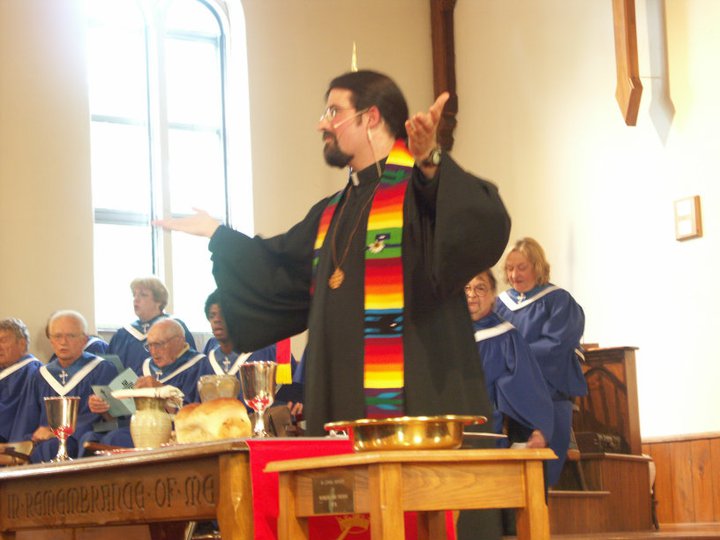
I preached this sermon on the tenth anniversary of the September 11 attacks. I am re-posting it today as the only thing I wish to say in remembrance.

J. Barrett Lee's avatarHopping Hadrian's Wall

I normally wait until after church to post my sermon, but I’m doing it early today, given it’s time-sensitive nature.  The recording will be up later.

My text is Matthew 18:21-35.

To be perfectly honest, I’ve been dreading this sermon all year, ever since I learned that today’s date would fall on a Sunday and I would have to get up into this pulpit and say something meaningful.  I wasn’t sure whether I should just ignore the day and preach the lectionary text from Matthew or cut whatever else we had planned for today and just focus on what I know is on everyone’s mind.  After agonizing over it all year, I can’t really think of any other way to begin except by coming right out and saying it:

Today’s date is the 11th of September.  And we’ve come together this morning to remember something important that happened. …

View original post 1,549 more words

Tierra Nueva in the News

I love it when I get to advertise for my friends and their ministry work, especially when said work is being done at Tierra Nueva, an ecumenical outreach organization in western Washington state.

Tierra Nueva played a major role in my discernment process when I was preparing for pastoral ministry. It was there that I had two major “moments” of realization about myself and my life.  To tell that story now would detract from this being a post about this remarkable friend of mine.

Jail Break

Their founder and director, Bob Ekblad, is a sessional lecturer at Regent College, where I went to seminary.  Bob was, without a doubt, my favorite professor there.  I first met him as a student in his class, Reading the Bible With the Damned.  Shortly after I took the class, Bob wrote a book with the same title, published by Westminster John Knox.  You can order that book on Amazon by clicking here.

These are my friends and I’m proud to know them.


The Democracy of the Dead

“I handed on to you what I also received…”  Image by Trilok Rangan.


Hacking Christianity has posted a wonderful response to A Growing Church is a Dying Church.  I can’t find an author’s name, but whoever it is has done a fantastic job of thoughtfully analyzing and critiquing my words.  I’m honored that someone would care enough to craft such an in-depth response.  The whole article is worth reading.  Here’s the link:

RE: A Growing Church is a Dying Church?

Why We need Tradition in the Wesleyan Church

Here is my rejoinder to Hacking Christianity’s rebuttal:

It wasn’t my conscious intention to be an “iconoclast of tradition”, but I can definitely see how my original post might read that way.  In my own mind, I’m quite the traditionalist, especially when it comes to liturgy.  If I were going to push against “tradition” at all, it would be two particular kinds:

1.  Nostalgia masquerading as Tradition.  In many cases, “the way we’ve always done it” actually refers to practices that only became established during the 1950s-1970s.  In my experience, those who fight hardest for this variety tend to be baby boomers who want to reconstruct the church of their childhood during the postwar church-attendance explosion.  What they want is a return to cultural dominance, popularity, and (most of all) money.  When they talk about returning to “traditional hymnody”, they don’t want the time-tested theological depth of Isaac Watts or Charles Wesley.  They want Fanny Crosby and the Sunday School hymns of the late 19th and early 20th century.  Never mind the horrible theology found in “This world is not my home, I’m just a-passin’ through”, people want to sing it because it reminds them of days gone by, just like Bing Crosby at Christmas.

When my generation retires, I’m sure there will be plenty of cranky curmudgeons who will torture their pastors about singing “Shout to the Lord” and “Awesome God”.  Rich Mullins will roll over in his grave on that day.

2.  Habit masquerading as Tradition.  “The way we’ve always done it” carries much stronger argumentative weight when people can identify why they’ve always done it that way.

For example, my wife’s grandmother used to always slice the end off of her Christmas ham each year.  When my mother-in-law asked why she did that, Grandma said she didn’t know, it was just the way her mother taught her to do it.  When Grandma later asked her mother about the origin of that tradition, Great Grandma revealed, “Oh, I only did that because the cooking pan I had back then was too small and a whole ham wouldn’t fit!”  All along, they had continued this tradition without knowing why they did it.

Here’s a counter-example of a well-reasoned tradition: My current congregation closes the Sunday service by singing the Clare Benediction.  They began this tradition while they were between pastors several years ago.  There was a long interim period, followed by a tragically short pastorate, followed by another long vacancy.  All in all, it had been about 7 years since they really felt at home with a pastor.  That’s a long time for a church that wasn’t ready to transition to a lay-led model.  The face in the pulpit varied each week (when they could get anyone to come at all), but the one symbol that held them together during that time was the fact that they closed each service with that same sung benediction.  That’s a tradition that means something.  They know exactly why they do it.  Ironically, that same awareness of tradition has allowed them the freedom to let that practice go.  This year, for the first time, we’re not singing it.

G.K. Chesterton called tradition “The Democracy of the Dead”.  I love that.  I want to preserve a sense of continuity with the Church Catholic from all times and places.  If anything, I’d like to see more tradition, not just Amazing Grace but also Phos Hilaron.  I long for us to constantly reopen the wells of living water dug by our ancestors.  Some of my folks dismiss practices like Sharing the Peace and weekly Eucharist without realizing their power as ancient traditions of the Church.

Jaroslav Pelikan once remarked that tradition is not “the dead faith of the living” but “the living faith of the dead”.  That’s what I want for my congregation.


The Morning After…

Hi everybody!

It’s been a very unusual few days.  This blog has received way more attention than ever before.  I’m still figuring out how to work with it and keep up.  Almost half of my all time hits on the blog have happened in the past two days.  The number of subscribers has tripled.  If you’re one of the many new readers, I’d like to formally welcome you to this conversation!

I use this place for posting my sermons, funny/witty/inspiring pictures from Facebook, expressing the occasional thought that hitchhikes through my brain, and promoting the work of friends and thinkers who I admire.  It began as a reflection on an inner-city chaplaincy program that I started a few years ago, but has since morphed into something else.  I’m open to requests for topics, hosting guest bloggers and reblogging interesting stuff from other sites, so if there’s something you’d like to see or talk about, don’t hesitate to ask!  I’m really glad you’re all here and I’m honored that something I wrote has touched a lot of people where they live.  Thank you so much for reading this and walking the journey with me.

Be blessed and be a blessing!

Barrett


A Growing Church is a Dying Church

Whenever a congregation goes looking for a new pastor, the first question on their minds when the committee interviews a new candidate is: Will this pastor grow our church?

I’m going to go ahead and answer that question right now: No, she will not.

No amount of pastoral eloquence, organization, insightfulness, amicability, or charisma will take your congregation back to back to its glory days.

What then can your pastor do?  She can make your board meetings longer with prayer and Bible study.  She can mess with your sense of familiarity by changing the order of worship and the arrangement of the sanctuary.  She can play those strange new songs and forget about your favorite old hymns.  She can keep on playing those crusty old hymns instead of that hot new contemporary praise music.  She can bug you incessantly about more frequent celebration of Communion.  She can ignore your phone call because she’s too busy praying.  She can ruin your perfectly balanced budget with appeals for more funds to be allocated toward mission and outreach.  She can take up your precious evenings with kooky new book studies and meditation groups.  She can take up your precious weekends with exhausting volunteer projects. She can open your church building to the ugliest and meanest freaks in town, who show up at odd hours, beg for handouts, track muddy snow into the building, leave their cigarette butts in the parking lot, and spill their coffee on the carpet during their Junkies Anonymous meetings.

She can come off sounding like a Jesus freak evangelical, gushing on and on about the Bible and your personal relationship with God.  She can come off sounding like a smells n’ bells catholic, pontificating on and on about tradition and sacraments.  She can come off sounding like a bleeding-heart liberal, prattling on and on about social justice and the need to constantly question old interpretations.

What can she do to grow your church?  Nothing.  There’s nothing your pastor can do to make your church grow.  She can’t save your church.  Your church already has a Savior and it’s not her.  She can push you.  She can open doors.  She can present you with opportunities.  It’s up to you to take advantage of them.  She can plant seeds and water them.  It’s up to God to make them grow.

And what if that happens?  What will growth look like?  Will all those old, inactive members suddenly return?  Will the pews be packed again?  Will you need to start a second service and buy the lot next door in order to expand the parking lot?  No.  You might see a few new faces in the crowd.  There won’t be many of them.  Some might stick around but most won’t.  Those who stay won’t fit in with the old guard.  They won’t know about how you’ve always done it.  They’ll want to make changes of their own.  Their new ideas will make you uncomfortable.  Your church won’t look or feel like it used to.  You’ll feel like you’re losing control of this place that you’ve worked so hard to preserve.  It will feel like your church is dying.

And that’s just the thing.  A growing church is a dying church.  It has to be.  It cannot be otherwise.  The way to Easter Sunday goes through Good Friday.  The way to the empty tomb goes through Golgotha.  The way to resurrection goes through crucifixion.  When Jesus told you to take up your cross and follow, did you expect it to lead anywhere else?  What Jesus told us about himself is also true of churches: Unless a grain of wheat falls to the ground and dies, it bears no fruit.

But what if it doesn’t work?  What if you let your pastor do all that crazy stuff and nobody new shows up?  What if the church still goes under?  What if all that time you spend studying the Bible, expanding your horizons, deepening your spiritual life, and serving your community turns out to be time wasted?  What if it does?

Tell you what: if that’s what happens, if you commit yourself to all this and still feel like it was a waste of time in the end, then maybe your church really needed to die.

Common Worship: From Revolution to Revelation

Re-blogged from the Presbyterian Hymnal Project Blog.

As a Presbyterian liturgical nerd and long-time fan of the Book of Common Worship, I find this exciting:

A guest post by David Gambrell from the Office of Theology and Worship:

Fifty years ago, something revolutionary happened in the world of Presbyterian worship.

In 1961, the UPCUSA (the former northern church) adopted a new Directory for Worship. For more than 300 years before that, the church had been relying on the Westminster Directory for Worship, written in 1645, making minor revisions here and there. The new Directory for Worship, written by Robert McAfee Brown, opened the door for radical, ecumenical liturgical reform and renewal in the Presbyterian Church—focusing on the centrality of the Word, a deeper understanding of Baptism, and more frequent celebration of the Lord’s Supper. One church historian has suggested that this work might have had an influence on the groundbreaking Roman Catholic reforms of Vatican II, which took place a couple of years later.[1]

The PCUS (the former southern church) took a similar action in 1963, adopting their own new Directory for Worship. And then, as we know, twenty years later, in 1983, the northern and southern churches merged to form the current Presbyterian Church (U.S.A.). One of the often-forgotten products of that new blended family was our current Directory for Worship, formed from the combination of the previous two… (Click here to continue reading)


Finding The Beauty In At-Risk Teens

Reblogged from NPR.org

by Coburn Dukehart

There is a sad, angsty, misunderstood teenager in all of us. Some of us are just better at letting it show.

So no matter how far past your teenage years you may be, Amy Anderson’s portraits of at-risk teens in Minnesota may take you back to that time in your life when you wished the world could see you differently…

Click link to continue reading at npr.org

Ruth and (Boaz?)

An old college friend sent me this photo over Facebook today, and, while I appreciate the humor and the overall sentiment, the biblical exegete in me can’t resist the urge to shed a little scandalous light on what’s REALLY going on in the book of Ruth.

First of all, the book of Ruth is not mainly a love story between Ruth and Boaz.  It’s a love story about Ruth and Naomi.  Some go so far as to claim that Ruth and Naomi were lesbian lovers.  However, the majority of biblical scholars dismiss this opinion as anachronistic speculation at best.

What is clear, however, is that the relationship between Ruth and Naomi takes center-stage in this book.  Furthermore, this is a relationship that is formed and conducted entirely outside the bounds of conventional definitions of relationships.

Their commitment to each other transcends the boundaries of race, culture, and religion.  Disastrous circumstances bring them together.  Their love for each other keeps them together.  This is a story about love as a lived reality that overcomes all barriers.

The life to which Ruth commits herself is one of hardship and illegitimacy.  Women were regarded as property in the Ancient Near East.  They had no legal rights without a man to speak for them.  Ruth and Naomi forge an existence together at the very edge of civilization, where they do whatever they have to do to survive.

Boaz himself is only a marginal character in this story.  He only shows up as a plot device.  Not a bad guy, to be sure, but not the hero either.

As women without means, surviving on their own, Ruth and Naomi hatch a plot to force Boaz into being their source of long-term legitimacy and security.  At the end of the harvest, when Boaz is passed out drunk from a long day of work and a long night of partying, Ruth crawls into bed with him and “uncovers his feet”.  This phrase is a Hebrew euphemism.  She uncovered his feet alright… and his knees… and his thighs… and everything else up there.  Basically, Ruth was shamelessly throwing herself at Boaz.  She was in no way acting like a lady in this moment.

Imagine this: Boaz stirs awake from a drunken stupor with his pants around his ankles and a woman straddling him.  Her actions are sending the message, “You and me: right now, right here.”  The innuendo in this passage is by no means subtle.  If we’re going to take the story of Ruth as a model for sexual morality, then I predict that the evangelical dating scene is about to get very… interesting.

Where I find the good news in this story is in the committed love between Ruth and Naomi that overcomes all circumstances and barriers.  They stay committed to each other, no matter what.  Their family relationship would have been unconventional, untraditional, and offensive to many in their society.  They were useless people, damaged goods, and human refuse.

They say that God works in mysterious ways.  In the book of Ruth, God can be found in the morally questionable behavior of those who eek out an existence of survival under dire circumstances at the very edge of civilization, but maintain their humanity by keeping faith in and with each other, despite anything that anyone else has to say about it.  Theirs is a scandalous love that takes risks and holds on no matter what, much like the love of God.  When it comes to finding a biblical model for relationships, I don’t pray that my kids will have a love like Ruth and Boaz.  May my children grow up find a love like Ruth’s and Naomi’s.  So may we all.

No offense to my old friend who sent me the picture.  It’s hilarious.  Thanks for indulging a preacher with a keen eye and a dirty mind.