The Eucharist is a supreme moment of cosmic, planetary, spiritual, and human embodiment. All the elements meet as one in a ritual engagement from which nobody, for any reason, should be excluded. Radical inclusion is at the heart of every eucharistic enactment, subversively modeled by the Jesus of Christianity, who welcomed everybody to the eucharistic table, including those who were totally prohibited according to the religious rules of the day: tax collectors, prostitutes, and sinners…
The Eucharist acclaims and celebrates unashamedly the radical relationality that characterizes every form of embodiment, from the cosmic to the personal. And it also pronounces that God is totally at home in the immediacy of that encounter; stated in the affirming assertion of Sallie McFague: God loves bodies! God is present precisely in the moments of intense bodily encounter, whether in the erotic passion of sexual embrace, the intensity of human intimacy, or the inexpressible…
It’s no secret that I’ve been part of several different varieties of Protestant church: Baptist, Evangelical, Charismatic, Emergent, Episcopal, Presbyterian…
All this time, I’ve been longing for a tradition, something bigger than my little self, of which I can be a part. Each time I land somewhere new, I think I’ve found it, that is, the place where I will finally put down roots and stay forever. And each time, I end up leaving after a few years. I’m beginning to think my ecclesiology is not as strong as I once thought.
I tend to leave each tradition with a keen (and perhaps overdeveloped) sense of what is wrong with it. My most severe criticism has been reserved for the one tradition that, during my youngest years, shaped me more than any other: the Baptists.
I graduated from a private Christian high school in the Bible belt that was run by a Baptist church (watch the film Saved! for an idea of my high school experience). I got to see the very worst of the Baptist tradition there. Theologically, they were the sweaty-brow, pulpit-pounding, Bible-beating, hellfire-and-damnation preachers for which the American south has become famous. Their commitment to ignorance was the foundation of their stupidity.
At no time was their hypocrisy more apparent than during my senior year when the pastor of that church sexually assaulted a student and the church covered it up. Meanwhile, that student’s mother (who happened to be a teacher at the school) was fired from her job. Later that year, another student was expelled from school because she was caught drinking at a party. The administration defended their actions, citing “discipleship” and not “evangelism” as the institution’s raison d’être.
After that experience, the one variety of church that I intentionally avoided was Baptist. To me, they represented the very worst of dogmatic and legalistic Christianity that was devoid of any mysticism, relationality, or intellectual integrity.
More recently, as I’ve been exploring what it means to believe and live as a self-identified liberal Christian, I have been basking in the light of several authors whose lives and words have touched me deeply. Specifically, I am referring to Howard Thurman, Walter Rauschenbusch, Harry Emerson Fosdick, and Martin Luther King, Jr. These icons of liberal Protestantism have touched me deeply with their commitment to everything I thought was lacking in my experience of the Baptist tradition.
And then it hit me: these four men had one thing in common that had eluded my consciousness until now. They were all Baptist ministers.
Delving a little more deeply, I discovered a whole new perspective on the Baptist tradition that I hadn’t noticed until now. Apart from the die-hard fundamentalists among them, Baptists are (and have been for four hundred years) committed to the power of freedom.
Walter Shurden has articulated the Baptist commitment to freedom in terms of four central values (I have lifted the following summary from Wikipedia):
Soul freedom: the soul is competent before God, and capable of making decisions in matters of faith without coercion or compulsion by any larger religious or civil body
Church freedom: freedom of the local church from outside interference, whether government or civilian (subject only to the law where it does not interfere with the religious teachings and practices of the church)
Bible freedom: the individual is free to interpret the Bible for himself or herself, using the best tools of scholarship and biblical study available to the individual
Religious freedom: the individual is free to choose whether to practice their religion, another religion, or no religion; Separation of church and state is often called the “civil corollary” of religious freedom
Needless to say, this discovery has sparked a reconsideration of my theological roots, dare I say it, the tradition in which I was raised. Upon further reflection and research, I came to another realization about my heritage:
Apart from the high school I attended, my experience of Baptist churches via the ones I attended as a child was an experience of very moderate to liberal Baptists. My parents, who I would describe as moderate in most respects, brought us to two different Baptist churches during my youth: First Baptist Church of Melrose, Massachusetts and Binkley Baptist Church in Chapel Hill, North Carolina. First Baptist of Melrose is where I have my earliest memories of church. Binkley Baptist is where I received my first Bible in the third grade. Both of these churches are American Baptist, formerly known as Northern Baptist, a much more diverse and moderate denomination than its southern counterpart. Binkley Baptist is also affiliated with the Alliance of Baptists, a very liberal denomination that split off from the Southern Baptist Convention in the mid-1980s. That same church made waves decades ago by hiring an openly gay minister before it was popular, even among mainline Protestants. Upon close re-examination, I would say that my perspective on my Baptist roots is shifting dramatically.
Having just completed my transition to the Presbyterian Church in the last twelve months, I’m not looking to make another switch. However, if one were to ask me what I see God doing in my personal life right now, I would probably point to the way in which my relationship toward my Baptist heritage is being redeemed in my own memory.
For the last several years (before this process began in earnest), I’ve even had recurring dreams of returning to Binkley. One involved making my way down a snowy path through the woods behind my childhood home and arriving at Binkley in order to talk with their pastor. In another dream, I was worshiping in their sanctuary on a Sunday morning, but the internal arrangement of the church (pulpit, pews, etc.) was 180 degrees opposite to what it had been when I attended there. Those are striking images, considering what I’ve been talking about here. Could it be that this internal redemption of my denominational heritage was an unconscious work-in-progress for several ears?
All of this material came up in my mind yesterday during my personal devotions. I was reading a passage from Genesis 12, where Abram is called away to an unknown land under divine guidance. The voice said to him, “Go from your country and your kindred and your father’s house to the land that I will show you.” He had no idea of where he was going. All Abram knew was that he would be blessed and would be a blessing to “all the families of the earth.”
You would think that this would be the beginning of a long epic that ended years later with his arrival in the Promised Land. However, such is not the case. We read in the text that Abram arrived in the Canaan by the end of the next paragraph. That seems rather anti-climactic and counter-intuitive to me. Where was the author’s sense of story and adventure? Odysseus took fourteen years to get where he was going, Abram took a paragraph.
But then I noticed something else: Abram’s journey did not end with his arrival in the Promised Land. It was only beginning. He continued to live as a nomad in Canaan, moving from place to place, “journeying on by stages,” as the text says. And at each stage along the way, he set up an altar. He acknowledged the sacredness of each patch of earth and gave thanks to the One who had called him in the beginning, guided him thus far, and promised to bless him until the end.
As it was with Abram, so I believe it is with me. Perhaps I have been in the Promised Land all along, still living as a nomad, traveling from place to place and church to church. Perhaps that sense of tradition and belonging for which I yearn has been with me the whole time. Maybe it is only now, as I am being led to embrace the part of my heritage I have despised most, that I am finally able to see my real tradition.
I build an altar here, acknowledging the sacredness of this patch of earth called ‘Baptist’ and blessing the One who brought me to and through its territory. I do likewise for the other theological provinces I have visited: Evangelical, Charismatic, Emergent, Episcopal, and Presbyterian. I do not know where my journey will lead me from here, but I look forward to exploring the land that is being shown to me and experiencing the mutual interflow of blessing between myself and all the families of the earth.
Time to sit up and pay attention. I’m asking YOU a question today, so I want to see lots of answers and comments down below!
This is a question that my philosophy students at Utica College are pondering and discussing this week and I thought it would be fun to put it before you.
I was having lunch at a cafe yesterday when someone walked up and handed me a religious pamphlet that asked whether I knew for sure that I was going to heaven when die. This is an interesting question.
It’s even more interesting that so many in the fundamentalist camp choose to start their evangelistic pitch with this question. If one’s faith is based on fear for the ego’s survival in an unknown afterlife, then it doesn’t seem to be qualitatively different from the dog-eat-dog drive for survival in this world.
I’m not trying to disparage eternal hope for anyone, but during Holy Week, Christians celebrate the death and resurrection of Jesus. Jesus was willing to sacrifice himself. His vision and ultimate concern was much larger than his drive for egoic survival. He embraced death willingly and so became the primary model by which Christians measure their faith.
There is an extent to which I believe we Christians are called to do the same. Jesus said, “Take up your cross and follow me.” Christians like to remind each other that Christ died for us, but there is also a very real sense in which we are called to die with Christ. We are participants, not merely consumers, in the unfolding drama of eternity.
Friedrich Schleiermacher said it like this in On Religion: Speeches to its Cultured Despisers (1799):
Religion is the outcome neither of the fear of death, nor of the fear of God. It answers a deep need in man. It is neither a metaphysic, nor a morality, but above all and essentially an intuition and a feeling. … Dogmas are not, properly speaking, part of religion: rather it is that they are derived from it. Religion is the miracle of direct relationship with the infinite; and dogmas are the reflection of this miracle. Similarly belief in God, and in personal immortality, are not necessarily a part of religion; one can conceive of a religion without God, and it would be pure contemplation of the universe; the desire for personal immortality seems rather to show a lack of religion, since religion assumes a desire to lose oneself in the infinite, rather than to preserve one’s own finite self.
The question I am putting before you, superfriends and blogofans, is taken from chapter 9 of William Rowe’s Philosophy of Religion: An Introduction.
How important to religion is the belief in personal survival after death? Do you think that religion must stand or fall with this belief? Can you imagine a viable religion which accepts the view that death ends everything? What would such a religion be like? Explain.
It probably feels a little strange to see your pastor preaching in a hoodie on Sunday. Half of you are probably wondering if I’m trying to make some kind of point. The other half of you are probably wondering if maybe we need to turn up the heat in here. Both groups would be right (in a manner of speaking).
It all got started earlier this year when I realized that Palm Sunday would fall on April Fools’ Day this year. I said to myself then, “Oh man, that’s too good. I’ve got to have some fun with this!” And the beauty is that it doesn’t even take that much work to find a connection between these two days.
The setting of the scene, as we already know, is the Jewish festival of Passover. Jesus and his disciples were joining crowds of their fellow Jews as they made their way on a pilgrimage to Jerusalem for the holiday. Passover is an annual celebration of Jewish liberation from slavery in Egypt. They get together each year and tell the story of how God set them free from foreign oppressors. The message of Passover was particularly powerful to Jews in Jesus’ day as they survived under Roman occupation.
In order to halt any bright ideas about rebellion during this festival, the Roman governor (Pontius Pilate) made a point of marching his troops through the city as a display of Imperial dominance. He wanted to send a clear message that Rome was in charge. The troops marched through town with their banners proudly waving. At the head of the line, Pilate sat mounted on his mighty steed.
Contrast this image with the image of Jesus riding into Jerusalem on a donkey, surrounded by his usual riffraff as they waved palm branches and made a scene. It was a deliberate mockery of Pilate’s procession. Jesus was making fun of it! It was like an April Fools’ prank, but with a point.
Jesus’ parody of Pilate’s pride was actually a brilliant and prophetic display of political and spiritual theater. I call it prophetic, not because it was predicting the future, but because, in that moment, Jesus was engaged in the exercise of “speaking truth to power.” People have this funny idea that prophecy is all about predicting the future or the end of the world. In reality, the job of a prophet is to reinterpret the present from a spiritual point of view. They present us with a vision of reality as it could be, if we would only open our hearts to what God is doing in our lives at this moment, or a warning of reality as it might become if we remain closed.
Jesus was hardly the first or last person in history to “speak truth to power” as a prophet. We can all think of others who, through their words or actions, presented us with a vision of reality as it could be. I have my own litany of saints who have affected me like that: Dorothy Day, Mother Teresa, Desmond Tutu, Mahatma Gandhi, Martin Luther King, Oscar Romero, Dietrich Bonhoeffer, Gene Robinson, and many others. Maybe you know of others.
Jesus had his favorites as well. One of them was an ancient Jewish prophet by the name of Zechariah. Zechariah had this crazy vision in his day that Jesus decided to make come true. Jesus knew that people wanted him to become king of the Jews. So, he decided to show them the kind of king he would be. You might call this his “royal mission statement.” He borrowed this donkey-riding image from the mind of Zechariah. Zechariah said,
Rejoice greatly, O daughter Zion! Shout aloud, O daughter Jerusalem! Lo, your king comes to you; triumphant and victorious is he, humble and riding on a donkey, on a colt, the foal of a donkey. He will cut off the chariot from Ephraim and the war horse from Jerusalem; and the battle bow shall be cut off, and he shall command peace to the nations; his dominion shall be from sea to sea, and from the River to the ends of the earth.
Jesus would be a humble king and a peacemaker, not a guerilla fighter or imperial overlord. And his reign of peace would include all the nations of the earth, not just his own ethnic group. This, by the way, was also another slight against the Roman Empire. They prided themselves on their large and (relatively) stable territory. They rejoiced in what they called the Pax Romana (Roman Peace) that would one day spread to the ends of the earth through the imposition of military order. Jesus shook his head at this idea and laughed. He used the words of the prophet Zechariah to introduce another vision of world peace.
In this hilarious lampoon of Rome’s arrogance, Jesus is reminding his followers (and everyone else) where true power lies. It doesn’t rest in the hands of the privileged few who happen to wield the death-dealing resources of an international superpower. True power comes from God. And it is not on display in the exercise of intimidation, but inspiration. True power, as God sees it, doesn’t come from dealing death, but giving life. It’s not about exclusion, but inclusion. Real power, according to Jesus, doesn’t come from our ability to condemn, but to forgive. This is the upside down vision of reality that Jesus is proclaiming to us on this Palm Sunday.
This leads me back to the hoodie that I’m wearing. Most of you are probably aware of certain events that took place in Florida over a month ago. An African-American teenager by the name of Trayvon Martin was on his way back from the store with a bag of skittles and an Arizona Ice Tea when a vigilante neighborhood watchman named George Zimmerman, who has a documented history of aggressive and violent behavior, called 911 about a young black male in his gated community. The 911 operators specifically told him to leave Trayvon alone, but Zimmerman picked up a gun and went after him anyway. The facts of what happened next have not yet been established (it appears that there was some kind of fight), but we know that it ended with George Zimmerman shooting an unarmed minor in the chest and killing him.
Over a month later, George Zimmerman is still free. He has not been arrested or charged with a crime. The state of Florida has not even suspended his license to carry a concealed firearm. In theory, this means there would be no legal barrier to prevent this same person from walking into this room with a gun right now. If this had happened to one of our kids in Boonville, would we be satisfied to wait a full month before the authorities investigated deeply enough to make an arrest? How safe would we feel if it was a student from Adirondack High School lying on the ground with a hole in his chest while the person who pulled the trigger was happily mowing his lawn a month later? Wouldn’t we, in the very least, be passionately asking questions about the truth of what happened that night? Of course we would.
In the weeks following Trayvon’s shooting and death, members of the media have been weighing in on this. I realize you might be sick of hearing about it, but I’m following the advice of theologian Karl Barth this morning: “Preach with the Bible in one hand and the New York Times in the other.” Some pundits have tried to paint a mental picture of Trayvon Martin as a no-good thug by appealing to stereotypical images of young black men. Geraldo Rivera went so far as to blame this incident on the fact that Trayvon was wearing a hoodie (like this one) on the night of his death.
There has been a widespread response to Geraldo’s ignorant comment. Last Sunday, pastors in churches all around the country joined together in a prophetic display of political and spiritual theater, just like Jesus’ famous entrance into Jerusalem on the first Palm Sunday. They all preached in hoodies. Since then, folks in other public professions have followed suit. There have even been some of our elected officials who have worn hoodies into the halls of Congress. I’m a latecomer to this action, since I didn’t hear about it until after-the-fact, but that’s okay because it fits well with what we’re talking about today.
Geraldo Rivera implied (intentionally or unintentionally) that wearing a hoodie somehow makes a person eligible to be shot. If that’s really true, then I’m eligible to be shot right now and, as I already noted, there is nothing to legally stop George Zimmerman from walking into this room and doing so.
Now, you and I know that such an idea is ridiculous. No one out there really believes that hoodies justify murder. The importance of this symbol lies in its association. This style of dress is associated with the hip-hop subculture which, in turn, is associated with negative stereotypes of African-Americans. So really, underneath the surface, this is still a conversation about race. Geraldo used the word hoodie, but what he really meant to say was black. Trayvon Martin was shot and killed because he was black. The only thing that disturbed George Zimmerman was the sight of a young black man walking down the street in a suburban gated community. Why? Because young black men aren’t supposed to live in gated communities, according to the racist subconscious assumptions of our society. We may have outlawed segregation on paper, but racism is still very much alive in reality. And that, brothers and sisters, is a gospel issue.
We agree with the apostle Paul when he says that, in Christ, “there is neither Jew nor Greek, male nor female, slave nor free.” We could easily add “black nor white.” When I and my fellow-pastors wear these hoodies into our pulpits, we are standing together to make a bold prophetic statement. We’re not doing it because we’re cold (although we are trying to “turn up the heat” on this issue). The prophetic statement we are making has to do with the equality of all people in the eyes of God. We’re saying that one black life, ended in violence, is no less disturbing or tragic than a white one. This prophetic action is shining the light on this truth, which we all hold dear.
In a few moments, we’ll all be participating together in another bold prophetic action as we celebrate the sacrament of the Lord’s Supper. Around this table of Christ, we gather together and partake of one loaf and one cup. We remind ourselves that we are all members of one family. The same blood, the blood of Christ, flows through each of our veins. This is the truth we believe in that trumps any other division or distinction we try to make among ourselves. We are connected, through the mystery of this sacrament, to each other and to God.
On this Palm Sunday, we remember Jesus’ prophetic proclamation of the power of peace. Likewise, we are making our own prophetic proclamations as we wear hoodies and share Communion with each other. This celebration leads us into Holy Week, the final stage of our journey toward Easter. We will be reminded during the coming week that there is a price to pay for speaking about God’s vision so boldly. This willingness to confront is what ultimately got Jesus crucified. He spoke out against the dominant system of power in his day and the system pushed back. The system used all the terrible might at its disposal to silence his message. But Jesus wasn’t afraid of them. He didn’t keep quiet. He continued to proclaim the prophetic vision loud and clear, even though he knew it would get him killed. Why? Because Jesus believed that love is stronger than death. He believed that the prophetic vision of the kingdom of God was bigger than his own individual survival. He trusted in resurrection more than survival.
As Christians, we are called to do the same. We are called to be Easter people who believe in the power of resurrection more than survival. Jesus has handed this prophetic vision to us, so that we might continue to proclaim its truth in the midst of a world that doesn’t want to hear it, but needs to hear it. As a church, a household of faith, we are called to take chances. We are called upon to risk our very lives for the sake of truth. We are called to embody this truth in our words and actions at church, home, school, work, or play. We should make those uncomfortable observations and ask the hard questions that we would rather ignore. It will not make us popular or successful. If we’re doing it right, it will lead us, as it did Jesus, to our own crucifixion and death. But it will also lead us to experience the Easter-power of resurrection and eternal life, which will continue to stand firm long after the systems and the nations of this world have passed away.
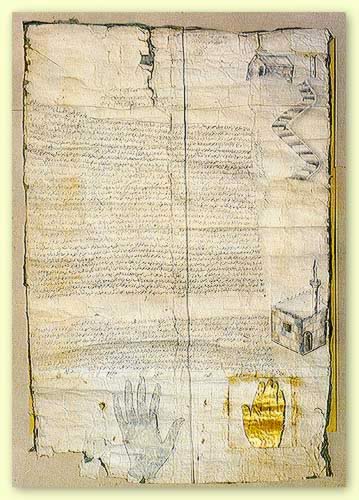
The Achtiname (Charter of Privileges) of the Prophet Muhammad, given to the monks of St. Catherine's monastery.
Last Sunday, I preached against Islamophobia from the pulpit of Boonville Presbyterian Church. As a supportive addendum to that message, I offer this post in hopes of fostering greater goodwill and understanding between Christians and Muslims.
The purpose of this post is to lead readers from all religions toward more peaceful coexistence. If that’s not something you want, then don’t read or comment on this article. All offensive comments will be deleted. I’m telling you now so that you don’t take it personally when it happens.
The following verses from the Qur’an and the English translation of the Achtiname of Muhammad were found in an article by Dr. Zakir Naik in the online magazine Islamic Voice. You can visit their website at: www.islamicvoice.com
Passages from the Qur’an on violence and forced conversions:
“Let there be no compulsion in religion: Truth stands out clear from error” [Al-Qur’an 2:256]
“Invite (all) to the way of thy Lord with wisdom and beautiful preaching; and argue with them in ways that are best and most gracious.” [Al-Qur’an 16:125]
The Achtiname (Charter of Privileges) is a document produced by the Prophet Muhammad himself for the monks of St. Catherine’s monastery on Mt. Sinai. The document provides a beautiful insight on the Prophet’s attitude toward Christians. The document has been preserved by the monks for centuries and stands as a memorial to interfaith respect.
Charter of Privileges
This is a message from Muhammad ibn Abdullah, as a covenant to those who adopt Christianity, near and far, we are with them. Verily I, the servants, the helpers, and my followers defend them, because Christians are my citizens; and by Allah! I hold out against anything that displeases them. No compulsion is to be on them.
Neither are their judges to be removed from their jobs nor their monks from their monasteries. No one is to destroy a house of their religion, to damage it, or to carry anything from it to the Muslims’ houses.
Should anyone take any of these, he would spoil God’s covenant and disobey His Prophet. Verily, they are my allies and have my secure charter against all that they hate.
No one is to force them to travel or to oblige them to fight.
The Muslims are to fight for them. If a female Christian is married to a Muslim, it is not to take place without her approval. She is not to be prevented from visiting her church to pray. Their churches are to be respected. They are neither to be prevented from repairing them nor the sacredness of their covenants.
No one of the nation (Muslims) is to disobey the covenant till the Last Day (end of the world).
I made it three minutes into Tyra’s interview with folks from Westboro Baptist this morning before I had to turn over to something a little more uplifting.
Tillich a was a person of his time, therefore we’ll have to forgive him his use of gender-specific language. With that in mind, here are a few inspiring quips:
But there are many things and events in which we can see a reason for genuine hope, namely, the seed-like presence of that which is hoped for. In the seed of a tree, stem and leaves are already present, and this gives us the right to sow the seed in hope for the fruit. We have no assurance that it will develop. But our hope is genuine. There is a presence, a beginning of what is hoped for. And so it is with the child and our hope for his maturing; we hope, because maturing has already begun, but we don’t know how far it will go. We hope for the fulfillment of our work, often against hope, because it is already in us as vision and driving force. We hope for a lasting love, because we feel the power of this love present. But it is hope, not certainty…
Is there a right to hope for mankind as a whole? There is one idea which has grasped the imagination of Western man, but which has already lost its power because of the horrors which have happened in our century; it is the idea of progress toward the fulfillment of the age-old hopes of man. This is still a half-conscious, half-unconscious belief of many people today. It is often the only hope they have, and its breakdown is a profound shock for them. Is progress a justified hope for man? In some respects it is, because man has received the power to control nature almost without limits and there is daily progress in science and in technical production. But the question is: Does this progress justify the hope for a stage of fulfillment? Certainly. Progress is a justified hope in all moments in which we work for a task and hope that something better and new will replace old goods and old evils. But whenever one evil is conquered, another appears, using the new which is good to support a new evil. The goal of mankind is not progress toward a final stage of perfection; it is the creation of what is possible for man in each particular state of history; and it is the struggle against the forces of evil, old ones and new ones, which arise in each period in a different way…
The hope of mankind lies in the here and now, whenever the eternal appears in time and history. This hope is justified; for there is always a presence and a beginning of what is seriously hoped for.
I always say that one of the reasons I’m so hopeful about the world is because I got to work with students for a long time, also in such a heightened intellectual atmosphere which really approves of curiosity, approves of exploration. I think we need more spaces like that in our churches and synagogues and mosques where we really approve of that kind of curiosity, where that’s part of what we think of as a religious message. Rather than certainty, actually, curiosity is what defines a religious person.
Pastors in several churches across the country wore hoodies to church last Sunday as a prophetic act of lamentation over the shooting death of Trayvon Martin.






 Hopping Hadrian's Wall