It’s Mine, And I Share It With You

Click here to read the bulletin. Readings included.

It amuses me sometimes when my kids really get into fighting over something at the house. I can pinpoint the exact moment in their epic struggle for justice when the tragic wail ascends to heaven over the unbearable tyranny that is being imposed upon them by their sibling. It’s usually over something electronic, like the computer or the television. Each of them is equally committed to their belief that the immutable laws of justice in the universe demand that they are the one who gets to claim ownership over the device in that moment. The outrage is so unbearable that the conflict sometimes comes to blows and an electronic device might go sailing across the room. And that’s usually when my wife or I decide that it’s time for a parent to intervene.

It reminds me of the times when my brother and I would get into similar battles as kids. It was the early 80s, so we didn’t have many electronics around the house, but kids never seem to have trouble finding things to squabble about. I remember one time as a five-year-old, in a fit of righteous indignation, I insisted that these toys were my toys, so I shouldn’t have to share them with my brother. And our quick-thinking mother came up with the perfect comeback: “No, they’re my toys, and I share them with you!”

I think sometimes that God wants to say the same thing to us grownups, when we bicker and fight over the things we think belong to us. People get so worked up about my house, my car, my money, my church, my country. I imagine God in those moments as the patient but stressed out mother, still in her bathrobe on a Saturday morning, shouting back her words of wisdom: “No, they’re mine, and I share them with you!”

The God we serve is a giving and forgiving God, but we humans, in our selfishness, often take that generosity for granted. We get all kinds of worked up over something that isn’t going right in our lives and quickly turn to shake our fist at the sky and shout, “Why, O God? Why?!!!” And when someone else, one of our brothers or sisters, comes along and asks something of us, we react as if some great injustice has been done to us. “Why should I have to give my spare change to that homeless person? This is my money; I worked for it!” And God says, “No, it’s my money, and I share it with you!”

We rarely stop to think about how much we’ve been given, and I don’t just mean material wealth. Think about sunlight. We remember from science class that stars shine by transforming matter into energy by way of nuclear fusion. I read a book recently that noted how our sun converts four million tons of its own matter into light energy every second. That light then travels 93 million miles to our planet, where it warms us in just the right amount to sustain life, and it does this for billions of years! Just think about that level of generosity and compare it to the paltry gesture of dropping a few coins into a hat for a fellow human being who has been standing out in that same hot sun all day.

We like to complain about the weather, how it’s always just a little too hot or a little too cold for our liking, but do we ever stop to think about the amazing and delicate balance that has kept life going and growing for all these millennia? Do we ever stop to give thanks for the wonder of it all? Or are we still too caught up in our own little tizzies about the next little thing that isn’t going quite right in our lives?

In today’s gospel, Jesus draws our attention to the great generosity of God that is constantly being poured out upon us, just as the sunlight is poured indiscriminately over the face of the earth. Jesus marvels at the way that God “makes his sun rise on the evil and on the good, and sends rain on the righteous and on the unrighteous.”

And our God is so gracious and unassuming in this ministry, never waiting to be thanked before offering the gift. Like so many human parents, God’s hope is that we will one day realize how much we have been given and pay it back by paying it forward to others. Children often don’t appreciate how hard their parents work to provide for them. And the parents don’t ask for recognition. Our only hope is that our children will one day be parents themselves, and will work just as hard to provide the same kind of love and care for their children. Jesus shows us today that God hopes the same thing for us.

Jesus says, “Give to everyone who begs from you, and do not refuse anyone who wants to borrow from you… Love your enemies and pray for those who persecute you, so that you may be children of your Father in heaven”.

It is a foregone conclusion that children tend to look like their parents. In a physical sense, they “bear the image” of the ones who made them. In the same way, each and every one of us is made “in the image and likeness” of our Father in heaven. Jesus asks us today to embrace that divine likeness in our own lives.

But something has to happen before we can begin that work in earnest. We need a Copernican Revolution of the soul.

Copernicus was a scientist in the middle ages who discovered that the earth was not the center of the universe. By careful observation, he figured out that our planet is traveling around the sun, not the other way around. This discovery sent shockwaves throughout the world. People’s whole conception of their lives was turned upside down. Church officials ranted and raved against Copernicus and his heretical ideas.

But history, as we know, proved Copernicus right. The earth is not the center of the universe. Ours is just one planet circling around a small star in a galaxy of billions of other stars, which is only one of billions of galaxies in the known universe. Copernicus’ idea caused a revolution in the scientific world, but it’s one that turned out to be true. And I thank God for Copernicus, because he has opened us up to discover so many more wonderful and useful things about ourselves and the world we inhabit.

In the same way, we humans today have once again fallen into the trap of believing that we are the center of the universe, while everything else simply revolves around us. In our sinfulness, we set ourselves up like little gods in life-or-death competition with all the other little gods around us. We battle each other for supremacy, screaming all the while, “It’s mine! It’s mine!”

But Jesus, our great Copernicus of the soul, comes alongside us to reveal the truth that makes us simultaneously smaller and bigger than we could have possibly imagined: We are not the center of the universe. We are not gods, but we bear the image of the God who says to us, “It’s mine, and I share it with you.” Jesus directs our attention to the bountiful generosity of God and invites us to participate in it, in our own small way.

Nowhere does Jesus embody this truth more fully than in his death and resurrection. In his passion, Jesus bore the sin of a world full of people who wanted to believe that they were the center of the universe. His Copernican Revolution of the soul was so dangerous to their agenda that they would stop at nothing to shut him up. And Jesus, ever the exasperated mother dealing with a toddler throwing a temper tantrum, willingly absorbed the full force of their hatred and violence. And he died there on that cross.

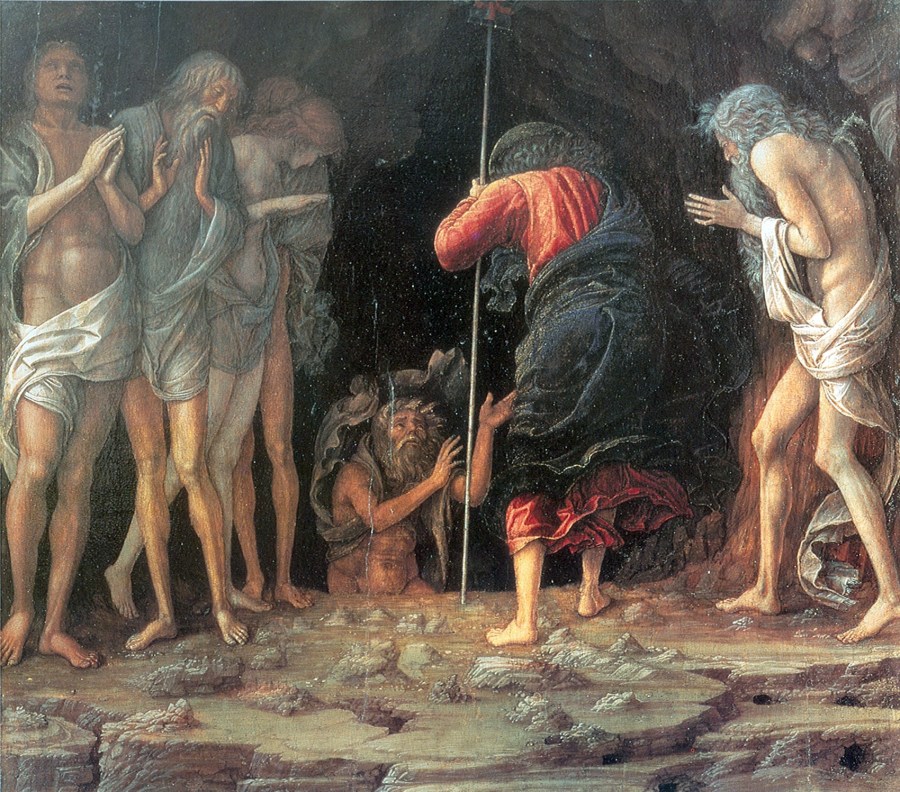
But then, in the greatest revolutionary moment in human history, he tore open the gates of hell and made death itself begin to work backwards. He rose from the grave, breathing peace to his betrayers and pronouncing, once and for all, that nothing “in all creation, will be able to separate us from the love of God in Christ Jesus our Lord.” (Rom 8:39)

Friends, this is the good news in which we stand today: We are not the center of the universe. We are the recipients of God’s amazing grace and Christ’s self-giving generosity that turns the world upside down. This grace is offered freely for you and for all by the One who “makes his sun rise on the evil and on the good, and sends rain on the righteous and on the unrighteous.”

“It’s mine,” God says, “and I share it with you.”

Jesus invites us this morning to join his Copernican Revolution of the soul and return the favor of this grace, not by paying it back, but by paying it forward: “Give to everyone who begs from you, and do not refuse anyone who wants to borrow from you… Love your enemies and pray for those who persecute you, so that you may be children of your Father in heaven”.

And remember the words of the old gospel hymn:

There’s a wideness in God’s mercy like the wideness of the sea.
There’s a kindness in God’s justice, which is more than liberty.
There is no place where earth’s sorrows are more felt than up in heaven.
There is no place where earth’s failings have such kindly judgment given.

For the love of God is broader than the measures of the mind,
and the heart of the Eternal is most wonderfully kind.
If our love were but more faithful, we would gladly trust God’s Word,
and our lives reflect thanksgiving for the goodness of our Lord.
Level Ground: A Universalist Preaches on Hell

Click here to read the service bulletin, including biblical readings

I heard a remarkable story a few years ago, about a series of events that took place on and around September 11, 2001. Unlike many of the stories that captured our attention that week, this one went largely unnoticed at the time, and took place far away from the cities of New York and Washington.

Many of us remember that all airplanes were grounded for several days after the attacks. This created quite a crisis for those who happened to be traveling. Many planes were diverted away from landing at American airports, and landed instead in the tiny town of Gander, in the Canadian province of Newfoundland. Waiting on the Tarmac for some kind of resolution, many were stuck on their planes for almost 24 hours.

Gander has a population of about 10,000 people. The number of passengers from 39 flights stranded there on September 11 was 6,500, well over half the size of the town. No one would have blamed the people of Gander if they had said, “Listen, we’re very sorry, but our town is just not set up to receive this many people at once.” But that’s not what happened…

The people of Gander opened their hearts and homes to the stranded travelers. They came with food, supplies, and offers of housing. The life of their town was disrupted for the next five days as citizens accommodated the needy travelers. They went out of their way and over the top to care for strangers in need.

Toward the end of their time in Gander, one of the stranded passengers had an idea. He spoke to his fellow passengers on Delta Flight 15 and took up a sizable collection. This money went to establish a university scholarship for the people of Gander as thanks for the generosity shown during a time of crisis. To this day, that scholarship continues to provide assistance for people of Gander to attend college and university.

There is nothing that binds people quite like coming through a crisis together. I hear this frequently from combat veterans and emergency responders. I have experienced it myself among my colleagues in ordained ministry. We may not have much else in common, but we share this one experience, and that binds us together as one forever.

In today’s gospel, Jesus describes a similar crisis that binds people together and erases the lines we tend to draw between ourselves in daily life.

We continue to hear from Jesus’ famous Sermon on the Mount this week. The section we read today is called ‘the Antitheses’ because Jesus is reinterpreting many of the commonly known laws of the Jewish Torah. He follows a certain formula, starting with, “You have heard that it was said…” and ending with, “But I say to you…”

At first glance, it appears that Jesus is overturning the old commandments, but in reality, he is deepening them (or “fulfilling” them, to use his words). Specifically, he addresses the commandments surrounding murder, adultery, divorce, and swearing oaths.

Jesus invites his followers to move beyond keeping the letter of the law to examining the spirit of the law. He does this because we humans have a strong tendency toward self-justification in morality. We like to set ourselves against one another in battles for superiority. Our spiritual life is no exception.

Examining my life according to the Ten Commandments, it seems at first that I am doing pretty okay (sort of). Sure, I haven’t always told the truth, rested when I needed to, or been grateful for what I have. If my parents were here today, they could give several examples of times when I did not honor my mother and father. But I can honestly say that I’ve never worshiped a pagan deity, robbed a bank, murdered another human being, or cheated on my spouse. So, at first glance, I’m scoring about fifty or sixty percent on God’s ‘Top Ten List’ of commandments. But when I listen to Jesus’ teaching in today’s gospel, my score drops dramatically.

I have never killed anyone, but I have harbored hatred and bitterness in my heart toward my fellow human beings from time to time. I have never committed outright adultery, but I have had a wandering eye and nursed unhealthy fantasies that would destroy my family, were I to act on them. I have never renounced the worship of God, but I have pledged my allegiance to things that are not God and allowed other concerns to take precedence over my baptismal commitment to Jesus Christ as Lord and Savior. The same could be said by any of us, if we are willing to be honest with ourselves.

What this means is that none of us has the right to set ourselves up as morally superior to another person. As St. Paul writes in his letter to the Romans:

“All have sinned and fall short of the glory of God.” (Rom. 3:23)

An honest consideration of the spirit of the law reveals that everyone stands on level ground at the foot of the cross. As sinners, saved by grace, we simply have no time to stand around in judgment over one another. We are all going through this crisis together.

So, what then is this crisis that we find ourselves in?

Jesus tells us repeatedly in this passage: it is hell.

Jesus talks about the evil one and the fire of hell no less than four times in this short passage.

Now, many of you may find it odd that I bring this particular detail up. Many of you have heard me say, on numerous occasions, that I tend to lean toward the theology of universalism, meaning that I believe God will save all people in time. For me, the belief in universal salvation is not born out of political correctness, liberal idealism, or a desire to avoid the harsher parts of the Bible I don’t like. I have several sound biblical and philosophical reasons for believing this, mostly relating to the character of God. However, I recognize that not all Christians agree with me. In the history of the Church, faithful Christians have devised many different ideas and interpretations about who and how many people will be saved for eternity. In the end, the decision about that will be made by the only one who is qualified: God, who judges the world with absolute fairness and absolute mercy. Hence, it is not for human beings to set limits on how far the redemption won for us in Jesus Christ can extend.

I am a universalist, but that does not mean that I can simply ignore Christ’s teaching about the very real danger of sin and hell.

When Jesus talks about hell in today’s passage, the word he uses is Gehenna. This is a reference to a real, physical place: the Valley of Hinnom on the southwest side of Jerusalem. We read in 2 Chronicles that this is a place that ancient Israelites used for human sacrifice to the Canaanite god Moloch in Old Testament times. The descendants of these Israelites were horrified by what their ancestors had done there. They kept the site from being used for any other purpose. Like the Auschwitz concentration camp, where Nazis sent countless Jews to their death, Gehenna stood as a perpetual reminder to history of what must never be allowed to happen again. By Jesus’ day, it had become the city dump of Jerusalem, where people would bring their trash to be burned. The sin of Israel had caused the Valley of Hinnom to become a stinking, perpetually burning pile of garbage that was good for nothing else. Our English translations have rendered his word Gehenna as hell.

I see hell, not as something that God will do to us in the afterlife, but as something that we do to ourselves in this life. I have sat at the bedside of addicts going through the shivers of withdrawal, and it is hell. I have spoken with parents who have seen their children gunned down in front of them by police, and it is hell. I have been to the overcrowded orphanages of Romania, and it is hell. I have listened to LGBTQ youth left homeless by self-righteous parents and pastors, and it is hell.

Jesus directs our attention to Gehenna as a warning about the very real and observable consequences of sin. If we occupy our lives with the relentless pursuit of property, pleasure, and power, we put ourselves in danger of becoming something disgusting and worthless. We develop ingrown souls that don’t care about being part of God’s plan for the world. If I were to translate Jesus’ warning in modern terms, I would say that those who despise and degrade their fellow creatures are in danger of “the ovens of Auschwitz.” Even as a universalist, I would say to you this morning that hell is real and the dangers of sin are real. This is the common crisis in which we all find ourselves as human beings on planet Earth.

But God has not abandoned us in this crisis. Even though we have turned away from God, God has never turned away from us. In Jesus Christ, the Word of God took on flesh and dwelled among us. He broke bread with outcasts and sinners. He healed the sick, opened blind eyes, and raised the dead. He challenged the status quo and called the people to move beyond the letter of the law to the spirit of the law.

When we humans, in our selfishness, could bear no longer to hear this message of grace and truth, we tried to silence Jesus by nailing him to the cross. But even then, after all hope was lost, the power of love overcame the love of power: God raised Jesus from the grave, in the words of an ancient Orthodox hymn, “Trampling down death by death, and upon those in the tomb, bestowing life.”

This risen Jesus invites us now to respond in faith by coming to his table, to share his broken body and shed blood in the Eucharist, to become one with him in body and spirit, and one with each other in the common loaf and cup. In this Sacrament, we receive Christ into ourselves and look forward to the day when hell will be conquered and emptied forever, our sins and sadnesses will cease, and all people will be made one in Christ.

Like those stranded travelers on September 11, we are bound together by the common crisis we have endured, and look forward in hope to the common destiny that awaits us in Jesus.

Becoming What You Already Are

Click here to read the service bulletin

Have you ever looked in the mirror and been unhappy with what you see?

Most of us have, at some point or other. We’re unhappy with the way we look, or the clothes we wear, or the house we live in, or the life we’re living.

Advertising executives make a fortune by promoting and manipulating that impulse within us. If only we buy this product, they say, our unhappiness and self-doubt will simply fade away. With their help, they say, we can be as happy and beautiful as the people we see in TV commercials.

It’s all lies, of course. We all know that advertisers are really just trying to get us to spend money we don’t have to buy things we don’t need in order to impress people we don’t like.

But here’s the thing: in order to effectively sell the lie, advertisers are preying upon a very real fear and very real desire that exist within each of us. The fear is that there is something wrong or missing inside of us, something that would make us profoundly happy, if only we had possession of it. The desire is the drive to be something other than who we are.

Want to look young and attractive forever? Buy this cream! Want to be an adventurous tough guy? Smoke the same cigarettes as the Marlboro man!

Religious advertisers have gotten in on this action too. Want to be free of that gnawing sense of guilt and loneliness? Join this church! Read this book! Attend this conference!

What all of the above have in common, from cigarettes to church conferences, is the claim to cure our sense of inner emptiness by way of some outside product. They claim that they can make us into something other than what we are. And it’s all a lie.

Christ, on the other hand, does the opposite. He offers us no quick-fix product or easy 3-step solution to our insecurities. On the contrary, Christ saves us by bringing us more deeply into who we already are.

In today’s gospel, Christ uses two images to describe this process: salt and light.

He begins by telling his followers, “You are the salt of the earth.” Salt, as we know, is a seasoning for food. We don’t typically eat it by itself; we put it on other things. It adds flavor. But what would happen if salt somehow lost its taste? Jesus tells us, “It is no longer good for anything”.

The second thing Christ tells his followers is, “You are the light of the world.” Light adds visibility to a dark room. If we hide it under a basket, we’ve lost the point of having light altogether. It belongs out in the open.

The common ground between salt and light is that they both add something to something else, whether it’s flavor to a meal or visibility to a room. Their presence deepens the experience of life. And they do this, not by becoming something else, but by being precisely what they are. Salt tastes salty by nature; light is bright by nature.

In the same way, Christ’s saving work in our lives is a process by which we gradually discover, embrace, and embody the image of God within us. The Christian saints of the East call this process ‘theosis’ or ‘divinization’.

According to Eastern Orthodox theologians, the ‘Image of God’ is who we really are inside. It is that part of our deepest selves that reflects something unique about God to the world. We humans can tarnish or cover this image by our sin, but we can never fully erase it.

The redemption won for us in Christ removes the dross of our sin, restores the flavor of our saltiness, and removes the basket from over our flame so that our inner light can be more clearly seen by the world. And this inner light is not our own, but only a reflection of God’s light, just as moonlight is a reflection of sunlight.

This is how Christ’s plan of salvation differs from that of advertising executives and Pharisees. The Pharisees were a religious group who promoted the product of biblical law as a way to change people into something other than what they are. The Pharisees said, “Come to us and follow our program, and you will be acceptable to God.”

They had a very public reputation for being very pious and righteous, so it must have been very disconcerting when Jesus said to his followers, “For I tell you, unless your righteousness exceeds that of the scribes and Pharisees, you will never enter the kingdom of heaven.”

Who was more righteous than a Pharisee? Jesus might as well have said, “You have to be more Catholic than the Pope” or “climb higher than Mount Everest” to enter the kingdom of heaven. Such an order would have seemed hopeless to the average person.

And I think that’s exactly the point that Jesus was trying to get across. It is hopeless. You can’t get there from here. If you’re trying to win your way into God’s good graces by becoming something other than what you already are, the battle is already over and you’ve lost.

Ironically, the path to holiness leads, not farther away from sin, but deeper into it. We exceed the righteousness of the Pharisees by admitting that we can never live up to it. We ascend by descending. The first step toward finding a solution is facing the problem. The fulfillment of the law begins with our failure to uphold it.

This way of thinking runs counter to the logic of our consumer culture, which brainwashes us to run away and hide from our brokenness, fearing that we could never be loved if others knew what we really are.

The promise of Christ, the “double-dog-dare” of grace, is that there is indeed a light within you. A light that was placed there by God and shaped to reflect God’s own light in a way that is utterly unique in the world. This light is our true beauty, and we will not find it by running away from what we are. We find it by grace, which gives us the faith to remove the baskets from over our candles and “let [our] light shine before others, so that they may see [our] good works and give glory to [our] Father in heaven.”

Blessed are You

My spouse’s sermon on the Beatitudes this week. I have no qualms about admitting that she is a better preacher than me.

suchkindways's avatarthe beautiful changes...

A few weeks ago my spouse went to get a haircut at one of the chains in town that welcomes walk-in customers. His stylist was a woman wearing a headcovering, which he assumed indicated she was Muslim, but when she saw his clergy collar, she shared that she was a member of the Armenian Orthodox church.
And then because my spouse is a geek about churchy stuff, they spent the next 15-20 minutes comparing notes on worship liturgies. This woman took great pride in the beauty of Orthodox worship, and Barrett agreed. He pulled up a video on his phone of an Orthodox cantor and choir reciting a Psalm for Pope Francis–it is a haunting and powerful chant of lament that took my breath away when I first heard it.
When this stylist saw the video, she pointed to the clothes the priest and cantor were wearing and said, “This…

View original post 1,494 more words

Beatitudes 2.0

Blessed are the losers, for they are winning.

Blessed are the guys who got caught, for they are free.

Blessed are those whose skin is black, for they are my next-door neighbors.

Blessed are those nasty women who have blood gushing out of their wherever, for they are my mothers, and sisters, and daughters.

Blessed are those who get grabbed by the pussy, for their consent will be sought.

Blessed are those who march in the streets, for they will see justice roll down like waters and righteousness like an everflowing stream.

Blessed are the lawless, for they have kept my commandments.

Blessed are the gangs, for they will be my disciples.

Blessed are the gays and lesbians, for they are truly married.

Blessed are those who are transgendered, for they know what it means to be a real man or woman.

Blessed are the uninsured, for their pre-existing conditions are covered.

Blessed are the immigrants, for they are the real Americans.

Blessed are the undocumented, for their citizenship is guaranteed.

Blessed are the refugees, for they will receive safe harbor.

Blessed are the Muslims, for they will know the love of Christ.

Blessed are you when presidents revile you and persecute you and utter all kinds of evil against you falsely on my account. Rejoice and be glad, for your reward is great in heaven, for in the same way they persecuted the prophets who were before you.

Silence

Abbot Andrew’s application of Girardian theory to Shusaku Endo’s novel (and Martin Scorcese’s film) ‘Silence’. Reading this book after college, while the evangelical interpretation of my faith was beginning to deteriorate, was an important moment for me. Spoilers abound in the commentary, so beware. I highly recommend this book and am looking forward to seeing the film.

andrewmarrosb's avatarImaginary Visions of True Peace

fumie Fumie

Shusaku Endo’s novel Silence has haunted, troubled, and uneasily edified many readers, me among them, since it was written. Scorsese’s film does the same, although the visual effects amplify the haunting, troubling and uneasy edification. The novel follows the book very closely. Very little, perhaps nothing, has been left out of the book by the movie. This review is primarily a response to the movie but it is a review of the book as well.

Certain dimensions of the novel/movie are brought out with the help of the French thinker René Girard. Girard discovered the anthropological trait of what he called “mimetic desire” in the greatest of Western novels, such as Don Quixote and Brothers Karamazov and in the plays of Shakespeare. Mimetic desire is imitating, not the actions of another, but the desires of another. Girard goes on to analyze ways that mimetic desire becomes conflictual and escalates…

View original post 1,324 more words

Ecclesia Catholica, Semper Reformanda

Article by Fr. John Macquarrie on the Catholicity of the Anglican tradition

Click here to read the full article

No doubt all Christians participate, in greater or less degree, in Catholicity.  They have all maintained something of the classic form.  Vatican II recognized that Anglicans had done this in a quite distinct way, and we are glad to have this recognition from our Roman brethren—it is a tremendous step forward from the old “all or nothing” position of 1896—and I shall have something to say about this later.  But if we are to take this change of attitude seriously, then I must insist on changing the form of the question which stands at the head of this article.  Because both Romans and Anglicans (as well as some others) have been true to the classical shape of Catholic Christianity, the question for us is not, “What still separates us from the Catholic Church” but hat still separates Anglicans and Romans within the Catholic Church to which they both so visibly and manifestly belong?”

Click here to read the full article

This Little Light of Mine

Click here to read the service bulletin, including biblical texts.

In the liturgical season between Epiphany and Lent, one of the major themes is Light. Christ is revealed as the Light of the World.

Now, here’s the funny thing about light: you can’t see it. You only know it’s there because it allows you to see everything else when it’s around. Even if you look at a light bulb, you’re not really seeing light; you’re seeing little strips of metal that have been heated up by electricity. The heating process causes the metal strips to emit light into the room. You can see the strips glowing, but that’s not light itself, just the effect.

Today’s readings introduce us to the idea of Christ as Light. Isaiah says it first and Matthew quotes him later:

“The people who walked in darkness have seen a great light; those who lived in a land of deep darkness— on them light has shined.”

The psalmist takes up the theme as well:

“The Lord is my light and my salvation; whom shall I fear?”

What does it mean to follow Christ the Light when we cannot see light itself?

My working theory is that we can experience the presence of Christ in the effect Christ has on the lives of people around him.

In today’s gospel, Christ encounters several people who will become his first disciples. We could say that he ‘illumines’ or even ‘enlightens’ them with his presence.

Let’s look at the text:

Where does Jesus first encounter Simon, Andrew, James, and John? On a beach.

And what are they doing as he walks up? Simon and Andrew are “casting a net into the sea.” James and John are “mending their nets.”

This starts off as a rather boring scene. These four people are only going about their daily routine. Christ meets them in the midst of everyday life.

This is important because it gives us a hint about where, when, and how we can expect to encounter Christ in our lives as well: in the mundane, boring, everyday stuff.

If they were construction workers, he would have met them on a job site. If they were doctors, he would be sitting in the waiting room. If they were students, he would be sitting next to them in class. If they were dialysis patients, he would be hooked up to the machine next to them. Wherever we happen to find ourselves is the place where Christ meets us.

This runs counter to the idea that one can only have spiritual experiences in spiritual places, or that one can only meet God in godly places.

If they had been drug dealers, Christ would have met them on the corner where they sell their dope. If they had been strippers, Christ would have met them at the club.

Religious people tend to have a hard time with this reality. We think that Christ only shows up when someone has sufficiently prepared themselves for the encounter, but Scripture plainly and repeatedly shows us that Jesus is not interested in such distinctions. Christ is everywhere. The only thing spirituality does is prepare us to see him whenever and wherever he meets us. In this case, it was on a beach with a bunch of uneducated, working-class fishermen.

The next thing Jesus does is even more interesting: he approaches Simon and Andrew and says:

“Follow me, and I will make you fish for people.”

He doesn’t say, “I will make you stop fishing.” Nor does he say, “What are you doing, wasting your time with this stuff?” He begins by affirming what they already know.

Just like light, Christ does not change the essential nature of the ones he shines upon. They don’t cease to be themselves. They are fishermen now, and so they will remain in God’s plan for their life.

Many people come to the Church because they want to be (or pretend to be) something other than what they are. But Christ doesn’t work that way. He doesn’t take fishermen and make them into saints; he makes them into saintly fishermen.

The light shines on us as we are, but it also helps us to see what we are more clearly. If I wake up before dawn, I can stumble around the room, looking for my clothes. Or I can turn on the light to look for them. Turning on the light doesn’t change the location of my clothes, it just lets me see where they already are.

When Christ the Light shines more brightly in our lives, we remain ourselves, but we come to see ourselves more clearly. Jesus saw something in Simon and Andrew that they had not yet seen in themselves. They were meant for bigger things than what they were already doing. Jesus helped them to see the deeper meaning of their lives and the calling that God had in store for them. They would remain fishermen, but they would be “fishing for people,” according to Jesus.

This is how Christ the Light shines in our lives today. We come to church, read the Bible, receive the sacraments, and discover that we are changing from the inside out. We do not cease to be who we have always been, but the deeper nature of our lives is revealed. We are like the elements of the Eucharist, which remain bread and wine in a physical sense, but are transformed spiritually into the Body and Blood of Christ.

I once heard a story about a woman who worked at a post office. When a new acquaintance asked her what she did for a living, she wisely responded, “I am a servant of the living God, cleverly disguised as a postal worker.”

When we look at ourselves in the mirror, or look at our lives, we see the disguise we have built for ourselves (or the disguise that was given to us by society). We see race, gender, sexual orientation, social class, education, employment, or criminal record. We come to falsely identify ourselves with these things because they are obvious and visible.

But the real truth of our lives lies beneath the surface of those accidental qualities. None of them fully captures the essence of who we really are. When Christ the Light shines upon us, our true selves are revealed. We, and others, begin to see more clearly the divine image we bear. Christ met fishermen and revealed the apostles in each of them.

Christ sees you and draws out the saint or mystic that lives just beneath the surface of your life. Maybe you just didn’t see it clearly before now. But that’s okay, because the lights have been turned on over you and the real you can now be seen and loved for who you really are.

So, go out into the world today as your true self, deepened and revealed by the light of Christ. With that light as your guide, see in yourself and others the beauty and dignity of Christ, whose image you bear. Be the hands and feet of Jesus in the world today, and “let your light shine before all people, that they may see your good works and praise your Father in heaven.”