
Bless Your Heart

Sermon for Proper 5, Year A

Genesis 12:1-9
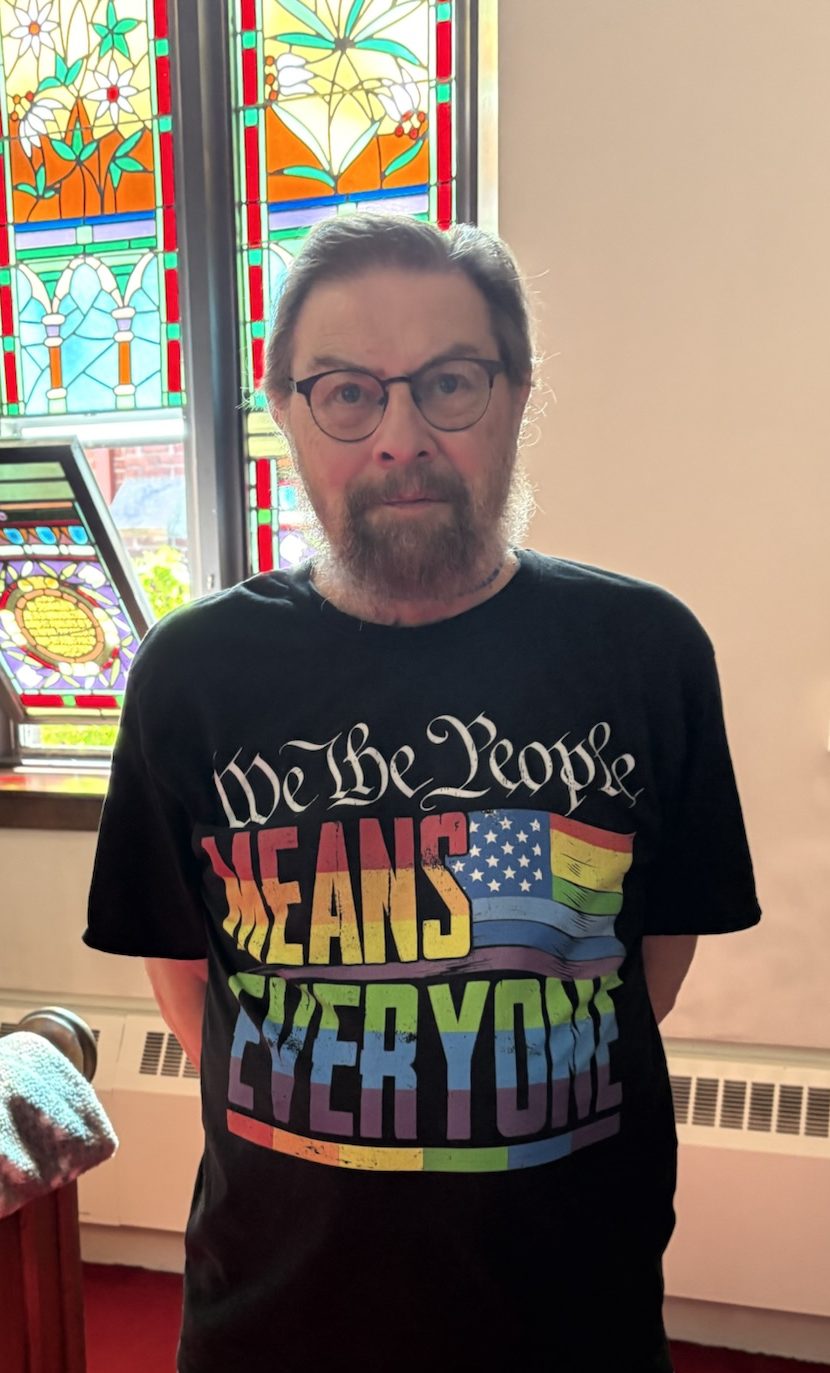
St. Mark’s parishioner Tom Greenburg standing up for Pride

When I lived down South, we used to have this saying.

It was pretty common—or at least I heard it a lot:
“Bless your heart.”

People would say this to me quite frequently. Every time I heard it, I would think, “What a nice thing to say. This person thinks I have a good heart. Thank you so much.”

It wasn’t until many years later, after I had moved away from the South, that someone finally explained to me:
“Barrett, that wasn’t a compliment. That’s just the polite Southern way of calling you stupid.”

I had misunderstood the meaning of the word “blessing.”

That’s a common thing that happens.

Often, when something good happens in someone’s life, or someone experiences success, material wealth, or prosperity, they might say, “I’ve been blessed.”
And that’s a really beautiful thing.
Because what I think most people are trying to say is, “I’m grateful for the good things in my life, and I want to give thanks.” Whether they are giving thanks to God, to the people around them, or simply expressing gratitude for life’s gifts, they are grateful and they want to express it.

But as with so many things in this world, there’s a flip side.

If material wealth and success become identified as blessings from God, then, if we’re not careful, we can start to think that they are signs of God’s approval.

And if we have God’s approval, then it’s only one more step to saying that whatever we say or do must be right.

And from there, it’s only one more step to saying that we cannot be criticized.

And there, I think, we can see the danger.

Because anyone who claims to be beyond criticism, and uses the Bible to justify that stance, is abusing Scripture.

There is a situation in our world today where I think this danger is present.

Our first reading today, Genesis chapter 12, is often quoted in relation to the tragic situation in the Holy Land between Israelis and Palestinians.
There is a longstanding argument over who gets to be in charge, who belongs there, and who has claim to the land.
Our Jewish neighbors—and we Christians as well—trace our spiritual lineage through Isaac, the son of Abraham.
Our Muslim neighbors trace their spiritual lineage through Ishmael, also the son of Abraham.
And both groups can point back to Abraham and say, “We are descendants of Abraham.”

Anyone who has followed the news at any point during the last fifty years can see that this has been the source of incredible tension and conflict.

I am not going to resolve that today.

It is a complex political problem that requires a complex political solution.
And anyone who claims the solution is simple is probably part of the problem.

But I do think some of that conflict arises from a misunderstanding of what blessing means.
God blessed Abraham and promised land to Abraham and his descendants.

We’ve already noted other ways in which people can misunderstand the meaning of blessing.

As Christians, we have a duty to pray for the leaders of all nations, that they would exercise their authority with justice, wisdom, compassion, and peace for the sake of the common good.

Insofar as our own nation is involved in that situation, let us continue to write letters and make phone calls to our elected officials, advocating for diplomacy, so that all of God’s children might live together in the peace and wholeness that God created them for.

So we’ve talked a little bit about what blessing is not.

Let’s talk now about what blessing is—and what it is for.

A blessing is a recognition of the inherent goodness that resides within someone or something.

When someone or something is blessed, we are saying:

“This person/thing is good.”

Our Hasidic Jewish neighbors have blessings for almost everything.

Like us, they often say a blessing before a meal.
But they also have blessings after meals.

They have blessings for waking up in the morning and blessings for going to sleep at night.

They have blessings for children.

They have blessings for using the restroom.

They even have blessings for seeing a particularly beautiful person.

The reason why our Hasidic Jewish neighbors do this is because there is a belief that a spark of divinity resides within everyone and everything.

When a blessing is spoken over that person or thing, that spark is recognized and reconnected to its source in God.

And this becomes a joyful and holy duty.

I think that’s beautiful.
And I think it captures something essential about what blessing means.

Blessing is the recognition and affirmation of the inherent goodness in someone or something.

It is recognizing that goodness as coming from God and returning to God.

This month, as many of you know, we are celebrating Pride Month.
This is a time of celebration for our lesbian, gay, bisexual, transgender, and queer siblings.
Theirs is a community that has often been demeaned by the language of others, sometimes by people misusing Scripture in order to do so.

People have called them names.

They have been described as abominations, unnatural, inherently disordered, or perverted.

As we have grown as a society, and as many Christians have grown in our understanding of Scripture, we have come to recognize some of those past mistakes.

Pride has emerged, in large part, as a counterargument to those demeaning messages.

It is a way for a community to bless itself.
It is a way of saying:
“There is a spark of divinity in us, too.
And we’re going to gather together and celebrate that.”

That’s what blessing is.

Now let’s talk about what blessing is for.

When God blesses Abraham in our first reading today, God says:

“I will bless you, and make your name great, so that you will be a blessing.”

And a little later:

“All the families of the earth shall be blessed through you.”

What Scripture is saying here is that the purpose of blessing is not ownership or possession.
The purpose of blessing is a calling.

Just as the inherent goodness—the divine spark—exists in me and in each of you, so it exists in everyone and everything else.

Our joyful calling as people of faith is to speak that blessing, to recognize that goodness in everyone and everything.

This is our joyful duty.

So as we go out into this week, as we continue to celebrate Pride Month, and as we continue to carry the burdens of the many problems in our world today, let us remember our calling to be a blessing to others.

And let us recognize that the inherent divine goodness within us is also present in everyone and everything else.

Amen.

Journeying on by Stages

Abram's Altar

It’s no secret that I’ve been part of several different varieties of Protestant church: Baptist, Evangelical, Charismatic, Emergent, Episcopal, Presbyterian…

All this time, I’ve been longing for a tradition, something bigger than my little self, of which I can be a part.  Each time I land somewhere new, I think I’ve found it, that is, the place where I will finally put down roots and stay forever.  And each time, I end up leaving after a few years.  I’m beginning to think my ecclesiology is not as strong as I once thought.

I tend to leave each tradition with a keen (and perhaps overdeveloped) sense of what is wrong with it.  My most severe criticism has been reserved for the one tradition that, during my youngest years, shaped me more than any other: the Baptists.

I graduated from a private Christian high school in the Bible belt that was run by a Baptist church (watch the film Saved! for an idea of my high school experience).  I got to see the very worst of the Baptist tradition there.  Theologically, they were the sweaty-brow, pulpit-pounding, Bible-beating, hellfire-and-damnation preachers for which the American south has become famous.  Their commitment to ignorance was the foundation of their stupidity.

At no time was their hypocrisy more apparent than during my senior year when the pastor of that church sexually assaulted a student and the church covered it up.  Meanwhile, that student’s mother (who happened to be a teacher at the school) was fired from her job.  Later that year, another student was expelled from school because she was caught drinking at a party.  The administration defended their actions, citing “discipleship” and not “evangelism” as the institution’s raison d’être.

After that experience, the one variety of church that I intentionally avoided was Baptist.  To me, they represented the very worst of dogmatic and legalistic Christianity that was devoid of any mysticism, relationality, or intellectual integrity.

More recently, as I’ve been exploring what it means to believe and live as a self-identified liberal Christian, I have been basking in the light of several authors whose lives and words have touched me deeply.  Specifically, I am referring to Howard Thurman, Walter Rauschenbusch, Harry Emerson Fosdick, and Martin Luther King, Jr.  These icons of liberal Protestantism have touched me deeply with their commitment to everything I thought was lacking in my experience of the Baptist tradition.

And then it hit me: these four men had one thing in common that had eluded my consciousness until now.  They were all Baptist ministers.

Delving a little more deeply, I discovered a whole new perspective on the Baptist tradition that I hadn’t noticed until now.  Apart from the die-hard fundamentalists among them, Baptists are (and have been for four hundred years) committed to the power of freedom.

Walter Shurden has articulated the Baptist commitment to freedom in terms of four central values (I have lifted the following summary from Wikipedia):

Soul freedom: the soul is competent before God, and capable of making decisions in matters of faith without coercion or compulsion by any larger religious or civil body

Church freedom: freedom of the local church from outside interference, whether government or civilian (subject only to the law where it does not interfere with the religious teachings and practices of the church)

Bible freedom: the individual is free to interpret the Bible for himself or herself, using the best tools of scholarship and biblical study available to the individual

Religious freedom: the individual is free to choose whether to practice their religion, another religion, or no religion; Separation of church and state is often called the “civil corollary” of religious freedom

Needless to say, this discovery has sparked a reconsideration of my theological roots, dare I say it, the tradition in which I was raised.  Upon further reflection and research, I came to another realization about my heritage:

Apart from the high school I attended, my experience of Baptist churches via the ones I attended as a child was an experience of very moderate to liberal Baptists.  My parents, who I would describe as moderate in most respects, brought us to two different Baptist churches during my youth: First Baptist Church of Melrose, Massachusetts and Binkley Baptist Church in Chapel Hill, North Carolina.  First Baptist of Melrose is where I have my earliest memories of church.  Binkley Baptist is where I received my first Bible in the third grade.  Both of these churches are American Baptist, formerly known as Northern Baptist, a much more diverse and moderate denomination than its southern counterpart.  Binkley Baptist is also affiliated with the Alliance of Baptists, a very liberal denomination that split off from the Southern Baptist Convention in the mid-1980s.  That same church made waves decades ago by hiring an openly gay minister before it was popular, even among mainline Protestants.  Upon close re-examination, I would say that my perspective on my Baptist roots is shifting dramatically.

Having just completed my transition to the Presbyterian Church in the last twelve months, I’m not looking to make another switch.  However, if one were to ask me what I see God doing in my personal life right now, I would probably point to the way in which my relationship toward my Baptist heritage is being redeemed in my own memory.

For the last several years (before this process began in earnest), I’ve even had recurring dreams of returning to Binkley.  One involved making my way down a snowy path through the woods behind my childhood home and arriving at Binkley in order to talk with their pastor.  In another dream, I was worshiping in their sanctuary on a Sunday morning, but the internal arrangement of the church (pulpit, pews, etc.) was 180 degrees opposite to what it had been when I attended there.  Those are striking images, considering what I’ve been talking about here.  Could it be that this internal redemption of my denominational heritage was an unconscious work-in-progress for several ears?

All of this material came up in my mind yesterday during my personal devotions.  I was reading a passage from Genesis 12, where Abram is called away to an unknown land under divine guidance.  The voice said to him, “Go from your country and your kindred and your father’s house to the land that I will show you.”  He had no idea of where he was going.  All Abram knew was that he would be blessed and would be a blessing to “all the families of the earth.”

You would think that this would be the beginning of a long epic that ended years later with his arrival in the Promised Land.  However, such is not the case.  We read in the text that Abram arrived in the Canaan by the end of the next paragraph.  That seems rather anti-climactic and counter-intuitive to me.  Where was the author’s sense of story and adventure?  Odysseus took fourteen years to get where he was going, Abram took a paragraph.

But then I noticed something else: Abram’s journey did not end with his arrival in the Promised Land.  It was only beginning.  He continued to live as a nomad in Canaan, moving from place to place, “journeying on by stages,” as the text says.  And at each stage along the way, he set up an altar.  He acknowledged the sacredness of each patch of earth and gave thanks to the One who had called him in the beginning, guided him thus far, and promised to bless him until the end.

As it was with Abram, so I believe it is with me.  Perhaps I have been in the Promised Land all along, still living as a nomad, traveling from place to place and church to church.  Perhaps that sense of tradition and belonging for which I yearn has been with me the whole time.  Maybe it is only now, as I am being led to embrace the part of my heritage I have despised most, that I am finally able to see my real tradition.

I build an altar here, acknowledging the sacredness of this patch of earth called ‘Baptist’ and blessing the One who brought me to and through its territory.  I do likewise for the other theological provinces I have visited: Evangelical, Charismatic, Emergent, Episcopal, and Presbyterian.  I do not know where my journey will lead me from here, but I look forward to exploring the land that is being shown to me and experiencing the mutual interflow of blessing between myself and all the families of the earth.