Redefining Success

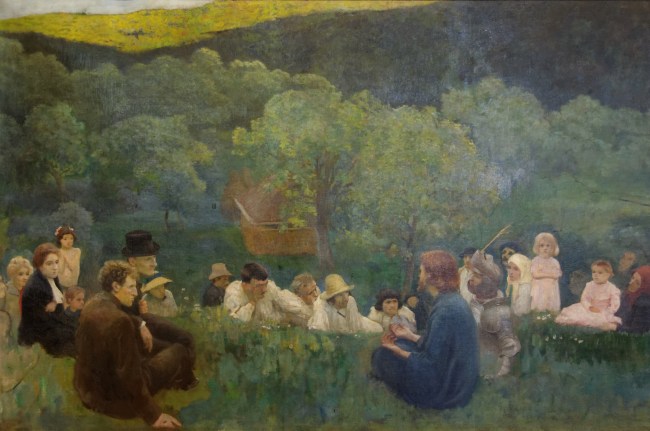
Image
Károly Ferenczy [GFDL (http://www.gnu.org/copyleft/fdl.html) or CC-BY-SA-3.0-2.5-2.0-1.0 (http://creativecommons.org/licenses/by-sa/3.0)%5D, via Wikimedia Commons

Introduction

What would you say are the marks of a successful church?

Here are some of my ideas for North Church:

  • We’re going to court some billionaire investors. Not donors, but investors. We want to incentivize their giving by promising a lucrative return. Once we have their money, we’re going to make use of it.

  • First of all, because we need to keep them happy (so they’ll keep sending us money), we’re going to turn our upstairs balcony into a skybox where our wealthiest members can observe the service in comfort, with leather recliners and a full wait staff serving champagne and caviar.

  • For our music ministry, we’re going to hire a full-time, paid, professionally trained choir (we already have the best organist in Michigan, so we won’t need a new one of those). Our contemporary worship team will get brand new, state-of-the-art AV equipment.

  • We’re going to get TV cameras so our service can be broadcast live via satellite around the world.

  • We’ll get paid endorsements from celebrities like Derek Jeter (add Christina Hendricks and George Clooney for sex appeal), who will tell everybody how great North Church is.

  • And finally, we’ll need to protect all this new stuff, so we’ll need to get a security force to guard the church. And I’m not thinking just some smiling, helpful rentacops either… I’m talking about SWAT team gear with assault rifles: I want such an overwhelming display of power that nobody will even THINK about messing with our church.

If we had all of those things (i.e. money, fame, and power), we would be a successful church, right? Wrong.

Blessedness

Jesus’ definition of the word success is different from the one accepted by the rest of the world. The world has a very self-centered definition of success, but Jesus presents us with a God-centered definition of success. The word he uses is blessed, which can also mean successful or lucky when you take away the spiritual side of it. That word blessed, by the way, comes from the Latin beatus and is where we get get the word Beatitude from. Blessedness, from the God-centered perspective of Jesus, is quite different from the world’s self-centered idea of success.

Blessed are the poor in spirit, for theirs is the kingdom of heaven.”

The world sees wealth as a sign of success: the Armani tux, the Vera Wang dress, the Italian sports car, the yacht, and the mansion. The world looks at people who have those things and calls them successful/lucky.But Jesus says, “Blessed are the poor in spirit, for theirs is the kingdom of heaven.” The kingdoms of this world (governments, corporations, institutions) cater to the desires of the haves, but the kingdom of heaven (Jesus’ vision of an ideal society) will serve the needs of the have-nots. On the day when God’s dream for this world comes true, no more will Senators and CEOs vote to give themselves raises and go on vacation while the people whose jobs they cut sleep in shelters and line up outside soup kitchens. That’s not going to happen anymore.

Blessed are those who mourn, for they will be comforted.”

The world looks at people who seem to be happy and calls them “successful.” Today is Super Bowl Sunday, the one day a year when people watch TV just as much for the commercials as they watch it for the program. How many people plugging products in those commercials will be average-looking folks, looking bored, and saying, “Meh, I guess this product is okay…”? Not very many, I think. TV commercials are full of beautiful, smiling people who are excited to tell you all about how a particular cleaning solution changed their lives forever. They want us to believe that we’ll be as beautiful and happy as they are if only we buy what they’re selling. The world says that happy people are successful people, but Jesus says, “Blessed are those who mourn, for they will be comforted.” Jesus invites us to not buy into that “cult of happiness.” Jesus doesn’t want us to turn away from the pain of this world, he wants us to look at it and do something about it. That’s what compassion is: Showing up with food or clothes, visiting the shelter, the drop-in, the hospital bed, the courtroom, and the prison cell. That’s the kind of love Jesus showed us and it’s the kind of love he wants us to show others. Wherever there’s pain, there’s Jesus, so that’s where we should be too.

Blessed are the meek, for they will inherit the earth.”

The world says that successful people are tough-minded alpha-dogs who stand their ground and don’t compromise. Those are the big-shots who end up in running the show. The world puts them in charge of things. But Jesus says, “Blessed are the meek (i.e. gentle, flexible), for they will inherit the earth.” I like this one because I read a book by a couple of biologists last year that talks about how competition is not the only driving force behind evolution. They make the case that cooperation plays just as big a role in the ongoing development of life. When God’s dream for this world comes true, the ones in charge will be the ones who know how to work well with others and value relationships more than ideologies.

Blessed are those who hunger and thirst for righteousness, for they will be filled.”

The world believes that truly successful people lack for nothing. They have everything they could ever want. They benefit from the way things are. Insulated by wealth and power, they don’t sense the urgency of the situation or feel the need to challenge the system. But Jesus says, “Blessed are those who hunger and thirst for righteousness (i.e. justice, fairness), for they will be filled.” That last part is especially ominous because history has shown, time and again, that poor people will not stay quiet and submissive forever. If the leaders will not change the system, the people will change the leaders. Jesus has been proven right more than once: “The first shall be last and the last shall be first.”

Blessed are the merciful, for they will receive mercy.”

The world says that successful people know how to give as good as they get. If you hit them, they hit you back. They make an example of you so that others know not to mess with them. That’s the politics of power. But Jesus says, “Blessed are the merciful, for they will receive mercy.” Real power, according to Jesus, comes from knowing that you could rip your enemies to shreds but choosing not to. What’s more is that mercy is contagious: it comes back to you. It stops the cycle of violence from going around and around and escalating until the situation is out of control. The United States and the Soviet Union spend the latter half of the twentieth century with nuclear missiles pointed at each other in the doctrine of Mutually Assured Destruction (MAD). But then the Cold War ended, not with a mushroom cloud, but with a party: people singing and dancing as the Berlin Wall came down. The doctrine of MAD-ness did neither side any good in the end.

Blessed are the pure in heart, for they will see God.”

The world says that successful people are savvy: they know how to read between the lines and close the deal. They’re street-smart; they have guile. Successful people know how the game is played and stay two steps ahead of the competition. These savvy, successful people are sure to see great big dividends on their investments. But Jesus says, “Blessed are the pure in heart, for they will see God.” Savvy, street-smart people see the world for what they can get out of it, but they’re missing a whole other dimension of reality. Those who see the world like Jesus does get to see the hand of God at work in creation. These blessed folks know that they’re not alone and that life has meaning. I like to compare this one to the scene in Star Wars when Han Solo is laughing at Luke Skywalker as he trains to be a Jedi Knight. Luke says, “You don’t believe in the Force, do you?” Han replies, “Kid, I’ve flown from one side of this galaxy to the other, and I’ve seen a lot of strange stuff, but I’ve never seen *anything* to make me believe that there’s one all-powerful Force controlling everything. ‘Cause no mystical energy field controls *my* destiny. It’s all a lot of simple tricks and nonsense.” Han is savvy but Luke is pure in heart. Luke is learning how to see the world through a different set of eyes and so, as Obi-Wan Kenobi said about him, he’s taking his “first steps into a larger world.”

Blessed are the peacemakers, for they will be called children of God.”

The world defines success by winning. Whether it’s trophies on the shelf or notches on the bedpost, the world wants to know about your conquests. This was especially true in ancient Rome, where the empire was built on the doctrine of Pax Romana: world peace through global conquest. They believed that Roman order would prevail over the barbarians of the world by the mighty hand of Caesar. And Caesar himself was worshiped and given a very special title: “The Son of God,” Sol Invictus, “the Unconquerable Sun.” But Jesus says, “Blessed are the peacemakers (not the conquerors), for they will be called children (lit. ‘sons’) of God.”

Blessed are those who are persecuted for righteousness’ sake, for theirs is the kingdom of heaven.”

Finally, the world says that respect is a measure of success. They say a good name is as good as gold. If people listen to what you say, you’re successful. If you get invited to the White House to advise the President on a matter, you’re successful. The world says it’s good to be admired and respected. Those who possess the kingdoms of this world are accorded respect, whether they deserve it or not. But Jesus says, “Blessed are those who are persecuted for righteousness’ sake, for theirs is the kingdom of heaven.” Notice the parallel with the first beatitude. God’s ideal world belongs to the have-nots, the disrespected, the ones without a voice, and those who suffer and die for standing up and speaking out for what’s right. When God’s dream for this world comes true, these are the people we’ll be listening to, not the flattering bootlickers who only tell powerful leaders what they want to hear. We need people of conscience who will “speak the truth in love” to the powerful ones in charge. That’s what prophets do, but they’re almost never listened to or given the respect they deserve. Nevertheless, Jesus calls them “blessed” and commands us to keep doing it.

Conclusion

Jesus redefines success. He takes the world’s self-centered idea of success and replaces it with his own God-centered idea of blessedness. In the mind of Christ, success is not a blessing and blessing does not look like success. God’s blessing is upon the poor and oppressed peoples of this world, the ones without a voice, the ones who weep in the night, and the ones who are literally starving for change. God’s blessing is upon the gentle, the compassionate, the pure in heart, and the peacemakers.God’s blessing is upon those who face the pain of this world and do what they can to make a difference. God’s blessing is upon those who are a blessing. And so it is that I say to you:

May God bless you and make you a blessing, this day and every day. AMEN.

Reclaiming Repentance

By Visitor7 (Own work) [CC-BY-SA-3.0 (http://creativecommons.org/licenses/by-sa/3.0)], via Wikimedia Commons
By Visitor7 (Own work) [CC-BY-SA-3.0 (http://creativecommons.org/licenses/by-sa/3.0)%5D, via Wikimedia Commons

Repent is one of the most misunderstood words in the Christian religious vocabulary.  The sound of it typically conjures up images of wild-eyed, Bible-thumping preachers screaming about hellfire and damnation from atop a soapbox on a street corner.  Even those who know better still tend to associate repentance with feelings of guilt and shame over past failures.

Jesus uses that word in this morning’s gospel reading when he says to the people, “Repent, for the kingdom of heaven has come near.”  I don’t think he was trying to lay a guilt-trip on his listeners, nor was he trying to frighten them into becoming disciples.

When Jesus uses that word, repent, he is inviting his listeners into an experience of expanded consciousness.  The word repent in Greek (the language in which the New Testament was written) is metanoia.  It literally means “to change one’s mind.”  Jesus is trying to get his listeners to think differently, think bigger, think outside the box.  Specifically, Jesus is inviting us to change the way we think about three things: God, ourselves, and the world.

First, Jesus is inviting his listeners to think bigger, think differently about God.  In the world of first century Judaism, people thought of God as being far away.  Moreover, they thought there were certain things that people needed to do or think in order to get God’s attention.  They thought God had to be appeased by certain rituals or impressed with good moral behavior and theological belief.  This is what groups like the Pharisees and Sadducees did with their time: they worked hard to get God’s attention/approval.

All of this is pretty consistent with what I call the human religious instinct.  In just about every human culture, on every continent, in every part of history, people have had some kind of belief in a Higher Power (e.g. God(s), Brahman, Tao, etc.).  Likewise, they have also had some kind of system in place for contacting, relating to, garnering favor with, or even controlling their Higher Power(s).  This is how religions are born.  Some scientists have even done studies that indicate our brains might be hardwired for forming religious beliefs and rituals.

One of the really interesting things about Jesus is that he takes this whole human religious enterprise and turns it on its head.  All religions present us with a way to find God, but Jesus presents us with a God who finds us.

He says in today’s reading, “The kingdom of heaven has come near.”  Other English translations read, “The kingdom of heaven is at hand.”  Think about that: at hand.  Hold your hand out in front of you and look at it.  Think about those words: “The kingdom of heaven/God (i.e. the place where God lives) is at hand.”  Later on, Jesus would take this idea even further and say, “The kingdom of God is within you.”

This is a radical, prophetic, and mystical shift.  If it doesn’t blow your mind, then you weren’t really paying attention.  This turns the whole human idea of religion upside down.  God is not far away, God is close.  How close?  At hand.  Within you.  Taking a hint from Jesus, St. Augustine of Hippo says that God is closer to you than your own heart.

The other part of this is that there is nothing we have to do (or can do) to get God’s attention or gain God’s approval because we already have it.  Theologically speaking, this is called grace.  Grace is the unmerited favor, or unconditional love, of God.  Grace is God’s basic orientation toward the world.  It can’t be earned any more than a baby can earn the milk that comes from its mother’s breast.  It’s just there, free for the taking, because that’s just who God is in relation to the world.

This is how Jesus changes the way we think about God: he turns the whole human religious enterprise on its head by presenting us with a God who is close by and accepts us as we are.  The importance of this shift cannot be overstated.

As one might imagine, this change in the way we think about God would naturally have a profound effect on the way we think about ourselves and the world.

Under the systems and institutions created by our own human religious instinct, membership in the community of faith is intentionally kept exclusive.  There are certain things one has to do, think, or say in order to be let into “the club.”  The privileges of membership are reserved for the few who prove themselves worthy.  There is always an us and a them, insiders and outsiders, the saved and the damned.  This is the way that our human religious instinct has trained us to think, but it’s not the way that Jesus thinks.  To him, there is only us, there are no outsiders, no one is damned, and all are destined for salvation.  This is the good news that Jesus preaches.

And he doesn’t just preach it, either; he practices what he preaches.  For Jesus, the community of faith is not exclusive but radically inclusive.  They literally let anyone through the door of this party.

Jesus demonstrates this first of all in his ministry of table fellowship.  Sharing a home-cooked meal with someone in the ancient near east was a powerful thing.  It meant that you accepted this person as is, with no strings attached.  So, it was quite the village scandal when Jesus gathered a reputation for eating with “tax collectors and sinners” in the towns where he traveled.  The religious leaders of his time were constantly up in arms over the bad example he was setting by his willingness to accept and love all people unconditionally (even the losers, rejects, ne’er do wells, freaks, geeks, and criminals).

Another way that Jesus demonstrates the inclusive nature of his ministry is in the calling of his first disciples, which was also part of today’s gospel reading.  Look at this text with me, if you will.  What kinds of professional or spiritual qualifications does the text say that Andrew, Simon, James, and John had before Jesus was willing to call them to be his disciples?  Does it say anything about an interview process?  Do they have to attend classes first?  Does the text of Matthew’s gospel say anything about how often they went to synagogue, prayed, or studied their Torah?  No, it doesn’t.  Jesus just calls them and something within them responds, feels drawn to this person.  As I once heard someone else say, “Jesus doesn’t choose the qualified; he qualifies the chosen.”  That certainly seems to be the case here, even when it came to Christ’s apostles.

In the centuries since then, the Christian Church (in its better moments, anyway) has tried to embody the same kind of open inclusivity in its community that Jesus demonstrated in his.  In the early days of the Church, the big controversy was over the question of whether or not to let Gentiles (non-Jewish people) join the Church.  This might not seem like such a big deal to us, but I assure you that it was to Christians in the first century.  The debate got so heated that it almost split the Church.  They fought about it for a long time, but eventually landed on the side of inclusivity, saying that their faith would be a global faith with room for “every tribe, language, people, and nation.”

In more recent times, we’ve seen Christians reach out in the name of our inclusive faith to bridge the gap between denominations and religions.  We’ve worked hard to make room in our congregations for people from every race, gender, social class, sexual orientation, and disability.

Right now, at this divided and polarized point in our nation’s history, when the spirit of community seems to be breaking down at all levels, the inclusive gospel of grace is one that people particularly need to hear.  In spite of the fact that people in our age are more electronically connected than ever, we have never been more spiritually isolated from one another.  We, the people of Christ, have been called to carry his subversive, disarming gospel to the nations.

We are called by Christ to repent (metanoia – “change the way we think”) about God, the world, and ourselves.  The gospel of Christ calls us to let go of our efforts to get God’s attention by doing, thinking, and saying the right things.  Christ calls us to rise up out of our polarized, divisive, and tribal consciousness shaped by the human religious instinct.  We are called to be a light to the world and show them by our gracious living that there is another way to be human.  We are called to lift up every voice and preach the good news of salvation: “The kingdom of heaven is at hand.”

Amen.

7 Ways to Be Sure You Are a Martin Luther King Jr. Kind of Christian (Reblog)

Image
By New York World-Telegram and the Sun staff photographer: DeMarsico, Dick, photographer. [Public domain], via Wikimedia Commons


Reblogged from Huffington Post

By Paul Brandeis Rauschenbusch

To understand the Rev. Dr. Martin Luther King Jr. one should first look to his Christian faith, which gave him the language, spiritual strength and community to fuel and sustain his singular efforts for justice, peace and freedom.

Faith was at the center of his life.

However, as we honor the legacy of Martin Luther King Jr. it is worthwhile to consider the kind of faith King embodied. Because there isn’t just one kind of Christian; and not all faith leaders lead towards freedom.

Click here to read the full article

16 Ways Progressive Christians Interpret the Bible (Reblog)

Reblog from Patheos.com by Roger Wolsey:

I’ve long stated that

Atheists and fundamentalists each tend to read the Bible in the same wooden, overly literalistic manner. The difference is that atheists reject what they read in that manner, while fundamentalists believe it.

There’s a lot of truth to that – enough that it tends to piss off members of both of those groups off when they come across what I said.

However, I’ve also said that

All Christians pick and choose which portions of the Bible literally, progressive Christians simply admit this and share how we discern.

That observation has resonated with many people – including many fundamentalists who are honest with themselves and who rightly contend that they don’t read “all of the Bible literally.” Some of these more self-reflective fundamentalists have asked me, “So, how do you progressives “discern” and interpret the Bible? Seems like you just read into it what you want it to say; twist it; and don’t take it seriously.” I generally respond by reminding them that – that which we criticize most in others, is often that which we struggle with most ourselves.

While no doubt true, and I fully stand by holding that mirror up to them, they deserve an actual response.

I can’t speak for all progressive Christians, but here’s how many progressive Christians approach, discern, and interpret the Bible:

Click here to read the full article

Listening for Echoes

An article reblogged from the Bellingham Herald about the Rev. Charis Weathers, a seminary classmate of mine who is planting a new progressive church community in Bellingham, WA:

During my four-year hiatus from pastoring a vision had begun to grow, one that had at its center a church that makes the larger community in which it exists a better place to live. A church that doesn’t see its greatest success in the number of butts in the pews, but in the work that it does and the larger community that it builds. A church that isn’t only inclusive of all persons, but includes care for animals, forests, landscapes. A church that doesn’t make a belief system the primary determinant of who’s in or who’s out, but instead supports the good work that is already being done by others, offering blessing and help. A church that champions honest dialogue, values the arts, and takes poverty issues seriously.

Echoes is the name of this new church. I don’t know if it will live up to my vision, but I have hope.

Click here to read the full article

Too Small A Thing

We’re having our Annual Congregational Meeting today at North Church, so I don’t have a sermon to share.  But my wife, Rev. Sarah Schmidt-Lee, is preaching at First Presbyterian Church in Decatur, MI.  Here is her sermon on Isaiah 49:1-7.

In 1954 a 25 year old pastor, fresh from seminary, started serving his first congregation in Montgomery, AL. It would have been so easy for the church to eat up all his time. To teach him everything he didn’t learn in seminary. To rely on him to keep their doors open and their bills paid. But they knew that focusing on what was going on inside that church building was too small a thing for their pastor. They supported him as he took leadership in community organizations, and within his first year as their pastor, Martin Luther King, Jr. involved with the Montgomery Bus Boycott, and at 27 he helped found the Southern Christian Leadership Conference. This young pastor had such a tremendous influence beyond the scope of his own congregation that we honor him with a national holiday tomorrow. It was too small a thing for that church to demand their pastor’s energy be focused solely on them and their needs. They knew they were called, and he was called to something bigger—to be a part of God’s work of changing the world.

“It is too light a thing that you should be my servant to raise up the tribes of Jacob and to restore the survivors of Israel; I will give you as a light to the nations, that my salvation may reach to the end of the earth.”

When I was in college, I had the privilege of meeting a homeless man named Bill Smith. In the course of volunteer work I did, I heard stories from Bill about how frustrated he was by churches in the area around Charlotte, NC. Many of them would send vans downtown to the rescue mission each Sunday to pick people up and bring them to church, which seems like a really great ministry. The problem was that once they got to the church building, these homeless men and women were usually ushered into the back pew, where no one would see them, and they were treated like an evangelism project. The church members seemed intent on sharing Jesus with them, despite the fact that most of them were Christians, already. As Bill put it, “Most of them would not have survived this long if it weren’t for their deep faith in Jesus. Those churches should stand those men and women up front to tell their stories, not stick them in the back and treat them like outsiders.”

One day, during my junior year of college, an excited Bill Smith shared with me how one congregation in town had partnered with the rescue mission to give Bill a part time job counseling other homeless men and speaking as an advocate for the homeless in area churches. That congregation recognized they had an opportunity to experience God in new ways, through new eyes, and sticking those homeless brothers and sisters in the back pew and treating them as outsiders to convert—it was too small a thing. They needed to hear the stories and learn about God from people who were struggling in different ways than they were.

“It is too light a thing that you should be my servant to raise up the tribes of Jacob and to restore the survivors of Israel; I will give you as a light to the nations, that my salvation may reach to the end of the earth.”

A few years ago a congregation in Tulsa, OK took a big risk, and decided to give all of their undesignated plate offerings away to other organizations. Disaster response, relief work, humanitarian projects overseas—there were a number of groups they already gave to, and they would add more. They are a large congregation, and in 2003, those undesignated offerings amounted to about $20,000 that many church leaders worried they couldn’t spare. But they took the risk in faith, and in 2004, the congregation gave away $150,000 in plate offerings.

But the biggest surprise? Not only did the weekly offering increase dramatically, the money given specifically to the budget increased by 10%, too. The leaders of this church recognized that meeting their own institutional needs was too small a thing—they needed to give generously to the world. And when they took a leap of faith, they discovered that their whole congregation understood this, too. Funding their own programs was too small a thing. When they saw the opportunity to give toward a bigger purpose in the world, the congregation rose to the occasion and was more excited about supporting the institutional needs, too. They could see that the institution was serving a higher purpose.

“It is too light a thing that you should be my servant to raise up the tribes of Jacob and to restore the survivors of Israel; I will give you as a light to the nations, that my salvation may reach to the end of the earth.”

In our gospel text for this morning, we see John the Baptist after he has baptized Jesus, and what is he doing? He is redirecting his own disciples to Jesus. Here is a man with a meaningful ministry, drawing people from far off cities into retreats where they confess sin and get baptized in the Jordan as a sign of cleansing and a fresh start. But when John encounters Jesus and sees what he has to offer, he realizes that his own ministry is too small. He cannot offer what these followers really need. Jesus is the one who can really give them new life.

In traditional paintings of John the Baptist, he is always pointing his finger away from himself. It’s as if he is always in that posture of redirection—I am not the Christ. I am not the one you need. Look to Jesus. Follow him. That’s the way.

“It is too light a thing that you should be my servant to raise up the tribes of Jacob and to restore the survivors of Israel; I will give you as a light to the nations, that my salvation may reach to the end of the earth.”

This passage from Isaiah was written during a time when a large proportion of Israel was in exile in Babylon, and the nation was in ruins. The prophet spoke of a servant of God who would lead the nation back to Jerusalem and back to prosperity and health. But here, in these words of God spoken to the servant, we hear the heart of God. “It is too light a thing that you should be my servant to raise up the tribes of Jacob and to restore the survivors of Israel. I will give you as a light to the nations, that my salvation might reach to the ends of the earth.”

God’s dream for Israel was bigger than rebuilding the temple, or returning to Jerusalem from exile. God’s dream for Israel was that it might shine out as a beacon so that the whole world would see God’s love and justice and recognize that the God of Israel was on their side, too.

Some people describe the current situation of the Mainline Protestant church in North America as a kind of season of exile. Generations ago, the Protestant church stood at the center of American culture. Attending church, or at least sending your children to Sunday School, was practically a civic duty. Nearly everyone knew the Lord’s Prayer, and Amazing Grace, and Psalm 23.

That is no longer the case, is it? Sending kids to sports programs is a much higher parental duty in today’s culture than making sure they get to Sunday School. And most Americans have far more commercial jingles than hymns memorized. Church is not anyone’s default setting, anymore.

And we feel it, don’t we? We see Sunday School classes getting smaller and smaller, and budgets getting tighter and church staff growing fewer, with fewer hours to work with. Most churches I’ve encountered spend a lot of time worrying about these changes, which are for the most part completely out of our control. We cannot change the tide of our culture any more than those Israelites who were carried off to Babylon could wish themselves back to Jerusalem. We can grieve the losses. We can remember who we have always known God to be. And we can learn to look for God in our new situation.

But it is too small a thing to focus on our own survival. As numbers shrink and budgets tighten, it is so tempting to focus our energy on keeping what we still have. Keeping the building in repair. Keeping all the same staff, but cutting their hours and benefits. Keeping all the Sunday School classes, even though we only have one or two kids in each age group. Keeping the Presbyterian Women’s program on a weekday morning even though all the younger women in the church are at work, then.

It is too small a thing to try to preserve the church, or restore it to its former glory. We need to discover the new possibilities God has in store for us. It is too small a thing to worry about our programs and budgets, when there is a whole world out there, and God is in it!

So, how are you pointing away from yourself, and toward Christ? How is your congregation and its money serving a higher purpose in the world? How are you seizing the opportunity to discover God in new places and in new people? How are you supporting your pastor and your members to be agents of change in the world?

If these questions are intimidating, or challenging, or frightening, that’s okay. You don’t need the answers today. You need only a desire to listen again to the heart of God—the God who called you to this community in the first place and marked you as a beloved child. Because God has a dream for you and for this church, and it is not a small dream. It is a big dream.

“It is too light a thing that you should be my servant to raise up the tribes of Jacob and to restore the survivors of Israel; I will give you as a light to the nations, that my salvation may reach to the end of the earth.”

The Journey of Transformation

Image
Nicolas Poussin [Public domain], via Wikimedia Commons

I think it’s a funny coincidence that this Sunday is the week when we remember the baptism of Jesus in the river Jordan because I got to have a very “baptismal” moment earlier this week when I showed up to work on Thursday and discovered “rivers of living water” coming out of a broken pipe in the kitchen downstairs.  I’m thankful to report that the repair crew told me it looks like I found the problem and acted on it quickly enough that the damage isn’t too bad, but the whole affair made me want to throw my hands up in the air and cry out, in the words of our Jewish ancestors: “Oy vey!”

Speaking of Judaism…

One of my favorite things about Matthew’s gospel is the way that it is so rooted in Jewish tradition.  The author, who was probably a Jewish Christian living in the first century, wants to demonstrate to the readers that Christianity stands in continuity with traditional Judaism.  Matthew goes to great lengths to identify the story of Jesus with the story of Israel and he does it in two ways:

First, by quoting liberally from the Hebrew Bible (Christians sometimes refer to it as the ‘Old Testament’).  In fact, that happens in today’s reading: When Jesus is baptized and is coming up out of the water, the text says the heavens were opened to [Jesus] and he saw the Spirit of God descending like a dove and alighting on him. And a voice from heaven said, “This is my Son, the Beloved, with whom I am well pleased.”

This is actually a quote from two different verses in the Hebrew Bible.  When the author does this, it’s kind of like someone singing one line from an old, familiar song (e.g. “Here she comes, just a-walkin down the street, singin…”).  The familiarity immediately triggers memory and makes the audience perk up and go, “Oh yeah, I know that one!”

The other way that the author connects the story of Jesus with the story if Israel is by dropping lots of little hints in the text that remind the audience of famous stories from Israel’s history.  For example: At the beginning of the book of Exodus, there is an evil king (Pharaoh) killing baby boys.  In Matthew’s gospel, another evil king (Herod) is doing exactly the same thing.  Later in Exodus, Moses brings God’s message (the Ten Commandments) to the people of Israel from the top of Mount Sinai.  And what’s the name of Jesus’ most famous message in Matthew?  The Sermon on the Mount.  In Exodus, before the people of Israel can enter the Promised Land, they must wander in the wilderness for forty years.  As Jesus begins his ministry, he fasts and prays in the wilderness for forty days and forty nights.  This is not just a series of coincidences.  They are intentional.  Once again: the author of Matthew’s gospel is trying to identify the story of Jesus with the Israel.

Just one more example, and it’s the one I really want to talk about today:

At the very beginning of Jesus’ ministry, he is baptized by John in the Jordan River.  This is another one of Matthew’s hints.  As Jesus begins his ministry, he passes through the waters.  In the same way, the people of Israel “passed through the waters” on the way from slavery in Egypt to freedom in the Promised Land.  Again, this is no coincidence.  Matthew is setting Jesus up as a kind of “New Moses” who leads God’s people from slavery to freedom.  The Christian journey of salvation, according to Matthew, is one where those who follow Jesus through the waters of baptism are liberated from slavery to sin and set free to live the life of the kingdom of heaven on earth.

Speaking in terms of (some of) the Ten Commandments, the Christian journey of salvation is one that takes us from violence to peace, from lust to love, from lies to truth, from greed to giving, and from envy to gratitude.  It’s a journey of personal transformation and baptism is the symbol of our agreement to take that journey with Jesus.  In the sacrament of baptism, we make a promise to ourselves, to each other, and to God that we will follow Jesus into a new way of living, just like the people of Israel followed Moses out of Egypt, through the waters of the Red Sea, and (eventually) to the Promised Land.  And it’s not a journey that we take on our own.  We travel by Christ, with Christ, and in Christ.

Here’s what I mean by that:

First of all, this journey of transformation is initiated by Christ.  Christians see Jesus, not just as an historical figure who taught some important ideas 2,000 years ago, but as a living presence who is involved in our lives today.  We believe that the person of Christ is the revelation of the heart of God to humanity, which is to say that, in Christ, God reaches out to us, meets us, and gets the divine hands dirty with the blood, sweat, and tears of this world.  When we are lost, Christ finds us and brings us home; when we are blind, Christ opens our eyes; when we are ignorant, Christ teaches us; when we are sick or wounded, Christ heals us; when we are dead inside, Christ brings us back to life again.  In the midst of the brokenness of this life and the selfishness of our hearts, while we are still hostages in Egypt, Christ shows up, liberates us from the slaveries of the past, and enables us to make a new beginning.  The journey of transformation is initiated by Christ.

Second, the journey of transformation is sustained with Christ.  We do not travel alone.  Christ guides us through the Word of God in Scripture and feeds us in the sacrament of the Lord’s Supper.  The Spirit of Christ empowers our spirits and gives us strength to keep walking the path.  The love of Christ fills our hearts and picks us up when we stumble and fall on the road.  Christ walks beside us and promised never to leave us alone until the journey is through.

Finally, the journey of transformation is completed in Christ when we begin to love like Jesus loves.  That’s ultimately where all this is going; that’s the main principle underlying each of the Ten Commandments: Love.  Jesus said as much when he said that you could sum up all the commandments of the Bible with, “Love God with all your heart and love your neighbor as yourself.”  It’s all about love.  St. Irenaeus, one of the early fathers of the church, famously said that, in the incarnation of Christ, “God became what we are so that we might become what God is.”  And what exactly is God?  According to 1 John 4:16, “God is love, and those who abide in love abide in God, and God abides in them.”  Love is who God is, therefore love is who we are.  Love is where we’re going in the end, therefore love is all that matters.  Love is the heartbeat of the cosmos and the foundational law of the universe, which is where we find the strength to say to one another, Sunday after Sunday:

I love you, God loves you, and there’s nothing you can do about it.

Be blessed and be a blessing!

COMMENTARY: Church shouldn’t be this hard (Reblog)

Reblogged from the Washington Post

After 36 years of serving churches as a pastor and consultant, I came to a startling conclusion the other day.

Not startling to you, perhaps. I might be the last person to get the memo. But the conclusion drew me up short.

My conclusion: Religion shouldn’t be this hard.

An assembly that exists to help people shouldn’t be so willing to hurt people — by declaring them worthless, unacceptable, undesirable or strangers at the gate.

Click here to read the full article

2013: The Year of the Post-Evangelical Memoir

2013: The Year of the Post-Evangelical Memoir

Reblogged from morganguyton.us

The post-evangelical memoir has exploded as a genre in the wake of Rachel Held Evans’ 2010 Evolving in Monkey Town: How A Girl Who Knew All The Answers Learned to Ask The Questions. Since that time, an industry of thirty-something post-evangelical memoirists has blossomed. And it seems like 2013 was the year that they all got published (or at least read by me). I read four post-evangelical memoirs this year that were each very different: Erika Rae’s Devangelical, Chris Haw’s From Willow Creek to Sacred Heart,  Tony Kriz’s Neighbors and Wise Men, and Addie Zierman’s When We Were On Fire. – See more at: http://morganguyton.us/2013/12/31/2013-the-year-of-the-post-evangelical-memoir-erika-rae-chris-haw-tony-kriz-addie-zierman/#sthash.G6MgDc59.dpuf

God Is With Us (in the little things)

Do you ever get scared?  I get scared sometimes.  I get scared of all kinds of things:

What if I get sick?  What if we run out of money?  What if I lose my job?  What if my marriage falls apart?  What if something happens to one of my kids?

What if this election doesn’t turn out the way I think it should?  What if the stock market crashes again?  What if essential relief and education programs get their funding cut by policy makers?

We live lives surrounded by fear.  The famous philosopher (and sometimes crankyperson) David Hume once went on a rant about all the things in this world that scare us.  First, he said, there are our natural enemies: those things that threaten our physical existence (i.e. predators, disasters, diseases).  Then there are our societal enemies: tyranny, oppression, injustice, inequality, violent rebellion.  Next you have our internal enemies: guilt, shame, fear.  Finally, as if all that weren’t enough, we have our own imaginary enemies that we make up ourselves: superstitions, taboos, mythical monsters.

Surrounded by so many enemies and things to be scared of on all sides, life hardly seems worth living, says Hume.  Why then do we go on?  Why don’t we just end it all?  Well, says Hume, because we’re scared of that too.  Death is the ultimate enemy to fear because no one knows for sure what lies on the other side of it.  And so, because we are ultimately afraid of death, Hume says, “We are terrified, not bribed, into the continuance of our existence.”

Now, this is a pretty dark portrayal of reality (David Hume was kind of famous for that), but I think he has a point in noticing that we live our lives surrounded by fear.  There’s always something to be worried about or afraid of.  This is the way it’s always been.

Way back in the 8th century BCE, there was a Jewish king named Ahaz who had a lot to be scared of.  His reign had been fraught with constant conflict.  Two of his enemies, the Ephraimites and the Arameans, had joined forces and were threatening to lay siege to the city of Jerusalem.  Ahaz was understandably scared out of his gourd.  The most sensible thing he could think of to do was to seek out support from a bigger, meaner bully down the block.  Back then, the biggest, meanest kid in town was the Assyrian Empire.

This, by the way, is the same rationale that leads some people, especially teenagers and young adults, to join gangs: they’re looking to garner a sense of safety when they feel like no one else cares about them.  But, as is so often the case with these kinds of things, there is a hefty price to pay and very little safety after all.  In King Ahaz’s case, he and his people would pay dearly for whatever protection they received from Assyria.  Having sacrificed freedom for security, they were no longer in charge of their own house.  The people of Judah paid tribute to the Assyrians and owed them allegiance, even to the point of worshiping Assyrian deities in the place of the Jewish God.  Because of fear, Ahaz lost sight of who he was and what he was supposed to stand for in the world. 

It didn’t have to be this way.  Isaiah the prophet, who was a pretty insightful dude, saw the bad end coming and tried to warn Ahaz.  He said, “These troubles are only temporary.  It’s not worth selling your soul in order to ensure your survival.  Have a little faith!”  He pointed to a pregnant woman and said, “You see this young woman?  By the time her baby grows up and is old enough to walk and talk, these conflicts will be nothing more than a distant memory.  Look at this woman and remember her.  Let her baby be a sign to you that God is with you, therefore you don’t need to be afraid.”

This was a powerful message.  And it’s one that has endured for thousands of years, even though its intended audience didn’t listen to a word of it.  Isaiah told Ahaz to look for God, not in grandiose displays of power or guarantees of success, but in the little things of this world.  The sign of God’s presence was that little baby, whose name would be Immanuel, which is Hebrew for “God is with us.”

Over seven hundred years after Isaiah first spoke these words, the early Christians would look back at them and say, “Hey, you know what?  Isaiah’s prophecy kind of reminds us of Jesus!  He wasn’t very powerful or successful by this world’s standards, but when we looked at him, we got that hunch that maybe “God is with us.”  Besides, Jesus taught us to look for God in the little things as well: in the birds of the air and the flowers of the field, in farmers sowing seeds and bakers baking bread. Jesus got us looking at all those little things in life that most people never pay attention to.  Because of him, we know that God is with us, just like Isaiah tried to tell Ahaz with that little boy Immanuel.”

I love that.  God is with us in the little things.  As we live our lives, surrounded and overwhelmed by fear, we often forget to pay attention to those little, everyday signs that God is with us.  Like Ahaz, we can sometimes be quick to lose sight of who we are and what’s really important, especially when we’re afraid.  It’s in those moments of overwhelming anxiety that we most need to take a step back, take a deep breath, and look… really look at ourselves, our lives, and our world.  We need to pay attention to those little things, the things we’re too busy for, the boring, ordinary things that happen every day, the things that don’t seem all that important: babies, bread, birds, flowers, seeds… because those places are the places where God meets us.

There may be no grandiose sign, no light from heaven, no singing angels.  There will be no guarantees of security or success.  Just the little things, little signs of Immanuel, that God is with us.  All we are promised from these encounters is a renewed perspective on who we are what life is all about.  The strength we find in these encounters is the strength to stand by our core values and central beliefs, come what may.  God is with us in the little things of this world to remind us that some things in life are more important than success or survival, therefore we don’t need to live in fear.  Fear is not the foundation of reality.  Deeper than fear, deeper still than the natural, societal, internal, and imaginary enemies who surround us on every side, at the very heart of reality, we have a friend who is always with us… a love that will not let us go.  My esteemed, late colleague, the Rev. Fred Rogers (host of the children’s TV show Mr. Rogers’ Neighborhood) said it best:

“I believe that at the center of the universe there dwells a loving spirit who longs for all that’s best in all of creation, a spirit who knows the great potential of each planet as well as each person, and little by little will love us into being more than we ever dreamed possible. That loving spirit would rather die than give up on any one of us.”

With a God like this on our side, what do we have to be afraid of?

Immanuel, God is with us, even (especially) in the little things.  This is the message that Isaiah tried to deliver to King Ahaz, although Ahaz wasn’t willing to hear it.  This is the message we are meant to take with us from the Christmas season.  The question for us is: are we willing to listen?

Immanuel, God is with us.  Do not be afraid.