The Greatest of These is Love

I’d like to tell you a story I heard several years ago about a church in crisis.  They were a relatively small church in a large, cosmopolitan city.  They were a young church, having only been planted a few years before, but had been around long enough to enter their second generation of leadership as their founding pastor moved on to another call and was succeeded by a popular, charismatic preacher.  The members of this church came from all across the ethnic and socioeconomic spectrum.  From the perspective of church growth marketing analysts, this place was set to be a gold mine!  They had everything: a prime location in a major urban center, a diverse membership, and a popular, dynamic preacher.  What could go wrong?  Well, as it turns out, there was a lot that could go wrong… and it did.

Now, my first thought would be: It must have been the pastor.  What did he do wrong?  He must have become embroiled in some kind of public scandal involving money or sex.  That’s all you really hear about from ministers in the media these days.  But no, it wasn’t the pastor.  In fact, their charismatic clergyman hardly shows up in this story at all.

In spite of everything they had going for them on paper, this church was struggling in reality.  In fact, things were going so badly, this church’s founding denomination was thinking about pulling the plug on the entire operation.

The reality was that this church was tearing itself apart from the inside out.  What started out as groups of like-minded friends had become rival factions in an all-out war for power and control of the church.  Their pious posturing was a thin veil over blatant hypocrisy.  This ongoing dispute between cliques became so all-consuming that the real problems facing the church couldn’t be addressed.

Newer members of the church were struggling with various spiritual and theological questions, but there was no one to help them search for answers.

Wealthy members of the congregation, primarily concerned with keeping up appearances, would intentionally schedule church suppers during times when they knew that the poorer congregants would still be at work.  By the time the latter group arrived at the suppers, there was often no food left for them.

At one point, it became publicly known that a prominent member of the church was tangled up in a scandalous affair (with his own stepmother, no less), but so much energy was being spent on dealing with the rival factions that the affair went unaddressed and this family was unable to receive the kind of attention and pastoral care they so desperately needed.

Outsiders and other church leaders were aghast when they heard about how bad things had become.  Some wondered whether this sorry mess of humanity could even be called a church anymore.  They were beginning to think that closing the church might even be the most compassionate option.

Instead of closing it down, the denomination decided to send in another pastor to help.  As it turned out the pastor they sent was the church’s founding pastor, who had left for another call some years before.  He had several insights to help them deal with their various crises, but the best thing he did for them was trace all their little problems back to a single big problem: Love, or the lack thereof.  The main problem was that these people just hated each other.

It was their mutual hatred for each other that consumed the members of this church from the inside out.  They couldn’t function as a church.  There was nothing anyone could do to fix that problem.  They had everything going for them: a great urban location, a dynamic super-pastor, and several wealthy financial supporters with deep pockets, but none of those things could make the church grow or stop it from dying if the members didn’t embody that single most important core value: Love.

None of it meant anything without Love.

Now, I want to pause for a moment and pull the curtain back on this church that I’ve been talking about.  I haven’t told you the church’s name or who the pastor was.  It’s not a church in our area or our denomination.  In fact, it’s not even a church that exists in our century.  The church I’ve been talking about is the first century Christian church in the Greek city of Corinth, founded by the apostle Paul himself.  He was that founding pastor who returned to help his former congregation in crisis.

The letter of advice he wrote to them is what we now call the book of 1 Corinthians in the New Testament of the Bible.  The most famous part of that letter is the section we read this morning: the Hymn to Love in 1 Corinthians 13.  This passage is most often read at weddings, where everyone looks great, music is playing, and love is in the air.  Most of us probably heard those words this morning and let them breeze right past us because they are so familiar and so associated with saccharine euphoria that we miss their real meaning completely.

These words, when lived in reality, are radical and revolutionary.  They have the power to transform the way we interact with one another and rescue the future for a community that most people have simply given up on.  This beautiful love poetry was not written for a wedding.  It doesn’t spring up from the same part of human experience that inspired Shakespeare’s Romeo & Juliet.  There is nothing sweet or saccharine about these words at all.

These words about love arose out of conflict within a church that was bitterly divided against itself.  These words are Paul’s challenge to every rival clique’s claim to superiority over others.  Listen to his words again.  If you’ve heard them before, listen to their meaning for the first time:

If I speak in the tongues of mortals and of angels, but do not have love, I am a noisy gong or a clanging cymbal. And if I have prophetic powers, and understand all mysteries and all knowledge, and if I have all faith, so as to remove mountains, but do not have love, I am nothing. If I give away all my possessions, and if I hand over my body so that I may boast, but do not have love, I gain nothing.

Love is patient; love is kind; love is not envious or boastful or arrogant or rude. It does not insist on its own way; it is not irritable or resentful; it does not rejoice in wrongdoing, but rejoices in the truth. It bears all things, believes all things, hopes all things, endures all things.

Love never ends. But as for prophecies, they will come to an end; as for tongues, they will cease; as for knowledge, it will come to an end. For we know only in part, and we prophesy only in part; but when the complete comes, the partial will come to an end. When I was a child, I spoke like a child, I thought like a child, I reasoned like a child; when I became an adult, I put an end to childish ways. For now we see in a mirror, dimly, but then we will see face to face. Now I know only in part; then I will know fully, even as I have been fully known. And now faith, hope, and love abide, these three; and the greatest of these is love.

Can you hear the urgency in Paul’s voice?  He’s telling the Corinthians to stop acting like children and grow up.  These little spats that their cliques are having over church power simply don’t matter.  At all.  All their theological knowledge, their faith, their pledge cards, and their volunteer service to the church are rendered meaningless if they don’t know how to love each other.

Love and love alone makes a church.  And this love isn’t just some warm fuzzy feeling they get when they sing Amazing Grace or Kum Ba Yah.  This isn’t some hippy flower fest; this is the church of Christ.  In here, love only counts as real when it takes on flesh and blood in the actions of those who claim to possess it.

Love is patient.  Are you patient?  Love is kind.  Are you kind?  Love is not irritable or resentful.  Are you?  Love is not envious, boastful, arrogant, or rude.  Are you any of those things?  Love does not insist on its own way.  How often do you insist on getting your own way in a church conflict?

Is this making you uncomfortable?  It should be.  What Paul is talking about here is nothing less than a complete reordering of our priorities.  He’s not just trying to change the way we live, he’s trying to change the way we fight.

The Corinthian Christians had a rather skewed perspective on the fight that was tearing them apart.  They all saw themselves as heroes defending a battleground (i.e. the church) from dangerous enemies (i.e. their rivals).  In reality, they were not the heroes: they were the battleground.  God was the hero defending them.  And their so-called rivals?  They were not the enemy.  They were actually God’s allies in the fight for each other’s souls.

In truth, the Love that Paul wrote about was already present in each one of their hearts.  They were members of the same body: the body of Christ.  What was good for one was good for all.  There was no point to the rivalry then, because they were trying to divide something that couldn’t be divided.  The sooner they realized this truth, the sooner they would get over their petty little squabbles and get back to really being what a church should be: a community of people so full of love that it just naturally spilled over and into the surrounding community.  That’s how you define a healthy, growing church.  The pastor, the size, the building, and the budget are all completely secondary concerns.  Our first job is always to embody the love of Christ within our own lives, amongst each other, and eventually flowing out into the larger community.  When the people in this lonely world see that, they will be naturally attracted to it and will come from all over to see what it is that we have here.

What might that transition from hate to love look like?

It’s hard to say. “Love,” as Han Suyin said, “is a many splendoured thing.”  Love looks different when it takes on flesh and blood in the lives of different people.  I can tell you the stories of a couple of times in my life when I had to make that transition from hate to love.

Hate is a strong word, and I don’t use it lightly.  But in these two cases, I can honestly say that I really, actually came to hate my enemy.  The first was one of my seminary professors.  The second was a co-worker at my first job after seminary.  In both cases, I was the one in the right.  My enemy had hurt and offended me with words and deeds that I found demeaning and humiliating.  Time after time, I tried to reach out in friendship, but was repaid with cold indifference.  Eventually, I stopped trying.  I left them to their miserable little worlds and went on with my life.

But they didn’t leave me.  Their hostile presence was still firmly lodged in my mind, even though we managed to avoid each other most of the time.  I learned what it felt like to grow hard and bitter inside toward another human being.  All of our public interactions were polite, but I seethed inwardly with a hot hatred I’d never felt before.  Mutual acquaintances quickly learned to never mention their names in my presence because of the sharp reaction it would provoke in me.  I had a problem: a problem with hatred.  Jesus said that to hate another person is to murder that person in your heart.  I get that now because I’ve felt it.

But the irony is that my enemies weren’t being hurt by my hatred, I was.  That fire inside was burning me alive without ever touching them.  My hate was keeping me from fully becoming the person I was meant to be.  Even though I knew I was in the right, that knowledge gave me no relief from the bitterness.  Something had to change.

I thought, at the time, that what I needed to do was forgive my enemies, just as Jesus had done to those who were crucifying him.  I tried and I tried hard, over and over, again and again.  I didn’t want to be a person who wallowed in hate.  I kept telling myself, “I need to forgive him… I need to forgive him…” but I just couldn’t.

And then, one night, it hit me.  I was standing on the balcony of my apartment in Vancouver, seething with more bitter thoughts about my enemy.  I said to myself again, “I need to forgive him.”  And then, it felt like I heard a voice whisper to me from the very back of my mind, “No you don’t.  You need to ask forgiveness for yourself.”  I believe now that what I heard was the voice of God, speaking wisdom to my heart.

The fact is that I was the one who had let my righteous indignation turn into bitterness, not my enemy who had hurt me.  I was the one who had allowed hatred to change me into the kind of person I didn’t want to be.  I had tarnished my enemy’s reputation with harsh words spoken behind the back.  I wanted the whole world to know what he had done to me.  I wanted him to pay.  But the irony is that I was the one who was paying the price and reaping none of the benefits of vengeance.  Beneath my anger, I was just as scared and hurt as ever.

After that initial insight on the balcony, I quickly realized what my next step needed to be: I had to face my enemy and ask him to forgive me.  I had to let go and throw myself upon the mercy of the person I hated.  It wasn’t fun, but it was the only remedy that could ease the searing pain in my heart.

When the deed was said and done, in both cases, relief came.  I never became close friends with either of the men I previously hated, but the war was over.  I found peace within myself.  More importantly, I discovered that an internal blockage had been removed from my heart and I was able to love much more fully than before.  I wasn’t just able to love my enemy more fully, I was able to love myself and world more fully as well.  Love was taking on flesh and blood in me, transforming me into Love’s hands and feet in the world.

Asking my enemy to forgive me, even though I knew I was in the right, is the hardest thing I’ve ever had to do, but it was worth it.

I think that’s the truth that Paul was trying to get across to the Corinthian Christians, who were so divided and hateful toward their fellow church members.  Paul wanted them to know that love is worth it because love is what lies at the center of reality.  God is love.  Therefore, our efforts to love one another are what make God’s loving presence more palpable to the rest of the world.  That’s our mission, as Christians.  That’s our church’s reason for existing.  If we’re not doing that, then we’re not a church, no matter how nice our building, how big our budget, or how handsome our pastor is.  Those things don’t make us church.  Love makes us church.

That’s all I really want to tell you today: Love one another.

Because I love you, because God loves you, and because there’s nothing you can do about it.

Not Just Pretty Clothes

This is my column for my church’s newsletter this month.  Superfriends and Blogofans from liturgical churches will probably find this information old news, but those of you from “low church” Protestant backgrounds (e.g. Methodist, Presbyterian, Baptist, etc.) might find this interesting.  Having come to the Presbyterian Church from an Anglican denomination, I see “high church” liturgy as one gifts that I can bring.  For a more detailed description of liturgical vestments (with pictures), visit: www.kencollins.com

Image by Gareth Hughes.  Retrieved from Wikimedia Commons
Image by Gareth Hughes. Retrieved from Wikimedia Commons

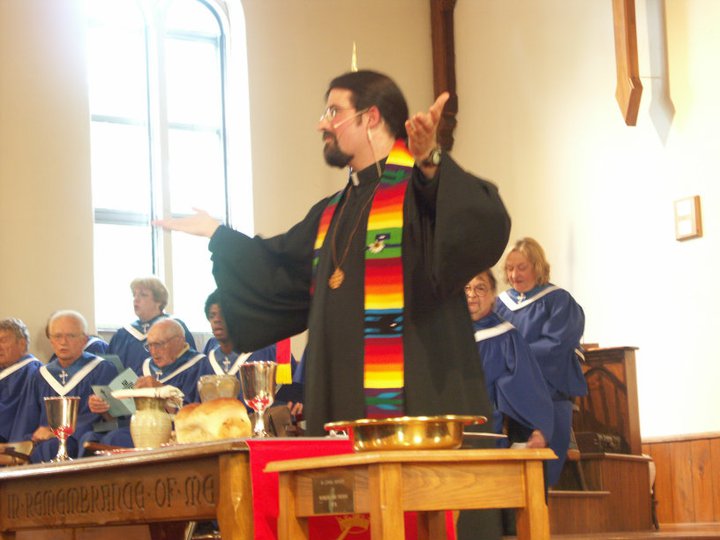
When people think of a Presbyterian pastor leading worship, they tend to think of someone wearing a long, black robe that looks like the kind of academic gown worn at graduations.  In fact, that’s exactly what it is.  This practice goes back to John Calvin himself, who was an educator by profession.  The academic robe (also called a Geneva gown, after the city Calvin lived in) was the socially acceptable thing for a teacher to wear in the 1500s, much like white coats for doctors and uniforms for police officers are today.  John Calvin wore his academic robe in the pulpit because he was opposed to the practice of wearing liturgical vestments like they did in the Roman Catholic Church.

Since Calvin’s time, relations between Presbyterians and Catholics have softened considerably.  Starting in the 1960s, we even began adopting each other’s worship practices.  For example, Catholics now lead mass in English and celebrate Communion while facing the congregation.  Presbyterians (and other Protestants) have been rediscovering the value of ancient and medieval forms of worship, including the weekly celebration of Communion and the wearing of liturgical vestments.

Liturgical vestments are special clothes worn by the clergy when they lead worship.  While they got their start as everyday street clothes in Roman times, they have taken on symbolic meaning over time.

First, there is the Alb.  This is a long, white robe that is a symbol of baptism.  The color white signifies the purity of a soul that has been cleansed from sin.  The sacrament of baptism is the sign of this cleansing.  Anyone who has been baptized can wear this vestment.  In Revelation 7:9, the Bible describes a heavenly scene: “I looked, and there was a great multitude that no one could count, from every nation, from all tribes and peoples and languages, standing before the throne and before the Lamb, robed in white, with palm branches in their hands.”

Second, there is the Cincture.  This is a rope belt that symbolizes the teachings of Christ.  Like the alb, anyone, ordained or lay, can wear the cincture.  After all, every Christian is supposed to follow Jesus’ teachings, right?  The cincture is a belt because we bind Christ’s teachings to our lives at all times.  It is just as Moses told the Israelites in Deuteronomy 6:6-9: “Keep these words that I am commanding you today in your heart. Recite them to your children and talk about them when you are at home and when you are away, when you lie down and when you rise. Bind them as a sign on your hand, fix them as an emblem on your forehead, and write them on the doorposts of your house and on your gates.”  The cincture is a visual reminder to us that we should do the same.

Third, there is the Stole.  This is the long scarf worn by pastors and priests.  It is a sign that the person wearing it has been ordained.  In Roman times, men would wear stoles on formal occasions in the same way that men wear neckties today.  Symbolically, it stands for the yoke of ordained ministry.  For those who are unfamiliar with cattle and oxen, a yoke is a special kind of harness that goes over an ox’s neck when it pulls a cart, just like the stole goes over the pastor’s neck.  This is a reminder of the pastor’s job: to pull the cart (the church) and take it wherever the driver (Christ) directs.  The pastor is not the driver.  The church does not belong to the pastor.  The church belongs to Christ.  Christ decides where the church goes.  The pastor’s job is simply to help the church get there.  If you catch me in my office immediately before or after worship, you might see me kiss the stole as I put it on and take it off.  This traditional gesture is a way for me to remind myself to embrace my calling as the pastor of this church.

Finally, there is the Chasuble.  This poncho-like vestment is only worn when the Eucharist (Communion) is celebrated.  It symbolizes the grace (unconditional love) of God, which covers everything like a big, warm blanket.  It is worn during Communion as a reminder of Christ’s unconditional love that led him to lay down his life for others.  This is the event we remember as we share the broken body and shed blood of Christ in the sacrament of the Lord’s Supper.  The word Eucharist means Thanksgiving, which is our primary response to God’s grace which has been made known to us in Christ.

More and more Presbyterians are starting to make use of these traditional liturgical vestments in worship.  I am sharing their symbolic meaning with you so that you can fully appreciate and enter into the spiritual truths they convey.  Our worship is not simply a matter of thoughts and words.  We bring our whole selves, body and soul, into church.  Sight, sound, touch, taste, and smell all play a part in our service.

I pray that your knowledge of these visual symbols in the special clothes I wear on Sunday will enrich your worship experience and make the presence of God more real to you as we render our reverence to God.

Be blessed and be a blessing!

Barrett

A New Convergence

This is a reblog of an article by Bryan Berghoef.

It reminded me of a conversation I had during a surprise visit from a childhood friend this year.  He and I both grew up to become pastors who also married pastors.

We grew up at opposite ends of the Protestant theological spectrum: my family was conservative evangelical, his was liberal mainline.  Both of our spouses, interestingly enough, grew up as part of the charismatic renewal movement in mainline denominations.

What we discovered is that our respective spiritual journeys, while starting in very different places, had led each of us to embrace very similar values, practices, and dreams for what we think the church c/should be.

This article reminded me of that conversation.  Enjoy!

A New Convergence

Happy Birthday, Vatican II!

Reblogged from NPR:

As a result of Vatican II, the Catholic Church opened its windows onto the modern world, updated the liturgy, gave a larger role to laypeople, introduced the concept of religious freedom and started a dialogue with other religions.

“It was a time of a new hope, when everybody was proud that we are able to convoke such a council, and having a real renewal of the Catholic Church,” says Hans Kung, who was the youngest theologian at Vatican II.

But the changes provoked a backlash, and many Catholics today say the council’s renewal momentum has been stopped in its tracks.

Click here to continue reading

A Priest Forever

This is the card my bishop gave me at my ordination. I keep it hanging in my office as a reminder.

Four years ago today, I became a priest.

It was a big step in a long journey.  It wasn’t the first step, for years of prayer and hard work had led me to that moment.  It wasn’t the last step either, for things didn’t turn out exactly as I’d planned.

I served the denomination that ordained me for a grand total of three and a half years: first as a lay chaplain, then as a deacon, and eventually as a priest.  I wish I could say that I was still serving there.  That church’s commitment to servant ministry among marginalized people is amazing.  It’s what first drew me to pursue my calling with them.

Unfortunately, there were problems as well.  In a group that small with a hierarchical structure, there was no accountability for people at the top of the chain of command.  Church policy was determined by the bishop’s bad temper.  My bishop was particularly prone to manipulative and abusive behavior.  When that behavior was eventually directed at my wife, I decided that I’d had enough.  I left my position in that denomination on the ides of September 2010.

My bishop made the process as difficult as possible.  In spite of the fact that their church constitution recognized the indelible mark of ordination (i.e. “once a priest, always a priest”) and the validity of holy orders without apostolic succession (a rare belief among sacramental churches), my bishop insisted that I wouldn’t be given my walking papers unless I officially renounced my holy orders.  In other words, I could only leave once I had declared that I was no longer a priest.

This was not strictly necessary, as the Presbyterian Church had already stated their willingness to receive me as one of their own.  Asking me to do this was my bishop’s way of twisting the knife into my back one last time.  In terms of my career, this was not a tremendous setback.  The Presbyterians told me, “Just give [the bishop] what [the bishop] wants.  We’ll ordain you again, if we have to.”  And that’s exactly what happened.  I started serving one of their congregations immediately and was eventually ordained as a Minister of Word and Sacrament on Pentecost 2011.

I’m glad to have found a home in my new denomination, but I have missed being a priest.  Liturgical and sacramental worship feeds my soul in ways that few things do.  Being disconnected from it feels like spiritual suffocation.  I continue to be a voice for high church renewal in the reformed tradition, but many Presbyterians still resist liturgical worship and weekly Eucharist on the grounds that such practices are “too catholic” or “too much work”.  Ugh.  It’s just not the same.

When I last met with my spiritual director, I mentioned that I have now been an “ex-priest” for as long as I was a priest.  My director (a progressive Roman Catholic) gave me a confused look and reminded me of the “once a priest, always a priest” theology.  My bishop had no right to ask that of me.  In ordering me to un-ordain myself, my bishop was asking the impossible.  I might as well have written a letter stating that I would no longer submit to the law of gravity.  A priest can resign (or be removed) from actively functioning in an official capacity within the organization, but one cannot be un-0rdained anymore than one can be un-baptized.

It is as my bishop said to me at my ordination: “You are a priest forever after the order of Melchizedek.”

Something funny happened at church on the very Sunday after I met with my spiritual director.  During the Prayers of the People, there is a spot where the layperson leading the litany offers prayer for “Barrett our pastor”.  But on this particular Sunday, the liturgist misspoke and accidentally prayed for “Barrett our priest”.  John Calvin must have rolled over in his grave.

It was an accident, but I think it was a holy one.  I take it as God’s way of reminding me about who I really am and what I am called to be:

A priest forever.

Ev’ry Day I’m Pastorin’: THOU SHALT VISIT THIS BLOG

I have never plugged another blog so vehemently as I am now plugging this one.

My wife and I were up until 1:30 in morning, rolling in laughter at this blog because IT’S ALL TRUE!!!

The author is not forthcoming with personal identity details, but that’s the blogger’s prerogative.  The experiences chronicled and parodied here are almost universal among mainline clergy.  I’m actually a little scared that if my parishioners found this blog, they would be able to read my mind.

Please check this out, especially if you happen to be the clergy type.

Thank me later.

http://everydayimpastoring.tumblr.com/

Vancouver’s Best Kept Secret

Waking up early on a Monday to do lecture prep for my Ethics course.

I found this image on Facebook.  For me, it’s not only cute, it’s also a little nostalgic.  My pastor in Vancouver, Rev. Dr. Sylvia Cleland at West Point Grey Presbyterian Church, used to have this photo up on her office door.

That was the last church I attended where I was not either the pastor or the pastor’s spouse.

I often call it “Vancouver’s Best Kept Secret” for several reasons:

  • It’s the only Presbyterian church I knew of where Koreans and Anglos worshiped together (they have separate presbyteries and usually keep apart).

  • It’s the only church I knew of where students from Regent College and Vancouver School of Theology would worship and serve their internships together.  In spite of the fact that they are only two blocks away from each other, these two seminaries usually keep separate.  The Regent folks generally assume that the VST folks are godless heretics while the VST folks assume that the Regent folks are fundamentalist fanatics.  They’re both wrong.

  • The church’s small size made it possible for ministerial interns to actually do real ministry, like preaching, pastoral care, and education.  At the bigger, more popular churches in town, student interns would end up answering phones and making coffee.  We actually got to find out what being a pastor was really like.

So, if you’re thinking of going to seminary in Vancouver, BC (at Regent College or Vancouver School of Theology), check out West Point Grey Presbyterian Church at the corner of 11th & Trimble.  Thank me later.


The Call to High Adventure

Vida Dutton Scudder. Image is in the public domain.

Vida Dutton Scudder (1861-1954) was a professor at Wellesly College, a member of the Socialist party, and a prominent activist in the Episcopal Church.  She was involved in the Social Gospel movement, the campaign for labor rights, the equality of women, and (eventually) pacifism.  She helped to organize the Women’s Trade Union League, the Episcopal Church Socialist League, and joined the Society of the Companions of the Holy Cross.  Vida and her partner, Florence Converse, lived together for 35 years, from 1919 until Vida’s death in 1954.  She is celebrated in the Episcopal Church’s calendar of saints: her feast day is on October 10.

Earlier today, as I was reading Diana Butler Bass’s book A People’s History of Christianity, I came across an amazing prediction of Scudder’s that Butler Bass took from Scudder’s 1912 book Socialism and Character.  In this passage, Scudder prophesies the advent of mainline church decline, which eventually started to happen in the latter half of the 20th century.  I was amazed at how closely Scudder’s views resemble my own, except that she was writing a full century before I started thinking about it.  Listen to what Scudder has to say:

One certitude is forced on us : it is unlikely that Christianity will retain so nominally exclusive a sway as it has hitherto done in western Europe. In all probability, the day of its conventional social control is passing and will soon be forgotten. The time will come when the Christian faith will have to fight for right of way among crowding antagonists as vigorously as in the times of Athanasius and Augustine.

And in thoughts like these all genuine Christians must rejoice. Without the call to high adventure, the faith has never flourished.


A Growing Church is a Dying Church

Whenever a congregation goes looking for a new pastor, the first question on their minds when the committee interviews a new candidate is: Will this pastor grow our church?

I’m going to go ahead and answer that question right now: No, she will not.

No amount of pastoral eloquence, organization, insightfulness, amicability, or charisma will take your congregation back to back to its glory days.

What then can your pastor do?  She can make your board meetings longer with prayer and Bible study.  She can mess with your sense of familiarity by changing the order of worship and the arrangement of the sanctuary.  She can play those strange new songs and forget about your favorite old hymns.  She can keep on playing those crusty old hymns instead of that hot new contemporary praise music.  She can bug you incessantly about more frequent celebration of Communion.  She can ignore your phone call because she’s too busy praying.  She can ruin your perfectly balanced budget with appeals for more funds to be allocated toward mission and outreach.  She can take up your precious evenings with kooky new book studies and meditation groups.  She can take up your precious weekends with exhausting volunteer projects. She can open your church building to the ugliest and meanest freaks in town, who show up at odd hours, beg for handouts, track muddy snow into the building, leave their cigarette butts in the parking lot, and spill their coffee on the carpet during their Junkies Anonymous meetings.

She can come off sounding like a Jesus freak evangelical, gushing on and on about the Bible and your personal relationship with God.  She can come off sounding like a smells n’ bells catholic, pontificating on and on about tradition and sacraments.  She can come off sounding like a bleeding-heart liberal, prattling on and on about social justice and the need to constantly question old interpretations.

What can she do to grow your church?  Nothing.  There’s nothing your pastor can do to make your church grow.  She can’t save your church.  Your church already has a Savior and it’s not her.  She can push you.  She can open doors.  She can present you with opportunities.  It’s up to you to take advantage of them.  She can plant seeds and water them.  It’s up to God to make them grow.

And what if that happens?  What will growth look like?  Will all those old, inactive members suddenly return?  Will the pews be packed again?  Will you need to start a second service and buy the lot next door in order to expand the parking lot?  No.  You might see a few new faces in the crowd.  There won’t be many of them.  Some might stick around but most won’t.  Those who stay won’t fit in with the old guard.  They won’t know about how you’ve always done it.  They’ll want to make changes of their own.  Their new ideas will make you uncomfortable.  Your church won’t look or feel like it used to.  You’ll feel like you’re losing control of this place that you’ve worked so hard to preserve.  It will feel like your church is dying.

And that’s just the thing.  A growing church is a dying church.  It has to be.  It cannot be otherwise.  The way to Easter Sunday goes through Good Friday.  The way to the empty tomb goes through Golgotha.  The way to resurrection goes through crucifixion.  When Jesus told you to take up your cross and follow, did you expect it to lead anywhere else?  What Jesus told us about himself is also true of churches: Unless a grain of wheat falls to the ground and dies, it bears no fruit.

But what if it doesn’t work?  What if you let your pastor do all that crazy stuff and nobody new shows up?  What if the church still goes under?  What if all that time you spend studying the Bible, expanding your horizons, deepening your spiritual life, and serving your community turns out to be time wasted?  What if it does?

Tell you what: if that’s what happens, if you commit yourself to all this and still feel like it was a waste of time in the end, then maybe your church really needed to die.