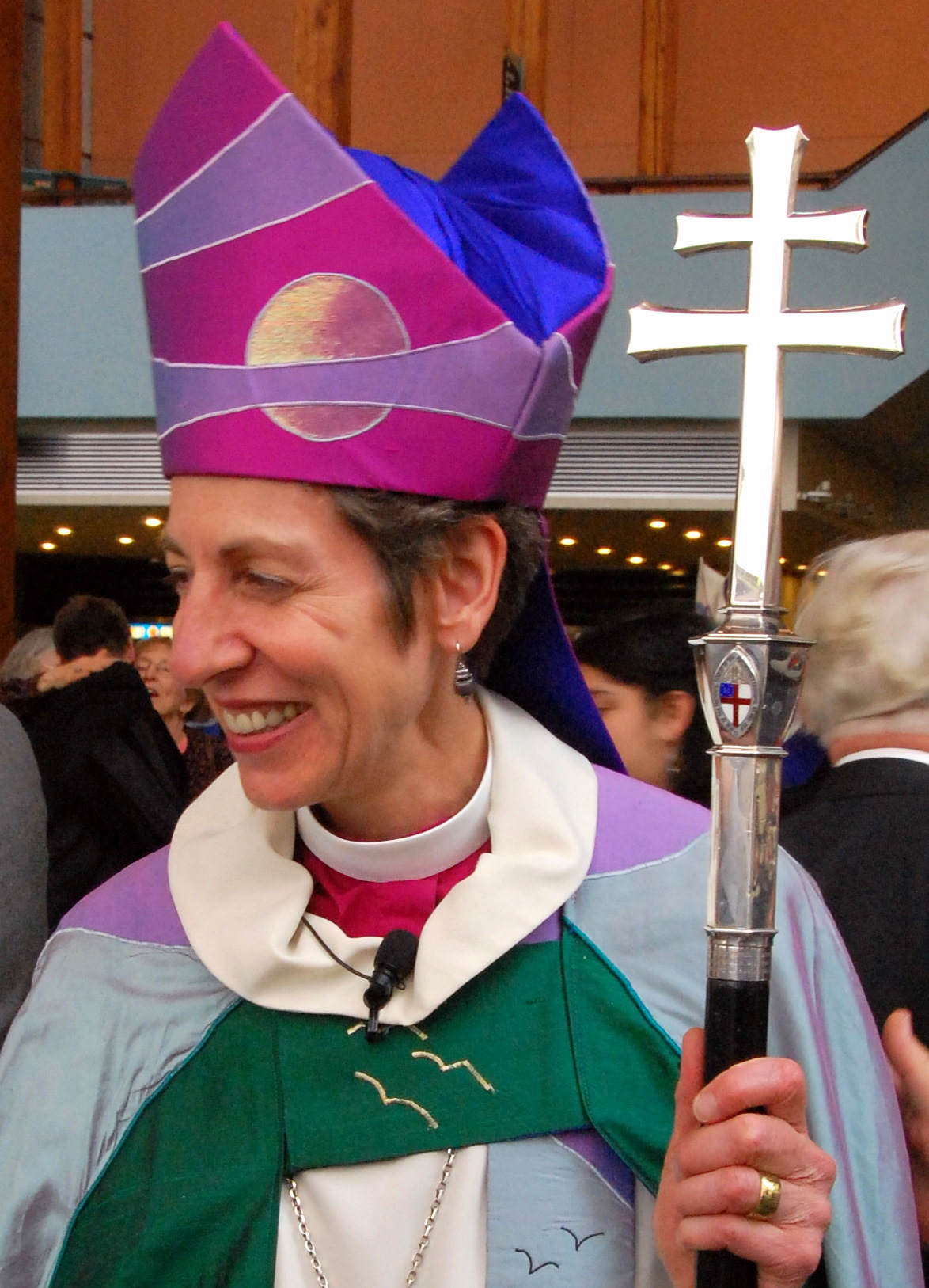
 Here is a YouTube video of the Most Rev. Katharine Jefferts-Schori (Presiding Bishop of the Episcopal Church) offering wise and wonderful words about the religious diversity in which we live.

Here is a YouTube video of the Most Rev. Katharine Jefferts-Schori (Presiding Bishop of the Episcopal Church) offering wise and wonderful words about the religious diversity in which we live.
As many of you superfriends and blogofans already know, my personal spiritual journey is one of constant searching for alternatives to the Bad Old Good News that is typically propagated by most traditional expressions of western Christianity (i.e. Roman Catholicism and Fundamentalist Protestantism).
One of the stops on this journey was with my former roommate from seminary (If you thought of Dark Helmet as soon as I said “former roommate,” you get 3 extra points).
Aaron Blue is the founder and Director of the Charis Project, an outreach organization that supports holistic and sustainable community development through orphanages in Thailand. Click the link above to learn more and support it.
While Aaron’s ecclesiastical roots lie in the early Vineyard movement, his is a theology that defies categorization. What made me gravitate toward him in seminary is the fact that he doesn’t seem to live by the same rules that everyone else does. A rather Christlike quality, if you ask me. Aaron would describe himself as follows: “While everyone else is trying to win the Superbowl, I’m questioning the validity of the NFL.”
Aaron’s journey has taken him in some interesting directions. We disagree on a lot, but that’s okay with us because we both believe that dogmatic conformity is probably the single worst criterion for evaluating the quality of one’s spirituality.
He keeps a blog of signposts from his metaphysical travels:
In Search of a Shameless Gospel
I recommend starting with this post:
Running from a Shameful Gospel – Part 1
This post is particularly reminiscent of conversations that Aaron and I were having about this time seven years ago. Those conversations played a big part in helping me talk about the Bad Old Good News in terms that are as ridiculous as the theology itself. Here’s how I like to say it:
The Bad Old Good News
You were such a horrible person that God had to torture and murder the only person in the world who didn’t deserve it. If you don’t think this is the best idea ever, God will torture you forever along with most of the rest of the human race.
Another favorite rendition:
Telepathically tell the zombie that he’s your master and you get to live forever.
That kind of “good news” is neither good nor news. It’s either silly, offensive, or both. Aaron and I both set off on our separate quests for a better Gospel. The journey has led us in very different directions, but we continue to share notes.

Here’s an inspiring passage I found in on pages 19-20 in Douglas F. Ottati’s book, Theology for Liberal Presbyterians and Other Endangered Species (Geneva: 2006).
Will the mainline churches in America hold together or split apart? Will liberal Protestants criticize the excesses and the idols of contemporary American culture but also remain open to the lessons and wisdom that nevertheless seem present in the wider society and culture? Will liberal Protestants simply disappear? Will the United States find positive, realistic, and responsible ways to exercise power in a multilateral world? What shall we say and do about racism, sexism, and homophobia; about urban policy, transportation, and education; about matters of war and peace? Can we ever become stewards of our natural environment?
These are among the important questions we face. Nevertheless, for Christians and their communities, the more basic question is this: How shall we center a faithful witness? The function of Christian theology is to help us answer this question, and I propose that we answer it in a single sentence: We belong to the God of grace.
Once we are clear about this, a number of things follow. First, we live in assurance, refuse to set limits on the extent of God’s faithfulness, and refuse to exclude anyone from the scope of grace and redemption. We then work for an inclusive church, support a ministry of reconciliation, and invite everyone everywhere to lay hold of the assurance and confidence that come with the knowledge of a gracious God. Second, we acknowledge the human fault and, without losing hope, maintain a realistic attitude toward the present age and its daunting challenges. Finally, we affirm that all people have worth, and we commit ourselves to public practices, policies, and leadership that respect persons, pursue equitable opportunities for the poor, and care for those in need.
We belong to the God of grace. This simple confession will enable us to interpret the many threats and conflicts and issues and promises of our day in a definite theological frame of reference.

Link to article in Good Magazine
For all you theological types out there, reflect on this article in conjunction with this passage from the Torah:
You shall count off seven weeks of years, seven times seven years, so that the period of seven weeks of years gives forty-nine years. Then you shall have the trumpet sounded loud; on the tenth day of the seventh month—on the day of atonement—you shall have the trumpet sounded throughout all your land. And you shall hallow the fiftieth year and you shall proclaim liberty throughout the land to all its inhabitants. It shall be a jubilee for you: you shall return, every one of you, to your property and every one of you to your family. That fiftieth year shall be a jubilee for you: you shall not sow, or reap the aftergrowth, or harvest the unpruned vines. For it is a jubilee; it shall be holy to you: you shall eat only what the field itself produces.
In this year of jubilee you shall return, every one of you, to your property. When you make a sale to your neighbour or buy from your neighbour, you shall not cheat one another. When you buy from your neighbour, you shall pay only for the number of years since the jubilee; the seller shall charge you only for the remaining crop-years. If the years are more, you shall increase the price, and if the years are fewer, you shall diminish the price; for it is a certain number of harvests that are being sold to you. You shall not cheat one another, but you shall fear your God; for I am the Lord your God.
You shall observe my statutes and faithfully keep my ordinances, so that you may live on the land securely. The land will yield its fruit, and you will eat your fill and live on it securely. Should you ask, ‘What shall we eat in the seventh year, if we may not sow or gather in our crop?’ I will order my blessing for you in the sixth year, so that it will yield a crop for three years. When you sow in the eighth year, you will be eating from the old crop; until the ninth year, when its produce comes in, you shall eat the old. The land shall not be sold in perpetuity, for the land is mine; with me you are but aliens and tenants. Throughout the land that you hold, you shall provide for the redemption of the land.
– Leviticus 25:8-24
 I had a fascinating exchange with an old college pal this week. I mentioned in an email that I self-identify as a Liberal Christian.
My friend responded, “So, what is a ‘Liberal Christian’? When I hear that, it makes me think it’s a code word for ‘Christians who think they’ve figured out how to be pro-choice Democrats, and still be in-line with the Bible’… Seems like they all listened to U2 also…”
While I’m not a registered member of any political party and my views on abortion do not conform to either pro-life or pro-choice platforms, I had to laugh at myself over the U2 comment. They just so happen to be my favorite band… I guess some stereotypes are true!
After that, I proceeded to this gentle-but-long-winded long-breezed history lecture on 20th century Christians and biblical interpretation. Unwittingly, I fell right into the two habits that most annoy me about Liberal Christianity: Negativity and Elitism.
Negativity
Have you ever noticed that we Liberal Christians spend a lot of time talking about what we don’t believe? We don’t accept Young Earth Creationism. We don’t think the Bible is inerrant. We don’t believe eternal life depends on accepting Jesus Christ as your personal Lord and Savior. We read books with titles like Why Christianity Must Change or Die and Taking the Bible Seriously but Not Literally (both of which happen to be good books, by the way).
Elitism
Along with our tendency to accentuate the negative, it’s also pretty obvious that our churches tend to be populated with college-educated, upper middle-class white folks. We Liberal Christians pride ourselves on being better educated, informed, and enlightened than our Evangelical counterparts. Just as some Evangelicals tend to hide behind walls of biblical literalism, Liberals tend to hide behind walls of intellectual superiority. Even though none of us would put it this way, we consider ourselves to be the “one true church” because we have risen above the naïve superstitions of Catholics and Evangelicals. Despite our claims to open-minded pluralism and tough-minded skepticism, we still claim to be the sole possessors of the “real truth” about Christianity. Despite our lip-service to diversity, our churches tend to be pretty monochromatic. Despite our passion for social justice, I once heard someone say about us, “They’ll bake a casserole for every cause but they won’t go to jail for any cause.” Is this really the legacy left by the Underground Railroad, the Suffragettes, and Martin Luther King?
In response to these tendencies toward Negativity and Elitism, I’d like to see us develop an Affirmative and Common Sense Liberalism.
Affirmative Liberalism
What do we believe as Liberal Christians?
First of all, we believe in freedom. That’s what the word liberal means, after all. We are free to make full use of our minds and hearts as we grow in our faith. We are free to disagree. There should be no litmus test of doctrine among us. Sadly, this is not always the case in practice. There are just as many mean-spirited Liberals as there are Bible-thumping Fundamentalists. I once witnessed an Evangelical ministry candidate in my own denomination being publicly mocked in front of her colleagues by a Liberal pastor who asked whether she thought the Second Coming might involve Jesus returning to Earth “in a rocket ship.” If I am free to question traditional doctrine, others should be free to accept it. We should rejoice with those whose lives are changed, for example, by a charismatic “born again” experience. We have every reason to believe that they have truly encountered the Spirit of the Living God. The difference is that we also believe the same for Gandhi, Buddha, and anyone who has ever scored free swag from the Oprah Winfrey Show. The mark of a truly Christian Liberalism is when we leave room for those who would not leave room for us. Personally, I’m still working on that.
Second, Liberal Christians believe in grace. We are all created, connected, redeemed, and sustained by the absolutely unconditional love of God. No one is exempt from this Good News, regardless of time, place, religion, or sexual orientation. We are all equally God’s children. Full stop. There is no moral standard upon which God’s ultimate approval is based. This does not mean, however, that there are no moral standards. We believe in the fair and equal establishment of liberty and justice for all. It is sometimes necessary to act decisively in correcting behaviors, protecting the innocent, or redressing grievances, but this does not involve a final condemnation or an ultimate devaluing of the whole person. Human parents must enact discipline in order to shape a child’s character, but eternal punishment is inconsistent with God’s purposes as a loving parent. What could make you subject your child to eternal torture without relief? No one is irredeemable. In short, everybody gets into heaven (if there is such a place). Alas, Liberal Christians have often failed on this front as well. One friend of a friend commented that, after leaving her rather Conservative Mennonite church for the United Church of Canada (a prominent Liberal denomination in the Great White North), she was disappointed to find just as much hard-nosed legalism among Liberal Christians. The difference, she noted, was that Liberal Christians made her feel guilty about recycling rather than masturbation. Whenever we are overwhelmed by either unfounded humanistic optimism or righteous indignation, we Liberal Christians should remember to keep this song in our hearts: “’Tis grace has brought me safe thus far, And grace will lead me home.”
Common Sense Liberalism
Watching certain candidates on the presidential campaign trail has reminded me how many people respond to folksy wisdom more than actual data. Conservatives seem to have cornered the market on common sense while Liberals cite academic facts and theories. I refuse to accept the necessity of this arrangement. We too can make pithy bumper stickers. We too can appeal to those beliefs and values that lie deep within the human heart and lead us toward a better world. We too can quote the Bible to support what we have to say. I’ll even do it in the good old King James Version:
Liberal Christians believe that God loves everyone. We believe that all people are created equal in one human family. We believe in fairness. We believe in freedom. We believe that God is a mystery so big that no one can fully understand. We believe in grace. We believe in justice. We believe that diversity makes us stronger.
The term Liberal has become a dirty word in recent years. It is used in the halls of Congress and churches to accuse, demean, and degrade. I want to reclaim the term Liberal, especially as it applies to Christian faith. There are no doubt others who will question my intellectual and moral integrity. That’s fine. They can do that. I’ll try not to argue back. This is just me trying to figure out what I believe and where I fit in the grand scheme of things. I am a Liberal Christian.
“Here I stand. I can do no other.” – Martin Luther at the Diet of Worms
This is my favorite passage from theologian Paul Tillich. It is taken from a sermon in his book The Shaking of the Foundations.
This is one of those precious few texts I repeatedly return to when I need to remind myself of what it means to be a “Christian”.
Do we know what it means to be struck by grace? It does not mean that we suddenly believe that God exists, or that Jesus is the Saviour, or that the Bible contains the truth. To believe that something is, is almost contrary to the meaning of grace. Furthermore, grace does not mean simply that we are making progress in our moral self-control, in our fight against special faults, and in our relationships to men and to society. Moral progress may be a fruit of grace; but it is not grace itself, and it can even prevent us from receiving grace. For there is too often a graceless acceptance of Christian doctrines and a graceless battle against the structures of evil in our personalities. Such a graceless relation to God may lead us by necessity either to arrogance or to despair. It would be better to refuse God and the Christ and the Bible than to accept them without grace. For if we accept without grace, we do so in the state of separation, and can only succeed in deepening the separation. We cannot transform our lives, unless we allow them to be transformed by that stroke of grace. It happens; or it does not happen. And certainly it does not happen if we try to force it upon ourselves, just as it shall not happen so long as we think, in our self-complacency, that we have no need of it. Grace strikes us when we are in great pain and restlessness. It strikes us when we walk through the dark valley of a meaningless and empty life. It strikes us when we feel that our separation is deeper than usual, because we have violated another life, a life which we loved, or from which we were estranged. It strikes us when our disgust for our own being, our indifference, our weakness, our hostility, and our lack of direction and composure have become intolerable to us. It strikes us when, year after year, the longed-for perfection of life does not appear, when the old compulsions reign within us as they have for decades, when despair destroys all joy and courage. Sometimes at that moment a wave of light breaks into our darkness, and it is as though a voice were saying: “You are accepted. You are accepted, accepted by that which is greater than you, and the name of which you do not know. Do not ask for the name now; perhaps you will find it later. Do not try to do anything now; perhaps later you will do much. Do not seek for anything; do not perform anything; do not intend anything. Simply accept the fact that you are accepted!” If that happens to us, we experience grace. After such an experience we may not be better than before, and we may not believe more than before. But everything is transformed. In that moment, grace conquers sin, and reconciliation bridges the gulf of estrangement. And nothing is demanded of this experience, no religious or moral or intellectual presupposition, nothing but acceptance.

 Hopping Hadrian's Wall