The Anglican spiritual theologian Martin Thornton once remarked that “the genius of St Benedict cannot be confined within the walls of Monte Cassino or any other monastery.” In continuing a discussion of the so-called Benedict Option, and what it means for Anglicans, my suspicion, and what is becoming my conviction, is that we Anglicans hold to a tradition which is not only well-suited to the Benedict Option, but which is the very thing itself. To be sure, there are Anglicans who would never in a million years consider themselves as such, but one can hardly deny the Benedictine character of Anglicanism, in her Prayer Book, in her mission, or in even the unique spiritual tradition of the English people. In the Middle Ages, England was often referred to as the “land of the Benedictines,” dotted as it was with monasteries, typically tied to the cathedral cloisters, following the Rule.
It is not a complete breviary that stands on its own, but a guide for praying the Office in a manner similar to the monks at St. Gregory’s Abbey, Three Rivers.
While not an exact replication of the Liturgy of the Hours at St. Gregory’s, Lex Orandi has been adapted to fit the schedules of people who live outside the monastery, but still want to pattern their prayer life after the Benedictine spirit.
While Abbot Andrew Marr and the brothers have helped me in this project and granted permission to reprint select portions of their Office (e.g. the Confraternity Prayers), Lex Orandi is an independent publication that has not been authorized or endorsed by St. Gregory’s Abbey, Three Rivers. Its use is not required.
Thank you to the community of St. Gregory’s Abbey, Three Rivers for your friendship, support, and guidance in this labor of love. It is my joy to make it available online for free to anyone who wishes to use it.
This is a short introduction to the Liturgy of the Hours (a.k.a. the Divine Office) by Fr. Jeremy Driscoll, OSB of Mount Angel Abbey. It is beautifully and simply done. Very much worth a few minutes of your time, especially if you’ve ever wondered what monasticism is all about.
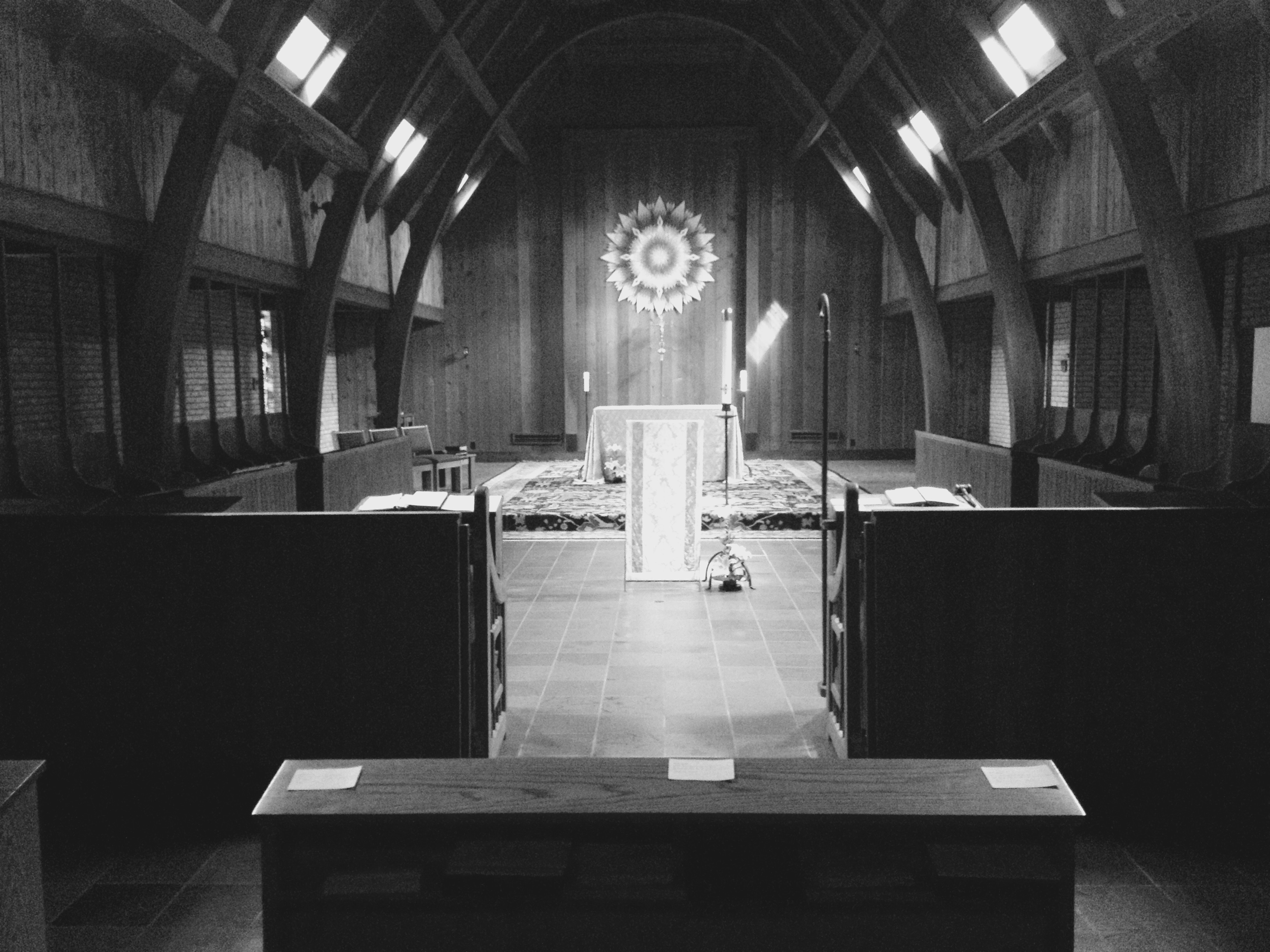
I know that some of my readers are curious about my week at St. Gregory’s Abbey, an Episcopal Benedictine monastery in Three Rivers, Michigan. In the week since I’ve been back, I’ve been trying to sift through what emerged during my time there. Much of it is too personal for publication, suffice to say that unplugging from work and electronics gave me the space I needed for some internal things to float to the surface, where I could deal with them.
One of the things that amazed me about this time was my experience of sharing space and time with others in silence. There were a few other visitors in the guest house with me. We were present with each other often, but talked very little. We slept in adjacent rooms, ate together, worshiped next to each other several times a day, read next to each other in the library, but said almost nothing.
This experience was quite unfamiliar to me: being present with each other without exchanging information. I got to know these neighbors of mine throughout the week, but there is almost nothing that I know about them. This was new for me, especially considering that I am a chatty, extroverted, social butterfly. Shutting up and just being together in the silence was agony for me at first, but I came to appreciate it by the end of the week.
What strikes me about that experience in retrospect is that it is the polar opposite of what happens with human interaction via social media, where relationship is entirely made up of information exchange and utterly void of real presence. I have Facebook friends and blog readers who I have never met, but we exchange information regularly. Most of it is quite pleasant or amusing. But when I read the comments on a YouTube video, I see the dark side of people whose humanity gets temporarily lost in arguments that are rich in data exchange but poor in intimacy. Spammers and Trolls do not see the humanity in the people on the other side of the screen. Hiding behind the comfortable curtain of anonymity, they say things they would never say to someone they loved, respected, and had to interact with. If I’m honest, I have to admit that I am not totally innocent of this offense myself.
Reading the Rule of St. Benedict this morning, I came across this passage from chapter 2:
Furthermore, those who receive the name of prioress or abbot are to lead the community by a twofold teaching: they must point out to monastics all that is good and holy more by example than by words, proposing God’s commandments to a receptive community with words, but demonstrating God’s instructions to the stubborn and the dull by a living example.
Benedict is the anti-troll in this sentence. He leads by example, especially with those who are resistant to what he has to say. He makes no attempt to argue; he has nothing to prove. He reserves talking for those who are already on the same page with him, so that they might develop and refine their ideas together.
It occurs to me that there is almost no capacity for this kind of leading by example online. Quiet presence offers no exchange of information, therefore no relationship (at least as far as the internet is concerned).
The recovery of sanity and civility requires that each of us recognizes and acknowledges the humanity we share in common with each other, especially those with whom we disagree in matters of politics and religion. Let us recover the lost art of being present with each other when information is not being exchanged, that our conversation might be all the more rich and fruitful.
As one who has long been interested in all things monastic, this article at Duke Divinity School’s Faith and Leadership blog really tickled my fancy. Enjoy!





 Hopping Hadrian's Wall
