Religious Liberalism 101: A Book Review of Paul Rasor’s ‘Faith Without Certainty’

I haven’t done a book review in a while, but I’ve been reading some good ones.  Just yesterday, I finished Faith Without Certainty: Liberal Theology in the 21st Century (Skinner House: 2005) by Paul Rasor, a Unitarian Universalist minister and college professor who currently works as director of the Center for the Study of Religious Freedom.

Enemies and allies of liberal theology are similarly inclined to use the term ‘liberal’ as a synonymn for ‘other’.  Until the last year or two, I myself was completely unaware of the historical depth contained within the joint traditions of Unitarianism and Universalism.  Knowing only what I’d been told from my evangelical upbringing, I had always thought that Unitarian Universalists (UUs) were ‘loosey-goosey’ and ‘airy-fairy’ liberals who had respect for neither tradition nor truth and adopted an ‘anything goes’ policy in regard to morality and ethics.  I would tell jokes like:

Q: What do you get when you cross a Jehovah’s Witness with a Unitarian Universalist?

A: Someone who comes knocking on your door for no apparent reason.

OK, I have to admit that I still chuckle at that one, even though I know it’s not true.  UUs are deeply committed to their theology and ethics.  If one knocks at your door, you can bet that it’s for a very good reason.  What I discovered is that UUs (as well as other religious liberals) are committed to process over content.  In other words, they’re more interested in how you live than what you believe.  This is beautifully reflected in the UUA’s Seven Principles.  I would love to go into greater detail about them here, but that will have to wait for another blog post.  The UUA, while it represents the largest organized group of religious liberals, is not the only place where they hang out.  There continue to be many of us who try to embody a similar flavor of religion within our respective communities.  What matters is that we who identify ourselves with this label (‘liberal’) must be able to simultaneously hold and share a conscious awareness of who we are and what we stand for in a positive sense.

Given the myriad ways that the term ‘liberal’ gets thrown around without being defined, I’m grateful for Rasor’s concise and readable primer that actually digs into the real roots  and trajectories of the liberal theological tradition.

If you don’t have time to read the entire book, the first two chapters after the introduction will familiarize you with what it is that religious liberals believe and how we came to embrace those values.  Whether you’re out to support or criticize us, it’s important that you know what you’re getting into.  Love or hate us for what we are, not what we’re not.

The remainder of the book lays out some of the challenges and frontiers that liberal theology is currently facing in its ongoing development.  With the arrival of the postmodern era, liberal religion (as a decidedly modern phenomenon) is reevaluating many of its core commitments (in much the same way that evangelical Christians (another modern movement) are also doing via the ‘Emergent Church’ movement).  Hard and fast categories, such as rugged individualism and universal human experience, are being questioned in the light of community, culture, and language.

Rasor is highly critical of his own liberal tradition in relation to issues of race and social class.  Despite its value of diversity, liberal religion continues to exist as a predominantly white and middle-class movement.  While his criticisms are honest and accurate, I wish that he had spent more time with them.  He mentions social Darwinism and the rise of manifest destiny in America, but he says nothing of Eugenics or the Holocaust, both of which were fueled in part by liberal theology.  These massive moral failures demonstrate that no one group, however utopian their ideals, is above the human tendency toward self-justified violence and oppression.  My primary criticism of Rasor’s book is that it seems to minimize and/or ignore these most prominent failures of liberal religion.

On the other hand, I was highly impressed by Rasor’s distinction between liberal and liberation theologies.  These two categories are often associated with one another in the common mind, mainly because of shared emphases on social justice.  However, as Rasor observes, they arise from different historical sources, make use of different methods, and emerge with very different values and convictions.  Liberation theologians tend to hold scripture and tradition much more closely, even as they criticize and reinterpret them.  Not all theological liberals are liberation theologians (and vice versa).  One need only look at the sermons of Archbishop Oscar Romero of El Salvador to see his deep commitment to the historical orthodoxy of Roman Catholicism.  If anything, I came away from Rasor’s book with an awareness that the construction of a theology that is simultaneously liberal and liberationist would prove to be a most difficult task.  Indeed, evangelicals would probably have an easier time of it, given the place they grant to the Bible in their theological systems.

All in all, I highly enjoyed Rasor’s book during my two weeks of vacation.  I expect that I will keep it on my shelf and refer to it often as a concise introduction to what religious liberals actually believe.

Click here to order this book on Amazon.com

Ten Things I Want to Tell Parents

Sorry to crowd the blogosphere this morning, but I came across this article and it was too good to pass by.  This is for all religiously and/or spiritually inclined parents out there (of any ideological stripe).  Solid, concise, and clear.  Originally written by Rev. Rebecca Kirkpatrick.

Reblogged from Bread Not Stones:

When I started this blog about a year ago, I planned to focus on sharing my insights into how parents can and should provide religious nurture for their children. As I have reflected on this past year, I thought it would be helpful to briefly lay out in one post some of the most important things that I have learned as a pastor and a parent who works with families.

Almost all of what I have written relates to one of these ten things that I think parents should know. Once we delve into the details and particulars of different parts of scripture or faith, sometimes these essentials can get lost in the shuffle.

So below are the ten most important things that I want to tell parents (even parents in my own congregation) as they work to strengthen the spiritual lives of their children.

Ways Through Time to Eternity

Fascinating thoughts on pluralism by philosopher John Hick. 

Warning: Liberal warm fuzzies ahead.  If you don’t want those, feel free to stop reading now.

The future I am thinking of is accordingly one in which what we now call the different religions will constitute the past history of different emphases and variations within a global religious life. I do not mean that all men everywhere will be overtly religious, any more than they are today. I mean rather that the discoveries now taking place by men of different faiths of central common ground, hitherto largely concealed by the variety of cultural forms in which it was expressed, may eventually render obsolete the sense of belonging to rival ideological communities. Not that all religious men will think alike, or worship in the same way or experience the divine identically. On the contrary, so long as there is a rich variety of human cultures—and let us hope there will always be this-we should expect there to be correspondingly different forms of religious cult, ritual and organization, conceptualized in different theological doctrines. And so long as there is a wide spectrum of human psychological types—and again let us hope that there will always be this—we should expect there to be correspondingly different emphases between, for example, the sense of the divine as just and as merciful, between karma and bhakti; or between worship as formal and communal and worship as free and personal. Thus we may expect the different world faiths to continue as religio-cultural phenomena, though phenomena which are increasingly influencing one another’s development. The relation between them will then perhaps be somewhat like that now obtaining between the different denominations of Christianity in Europe or the United States. That is to say, there will in most countries be a dominant religious tradition, with other traditions present in varying strengths, but with considerable awareness on all hands of what they have in common; with some degree of osmosis of membership through their institutional walls; with a large degree of practical cooperation; and even conceivably with some interchange of ministry.

Beyond this the ultimate unity of faiths will be an eschatological unity in which each is both fulfilled and transcended—fulfilled in so far as it is true, transcended in so far as it is less than the whole truth. And indeed even such fulfilling must be a transcending; for the function of a religion is to bring us to a right relationship with the ultimate divine reality, to awareness of our true nature and our place in the Whole, into the presence of God. In the eternal life there is no longer any place for religions; the pilgrim has no need of a way after he has finally arrived. In St. John’s vision of the heavenly city at the end of our Christian scriptures it is said that there is no temple—no Christian church or chapel, no Jewish synagogue, no Hindu or Buddhist temple, no Muslim mosque, no Sikh Gurdwara. . . . For all these exist in time, as ways through time to eternity.

John Hick, God and the Universe of Faiths

How Important is the Afterlife?

Ok class,

My classes will never be as cool as this guy's.

Time to sit up and pay attention.  I’m asking YOU a question today, so I want to see lots of answers and comments down below!

This is a question that my philosophy students at Utica College are pondering and discussing this week and I thought it would be fun to put it before you.

I was having lunch at a cafe yesterday when someone walked up and handed me a religious pamphlet that asked whether I knew for sure that I was going to heaven when die.  This is an interesting question.

It’s even more interesting that so many in the fundamentalist camp choose to start their evangelistic pitch with this question.  If one’s faith is based on fear for the ego’s survival in an unknown afterlife, then it doesn’t seem to be qualitatively different from the dog-eat-dog drive for survival in this world.

I’m not trying to disparage eternal hope for anyone, but during Holy Week, Christians celebrate the death and resurrection of Jesus.  Jesus was willing to sacrifice himself.  His vision and ultimate concern was much larger than his drive for egoic survival.  He embraced death willingly and so became the primary model by which Christians measure their faith.

There is an extent to which I believe we Christians are called to do the same.  Jesus said, “Take up your cross and follow me.”  Christians like to remind each other that Christ died for us, but there is also a very real sense in which we are called to die with Christ.  We are participants, not merely consumers, in the unfolding drama of eternity.

Friedrich Schleiermacher said it like this in On Religion: Speeches to its Cultured Despisers (1799):

Religion is the outcome neither of the fear of death, nor of the fear of God. It answers a deep need in man. It is neither a metaphysic, nor a morality, but above all and essentially an intuition and a feeling. … Dogmas are not, properly speaking, part of religion: rather it is that they are derived from it. Religion is the miracle of direct relationship with the infinite; and dogmas are the reflection of this miracle. Similarly belief in God, and in personal immortality, are not necessarily a part of religion; one can conceive of a religion without God, and it would be pure contemplation of the universe; the desire for personal immortality seems rather to show a lack of religion, since religion assumes a desire to lose oneself in the infinite, rather than to preserve one’s own finite self.

The question I am putting before you, superfriends and blogofans, is taken from chapter 9 of William Rowe’s Philosophy of Religion: An Introduction.

How important to religion is the belief in personal survival after death?  Do you think that religion must stand or fall with this belief?  Can you imagine a viable religion which accepts the view that death ends everything?  What would such a religion be like?  Explain.

Post your answer in the comments below!

Evolutionary Thoughts: Kingdom Come

God’s presence in our history and in the evolution of creation at large is that of a Spirit-power, wisely shaping and forming the inter-connected web of relationships that holds everything in being.  The divine is first and foremost a wisdom-force, forging unceasingly the relationships that sustain and enhance life.  In our Christian story, that relational process is encapsulated in the concept of the new reign of God, traditionally described as the “kingdom of God.”

The wisdom that imbues the sacred writings of many great religions, the wisdom that Christians perceive to be embodied uniquely in Jesus of Nazareth, is that same wisdom that gave birth to stars, pulsars, planets, and people.  Although I have drawn mainly on the Christian story, I want to acknowledge that the wisdom story is bigger than Christianity and indeed exceeds in grandeur and elegance all the insights of the great religions.  It is the prodigiously creative energy of being and becoming.  It is the heartbeat of the evolutionary story in its elegant, timeless, and eternal unfolding.

Evolutionary theology requires us to honor the big picture where God in time begins prior to the evolution of the major religions as we know them today.  The wise and holy God was at work for billions of years before religious consciousness began to develop.  And that same creative wisdom will continue to beget radically new possibilities, forever defying and challenging the outstanding theories and inventions of the human mind.

Diarmuid O’Murchu, Evolutionary Faith, p.72

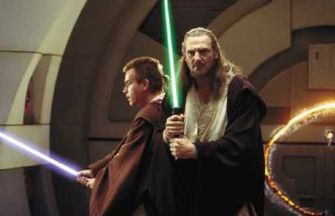
Who Wants To Be A Jedi?

Star Wars as a Modern Myth

Yesterday, I was having a lively after-class discussion with my students in the coffee bar at Utica College.  The topic: Star Wars as a modern myth.

While I have nothing but disdain for George Lucas as a megalomaniac and director, I have to tip my hat to him as one of the most brilliant cinematic storytellers of the 20th century.  He intentionally wrote Star Wars according to the mythical pattern laid out by Joseph Campbell in The Hero With A Thousand Faces.  Campbell applied Jungian archetypes to the study of comparative mythology.  He argued that all the major myths of the world’s religions conformed to a pattern that he called the monomyth.

While Campbell specifically mentions the stories of Prometheus, Osiris, Buddha, and Christ, we can identify the monomythical pattern in the more recent works of L. Frank Baum, J.R.R. Tolkien, J.K. Rowling, and yes, even George Lucas.  Thus, Dorothy Gayle, Frodo Baggins, Harry Potter, and Luke Skywalker are all basically the same character.  What makes Star Wars different from the others is that Lucas was directly inspired by Campbell and intentionally wrote Star Wars as a “modern myth” according to Campbell’s pattern.

The Jedi as a Religion

Given that Lucas intentionally designed Star Wars as a myth, it shouldn’t be surprising that an actual religion has arisen around it.

The Jedi have been objects of admiration by many (including myself).  Part monk, part Samurai, and you get to carry a lightsaber.  Who wouldn’t want to convert?

In fact, you can.  The Universal Life Church will gladly ordain you as a legal minister over the internet and, for the low price of $10.99, you can order a certificate that identifies you as a Jedi Knight.  I’m not kidding.  Click here if you’re interested.

For those who are looking for a little more commitment, check out the Jedi Church website.

Around the time that Revenge of the Sith was released, science fiction legend Orson Scott Card published an article on the Jedi as a religion.  The question that Orson Scott Card asks is, if we take the Star Wars movies as the foundational texts for the Jedi religion, what kind of religion can we expect to emerge?  Are the Jedi, as presented in the films, the kind religious order that we would actually like to see?  Card has some fascinating things to say about it.

Click here to read his fantastic article, No Faith in this Force