Do Whatever He Tells You: A Practical Guide for Turning Water into Wine

Sermon for the second Sunday after the Epiphany, Year C.

Delivered at St. Mark’s Episcopal Church, Coldwater.

Click here to read the biblical passage.

“The key to the perfect wedding day is imperfection.”

That’s the one piece of advice I give to every couple who asks me to officiate their wedding. So long as both parties arrive at the ceremony safely, say their vows in front of an officiant and witnesses, and sign the license, it qualifies as a successful wedding. Everything else is extra. You can bank on some kind of hiccup with the DJ, the catering, or the dress. At my own wedding, the pre-recorded entrance music cut out while my wife was still halfway down the aisle, so she had to walk the rest of the way in silence. It was still a lovely day and a successful wedding.

In biblical times, however, things weren’t so simple. Weddings back then were week-long affairs that involved the entire town. The ceremony was a reaffirmation of the social bonds that held their community together; the couple served as a sacred symbol of God’s covenant with the people of Israel.

Furthermore, wine itself was an important symbol of blessing and joy, so it’s absence would have undoubtedly be interpreted as a bad omen for the new couple.

Running out of wine during such an auspicious occasion would have brought permanent shame on the family. This level of shame, more than mere embarrassment, would lead to the entire family being cut off from the community and not allowed to participate as functioning members of society. The closest thing our culture has to this kind of shaming is when a celebrity gets ‘cancelled’ for acting inappropriately with staff or fans. The difference is that the stakes were much higher: Firstly, because the people involved were regular, working-class folks and, secondly, because the bar for getting ‘cancelled’ was much lower than it is today. The shame of running out of wine at a wedding would have absolutely ruined the family involved.

Knowing this cultural background helps us understand the urgency in Mary’s voice when she informs Jesus, “They have no wine.”

Jesus’ curt response, then, seems shocking: “Woman, what concern is that to me and to you?”

This is a sentence that requires some explanation. At first glance, it sounds rude and dismissive, like a teenager who has just been asked to clean his room (“Ugh… whatever, bruh!”), but a careful examination of the language reveals a very different tone.

First of all, the term “woman” was a term of respect, much like “ma’am” or “madam” would be today. Since our culture uses different words for respect, I would personally not recommend calling your wife, partner, or mother, “woman.” (If you would like to test this hypothesis for yourself, I invite you to do so, and I will happily come to visit you in the hospital afterward.)

Second of all, the comment “what concern is that to me and to you” is meant to be more reassuring than dismissive. If Jesus had been Australian, he might have said, “No worries, mate!” In America, we might say, “No problem. Piece o’ cake!” That phrase is used in other parts of Scripture when a minor issue does not present a barrier to a relationship between two people. In essence, what Jesus is saying here is, “Don’t worry, ma’am. Everything is fine.”

Of course, this response is also shocking, albeit in a different way. Given what we just learned about weddings and wine in ancient Galilee, it would have been perfectly understandable if Mary had said, “What do mean, Jesus?! Everything is not fine! This is a real crisis!” But Mary doesn’t do that. Instead, she calmly turns to the servants and says, “Do whatever he tells you.”

The rest of the story plays out as we read it in today’s gospel. The servants follow Jesus’ instructions and a miraculous transformation ensues. Symbolically, the joy and abundance of life is restored to an even greater level than where it was before.

I’d like to think that I would have the same quiet confidence as Mary during a catastrophe, but I’m not 100% sure that I would. (Then again, maybe that’s why God chose her, instead of me, to be Jesus’ mother.) I’ve been known to indulge in more than my fair share of “doom-scrolling.” Like so many of us, I frequently feel overwhelmed by the crushing pressure of crises, in my life and in the world, that I can do nothing to fix. Mary’s plea to Jesus, “They have no wine,” has often escaped my own lips as a cry for justice, freedom, or hope, sometimes for others and sometimes for myself. When I imagine Jesus telling me, “Don’t worry, sir, everything is fine,” I want to shout back at him, “No it isn’t! We’re in a real crisis, here!”

It is then, when I find myself in times of trouble, that I need Mother Mary to come to me, speaking words of wisdom: “Do whatever he tells you.”

When I hear those words from Mary, I think of the things that Jesus has always told everyone to do: Feed the hungry, clothe the naked, give to the poor, welcome the stranger and the outcast, visit the sick and incarcerated, and love your neighbor as yourself. There is so much wrong in this world that I have no power to fix or control. What I do have power over is my own choices. I can choose to give in to despair and cynicism, or I can choose to be the kind of person that Jesus was by doing the kinds of things that Jesus told me to do.

The popular author (and dedicated Episcopalian) Brené Brown refers to this power-to-choose as “micro-dosing hope.” She says:

“I have no access to big hope right now, however, I am asking myself how I can support the people around me. The people on my team, in my community. How can I make sure that, in the maelstrom of my emotions, I stay committed to courage, kindness, and caring for others regardless of the choices made by others? Doing the smallest next right thing is hard, but sometimes it’s all we’ve got.”

There is a particular community of Christians that has been practicing this principle for more than a millennium: the Benedictine Order of monks and nuns. They were founded in the early sixth century by St. Benedict of Nursia as a community committed to round-the-clock prayer. Every three hours, starting in the middle of the night, they would stop whatever they were doing and chant psalms in the church. Their practice forms the basis for the Daily Offices of Morning and Evening Prayer, which we use in The Episcopal Church today.

The Benedictine commitment to a life of prayer also opened their hearts to the practice of radical hospitality. Whenever strangers would present themselves at the monastery gates, the monks and nuns would welcome them as if it was Christ himself knocking at their door.

Over a thousand years later, the monks and nuns of the Order of St. Benedict continue to live by their rule of prayer and hospitality. In fact, they have a community just 30 minutes away from here by car: St. Gregory’s Abbey of Three Rivers. This small group of Episcopalians has lived by the Rule of St. Benedict since their founding in 1939. [NOTE: Your current rector is an oblate of St. Gregory’s Abbey. If you would like to know what that means, please feel free to ask me after the service or stop by my office sometime.]

[Click here to learn more about St. Gregory’s Abbey, Three Rivers.]

This dual-commitment to prayer and hospitality led the Benedictines to establish sustainable communities with adequate food, shelter, healthcare, and education. The stability of the monasteries made it possible for the Benedictines to preserve the cultural treasures of Western Europe, even as the Roman Empire was collapsing around them.

The entire goal of Benedictine monasticism is to become the kind of person that Jesus was by doing the things that Jesus told people to do. The monks did not set out to save civilization, but the miracle is that they ended up doing so, almost by accident.

This historical example presents us with a possibility for how we too might transform “water into wine” by putting the teachings of Jesus into practice in our own lives. Beyond voting in elections and writing letters to our elected officials (both of which we should absolutely be doing), there is little we can do to directly effect the biggest problems of the world. We can, however, “do whatever Jesus tells us” by putting into practice the things he taught his disciples. We can take care of each other and the most vulnerable people in our community by feeding the hungry, caring for the sick, sheltering the homeless, welcoming the outcast, and loving our neighbors as ourselves. Each of us can choose to be the kind of person that Jesus was.

This, I believe, is the secret for making it through tough times. In the days to come, I pray that each of us (myself included) will understand the reassuring words of Jesus: “Don’t worry ma’am/sir/friend, everything is fine.” I pray that each of us (myself especially) will heed the advice of Mary: “Do whatever he tells you.” I pray, most of all, that we will become the kind of people that Jesus was: Transforming the water of crisis into the wine of hope.

May it be so. And “may the God of peace give us peace at all times in all ways” (II Thessalonians 3:16).

Love in the Past Tense: Grief Without Shame

Sermon for the Feast of All Saints.

The text is John 11:32-44. Click here to read it.

Here is the video of the entire service. The sermon starts at 32:23.

“Jesus began to weep.”

John 11:35

This brief verse, John 11:35, rendered even more concisely in other translations as, “Jesus wept,” is well-known as the shortest verse in our Bible. For that reason, it was a favorite among students at the Christian high school I attended, where our teachers required us to memorize a Bible verse each week.

As a teenager, I liked this verse because it was short, but today, in my middle age, I have found other reasons to love it. I continue to love John 11:35 (“Jesus wept”) because it puts the grief of our fully divine and fully human Lord and Savior on full display and, thereby, it gives us mere mortals permission to grieve, when we feel the need to do so.

Grief is a tricky subject. We pragmatic Americans tend to think of grief as a problem and grieving as an emotional symptom of said problem. When we operate under this misconception, we try to solve the “problem” of grief by making the “bad feelings” go away. This is why so many well-intentioned friends tend to offer so many problematic platitudes like:

  • They’re in a better place;
  • Everything happens for a reason;
  • Heaven needed another angel;
  • God has a plan;
  • It’s not up to us to question the will of the Almighty;
  • Maybe God is trying to teach you a lesson.

If you’ve ever found yourself in a state of grief, and heard this kind of pseudo-theological drivel spat at you by well-intentioned believers, then you too know just how unhelpful such slogans can be. These kinds of “bumper sticker theology” serve to comfort the minds of the bystanders more than the hearts of the bereaved.

Through my years of service as a hospice chaplain, I have come to realize that the beliefs that “grief is a problem to be solved” and “grieving is a feeling” are fundamental errors. Grief is not a problem; it is a process, and grieving is not a feeling; it is a skill. And frankly, speaking as a fellow pragmatic American, grieving is a skill at which we tend to be very, VERY bad.

If we were to look for a culture that is more skilled at the art of grief than our own, I think we need look no further than the Jewish culture of our Lord Jesus. Jewish culture tends to understand the process of grief better than our own. Our Jewish neighbors have, over the course of several millennia, developed a practical approach to mourning that guides people through the process of grief in a systematic way.

During the first stage of grief, between the death of a loved one and their funeral, Jews recognize that people are in an initial state of shock. The bereaved are exempted from performing many of the commandments of the Torah while they process the loss of their loved one. For the first week after the funeral, they are said to be “sitting shiva,” where they are not expected to go to work, leave the house, or even prepare meals. During this time, friends will visit the family to bring food, sit with them, tell stories, and say prayers. Gradually, after this week of sitting shiva, family members will begin to reintegrate into society. There are certain limitations placed on their activity for the first month and the first year after their loss. After that first year, life has more-or-less returned to normal, but they still pause once a year to remember their loved one on the yahrtzeit, the anniversary of their death. Jewish culture understands, better than American culture, that grief is a process and grieving is a skill that must be taught and can be learned.

In today’s gospel reading, we get to see an example of Jesus sitting shiva with his close friends, Mary and Martha, after the death of their brother Lazarus. What’s amazing about this passage is how Jesus meets each of the sisters where they are, according to their distinct personalities. Both sisters begin their conversation with Jesus in the exact same words:

“Lord, if you had been here, my brother would not have died.”

John 11:32

And then, with Martha, the more practical and intellectual of the two, Jesus engages in a theological discussion about resurrection; with Mary, the more emotional and contemplative sister, Jesus says nothing, but simply weeps.

Though we know, from the rest of the gospel story, that Jesus is about to miraculously raise Lazarus from the dead, that knowledge does not stop Jesus from being fully present with these bereaved sisters in their grief. Jesus knows what he is about to do, but he still takes time to meet people where they are.

The most beautiful thing about the Christian faith is our belief that God, in Christ, has entered fully into the human experience, including our experience of grief and death. Divine omnipotence does not create a stoic barrier between us and our feelings, but allows us to enter into them more fully. Real faith enables us to skillfully navigate the troubled waters of grief, charting a steady course between the way things are and the way they ought to be.

When I, as a hospice chaplain, am invited to the bedside of one who has recently died, I notice how often the bereaved family members feel ashamed of their grief. While I stand silently by, they sometimes say to me, “I’m sorry for crying; I know they’re in a better place and I should have more faith, but I just miss them so much!”

Those are the moments when I, as their chaplain, will break my silence by referring to the very Bible verse that inspired this sermon. I say to them, if they are Christian, “When Jesus visited the grave of his friend Lazarus, the Bible very clearly tells us that ‘Jesus wept.’ If it’s okay for Jesus Christ himself to weep at the death of a loved one, then it’s okay for you to do it too.”

As further evidence for my position on this matter, I would cite St. Paul the Apostle, in his first letter to the Thessalonians, chapter 4, verse 13:

“We do not want you to be uninformed, brothers and sisters, about those who have died, so that you may not grieve as others do who have no hope.”

1 Thessalonians 4:13

St. Paul does not say, “so that you may not grieve;” he says, “so that you may not grieve as others do who have no hope.” Grief is a very good and natural part of human life, even for the life of a Christian. Grief, as I like to say, is simply “love in the past tense.” Others have said that grief is just “love with no place to go.” Grief is not a sin. Grief is not a problem to be solved. Grief is a normal process, which we all must go through. Grief is a natural consequence of love, which our Lord Jesus commands us to do.

Kindred in Christ, I want you to hear today that there is no shame in grief; it is simply “love in the past tense.” If you feel sad because you are working through the process of grief, I want you to know that Christ is with you in your grief and this shortest verse of the Bible, “Jesus wept,” is spoken for you this day.

The grief that you experience might be for a loved one who has died; it might also be because of the loss of a job or the end of a relationship. Your grief might be part of coming out of the closet, because you yourself or someone you love is not the person you thought they were. The grief you experience might even be because of something good, like getting married, having a baby, graduating from school, or retiring from a career after many years of faithful service. All of these events are good things, but each of them also involves the end of a previous identity and way of life.

Whatever the source of your grief is today, I want you to know that it is healthy, normal, and good. Jesus Christ does not stand in judgment over you for your grief, but kneels down in the dirt and weeps with you for your loss.

I pray that you will take this mental image with you into your experience of grief. I pray that it will give you the grace to go easy on yourself while you are going through the process of grief. I pray further that your self-acceptance, and your faith in Christ’s acceptance, will give you the wisdom to have mercy on others who are going through their own process of grief.

Through it all, may the peace of God, which passes all understanding, keep our hearts and minds in the knowledge and love of God, and of Jesus Christ, God’s Son, our Lord. And may the blessing of God Almighty, the Father, the Son, and the Holy Spirit, be amongst us and remain with us always.

Amen.

Newness of Life

Easter Vigil sermon.

The text is Romans 6:3-11

Dearly beloved, we gather together this evening to celebrate the mystery of resurrection.

The resurrection of Christ is the central event of the Christian faith. In the season of Easter, we remember how the disciples, in some way that defies rational explanation, experienced Jesus as alive after his crucifixion and death. Many historians over the past two millennia, secular and religious alike, have debated the evidence about what really happened on Easter. What they all agree on, however, is that something significant happened that set Christianity apart from other Messianic Jewish movements of the time (of which there were many) and that the unanimous agreement among the earliest Christians was that Jesus had risen from the dead.

Tonight, I will not presume to settle this longstanding debate about the historical facts. Such questions matter deeply, but I leave the resolution of factual questions to archaeologists, historians, and biblical scholars better equipped and better educated than myself. Christian faith in the resurrection is about more than just picking sides between competing sets of alternative facts.

Resurrection, as I said at the beginning, is a mystery. As such, it is more than an historical event that happened once upon a time in Jerusalem; it is an eternal event that is always happening, in every time and place. That is why I say that we have gathered to celebrate the mystery of resurrection, and not merely commemorate it.

When we celebrate something, we give honor to an event that is also an ongoing reality. When we gather together for a birthday or an anniversary, we don’t just remember a birth or a wedding, we celebrate the ongoing reality of a person or a marriage. The Church does the same thing in our celebration of the mystery of Christ’s resurrection. 

St. Paul elucidates this aspect of celebration in the passage we read tonight from his Letter to the Romans. Paul writes:

Do you not know that all of us who have been baptized into Christ Jesus were baptized into his death? Therefore we have been buried with him by baptism into death, so that, just as Christ was raised from the dead by the glory of the Father, so we too might walk in newness of life.

For if we have been united with him in a death like his, we will certainly be united with him in a resurrection like his.

For Paul, the mystery of the resurrection is an eternal event, in which we all participate. The ritual that makes this eternal event real to us is the Sacrament of Baptism. In Baptism, Paul says, we come to participate consciously in the death and resurrection of Christ. The significance of this conscious participation is primarily ethical, according to Paul. He says, “We know that our old self was crucified with him so that the body of sin might be destroyed, and we might no longer be enslaved to sin. For whoever has died is freed from sin. But if we have died with Christ, we believe that we will also live with him.”

Paul’s presentation of death and resurrection in Baptism is akin to philosopher John Hick’s description of the spiritual journey as “the transformation of human existence from self-centeredness to Reality-centeredness.” According to both Hick and Paul, the spiritual journey of death and resurrection is a paradigm shift of Copernican proportions, in which our fragile egos come to realize that they are not, in fact, the center of the universe. In the mystery of death and resurrection, we come to embrace the reality that our true selves are rooted and grounded in the sacred energy that is eternally giving birth to the cosmos. Our individual selves are temporary manifestations of that energy, like waves on the surface of an infinitely vast ocean. Our true life, as it were, “is hidden with Christ in God”(Colossians 3:3), and this eternal life is one over which death has no final victory.

Dearly beloved, the mystery of resurrection is not limited to a single event in first-century Judea, but has been unfolding from the beginning of time until now, and I have every reason to trust that it will continue to do so in perpetuity. Furthermore, the mystery of resurrection is not limited to Christians, humans, or even planet Earth, but is active in all corners of the universe simultaneously. 

I do not ask you to tonight to put blind faith in these statements, simply because they have been spoken from a pulpit. I invite you to examine the facts for yourselves.

Approximately sixty-six million years ago, an asteroid more than six miles wide slammed into Mexico’s Yucatan peninsula. The impact made a crater 110 miles wide and twelve miles deep, deposited a layer of iridium in soil around the planet, and set off our planet’s fifth mass extinction. Seventy-five percent of all life on the planet, including the dinosaurs, were wiped out by the environmental devastation unleashed by this impact.

There can be no debate about the profound destructiveness of this event, but there is a wonderful and creative aspect to the story that is often overlooked. During the time of the dinosaurs, mammals were small in size and few in number. Tiny shrew-like rodents huddled together in underground burrows in order to avoid the gargantuan lizards that dominated Earth’s surface. 

Unlike the reptiles, natural selection had gifted these little mammals with a powerful new tool in their brains, called “the limbic system.” The limbic system is the part of our brains where emotions are produced. It governs our social relationships and allows us to make more complex judgment calls than the basic survival instincts of our brain stem. Because of the limbic system, mammals were able to care for their young andform bonded family groups. Those little rodents were more to us than just vermin infesting the forest floor; they were our great-great-great grandparents.

When the dust finally settled after the asteroid impact that killed the dinosaurs, our mammalian ancestors cautiously emerged from their underground dens and began to explore the surface the Earth. In time, they evolved into primates with a highly developed neocortex (that’s the computer part of our brains) and, eventually, into humans. 

So, the asteroid impact that caused the death of the dinosaurs also led to the evolution of new forms of life. Because of our cuddly mammalian ancestors and their beautiful little limbic systems, this cataclysmic extinction event opened the door for deeper expressions of love than had ever existed before on planet Earth. And you, the people sitting in these pews tonight, are the direct descendants of those brave and loving creatures. 

Here, in the very fabric of our planet, we discover the mystery of resurrection at work on a timescale that predates the human by millions of years. There is also, in this discovery, a profound harmonization between the scientific story of nature and the biblical story of creation. Dr. Francis Collins writes, “God has now given us the intelligence and the opportunity to discover [God’s] methods… For me scientific discovery is also an occasion of worship” (Time Magazine, August 7, 2005).

Turning from the Christian story of Easter and the scientific story of creation, we can also findthe great mystery of resurrection at work in our lives today. In every life, it is said, a little rain (and not a few asteroids) must fall. Each of us endures moments (or seasons) of crisis, in which we die a little (or a lot) to one way of being and rise to another. Perhaps a job or a relationship has not turned out as expected; perhaps a diagnosis or accident has derailed one’s plans for the future; perhaps a person or community, in whom one had trusted, has utterly betrayed that trust. Even happy events, like weddings and graduations, can be occasions of death for one’s former way of life.

Like most parents, I can remember that there was once a time before I had children, but I no longer have any emotional access to that memory. Since becoming a father, my energy, my time, and (Lord knows) my money are no longer my own. Adapting Paul’s words to my present circumstances, I can definitively testify that the luxury of my formerly child-free life has been “buried with Christ by baptism into death,” but I can also testify that the experience of parenthood has opened my heart to greater depths of love and raised me to “newness of life” in ways that I could never have imagined. In my life as a father, and in my life as a Christian, I must come to admit that I am no longer the center of my own little world. Instead, I am but a speck of dust in company with my fellow specks, orbiting around a much greater center of our being. My self-centeredness has died and been resurrected as wonder and love on a cosmic scale.

This Easter, I invite you to consider the many deaths and resurrections you have endured in your life. I invite you to ask yourself: What are the cataclysms and crises that brought an end to an old way of life for you? What helped you make it through those days? What new insights and perspectives did you gain from those crises that you continue to carry to this day? Finally, looking at the present challenges in your life or the world around you, what new possibilities might be emerging from just below the surface?

As you ask yourself these questions, I pray that the answers you find and the meaning you create will lead you to “newness of life” in the mystery of resurrection. Whoever you are, whatever your personal beliefs or faith tradition may be, and in whatever way is most meaningful to you, may you journey alongside us Christians in the spirit of our Easter proclamation: “Christ is risen indeed! Alleluia!”

Improvising a Life

It was my great privilege to be a guest speaker at the Unitarian Universalist Community Church of Southwest Michigan this morning. I am so thankful to be able to celebrate with this lovely faith community and make lots of new friends!

The meditation on which the sermon is based is the following video by Abigail and Sean Bengson.
I highly recommend watching it before listening to or reading the sermon.
It will lift your spirits and provide context for my message.

Here is a video recording of the message.
I apologize for the scruffy sound of the microphone on my shirt.
I didn’t realize that was happening during the talk.
If you would rather read than listen, the typed manuscript is posted below.

As I begin, I would like to express my sincere thanks to several people for the opportunity to join you in celebration on this beautiful Sunday morning. I would like to thank your minister, the Rev. Gy Ludvig-McCartney, for inviting me to join you and share my thoughts with you today. Our thoughts are with Gy and their spouse Patti this morning. I would also like to thank your Director of Religious Education, Miriam Epskamp, for her kind and helpful guidance in helping me navigate the technical challenges of online church during a global pandemic. Finally, I would like to thank all of you, the lovely people of the Unitarian Universalist Community Church of Southwest Michigan, for your warm welcome into this sacred space and time on this first Sunday of the year 2021. It is a great honor to participate in your worship service and I hope to make an inspiring and informative contribution this morning.

I love the video of the ‘Keep Going On Song’ for several reasons. First of all, it sends a message of hope and compassion in a year when we sorely need it. It comes from fellow travelers who were struggling through 2020 just like the rest of us. They used their powers of creativity to bring a little more light and goodness to a world that was (and still is) feeling like a very dark and lonely place.

But more than that: I love this video as a musician. The way that the singer improvises around the chord progression and returns to the chorus is magnificent. There is an orderliness in the structure of the song, and there is also chaos in the improvisation. This song could never be sung the same way twice.

I would like to talk with you today about this unfolding interaction. When order and chaos come together, they form something that is neither one nor the other. Nor do they reach a compromise between the two extremes. What they form is something new that includes and transcends both order and chaos in their fullness. The word I would like to use for this new thing is creativity. And creativity is what I would like to talk about with you today.

Creativity, understood as an emergent property of the interaction between order and chaos, is fully present in the natural world. I can see it happening particularly in the process of biological evolution, which has been happening on this planet for the last 4.5 billion years, and is still continuing today.

As many of you grownups will remember from your high school biology classes, there are two main components to the engine of evolution. The first component is genetic mutation. This the chaotic part. A mutation is a copy error that occurs in our DNA during the process of cellular division (mitosis). Something in the code unexpectedly changes, which alters the way the new cell functions when the code is read. Often, these errors are harmful to the new cell, but every now and then, a mutation happens that is actually helpful.

Now, the question arises: How do our cells decide which mutations are helpful and which ones are harmful? Well, that’s where the second component of the evolutionary engine comes in.

Genetic mutations cause changes that give either an advantage or a disadvantage to an organism’s chances for survival in its environment. A mutation, for example, that allows a cell to digest a certain kind of food in an environment where that food source is abundant will have a survival advantage. In other words, the new cell that can digest the food is more likely to survive than the cells that cannot digest that food. When this new cell later divides into daughter cells, it passes on its mutation to the next generation. The other cells, meanwhile, are more likely to die before they can reproduce. The name that biologists have given to this process is natural selection.

Natural selection is the orderly component of the evolutionary engine. It takes the errors provided by genetic mutation and determines which ones will provide a survival advantage for the organism. The process itself may be blind, but it is certainly not random.

Critics of evolutionary theory have sometimes used an imaginary example to explain why they think a blind process could not produce the immense diversity and complexity of life that we have on this planet today.

“Imagine,” they say, “a monkey in front of a computer, randomly pushing keys on the keyboard. What are the odds that this monkey could accidentally produce a Shakespearean sonnet? The odds are infinitesimally small.”

The purpose of this thought experiment is usually to demonstrate the idea that something as beautiful and complex as a Shakespearean sonnet can only be produced by a conscious entity with the intelligence of William Shakespeare. “So,” they say, “there must be some kind of intelligent designer at work, consciously directing the process of evolution in ways that are not random or chaotic.” Most proponents of this intelligent design hypothesis use this thought experiment as an argument in favor of the existence of God.

But there is a key piece that intelligent design proponents leave out, and that key piece is natural selection. If we were to adapt the monkey/computer thought experiment to account for natural selection, we would have to add something like the following:

Imagine that there was some kind of system in place that rewarded the monkey with a banana each time it pressed the correct key in the correct order. Over time, the monkey would be able to realize and remember that pressing certain keys in a certain way gave that monkey an advantage. And now, imagine that there was some way to keep each correct letter on the computer screen while erasing the incorrect letters. Finally, imagine further that there were millions of monkeys working on this project at the same time, and each time a monkey anywhere pressed the correct key, the letter on the screen would be kept. Suddenly, it is not at all inconceivable that the monkeys might be able to produce a Shakespearean sonnet in a very short amount of time! And all this would happen without any of the monkeys being aware of the literary masterpiece they were creating. (See Endnote 1)

This is how the creative process of evolution works. It uses the interaction between chaos and order to improvise increasingly diverse and complex forms of life, up to and including you wonderful homo sapiens who have gathered together online to reflect on the meaning of life this Sunday morning.

Music and evolution are not the only places in the universe where chaos and order come together to improvise bonds of creativity. We humans, individually and collectively, have an opportunity to make our own unique contribution to the ongoing creativity of the universe.

You and I experience the interaction of chaos and order in our lives on a daily basis. The chaos has been particularly evident over the course of the year 2020. We are currently living through a global pandemic that has claimed nearly 2 million lives, so far. We have endured quarantine, lockdowns, and violent reactions against those lockdowns. Frontline medical workers, such as myself, have put our lives on the line to care for those who have contracted and sometimes died from COVID-19. We have all witnessed (and some of us have participated in) protests against acts of police brutality that disproportionately impact people of color in the United States. Many of our fellow citizens (including my wife) have been tear-gassed, beaten, and shot by the very officers we commission to keep us safe from unlawful acts of violence. We Americans have endured the spectacle of a particularly contentious presidential election and watched in horror as the legitimacy of that electoral process was called into question by those who have sworn to uphold it. The collective chaos in 2020 has indeed been particularly evident.

In the midst of chaos such as this, it is not uncommon for humans to grasp at straws for meaning. We say things like, “Everything happens for a reason.” The more religiously inclined among us might say, “God has a plan.” In the midst of chaos, many of us might ask, “Why is this happening,” or, “What is the meaning of life, anyway?”

I think we humans tend to ask these questions because we are afraid that the alternative to an orderly plan is a universe that is entirely chaotic and meaningless. We have already observed, however, that life is not entirely chaotic or orderly, but the product of a process that includes and transcends both chaos and order: the universe is a creative process. (See Endnote 2)

I would like to propose a new question this morning: What if the meaning of life is not something we find, but something we make?

The making of meaning is how we humans participate in the process of creativity. Things happen to us that seem chaotic: The lost job, the failed relationship, the missed opportunity, the unforeseen disaster, or the chance encounter. What is ultimately important about these events is not the events themselves, but the story we tell ourselves about them.

When a relationship ends, we can say to ourselves, “That’s just proof that I will never be loved in the way that I want to be,” or we can say, “I have made many mistakes in this relationship, but I will work on myself, learn from my mistakes, and act differently the next time I am in another relationship.” When a baby unexpectedly dies, we can say, “This is evidence that I am just not ready to be a parent,” or we can say, “I will join a support group to help other parents, who are enduring this inestimable loss, and make a way through the darkness of grief.” We cannot control what happens to us in life, but we can decide how we will respond to our chaotic circumstances.

When the unexpected happens, will I choose respond with faith or fear? Will that which does not kill me make me more cynical or more sensitive? Will I use my experience of pain to hurt or to help? The choice is up to us.

May the powers of creativity, compassion, and courage, which are already within you, be your guide, your strength, and your hope as you go out into the world. May each of you become meaning-makers in the midst of chaos, today and every day.

So say we all.

Endnotes

1. I adapted the extended metaphor of the monkeys at the computer from Breaking the Spell: Religion as Natural Phenomenon by Daniel C. Dennett.

2. I am indebted to Karl E. Peters for the conception of creative process as an interplay between chaos and order, especially in regards to genetic mutation and natural selection. See especially his book, Dancing with the Sacred: Evolution, Ecology, and God.

What Can Love Do?

Holy Eucharist for Sunday, Proper 25, Year A
St. Luke’s Episcopal Church, Kalamazoo, MI

Matthew 22:34-46

The culture of Jesus’ time and place, much like our own, was no stranger to the perils of partisan conflict. Today’s gospel opens in the middle of an argument between two established schools of Jewish thought: the Pharisees and the Sadducees.

These two communities offer alternative interpretations of Judaism, in much the same way that different denominations offer alternative interpretations of Christianity today. Additionally, because there was no “separation of church and state” in the ancient world, the Pharisees and Sadducees also functioned as something like political parties in Judea. Imagine, if you will, a messy situation where The Episcopal Church functions as the primary meeting of the Democrats, while the Southern Baptists set the platform for the Republicans.

The Sadducees were a smaller group of wealthy elites who centered their worship on the sacrificial rituals of the Jerusalem Temple. Theologically, they accepted only the Torah, the first five books of the Hebrew Scriptures, as divinely inspired and authoritative. They did not believe in destiny, angels, or an afterlife. Politically, they sought friendly and peaceful relations with the occupying Roman government.

The Pharisees, on the other hand, were a somewhat larger group of the lower classes. Their worship emphasized the study of the Torah in synagogues under the tutelage of learned rabbis. In addition to the five books of the Pentateuch, Pharisees also accepted the oracles of the prophets, collections of wisdom literature, and the oral interpretations of rabbinical scholars. They believed that moral purity would reform their national life and convince God to send the Messiah, an anointed king who would liberate their people from foreign occupation and influence. The Pharisees went on to form the foundation of Judaism, as it is practiced today.

Together, the Pharisees and Sadducees were both thoroughly Jewish movements. As joint religious denominations and political parties, they advocated competing agendas for “God and country” in Judea during the time of Jesus.

Our gospel reading for today begins as Jesus is ending a debate with one member of the Sadducee party. A nearby Pharisee, a legal scholar, listens with great interest to this argument. “If Jesus is obviously opposed to the Sadducees,” he thinks, “then maybe he is a member of our party?” With this question in mind, he decides to put Jesus to a little theological test about the Jewish Scriptures.

“Rabbi,” he says, “which mitzvah (commandment) in the Torah is the greatest?”

Jesus responds by ushering his interlocutor into the heart of their shared tradition by referencing the Shema.

The Shema, in Judaism, is the foundational faith statement of monotheism:

“Shema Yisrael:” (Listen, O Israel:)

“Adonai Eloheinu,” (The Lord is our God,)

“Adonai Echad.” (The Lord is ONE.)

This declaration of oneness represents not only the heart of Jewish tradition, but the heart of reality itself, as Jesus and his fellow Jews understand it: That, beneath the unfathomable diversity of beings and events in the universe, is Sacred Oneness.

Mystics, from many different religious traditions, affirm this Oneness in ways that are remarkably similar to one another. Lao-Tzu, the Buddha, Rumi, and Meister Eckhart all describe a state of Non-Duality that includes and transcends all separations: self and other, left and right, light and dark, spiritual and secular. Spirituality, it seems, is the art of unifying opposites in transcendent wonder.

Neurologists have identified those parts of the human brain that allow us to lump together separate objects as parts of a unified whole. Their studies of dedicated monks and nuns have demonstrated that those parts of the brain are particularly active during periods of intense meditation, thus explaining those experiences of peace and unity that mystics have tried to express for millennia.

Physicists, in their study of the beginning of time, have likewise affirmed that the universe seems to have had its beginning in a Singularity of time, space, matter, and energy that exploded some 13.8 billion years ago in a cataclysmic event to which we now refer as the Big Bang.

Jesus’ response to the Pharisee in today’s gospel makes reference to this same Sacred Oneness at the heart of reality itself. The only appropriate response to Sacred Oneness, Jesus declares in the words of the Torah, is Love.

The greatest commandment in the Torah, according to Jesus, is to “love the Lord your God with all your heart, and with all your soul, and with all your mind.” These words, adapted from Deuteronomy 6:5, appear in the Torah immediately after the verse which lays out the Shema for the first time. “The Lord is one,” Jesus says in effect, “and the only appropriate response to Sacred Oneness is love.”

But Jesus doesn’t stop there. For Jesus, love is not just the sappy feeling sensationalized in pop songs and rom-coms. For Jesus, love is not something you feel, but something you do. Love is action. Love is a verb.

This creates a problem: How does one show love to Love Itself? What could mere mortals possibly offer to a God who, by definition, already has and holds everything in the tender embrace of the Divine Self? The answer, according to Jesus, is simple: “You shall love your neighbor as yourself.”

This commandment comes from the Torah as well, from Leviticus 19:18. It comes on the heels of Moses’ teaching about vengeance: “You shall not hate in your heart anyone of your kin… You shall not take vengeance or bear a grudge against any of your people, but you shall love your neighbor as yourself.”

This commandment to love one’s neighbor speaks directly to the problem of partisan conflict, which was as active in Jesus’ day as it is in our own. Mahatma Gandhi famously said, “An eye for an eye and eventually the whole world goes blind.” Desmond Tutu, the Anglican Archbishop of South Africa (who has worshiped in this very church), said similarly, “There is no future without forgiveness.”

The commandment to love receives its most explicit and biting explication later in the New Testament, in the first epistle of St. John, chapter 4:

“God is love, and those who abide in love abide in God, and God abides in them… Those who say, ‘I love God,’ and hate their brothers or sisters, are liars; for those who do not love a brother or sister whom they have seen, cannot love God whom they have not seen. The commandment we have from him is this: those who love God must love their brothers and sisters also.”

Brothers and sisters, I put it to you today that the commandment to love God and to love one’s neighbor are not separate, but a single commandment from our Lord Jesus Christ himself. The Way of Love moves at heart of everything Jesus said and did in his life on Earth. In the venerable words of Presiding Bishop Michael Curry, “If it ain’t about love, it ain’t about God.”

Notice that neither Jesus nor John, neither Mahatma Gandhi nor Archbishop Tutu, neither the Torah nor the Presiding Bishop puts any provisos or exceptions on their joint commandment to love.

I am as aware as each and every one of you that we have the misfortune of living in a moment when love seems more powerless and the people of this country seem more divided than ever.

What can love do when our elderly and most vulnerable neighbors are being stalked by an invisible predator that steals the air from their lungs while their families watch in horror from the other side of a reinforced glass window?

What can love do when the beautiful bodies of our black brothers and sisters are left bleeding in their beds and on the streets, full of bullet holes?

What can love do when temperatures rise and songs of praise to the Author of Life are silenced at the rate of a species every single day? What can love do?

Brothers and sisters, this is the very question that I put before this morning: What can love do?

The answer we give to this burning question is the only response that God is interested in hearing from us. It is the only offering we can make that is worthy of the name Worship.

Love, in all its living and active forms, is the embodied reality that has the power to overcome all the partisan divisions of Jesus’ day and our own. Love is the only appropriate response to the Sacred Oneness that gave birth to the universe.

Let us return to the biblical exhortations of St. John the Beloved, in chapter 3, verse 18 of his first epistle: “Little children, let us love, not in word or speech, but in truth and action.”

As we go out into the world this week, let us honor that Sacred Oneness. In the words of St. John, “let us love, not in word or speech, but in truth and action.”

As we catch ourselves in the mirror while shaving or brushing our teeth, “let us love, not in word or speech, but in truth and action.”

As we relate to family and friends, “let us love, not in word or speech, but in truth and action.”

As we interact with coworkers and classmates, “let us love, not in word or speech, but in truth and action.”

As we converse with neighbors and enemies alike, “let us love, not in word or speech, but in truth and action.”

As we read the news headlines and prepare to head to the polls next week, “let us love, not in word or speech, but in truth and action.”

I close, once again, with these memorable words from Presiding Bishop Curry, which he borrowed from Jesus, who borrowed them from the Torah of his ancestors: “Brothers and sisters: love God, love your neighbor, and while you’re at it… love yourself!”

One of Us

sermon – what if god was one of us?

When Rev. Rachel invited me to speak this morning, she jokingly said that I could be her “token Christian” and talk about Jesus. So, that’s what I intend to do today.

In a Unitarian Universalist context, it would be easy to talk about Jesus as a teacher of wisdom or the leader of a movement, but I decided to take a slightly more interesting path and talk about one of the distinctive theological principles of the Christian spiritual tradition: the divinity of Christ.

Before I jump into this subject, I think a certain disclaimer is in order. Something I have long admired about you, my Unitarian Universalist friends, is the way that you create a safe haven for so many people who struggle with and/or experience exclusion from other religious communities. This “love beyond belief” is an amazing gift that you offer to the interfaith community, and I heartily thank you for it. The fact is not lost on me that many who find their way to a Unitarian Universalist congregation come as religious refugees from Christianity, the very tradition I represent here today. I stand before you with a sorrowful awareness that Christians have deeply wounded some of you in the name of Jesus. Speaking as a Christian, I am ashamed and angry at these injustices that continue to be heaped upon others in the name of my religion. The greatest threat to Christianity in the world today is not Islam, secular humanism, or Communism, but Christians who refuse to practice the principle of unconditional love taught by our Lord and Savior.

For many of you, it is entirely possible that the path of healing is dependent on this faith community, where the acceptance of traditional Christian dogma is not a requirement for membership. I want to reassure you, at the outset of this talk, that this cherished aspect of your church is not about to change. I am not here this morning to convert or convince anyone toward any doctrinal position, Christian or otherwise. What I intend to do today is explore one way that the Christian spiritual tradition might be able to provide useful tools in the joint, interfaith cause of justice and compassion in this world. I hope these words of mine will be helpful to people from any or no religious background, including Unitarian Universalism.

In the song we just listened to, Joan Osborne asks a significant question: “What if God was one of us?” This is the very question Christians have been asking for almost two thousand years. Since the beginning of our movement, we have sought to take the idea of the Divine out of the heavens and give it flesh and blood on earth. In the theological language of our tradition, we call this attempt the mystery of the Incarnation.

For Christians, Jesus Christ is more than just an historic teacher and leader. Whether or not we take literally the biblical claims about his life, death, and resurrection, Jesus is, for Christians, the eternally living embodiment of the Divine. Christians call him “God incarnate,” which literally translates as “God in-the-flesh.”

One of the most well-known titles for Jesus in the Bible and early Church is Son of God. This Messianic title, far from being a commentary on the historical Jesus’ parentage, is a statement about who Jesus is and what he reveals to us. Christians call Jesus the “Son of God” in the same way that others might look at a child and see reflections of the parent in that child’s face or personality. When I look at my seven-year-old’s features, I see my father-in-law staring back at me. When I hear my nine-year-old shout, “Look at me!” during a performance, I say to myself, “She is her mother’s daughter!” In the same way, Christians look into the loving eyes of Jesus and understand what God must be like. That is why we call him the Son of God.

This, I think, is the unique contribution that Christianity can make to interfaith dialogue: We find God in a person. Other religions encounter the Divine in sacred books and rituals. The prophet Muhammad (pboh) was the vessel through which the Qur’an was revealed; the Buddha taught the Eightfold Path; Lao Tzu wrote the Tao Te Ching. But Christianity is unique among the world’s religions insofar as we believe that Jesus Christ was not simply God’s messenger, but also the message itself.

Why is it important that Christians find God in a person? It’s important because you relate differently to a person than you do to a text or ritual. You can agree or disagree with a text; you can observe a ritual or not; but a person must be loved in an intimate way. I married my wife in a ritual; I abide by the limits set by the rules of monogamy; but the real substance of our marriage is in the love that is shared between us, as persons.

It is the same for Christians in our spirituality: we look into the eyes of a person and find there the embodiment of everything that is good and true. We look at Jesus of Nazareth and find in him the meaning of life.

One does not need to be a Christian, or even believe in God, to benefit from this kind of spiritual practice. Jesus himself never criticized someone for their theology, but thanked them for their trust. In the words of Jesus himself, the true measure of our faith is not in our religious observance, but in the way we treat one another.

Jesus’ followers once asked him,

Lord, when was it that we saw you hungry and gave you food, or thirsty and gave you something to drink? And when was it that we saw you a stranger and welcomed you, or naked and gave you clothing? And when was it that we saw you sick or in prison and visited you?

And Jesus said to them, in Matthew 25:40 (look it up): “Truly I tell you, just as you did it to one of the least of these who are members of my family, you did it to me.”

Later in the New Testament, Jesus’ biological brother James, a bishop in the early Church, said to his congregation:

What good is it, my brothers and sisters, if you say you have faith but do not have works? Can faith save you? If a brother or sister is naked and lacks daily food, and one of you says to them, “Go in peace; keep warm and eat your fill,” and yet you do not supply their bodily needs, what is the good of that? So faith by itself, if it has no works, is dead… Show me your faith apart from your works, and I by my works will show you my faith (James 2:14-17, 18b NRSV).

Christians believe the meaning of life was revealed through a person, therefore real people out to matter to us; Christians believe God took on material flesh, therefore matter ought to matter to us. Jesus taught us that the way we treat one another is a reflection of the way we treat God, therefore we are honor-bound to show our neighbors the kind of respect and sacredness we would show to God’s own self.

I would invite you this morning to turn to the person next to you, whether that person is your spouse, or a stranger, or anything in between. Look deeply into that person’s eyes. Try to imagine in that person what the early Christians saw in Jesus Christ. See in your neighbor’s eyes the meaning of life itself. Try to see in them everything that is good, or noble, or true. Continuing to look into that person’s eyes, hear in your ears the great wisdom of Jesus: “You shall love your neighbor as yourself (Matthew 22:39).”

Friends, this is the great contribution that Christianity can make to the world around us, whether people follow the Christian religion or not: that God (or the meaning of life) can be found in people. Each of us carries a spark of the Divine within us, and therefore deserves to be treated with respect, dignity, and compassion.

As a Christian, I look at the seven Principles of Unitarian Universalism and find in them a helpful guide for living the faith that Jesus taught:

The inherent worth and dignity of every person;

Justice, equity and compassion in human relations;

Acceptance of one another and encouragement to spiritual growth in our congregations;

A free and responsible search for truth and meaning;

The right of conscience and the use of the democratic process within our congregations and in society at large;

The goal of world community with peace, liberty, and justice for all;

Respect for the interdependent web of all existence of which we are a part.

Whether or not you consider yourself a Christian, I hope that you are able to leave this place today and find in the eyes of your fellow human beings the source of goodness, truth, and meaning for life. I hope that our time together today has inspired you to treat your fellow “strangers on the bus” with all the respect and dignity they deserve. And finally, if you can accept the term (in whatever way makes sense to you), I hope you have found the faith to answer Joan Osborne’s question in the affirmative: “Yes, God is one of us.”

Fully Human

Preaching this week at First Presbyterian Church of Paw Paw, MI.

Click here to read the biblical text.

There are two great mysteries that are central to the Christian faith, as it has been handed down to us from the Apostles. As mysteries of the faith, they cannot be proved by philosophical reasoning, but can be experienced directly and expressed through intuition and imagination in the stories and practices of our tradition.

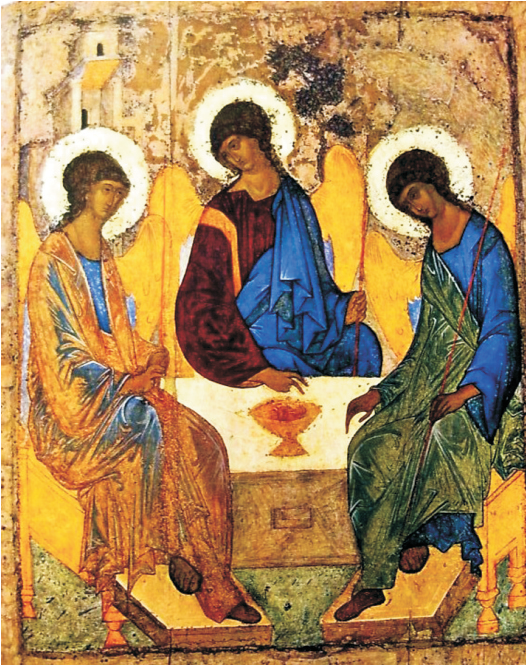
The first is the mystery of the Trinity: we believe in one God who exists co-eternally as three persons, traditionally referred to as Father, Son, and Holy Spirit. The main thing we learn from the mystery of the Trinity is that God is relational. God exists, not as a monolithic object in space, but as network of relationships between individual persons. It would not be too much to say that God is a relationship. This is how Christians are able to say, in the words of 1 John 4:16, “God is love, and those who abide in love, abide in God, and God abides in them.”

The second great mystery is the mystery of the Incarnation, which we are gearing up to celebrate during Advent and Christmas. Christians believe, in the words of John 1:14, that God “became flesh and lived among us” in the person Jesus Christ. In other words, God is one of us. Jesus Christ, according to the Church, is both fully human and fully divine, at the same time. According to the mystery of the Incarnation, everything Jesus is, God is. Jesus Christ reveals the Divine to us. If we want to understand what God is like, we look at the human person Jesus.

These two mysteries, the Trinity and the Incarnation, are central to the Christian faith. They are also central to understanding today’s Gospel reading from Matthew 25.

In this passage of Scripture, Jesus tells us a story of the Final Judgment. At the end of the age, the Son of Man (literally “the Human One”, Jesus’ favorite title for himself) will come to Earth in all his glory and divide the people of the world into two groups. One group, whom he calls “sheep”, and another, called “goats”. The “sheep” will “inherit the kingdom prepared for [them] from the foundation of the world” while the “goats” will “depart… into the eternal fire prepared for the devil and his angels.”

The basis for this final judgment, contrary to what we tend to hear from popular “evangelists” in the media, is not a test of theological doctrine or church attendance, nor is it a question of whether one has received the Sacraments of the Church or “accepted Jesus as their personal Lord and Savior.” The basis of this final judgment, according to Jesus himself in Matthew 25, is how we treated the most vulnerable people among us in this life.

Jesus said, “I was hungry and you gave me food, I was thirsty and you gave me something to drink, I was a stranger and you welcomed me, I was sick and you took care of me, I was in prison and you visited me.”

With a look of confusion on their faces, the righteous ask when it was that they did all these things, and Jesus replies, “Truly I tell you, just as you did it to one of the least of these who are members of my family, you did it to me.”

What Jesus says here is firmly rooted in the central mystery of the Trinity and the Incarnation.

From the mystery of the Incarnation, we learn that God is fully human, so Jesus asks us, “Are you fully human?”

From the mystery of the Trinity, we learn that God is relational, so Jesus asks us, “Are you relational?”

Much of the imagery that Jesus uses in this story comes from chapter 7 in the book of the prophet Daniel, in the Hebrew Scriptures. In that chapter, Daniel has a vision of four empires, which he envisions as vicious monsters that destroy and devour people with their violence. But then, Daniel says, “I saw one like a human being (literally “a Son of Man”…get it?) coming with the clouds of heaven.” And this “Son of Man” will repeal and replace the monstrous empires with the kingdom of heaven-on-earth. And Daniel says, “His dominion is an everlasting dominion that shall not pass away.”

According to Jesus and Daniel, this is God’s ultimate vision for the human species: for a truly human kingdom to replace the monsters and empires that have the power on earth for now.

So, how did we get into this sad state of affairs? What happened?

Well, the Gospel tells us that our Triune, relational God created a relational universe and invited human beings to take our part in harmonious relation to the whole of creation, but we were not satisfied with this gift. We humans wanted to be the center of our own little worlds. We were ambitious to become gods, but became monsters instead. We destroyed and devoured one another in our lust for power, and set up exploitative systems that oppress our fellow creatures in the name of “law and order”.

God kept trying to reach out to us, to show us that there is another way, but we were unwilling to listen. So, God “took on flesh and lived among us” in the person Jesus Christ, showing us that to be fully human is to be fully divine. Jesus loved us, bringing healing, wisdom, and forgiveness into our midst.

But we were still unwilling to listen. Clinging to our old delusions of grandeur, we rejected Jesus and turned on him with all the monstrous might of imperial power. We crucified and killed this God-made-flesh in a final, desperate attempt to shut him up.

But Jesus wouldn’t take No for an answer: he rose from the grave on Easter morning, conquering the power of death and hell, and declaring peace and forgiveness to his deniers and betrayers.

After his resurrection, Jesus gathered his community of followers once again and breathed into their hearts the Holy Spirit, the very presence and power of God. Jesus made the Apostles into little incarnations of the Divine.

These Apostles were sent out to say and do the same things that Jesus said and did: gathering communities of lost and broken people, blessing the little ones, teaching, healing, forgiving; baptizing, confirming, and ordaining, human beings to be the hands and feet of God in the world.

These gathered communities, the Church, gradually spread and grew to the ends of the earth, continuing the Apostles’ mission, right up to this very day in Paw Paw, Michigan, where we have been gathered together by the Holy Spirit as the apostolic people of God in this place and time.

All of us have come here today to hear God’s Word and be fed with the Sacrament of Christ’s Body and Blood, to give thanks, to pray, to give, and to be sent back out into the world, that we might take our part in the advancing kingdom of heaven on earth, saying and doing the very same things Jesus said and did when he walked among us in the flesh.

We are called upon today to live as citizens of the kingdom of the One who is fully human (and therefore fully divine).

This kingdom of heaven-on-earth is advancing here and now, just as Jesus and Daniel said it would. The kingdom’s advance is not always readily apparent, but it is real. In every age, women and men have risen up to demonstrate to the monstrous empires of this world the truth that there is another way to be human. We call these people “Saints”. But saints are nothing more than further examples of what life in this world could be, if we would but set aside our selfish, ego-driven agendas and pledge allegiance to God’s kingdom of heaven-on-earth.

The marching orders of Jesus, our commander-in-chief, are clear: Feed the hungry, slake thirst, welcome foreigners, care for the sick, and visit incarcerated criminals.

The quality of our spirituality (and our divinity) is measured, not by our religious observance or theology, but by the quality of our relationships with hurting, broken, and vulnerable human beings, without stopping to ask whether they are worthy. This is what it means to live in this world as citizens of the kingdom of the truly human one, the kingdom of heaven-on-earth, which is our clear and present hope.

Jesus asks these things of us, not because they work as effective policy in this world, but because they are right. Jesus asks these things of us because they make real to us the presence and power of our fully human and relational God. As a bonus, this strategy happens to make God real to others, as well.

Jesus asks these things of us because the kingdom of heaven is real and advancing across the broken terrain of this Earth. In every age, the saints of God have taken their place in this kingdom, living on Earth as if they were already in Heaven. Today, we are invited to take our place in this kingdom as well.

Our God is relational, therefore Jesus’ question to us is: “Are you relational?”

Our God is fully human, therefore Jesus’ question to us is: “Are you fully human?”

To the extent that we can answer Yes to those questions, we can honestly say that we are living in the kingdom of heaven-on-earth, and we are finally fulfilling humanity’s oldest and greatest ambition: To become divine.

The Adoration of the Outsiders

Eliza_Codex_24_Ethiopian_Biblical_Manuscript_a
Ethiopian Biblical Manuscript. Public Domain. Retrieved from Wikimedia Commons.

A few years ago, there was a big to-do about this book (and subsequent movie), The Da Vinci Code. I won’t get into the particulars of the plot, suffice to say that it provoked a lot of big, emotional reactions from people everywhere.

On the one hand, a lot of church-folks were offended by the ideas it presented, which didn’t exactly mesh with what we had learned as kids in Sunday School. On the other hand, a lot of folks from outside the church were really excited about the book because they thought it revealed a picture of Jesus that was bigger than the one presented by traditional Christianity.

I even had one friend who said, “I knew it! The Vatican has known about this stuff all along, they’ve just kept it hidden and locked up in some secret vault so that the rest of us won’t find out about it.”

Well, I don’t think I’d put much stock in that particular theory… or in the book’s ideas about the historical Jesus (The Da Vinci Code is a work of fiction after all), but I do find the whole phenomenon extremely fascinating from a sociological point of view.

During the peak of the book’s popularity, Jesus Christ was once again on the cover of popular, secular magazines. Books were being written (and read) about him. For a brief cultural moment (and not for the first or the last time), everyone was talking about who Jesus is and what he means to the world. It was a really interesting thing to behold.

And here’s what stood out to me in that conversation:

People feel drawn to Jesus. They want to be connected to him somehow, even if they never darken the door of a church or call themselves Christians. Jesus means a lot to people. There are few, even in the non-religious world, who speak negatively about Jesus or the things he said and did. Most secular criticism is directed, not at Jesus himself, but at us Christians (and what we have done in his name).

In this morning’s gospel reading, we read about a group of people, the wise men, who also felt drawn to Jesus. Like the readers of The Da Vinci Code, these people came to encounter him from outside the bounds of conventional, orthodox, institutional religion.

In the time of King Herod, after Jesus was born in Bethlehem of Judea, wise men from the East came to Jerusalem, asking, “Where is the child who has been born king of the Jews?”

To begin with, these wise men were not Jewish. The text of Matthew’s gospel simply says they were “from the east”, which probably means they came from Persia (the part of the world we now know as Iraq and Iran). They wouldn’t have known anything about the Bible or Jewish customs. They had probably never been to a synagogue service in their life.

So then, how did they come to be aware of this miraculous birth?

“For we observed his star at its rising, and have come to pay him homage.”

They were astrologers. They studied the stars and interpreted their movements as messages from heaven. We have astrologers today who do similar work, but most of it is for entertainment via 1-900 numbers. In the ancient world, astrology was generally accepted as a form of science. Kings and generals would have depended on the predictions of astrologers for guidance.

The message these particular astrologers were discerning from the stars was that something significant was happening in the Jewish homeland. A royal baby was being born. Matthew doesn’t say why, but something in these astrologers’ hearts was stirred enough that they felt compelled to go and pay their respects to the new baby.

So, they did what any reasonable person would do: bring gifts of congratulations to the royal palace in the capital city: Jerusalem. These wise men, Persian astrologers, felt drawn to Jesus, even though they had no idea where to go or what to do when they got there.

King Herod and the Jewish leaders, on the other hand, didn’t fare much better. Even though the astrologers had gotten a little turned around, at least they were aware that something important had happened. The astrologers’ arrival woke the Jewish leaders up to what they had forgotten or neglected in the midst of their own self-important agendas.

When King Herod heard this, he was frightened, and all Jerusalem with him; and calling together all the chief priests and scribes of the people, he inquired of them where the Messiah was to be born.”

The astrologers’ questions sent the theologians and seminary professors scrambling for answers. As it turned out, the answer they were looking for was in a tiny, little, forgotten village:

“They told him, “In Bethlehem of Judea; for so it has been written by the prophet: ‘And you, Bethlehem, in the land of Judah, are by no means least among the rulers of Judah; for from you shall come a ruler who is to shepherd my people Israel.'”

The arrival of these outsiders and their questions woke the Jewish religious scholars up to those parts of their own country and their own faith that they had neglected for too long. At this point, Herod and the religious leaders have an opportunity before them. Their eyes have been opened to the Messiah’s birth. They now have the chance to step outside their own selfish, little worlds and become part of what God is doing on earth. Is that what they do?

“Then Herod secretly called for the wise men and learned from them the exact time when the star had appeared.”

Instead, there is a reactionary pushback against this news of the Messiah’s birth. The powerful ones are secretly plotting and scheming, not so that they can be part of what God is doing in the world, but so that they can keep their power and maintain their privileged positions in Israel. Those who have power want to keep it, even if that means going against the very essence of what defines them as a people. They would do anything, even kill the Messiah, to maintain their illusion of power and control.

Herod is so delusional, so drunk with power, that he even starts ordering these foreign wise men around like they were his own subjects or property:

“Then he sent them to Bethlehem, saying, “Go and search diligently for the child; and when you have found him, bring me word so that I may also go and pay him homage.””

The irony here is that he is the one who is dependent on them. He would have no knowledge of this situation if it wasn’t for their pagan, foreign practice of astrology. Yet the wise men are the ones who respond with open hearts and minds. They came to pay their respects because they felt drawn by the heavens. All these secret, back-door deals combined with biblical hermeneutics and seminary professors probably seemed pretty strange to them. In the end, it seems like they (rightfully) disregarded everything Herod and the religious scholars had just taught them:

“When they had heard the king, they set out; and there, ahead of them, went the star that they had seen at its rising, until it stopped over the place where the child was.”

Does the text say that the wise men set out to follow the biblical scholars theologically correct directions? Or does it say that they went back to following what they already knew?

The answer is the latter, of course. The wise men basically took the Bible and theological training and threw it out the window. They didn’t know about all that Jewish stuff, nor did they want to. They knew about stars. So, when they set out again (probably more confused than when they arrived), they went back to working with what they knew.

One might think that such pagan backsliding would lead the wise men down the path of sin and deception. Surely, they would be lost forever in the desert, never to find the newborn king.

But that’s not what happened. The text tells us that the star “stopped over the place where the child was.” Get this: by following what they knew, they ended up exactly where they were supposed to be.

They set out on this journey in search of Jesus, and lo and behold: they found him (in spite of the so-called ‘advice’ given by powerful figures and religious leaders). And what was their reaction when they found him?

“When they saw that the star had stopped, they were overwhelmed with joy.”

Their hearts were more open than the hearts of those who had spent their lives studying this stuff.

“On entering the house, they saw the child with Mary his mother; and they knelt down and paid him homage.”

Despite their unorthodox methods and status as religious outsiders, the wise men ended up exactly where they were supposed to be: with Jesus. Their faith did not look anything like conventional Jewish faith, but it proved to be more real and more authentic than the faith of those people who were supposed to have all the answers.

I wonder whether the same thing might be true in the world today?

It seems to me, based on what I saw during The Da Vinci Code’s popularity, that there are a lot of people in this world who feel drawn to Jesus, but want nothing to do with the church or institutional Christianity. To be honest, I can’t blame them. We Christians have a lot to repent for when it comes to representing Jesus to the world. We have often attached his name to our own projects and agendas, but rarely have we acted in a way that is consistent with his Spirit. I think that is what it really means to “Take the Lord’s name in vain”: When we talk about him, but don’t act like him.

Meanwhile, those wise souls who are diligently searching for truth and love in Jesus are driven to look elsewhere because the church has done such a poor job of pointing the way to him. In those circumstances, I am not at all surprised that God is willing to reach out take hold of people’s hearts using things like astrology, science, philosophy, or other religions. I have met atheists who have a closer relationship with God than some Christians (even though the atheists would never use that name: God).

The good news in this is that God is willing to reach out to us human beings using any means necessary. As my seminary roommate was fond of saying, “God will broadcast on any antenna you put up.” Only God knows those hearts that truly seek after God. And, as Jesus himself promised: “Those who seek will find”… he never says they have to seek God in a particular way.

The challenge given to us then is this:

Are we open to what God is doing in the world? Are we open to the fact that God might show up in the least expected way, or in the least expected place? When we encounter others who might be seeking God in ways that seem foreign or unorthodox to us, do we have the faith to trust that God is working in their lives (as well as ours) to bring us all to that place where we can worship Jesus together?

Just like the wise men, these outsiders have precious gifts to bring to the table. Will we work with them and help them to open their treasure chests so that these gifts can be offered to Jesus and shared with the world?

God is inviting us Christians to open our hearts, minds, arms, and doors to those outsiders to the faith who bring unconventional gifts to the table and seek God in unorthodox ways. The question that God sets before us is not “Do we approve of them (or their strange methods)?” or even “Do we welcome/accept/tolerate them in our midst?”

The question is: “Will we travel to Bethlehem with them?”

Will we seek Jesus together as companions in life’s journey? Someone else’s journey might not look exactly like yours and that’s okay. Will we be open to the gifts that others bring to the table? Will we let those gifts challenge our structures of privilege and power? Will we let them change the way we think about church and “the way it’s always been” or the way we think it should be done?

These outsiders come to us, not because we have something they need, but because God has led them to us and called all of us to seek Christ together.

So then: Let’s get going.

Including and Transcending

Mark 1:1-8, NRSV

The beginning of the good news of Jesus Christ, the Son of God.

As it is written in the prophet Isaiah,

“See, I am sending my messenger ahead of you,
who will prepare your way;
the voice of one crying out in the wilderness:
‘Prepare the way of the Lord,
make his paths straight,’”
John the baptizer appeared in the wilderness, proclaiming a baptism of repentance for the forgiveness of sins. And people from the whole Judean countryside and all the people of Jerusalem were going out to him, and were baptized by him in the river Jordan, confessing their sins. Now John was clothed with camel’s hair, with a leather belt around his waist, and he ate locusts and wild honey. He proclaimed, “The one who is more powerful than I is coming after me; I am not worthy to stoop down and untie the thong of his sandals. I have baptized you with water; but he will baptize you with the Holy Spirit.”

Have you ever experienced yourself (or some part of your life) as completely and totally unacceptable? Something that, if it were known publicly, would cause you so much shame that you’d probably just go ahead and spend the rest of your life hiding under your bed, eating Cheetos? I think we all do.

We all have some parts of our life that we think about and go, “If anyone ever knew about this, they’d never speak to me again!”

A lot of the time, we don’t even like to think privately about the fact that these parts of ourselves exist.

And, even though we believe theologically that God knows everything and God’s love is unconditional, a part of us is still terrified that even God would look away in from us in disgust if such a thing became known.

And so we hide… whether we’re under the bed eating Cheetos or covering ourselves with fig leaves like Adam and Eve in the book of Genesis, we ashamed and afraid of being exposed, so we hide these parts of our lives.

Looking at our gospel text this morning, the narrator (who is named ‘Mark’ by tradition) opens his story with the announcement that this is “the beginning of the good news of Jesus Christ, the Son of God.”

But the story is not just Jesus’ story alone: Right here, at the beginning, the narrator goes to great lengths to demonstrate how the story of the gospel includes parts of all different stories.

First of all, there is the Jewish story. This is not surprising, especially since Jesus and his earliest followers were all Jewish. So, it makes perfect sense that the story of Jesus would have a particularly Jewish feel to it: Jewish memories of the past, Jewish hopes of the future.

We can see Mark intentionally including those elements in the way he tells Jesus’ story:

For example, there is his use of the word Christ. Contrary to popular opinion, Christ is not Jesus’ last name. Christ (Christos in Greek) is a Greek word that translates the Hebrew word Mashiach (Messiah). The English translation of both of these words is Anointed. It refers to a part of the ritual for crowning kings in ancient Israel when a prophet or a priest would pour olive oil on the head of the new king. This anointing was a sign that the person in question was God’s choice as leader. In Jesus’ time, this idea had developed into a national hope for a coming king who would liberate the Jewish people from occupation by the Romans. So, by calling Jesus the Anointed (i.e. Christ, Messiah), Mark is including the Jewish story (with all of its memories and hopes) in Jesus’ story.

There’s another way that Mark makes this connection:

It’s not with Jesus himself, but with this other important figure: John the Baptist. When Mark introduces John, he spends a great deal of time describing what John is wearing – “Now John was clothed with camel’s hair, with a leather belt around his waist, and he ate locusts and wild honey.”

These are all very important visual cues that Mark is giving his readers, but we 21st century people are likely to miss them, since we’re not from the same culture as Mark’s readers. However, we can get an idea of what he is talking about: If I were to use visual cues to describe a fat man in a red suit coming down a chimney, who do you think I would be talking about? Santa Claus!

We recognize those visual cues because they are deeply embedded in our own culture. In the same way, Mark is giving his audience visual cues about John the Baptist by describing what he is wearing. When he says that John is “clothed with camel’s hair, with a leather belt around his waist, and eating locusts and wild honey,” people in his culture would immediately recognize that as the prophet Elijah, whose return to earth was supposed to foreshadow the coming of the Messiah, God’s anointed king.

Mark reinforces this idea by quoting a verse from the book of the Jewish prophet Malachi:

“See, I am sending my messenger ahead of you, who will prepare your way.”

That’s all that Mark quotes, but if we kept reading in the book of Malachi, we would quickly come to this verse in the same section – “Lo, I will send you the prophet Elijah before the great and terrible day of the Lord comes.”

Again, we encounter this idea of Elijah preparing the way for the Messiah, God’s anointed king. Between these visual and verbal cues, Mark is actually laying it on pretty thick that John the Baptist is Elijah, so when John says, “The one who is more powerful than I is coming after me,” Jewish readers would get really excited, because that means that the promised Messiah is about to come. And we, as Christians, believe that’s exactly what happened when Jesus appeared on the scene.

So again, Mark is including these Jewish memories and hopes in his presentation of the Christian gospel. The Jewish story is part of Jesus’ story.

But wait, there’s more:

Mark doesn’t just include the Jewish story in Jesus’ story, he includes the Roman story as well. This is really surprising. After all, the Romans were pagans who didn’t worship Israel’s God at all. Also, they were foreigners: an invading army that was occupying the lands of Judea and Galilee. One would certainly not expect the story of the Jewish Messiah to also include the memories and hopes of pagan foreigners, but it does.

Mark begins Jesus’ story by calling it “the good news” (euangelion), which is also where we get the word “gospel” from. The term was not initially a religious term, but a Roman political one. An euangelion was an imperial proclamation that a royal child had been born, that a new emperor had ascended the throne, or that Caesar was victorious over his enemies.

Also, Mark refers to Jesus with the title Son of God. These days, we’re used to that title being applied to Jesus, but in Roman times, it was a title reserved for Caesar alone. By using the terms euangelion and Son of God, Mark is intentionally including elements of the Roman story in Jesus’ story. He’s saying that the gospel of Jesus Christ is not just for the Jews; it’s good news for the whole world.

However, even as the gospel of Jesus includes elements from these other Jewish and Roman stories, it also transcends them.

First of all, using Roman imperial images to refer to Jesus sets him up as another authority figure who will compete with the power of Rome. When the early Christians proclaimed, “Jesus is Lord!” they were making the dangerous and subversive implication that “Caesar is not.” That, to a large degree, is why the Roman Empire perceived Christians as a threat to national security and subsequently hunted and executed them.

The Caesars of Rome had a particular agenda that they were advancing: the Pax Romana. Their goal was to achieve world peace through conquest. They would impose Roman order over the face of the entire world under the leadership of Caesar. The dangerous claim of Christians is that they would achieve the same goal, but Jesus (not Caesar) would be the head of the global household. Also, the Roman vision was “peace through conquest” but the Christian vision was “conquest through peace.” The harmony of creation would be restored, not by imposing order from without, but by nurturing peace within. The Pax Christi (Peace of Christ) reigns in the hearts and minds of Jesus’ disciples by the power of God’s love, not by the power of the sword. The story of Jesus includes, but also transcends, the Roman story.

In the same way, the story of Jesus includes, but also transcends the Jewish story. The Jewish idea of the coming Messiah was that of a revolutionary leader who wields political and military power to liberate the Jewish homeland from foreign occupation and usher in a Jewish golden age of national security, prosperity, and fidelity to the Torah of Moses.

But the gospel of Jesus is much bigger than that. The gospel of Jesus is not just a Jewish story; it includes the Gentiles and all the nations of the world (even the Romans). So, just as it was with the Roman story, the story of Jesus includes, but also transcends, the Jewish story.

When it comes to our lives, I think the same principle applies. The Christian gospel includes, but also transcends our personal stories.

Nothing is left out: all that you have, all that you are, everything that has ever happened to you, and everything you’ve made happen is part of what God is doing in your life.

This is a message of total acceptance. You are loved and accepted, radically and unconditionally, by God. God loves you, not just in spite of your mistakes, faults, character flaws, quirks, and wounds, but with them. God loves you, just as you are. Full stop. No exceptions. God’s love for you is an act of free, radical, and sovereign grace. There’s nothing we can do to earn it or lose it. As the theologian Paul Tillich was fond of saying, “All you can do is accept that you are accepted.”

Like you hear me say every week: God loves you and there’s nothing you can do about it. This is a powerful truth (which is why I make a point of saying it every week). If we were to let the significance of this truth sink into our souls, it would change the way we live our lives. I dare say that it would even change the world.

The story of Jesus’ work in your life includes all parts of your own personal story. Nothing is left out. Christ looks at every part of your life (no matter how bad) and says, “I can work with that!” Nothing ends up on the cutting room floor, as it were. Total acceptance. Total inclusion.

And just like the Roman story and the Jewish story, even as every element of our personal stories are included in the story of the gospel in our lives, every element of our personal story is also transcended.

Nothing is left out. Just as Christ looks at every part of your life (no matter how bad) and says, “I can work with that,” Christ also looks at every part of your life (no matter how good) and says, “Let’s work on that.”

God loves us just as we are, and loves us too much to let us stay that way. When I was a kid, there were recruitment videos for the U.S. Army that called soldiers to “Be all that you can be.” But Christ is calling us to be more than that.

One of my favorite hymns in our new hymnal is “O Love That Will Not Let Me Go.” The second verse of that hymn addresses this subject of transcendence and transformation directly:

O Light that followest all my way, I yield my flickering torch to thee;
my heart restores its borrowed ray, that in thy sunshine’s blaze its day
may brighter, fairer be.

By including, but also transcending, all the various elements of our personal stories, Christ is calling us to a destiny that is bigger and more magnificent than we can possibly imagine. Just like the Transformers, there is “more” to us “than meets the eye.” Jesus is calling us up into that “more.”

What does it look like? Well, the answer is complicated.

We know that each person is unique. We believe that each person is made in the image of God. Therefore, it stands to reason that each person will reflect the image of God in their own unique way.

Christ is calling you to be more than you are now, but never calls you to be what you are not. God’s calling on your life will not look exactly like God’s calling on someone else’s life. Whatever you’re called to be, you’re not called to be exactly like them.

It’s like stained-glass windows in a church: each one is different from all the others; each one is hand-crafted by a master artist. But when the sunlight shines through them, it is the light of the one and only sun.

In the same way, our lives and callings in Christ will look very different from one another. We come with our own unique gifts and struggles. When the light shines through us, it shines differently, but it is the one Light of Christ: including and transcending all the various parts of our personal stories and making them part of the one Great Story: the Gospel of Jesus Christ, the Son of God.

The Deeper Yes

I find it to be a matter of common sense that you and I live in a fragmented world. We’re divided and scattered. Relationships are broken: between nations and neighbors, between races and religions, between partners and parties. Why, we’re even fragmented within ourselves: doing what we don’t want to do and unable to do what we most deeply want to do, as we heard St. Paul say in this morning’s reading from his letter to the Romans. We’re fragmented. Things are complicated. We don’t quite know what to make of it. We’re lost and we need to find our way again. We need to get our bearings, so to speak. We need context: we need to understand where it is that we are, how we got here, and how we can get to where we ought to be as individuals, as families, as communities, and as nations. This is the state of our generation on planet earth: fragmented, lost, Paul calls us “wretched.”

Into this maelstrom, enter Jesus. To quote Paul once again: “Who will rescue me from this body of death? Thanks be to God through Jesus Christ our Lord!” And Jesus shows up in our gospel reading this morning with his usual wit and insight that cuts to the core of who we are and lays our souls bare for the healing. Here, Christ the great physician (Doctor Jesus) is practicing a kind of spiritual surgery in order to get inside us and expose what we are so that we might become what we ought to be.

And his surgeon’s tools, the scalpel and forceps he uses to simultaneously wound and heal his patients, are twofold: Questions and Stories. Anytime Jesus asks a question or says “Let me tell you a story…” smart people will head for the hills because they know it isn’t going to be pretty. And in today’s passage, Jesus does both. He asks his listeners, “To what will I compare this generation?”

He’s making a comparison: using the rhetorical art of analogy to provide insight and context. He’s showing us how to recognize the patterns of thought and behavior that we have become so unconsciously accustomed to by force of repetition and reinforcement by societal values.
And here is his comparison: “It is like children sitting in the marketplaces and calling to one another”.

Children sitting in the marketplaces. Can you imagine anything more out of place? What if the New York Stock Exchange on Wall Street had an annual “Bring your kids to work Day”? What would it be like to have kids playing games and chasing each other around the trading floor? What would it be like to have a bunch of whiny babies throwing temper tantrums on the floor of the U.S. House of Representatives? It would be chaotic and disruptive. They would constantly be under foot. Nothing could get done.

“Children sitting in the marketplaces and calling to one another”. According to Jesus, that’s the fragmented state we’re in as individuals and as a society. We’re tripping over ourselves, getting in our own way, and disrupting the divine plan with all sorts of mindless chaos and petty selfishness.

Jesus said that we’re “calling out to one another.” What is it that we’re calling out? “We played the flute for you, and you did not dance”.
That’s an interesting one to me, especially in this consumerist, hedonistic, entertainment-addicted society. The world is always “playing the flute for us” in one way or another, isn’t it? We are bombarded with advertisements from the moment we get up in the morning to the moment we close our eyes at night. Every single product and service promises a long and happy life, but none can actually deliver on that guarantee. Sensationalist media headlines are specifically designed to get our attention and provoke a reaction from us. They force our emotions out of us by making each new experience faster, funnier, sexier, scarier, or more intense than the last one. They keep us on the hook. The world plays the flute and we are expected to dance like puppets.

What else are we, as a society of “children in the marketplace” calling out to each other? “We wailed, and you did not mourn.”

This one is the mirror image of the last disruptive cry. Once again, the world is trying to provoke a reaction from us, trying to throw us off of our spiritual center of gravity. But this time, they’re using pain instead of pleasure, the stick instead of the carrot. If you follow current events (from either the right or the left), you’re probably familiar with this “wailing” tactic: there’s no such thing as a small problem in Washington. When is the last time you can remember either Republicans or Democrats sitting down together around a piece of proposed legislation and saying, “I guess we have a few minor disagreements about this bill” or “I’m sure we can figure out some kind of compromise”? Does that ever happen? No. Every little problem is an apocalyptic crises. Every opponent is a demon and every ally is an angel. It’s all just another form of sensationalism and manipulation.

When the world isn’t playing the flute for us, it’s wailing at us. It wants to provoke a reaction in us so that we’ll keep on playing these little games and sending our money to the big shots on Wall Street, or in Washington, or in Hollywood. Their game is simple: if we play, they win.
So, what’s the solution? Don’t play. That’s what Jesus said. He said: “John came neither eating nor drinking”.
Here Jesus is speaking, of course, of his cousin, St. John the Baptist. John was a prophet: the greatest of prophet who ever lived, according to Jesus. John was kind of like a monk: he lived a very simple, ascetic life in the desert and people would come to be baptized and listen to him teach.

The thing about John the Baptist is that he didn’t play the world’s game. He said “No” to the flutes and “No” to the wailing. He didn’t participate. He boycotted. He was a resistor. He was a fiery preacher who wasn’t afraid to call a spade a spade. He criticized the religious establishment and he called out political leaders.

And what did the dominant powers-that-be do to him? They demonized him. They arrested him. In the end, they killed him.

His experience reminds me of the Civil Rights movement: people marching in the streets, speaking truth to power, boycotting the bus system, sitting in at lunch counters. They said “No” to racism, segregation, and inequality. Like John, many were arrested and some were killed. They too were demonized with the worst possible insult one could think of in the 50s and 60s: “Communist.”

If St. John the Baptist had lived during the 1960s, they would have called him a Communist too. John said “No” to the world’s childish games and they said, “He has a demon.”

Saying “No” is an important step in the prophetic ministry. We have to do it if we ever hope to regain our moral and spiritual footing in this life. We have to say “No” to what the world is offering in order to say a deeper “Yes” to what God is offering us instead. And what is that deep “Yes” that we are called to say with our whole hearts?

Jesus shows us: “The Son of Man came eating and drinking”. Notice the dichotomy with John’s ministry: “John came neither eating nor drinking” (he said “No”) but “The Son of Man (Jesus’ favorite name for himself, it really just means “human being”) came eating and drinking” (Jesus is saying “Yes”).

Jesus, if you remember, got his start by working with John in his ministry. John baptized Jesus and Jesus’ message, in the early days of his ministry, is almost indistinguishable from John’s: Both of them baptized people and told them to “repent and believe the good news, for the kingdom of heaven is at hand.”

But then a shift began to happen after John was arrested and killed. Jesus branched out on his own and took the movement in a new direction. As John himself said, “He (Jesus) must increase and I must decrease.”

Rather than disengaging from society and staying out in the desert, Jesus ventured back into the city streets. He got involved in people’s lives, loving without judgment. He scandalized the dominant powers of this world in a different way: by practicing such open acceptance, he defied their nicely defined ideological categories and the boxes into which they so conveniently put people and God.

As a result, they reduced him to the lowest common denominator and called him “a glutton and a drunkard, a friend of tax collectors and sinners.” Ironically, they couldn’t be more right. The reality of God’s love in Christ was far deeper and broader than they could imagine. Jesus envisioned a community where all people would be welcome at heaven’s table, not just those who passed theological or ethical muster. This was more than the powers of this world could handle. They just couldn’t imagine sharing heaven with such pathetic riff-raff.

During this time, the disciple’s eyes were gradually opened to the truth that this Son of Man is also the Son of God. The Church, after reflecting on this reality for centuries, came to affirm that Christ is both “fully human” and “fully divine”. The theological term for this is Incarnation – the belief that God has taken on flesh, that through Christ, God is present with us in the very stuff of this universe. Therefore, the stuff of this universe is sacred. Christ is the Alpha and Omega, the beginning and the end, the Source from which all things come and the Destiny toward which all things are going.

In Christ, the universe itself finds healing and wholeness. Our broken world is fragmented no more. We are free to eat and drink once again, having overcome the clatter of this world’s childish wailing and flute-playing. We are now able to approach life with new eyes, the eyes of faith, strengthened by Christ’s Word and Sacraments, which point us back to the deeper truth of hidden wholeness beneath the fragmented surface of the world. All things come from Christ and return to Christ by way of Christ.

With that knowledge, we are able to put our worried minds at ease and our weary souls at rest, as Jesus himself said, “Come to me, all you that are weary and are carrying heavy burdens, and I will give you rest. Take my yoke upon you, and learn from me; for I am gentle and humble in heart, and you will find rest for your souls. For my yoke is easy, and my burden is light.”