
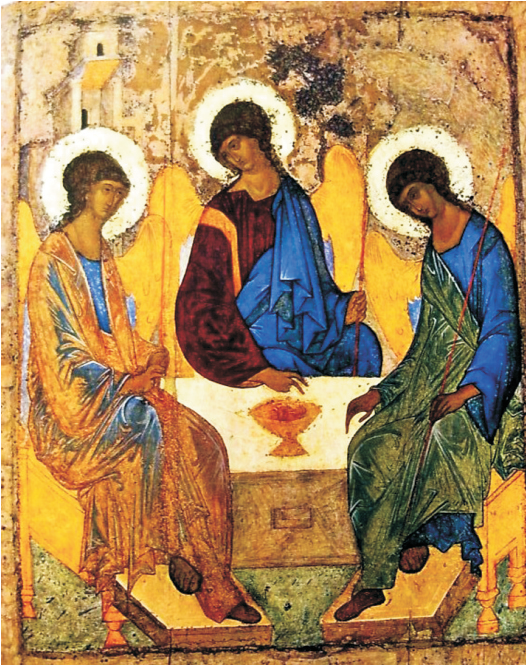
Sermon for Trinity Sunday
Service Bulletin:
There are several different kinds of knowledge.
First, there’s book smarts, like knowing that tomatoes are a fruit and not a vegetable.
Then there’s practical wisdom, like knowing that it’s not a good idea to put tomatoes in a fruit salad.
And then there’s philosophy, like wondering whether that means ketchup is technically a smoothie.
Today, we’re going to be talking about that third kind.
Today, we celebrate Trinity Sunday, conventionally known in the Episcopal Church as “associate rector appreciation Sunday” because this is the week that senior rector’s most often take as their vacation. They would much rather leave the explanation of complicated and abstract concepts to those younger clergy who have more up-to-date seminary training. Since we don’t have an associate rector in our parish, and I failed to accurately calculate the week of my vacation, this enviable task has now fallen to me.
So, instead of building up to a conclusion, I’m going to cut straight to the chase. Here’s the main thing I’m going to say about the mystery of the Trinity:
If you think you understand the mystery of the Trinity, you do not understand the mystery of the Trinity; if you do not understand the mystery of the Trinity, you understand the mystery of the Trinity.
Got it? Good. Amen. Let’s all get out of here before the Methodists get the good lunch tables at the diner.
Of course, the problem is that this little riddle leaves us right back where we started, so we end up going around and around until our heads fall off… and that’s the point of the whole thing.
The mystery of the Holy Trinity is the primary Christian concept of God. According to the historical documents of the Anglican theological tradition, “we worship one God in Trinity, and Trinity in Unity, neither confounding the Persons, nor diving the Substance” (The Creed of St. Athanasius, BCP 864). The three Persons of the Godhead are “of one substance, power, and eternity” (Articles of Religion, BCP 867). Don’t worry, I can hear all of you mentally checking out, as we speak.
This is why I started with my main statement: If you think you understand it, you don’t understand it; if you don’t understand it, you understand it. It’s like wondering whether ketchup is a smoothie. The question itself supposed to break your brain, not to break it down, but to break it open and leave you slack-jawed in awestruck wonder at the unknowable mystery of ultimate reality.
The doctrine of the Trinity is not explicitly outlined in the Bible. It gradually came together, over the course of several centuries, as the greatest minds of the early Church contemplated their experience of God. Beginning with the monotheism of the Jewish tradition, the earliest followers of Jesus realized that they were, in some way that they couldn’t understand, experiencing the very presence of the God of their ancestors through this individual human being. How was that even possible? They had no idea; they just experienced it to be true. And then, just as mysterious, they continued to experience this Jesus as a living presence in the midst of their community after his death. How was that even possible? They had no idea; they just experienced it to be true. Their knowing had neither the categorical certainty of book smarts nor the effectiveness of practical wisdom. Their knowing was a knowledge of the heart: more like falling in love than solving a math problem. As the philosopher Blaise Pascal famously said, “The heart has its reasons of which reason knows nothing.”
After almost three hundred years of contemplation, the bishops of the early Church finally settled on the mystery of the Trinity as their non-answer to a question that, by its very nature, can never be answered. Whenever some innovative theologian claimed to have solved the mystery, the bishops of the Church were quick to stand up and pronounce that answer as a heresy, not because they thought that they had a monopoly on the truth, but because they believed that the main thing is to keep the question open.
If you think you understand the Trinity, you do not understand the Trinity; if you do not understand the Trinity, you understand the Trinity.
I love this central commitment of our faith tradition. We don’t claim to have the answers to ultimate questions. We sit in awestruck wonder before the mystery of reality. This is why I like to say that I couldn’t be a Christian, if I wasn’t also an agnostic.
The ultimate unknowability of the mystery of God affords Christians a certain playfulness, when it comes to expressing that mystery in various ways. The language of our tradition tends to default to language that is very personal, very masculine, and very hierarchical. Most of our prayers use words like “Father” and “Lord” to describe the mystery of God, but the witness of our sacred Scriptures point to a wide array of metaphors for expressing our faith in God.
In addition to the exclusively masculine language of Father, the Bible also describes God as a “Mother” (Isaiah 66:3). In addition to the hierarchical language of Lord, the Bible also describes God as a “Servant” (Luke 22:27). In addition to the numerous personal metaphors for God, the Bible also describes God as a “Mighty Rock” (Psalm 62:7), “Living Water” (John 7:38), “Rushing Wind” (Acts 2:2), and “Consuming Fire” (Hebrews 12:29). As I mentioned in a previous sermon, Jesus even compares himself to a chicken in Matthew 23:37.
Therefore, kindred in Christ, since the Bible itself gives us such a wide array of metaphors for the Divine, and since the bishops of the early Church were so doggedly committed to keeping open the question of God’s unknowable nature, we too ought to remain open to exploring a wide variety of metaphors for God.
God is with us always and in all things. Therefore, let us also look for her, for him, for them, for it, always and in all things. How is God like a cloud or a tree? How is God like a chair or a bookshelf?
Jesus, in his parables, often pointed to agricultural metaphors that were common to the everyday experience of ordinary people, when describing the realm of the divine. For Jesus, the realm of the divine was like a woman baking bread (Matthew 13:33), like crops growing in a field (Mark 4:26-29), like a merchant trading in the marketplace (Matthew 13:45-46), like a small seed growing into a great tree (Matthew 13:31-32). This is not an exhaustive list, by any means.
I want to encourage you today to be playful in the many ways that you imagine God to be present in your life. The language we use about God matters, not because we have to be careful to get it right, but because we cannot get it wrong. Everything is potentially a symbol of God, yet nothing fully encapsulates the mystery. Whenever we try to put God in a box, whether that box is Pope-shaped, Bible-shaped, Church-shaped, man-shaped, or colored white, we commit the sin of idolatry and close ourselves off to the great mystery of the divine.
God is with us always, and in all things, therefore let us keep open the question of what God truly is. Let each of us remain humble in our own conceptions of God and tolerant of the expressions of others. As brothers, sisters, and siblings, let us stand side-by-side, following the example of the Bible and the early Church, and maintain a posture of awestruck wonder before the divine mystery that is beyond our understanding.




 Hopping Hadrian's Wall