
Author: J. Barrett Lee
Liturgical Animals (1)
Human beings are liturgical animals. I’ve often said the same.

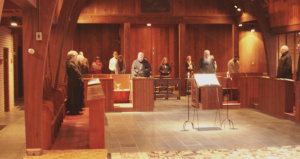 The reality of mimetic desire guarantees that we will engage in liturgical activity. What kind of liturgical activity and for what end leads to many possibilities. However, since we instinctively react to the desires and intentions of others, we also instinctively move and sing with each other and act together. Since we are mimetic animals, we are also liturgical animals. Much liturgy takes place in churches and temples but liturgy can be done anywhere at any time and it is indeed done all over the place.
René Girard’s theory of scapegoating violence places the origins of ritual and liturgy in the spontaneous mob violence against a victim that “solves” a massive social crisis. At first thought, one would think there is nothing liturgical about collective violence; it just happens. But actually collective violence is a very predictable phenomenon that consistently works in a certain way once it gets started. We…
View original post 583 more words
On Gathering with Those who Keep Oil in their Lamps
From Abbot Andrew of St. Gregory’s Abbey:
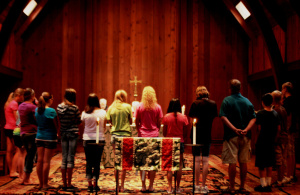 Like many parables, the Parable of the Wise and Foolish Maidens is obvious and yet puzzling in some respects. The notion of forfeiting eternal life for failing to be prepared at a certain level is oppressive, but we can lift this degree of oppression by noting that the Kingdom of God is something we are supposed to be living NOW, in this life. This is what we are to be prepared for. If we are prepared NOW for the kingdom, entering more deeply into the Kingdom when we die will take care of itself.
It is worth noting that just before this parable, Jesus has thrown out the parable of the household where the wicked servant beats his fellow servants and gets drunk with the drunkards. Here we have an image of the violence humanity commits and suffers for not being alert to God’s Kingdom. Ironically, the wicked servant thinks…
View original post 781 more words
The Long Journey Home
One of the highlights of my college experience was Spring Break 2002, when I got to spend 10 days in Romania on a student mission trip. While there, we led evangelistic services in churches and cultural halls, visited orphanages and psychiatric hospitals, played and prayed with the people who lived there, and handed out packages of gifts prepared by volunteers through an organization called Samaritan’s Purse.
The trip was sponsored by the church I attended at the time: a non-denominational charismatic church in western North Carolina. Our pastors told us they had seen some pretty amazing things happen on these trips in the past, especially as they were praying for sick people. The Bible calls them ‘signs and wonders’ while most modern people refer to them as ‘miracles’. They told us the kinds of stories we had only read about in the Bible: blind people suddenly being able to see for the first time, injured people throwing their crutches up into the air and then dancing home.
I thought to myself, “Hey, that’s something I want to see!” I wanted to have direct, personal experience with the kinds of phenomena I had only read about in the Bible. But then it didn’t happen. I watched, I waited, I prayed, but it still didn’t happen.
When I go back and read my personal journal from that week, I’m kind of embarrassed at how obsessed I was with the idea of witnessing a miracle. It’s pretty much all I wrote about, even though I was on the other side of the world, leaving my home country and seeing real poverty for the first time, hearing another language, meeting people whose lives were very different from my own. I got to drive around the back corners of post-Communist, Eastern Europe, far off the beaten-path carved out for tourists. I woke up to the sound of Orthodox monks chanting in a church across the lake from the hotel where we stayed in Bucharest. I got to spend St. Patrick’s Day in Vienna, visiting a Gothic cathedral and drinking really good, dark beer with a bunch of singing old men in a hole-in-the-wall pub that had first opened its doors in 1435… decades before Native Americans discovered Christopher Columbus lost at sea.
I met a Baptist family in the city of Galati, who had transformed their home into a refuge for young men who had been turned out of the orphanage on their 18th birthday with no educational or occupational prospects for the future. This family welcomed these guys into their home, helped them learn enough to get a job, and incorporated them into the life of their church. This same family welcomed us as well and put out a delicious spread of hors d’oeuvres for our group of loud, whiny, and tired American college students who had driven in from several hours away and hadn’t had much to eat that day. We sang Amazing Grace together around that table, in English and Romanian… I think that moment the closest to heaven I’ll ever get in this life.
I even flew over the Alps, for crying out loud, the ALPS: one of the most majestic mountain ranges in the world. If it was miracles that I wanted to see, I was surrounded by them; I just didn’t have the eyes to recognize it the time. I was too obsessed with a particular idea of a miracle as a supernatural event that violates the normal laws of physics or biology. What I think I was looking for during that week was some kind of absolute assurance for my faith. I wanted to know beyond a shadow of a doubt that God is real and God loves me.
I think a lot of people are looking for that kind of absolute assurance these days. I think it’s one of the main reasons why people get caught up in cults or other kinds of religious fundamentalism. There is so much to be uncertain about in this life; they just want something to hold onto, so they look for it in paranormal phenomena, mystical experiences, sacred texts like the Bible or the Qur’an, theological systems like Calvinism, religious institutions like the church, or authoritative leaders like the Pope or David Koresh.
Faith is hard. It’s a long journey home. Just like Moses and the Israelites leaving Egypt and traveling to the Promised Land through the barren wilderness, it’s a winding journey that takes a lifetime.
People naturally look for something to hold onto in that journey. We’re looking for something to help us keep going when the going gets tough, which is why we so often stumble into problems like cults, fanaticism, and fundamentalism. We’re looking for something concrete that we can put our faith in, some kind of absolute assurance that God is with us and will be faithful to love us all the way home.
That was the inner need that drove the Israelites in the book of Exodus to build a Golden Calf. They had already experienced God’s presence and power in their lives: God had already led them, by the hand of Moses, out of Egypt, across the Red Sea, and into the wilderness on their way to the Promised Land.
But now they were at a crossroads, camped out at the foot of Mount Sinai. Moses had disappeared over a month ago in a thunderstorm at the top of the mountain and, by Moses’ own orders, they weren’t even allowed to send a rescue mission to go look for them. After 40 days with no contact, they didn’t know if he was alive or dead.
So they said to Aaron, Moses’ brother, “Hey, we’ve been patient but enough is enough. We need to face the fact that Moses is probably never coming back. So, we want you to take command and the first thing we need you to do for us is give us some kind of absolute assurance, something we can believe in, something we can hold onto while we make this long, hard journey to the Promised Land.
So Aaron did what he could, given the circumstances. Someone in my profession might say that he was just trying to be a good pastor and meet his people’s spiritual needs. He took up an offering of gold, the very best they had to offer, and melted it down. Then he constructed the image of the Golden Calf from it and presented it to the people saying, “Here! This is your absolute assurance that we will make it to where we’re going… These are your gods, O Israel, who brought you up out of the land of Egypt.”
And the people were delighted. They were unified, inspired, and motivated. Even Moses, with all his signs and wonders, hadn’t been able to give them something so clear and concrete. This was a God they could understand; this was something they could look to in the hard times, not some mysterious presence that could never be seen or touched. This was their “blessed assurance.”
The problem is that it was all a lie. In the eyes of God, their assurance, their absolute certainty, was nothing more than an idol: a graven image, made by human hands, to which they were bowing down in place of God.
God gives us many things, but certainty isn’t one of them. Absolute certainty, especially when it comes to the divine mystery, is idolatry. As it says in the Ten Commandments:
You shall not make for yourself an idol, whether in the form of anything that is in heaven above, or that is on the earth beneath, or that is in the water under the earth. You shall not bow down to them or worship them; for I the Lord your God am a jealous God.
God had no desire to fit inside any box that can be made by human hands, be it a literal box, a statue, a building, an institution, a book, a theological system, or any other Golden Calf we can imagine with our minds and construct with our hands. The basic motivation behind religious fundamentalism, whether it leads people to fly airplanes into buildings or picket funerals with offensive signs, is idolatry. These people, who often have the loudest voices calling others back to “worship the one, true God,” are the very same people who have bowed their knee to a graven image: a god who fits inside of a box, a god we can wrap our heads around, a god we can see and touch, and ultimately a false god who is not worthy of our worship.
Whether the format is Pagan, Muslim, or even Christian, any God we can fully understand is unworthy of our worship.
But this divine mystery doesn’t leave us much to hold onto. Once again, we find ourselves with the Israelites: camped out at the foot of Mount Sinai, facing a long and difficult journey that we don’t expect to complete in this lifetime. We need something to hold onto. We need some kind of assurance, even if it isn’t absolute assurance. And Moses (who is not dead) knows this about us. And so he pleads with God on our behalf.
In today’s reading, God gives Moses two things: a mission and a promise. The mission is simple: “Bring up this people.” God wants Moses to guide his people home, to the Promised Land (which is always referred to as ‘up’ in Israelite geography). And God’s promise to Moses is this: “I know you by name, and you have found favor in my sight.”
These are good words, powerful words, and they reflect the truth of God’s reality and God’s disposition toward Moses and the people. But Moses follows with a very reasonable concern: what might be an appropriate alternative to the Golden Calf? What kind of assurance can we, as God’s people, hold onto in this journey? Moses says, “Now if I have found favor in your sight, show me your ways, so that I may know you and find favor in your sight.”
He’s saying, in essence, “God, I believe that what you’re telling me is true, but how will I know?”
God replies, “My presence will go with you, and I will give you rest.”
And again Moses puts the question to God, “But how will I know?” He says, “For how shall it be known that I have found favor in your sight, I and your people, unless you go with us?”
And God repeats again the very first thing he said to Moses, “You have found favor in my sight, and I know you by name.”
And Moses says, “Okay, God. Show me… Show me your glory, I pray.”
And God says, “I will do the very thing that you have asked… I will make all my goodness pass before you.”
“But,” God says, “you cannot see my face; for no one shall see me and live.” God gives Moses what he asks for, but also doesn’t give it. God’s face, the fullness of divine mystery, is too big for anyone to handle. We can’t wrap our minds around it… our heads would explode. Moses has asked the impossible: he simply can’t see God’s face. But that doesn’t mean he gets nothing.
Moses has a direct experience of God, just not the one he asked for. God says, “I will make all my goodness pass before you… See, there is a place by me where you shall stand on the rock; and while my glory passes by I will put you in a cleft of the rock, and I will cover you with my hand until I have passed by; then I will take away my hand, and you shall see my back; but my face shall not be seen.”
Moses doesn’t get to see God’s face, but he does get to see God’s back. He has an experience, just not the one he asked for. It’s something less than the full experience of divine glory (which he couldn’t handle anyway).
Moses seeing God’s back reminds me of a parable that originated somewhere on the Indian subcontinent and is told and retold in many different religious traditions:
Six blind men decide to find out what an ‘elephant’ is, so they set out to examine one by feel. One touches the trunk and says, “An elephant is like a great snake.” Another touches an ear and says, “An elephant is like a great flap of leather.” Another touches the side and says, “An elephant is like a great wall.” Another touches a leg and says, “An elephant is like a great pillar.” Another touches the skull and says, “An elephant is like a great boulder.” And the last one grabs the tail and says, “An elephant is like a great rope.”
Now, which one has it right? All of them. And which one has it wrong? All of them. Each blind man is having some kind of true experience of an elephant, but none of them is experiencing the full reality of ‘elephant-ness’.
Just as it was for these six blind men and the elephant, and as it was for Moses seeing God’s back and not God’s face, so it is with us and our experience with God.
Just like Moses on the mountain, God’s back is all we get to see in this life. The only thing that spiritual experiences, the Sacraments, the Bible, theology, and church can do is, when they are at their best, express God’s reflected glory in an indirect and incomplete way. These things are all good as means to an end, but they are not ends in themselves. They point us to God, but they cannot replace God.
There is no such thing as absolute assurance or certainty in this life. We cannot see the face of God, but only the back. Faith does not come with a money-back guarantee, there is always a risk. We will always have to take that ‘leap of faith’ in order to believe.
When we do (take that leap), it changes the way we see the world. The brilliant physicist Albert Einstein once said, “There are only two ways to live your life. One is as though nothing is a miracle. The other is as though everything is a miracle.”
Through the eyes of a faith that dares to risk believing, everything becomes a miracle. The whole universe is able to reflect the glory of God’s back. Everything can be a metaphor for God.
In church, we tend to use the most well-known biblical image for God, “Our Father,” but did you know that the Bible also refers to God as a Mother? Also in the Bible:
- God is honored as a king, yet humble as a shepherd;
- God is powerful as a warrior and weak as a baby;
- God is bright as light, yet ‘cloaked in darkness’;
- God is one and God is three;
- God is a rock, God is the wind, God is a river, God is a fire, and God is a star.
All of these are valid, biblical images for God, but none of them captures the fullness of the divine mystery. To paraphrase Rev. Forrest Church, “God is present in each of these things, but is also greater than all of these things.”
Anything and everything communicates something of God to us. Not the fullness, but a part; not the face, but the back.
Can we see it? Do we choose to see it with the eyes of faith?
If we let them, all things can point us back to God, their Source. In order to see it, we must trust (have faith) in the promise, God’s word to Moses: “I know you by name, and you have found favor in my sight.” In other words, “I’m here, I’m with you, and I love you.”
This is all the assurance we have in this life. Indeed, it’s all we need for the long journey home.
In Defense of Pronouns
A couple of years ago, I wrote a blog post on my ideas about church growth and pastoral leadership:
A Growing Church is a Dying Church
As it turns out, this post said what many others were thinking. I watched as it made its way around the theological corners of the blogosphere, sparking an enthusiastic “Amen!” from many of my colleagues in ministry. The response, however, has not been entirely positive. A small minority of commentators have branded me as a ‘Leftist’ whose heretical views are responsible for the decline of mainline Protestant churches.
Why have I been so labeled?
- Have I blasphemed against the doctrines of the Trinity, the Incarnation, or the Atonement? No.
- Have I called for Christians to stop praying, throw out the Bible, or cease & desist from celebrating the Sacraments? No.
- Have I discouraged churches from engaging in mission, serving their communities, or speaking publicly about their faith? No.
I have done none of these things. To the contrary, my call in the article is for more prayer and Bible study, more frequent celebrations of the Eucharist, and more community outreach, all of which are activities that even the most theologically conservative Christians could get behind with their whole hearts.
The issue that has repeatedly stoked the fires of anger in some of my readers is my use of a single, three-lettered pronoun: She. The hypothetical pastor in my article is a woman.
It was a relatively minor editorial decision that I made on the fly. When I wrote the article, I didn’t set out to make any kind of deliberate statement about feminism or gender equality through my use of pronouns. Honestly, I didn’t give it much thought because it didn’t seem like a big deal to me at the time.
I serve in the Presbyterian Church (U.S.A.), where we have ordained women to the ministry of Word and Sacrament for over half a century. In every single congregation I have served, women have not only been my colleagues, but also my predecessors at the table and in the pulpit. My wife was ordained several years before I was and it was through her, in part, that I began to discern my own call to pastoral ministry.
I have been shocked that this minor detail seems to have drawn out the sexist attitudes that still poison our church life and do violence to the gospel itself, no less than the arbitrary distinctions between Jews and Gentiles that St. Paul sought to overcome in his time.
It seems ridiculous to me that this particular article could have sparked such a hateful reaction.
Even though the article itself only advocates for things that could be affirmed by all Christians, detractors point to my use of feminine pronouns as evidence for a liberal conspiracy to undermine, subvert, and destroy the church from within.
Gender equality had nothing to do with the main thrust of my article, but it has emerged as an important issue in the way that the article has been received by its critics. To me, their unexpected vitriol highlights two important realities:
- That our sisters in ordained ministry are being compelled to carry the cross of mainline decline.
- That some versions of the conservative vision for ‘renewal’ in the church have little to do with fidelity to the gospel and much to do with returning to a nostalgic ideal of a specifically American way of life, dominated by straight, white men.
In the time since the article’s initial publication, I have received numerous requests for it to be reprinted in church bulletins and newsletters. Some churches have asked whether they could change the pronouns from feminine to masculine. I have refused to authorize any such changes.
I think it’s important to keep the feminine pronouns as they are. So long as it is up to me, I would rather there not be a second version of this article in circulation that could be used to remove the scandal for sexist ears.
I Thank God for Pastors (reblog)
Another winner from Ministry Matters.
Also a winner from Brian McLaren, whose work never fails to impress.
Check it out:
I Thank God for Pastors
I was a pastor for over twenty years, and nothing I have ever done before or since has been more difficult.
Opening to God
What are you so afraid of?
This is a question we could ask of our entire culture and everyone in it. People would answer in all kinds of ways: Pain, insecurity, running out of money, etc.
In fact, I’ve noticed that people are usually more than ready to list each of the ten thousand problems that are currently plaguing their life to one degree or another. They recite this litany of sorrows, thinking that if they could only think of ten thousand solutions to go with each one of these ten thousand problems, they would finally be happy. However, I have yet to see anyone come up with such a list and happiness seems to be as elusive as ever in this world.
There was a 20th century philosopher and theologian named Paul Tillich who explored this subject in a very famous book called The Courage to Be. He pointed out that our fears related to each of those ten thousand problems were really just echoes of one deeper, larger problem, which he called anxiety.
According to Tillich, our overall state of anxiety is not related to any of the particular crises that may or may not be taking place in our life right now, but rather to our awareness that it is possible for us to not exist. Each of us is generally aware that there was a time in history when we did not exist, therefore it is entirely possible that there may come another time in the future when we will return to that state of non-existence. The same thing is true of every other person and object in the universe, up to and including the stars and the universe itself. None of these things is essential or necessary. Each of them can either exist or not exist. The philosophical term for this state of affairs is contingency. You, me, and everyone we know are all contingent (as opposed to necessary) beings. If we ceased to exist, the universe could simply keep going without us.
This fact scares us like nothing else. Paul Tillich says that each of our smaller fears is really just a reflection of this deep, inner awareness. If this is the way things are, we think, then what’s the point of it all? Is life just empty and meaningless? This is our human anxiety, which we then project into each of our little fears and problems, thinking that we might be able to cure our overall anxiety if only we can find the solution to our next problem.
This futile problem-solving strategy becomes the source of much of our conflict in the world. In an attempt to look tough and strong in the face of adversity, we hide our anxiety and cover over our fears with the more socially acceptable shroud of anger and outrage. Think of the President of the United States on September 11:
He would have been ridiculed if he had gone on TV and simply said what each of us was feeling that day: “I’m so scared; I don’t know why this happened; this is so horrible; I don’t know what to do!” Anger is more socially acceptable than fear (because it gives the illusion of strength), so the response instead was, “We will not be deterred; we will find these people; we will bomb them; we will kill them.” And his approval ratings shot through the roof.
Anger is more socially acceptable than fear, but it has a cost: the breakdown of social relations. When everyone is covering for their fears with anger, they turn on each other. They fight with one another. Just turn on Fox News or MS-NBC and you can see it happening right there.
If you ever want to know what a person is really afraid of, just pay close attention to what makes them angry. Rage is a cover for fear, which is itself only a projection of our deep, existential anxiety over the fact that it is possible for us to not exist.
St. Paul noticed this tendency in people and he wrote about it in his letter to the Christians at Philippi, which we read from this morning. There was just such a conflict going on in that church, where two people were projecting their anxiety into anger.
Paul names two women, Euodia and Syntyche, who were fighting with each other. The text of Paul’s letter doesn’t tell us exactly what they were fighting about, but as we’ve already seen, that doesn’t really matter so much. The fact is that they were fighting.
And Paul, genius that he was, draws the line of connection between anger and anxiety when, after urging these two Christians to stop fighting and get along, he moves almost immediately to say, “Do not worry about anything.” For Paul, anger and anxiety are two very closely related concepts.
When our relationships break down into endless conflict, what we’re really dealing with is a breakdown in our faith, which is when fear starts to take over. People start acting like wounded animals who have been backed into a corner, which is when they attack.
Paul’s proposed solution, which strikes at the heart of this problem, is prayer. He advises the Philippians, “Do not worry about anything, but in everything by prayer and supplication with thanksgiving let your requests be made known to God.”
Prayer is a very misunderstood practice in the modern world. I would even go so far as to say that it is equally misunderstood by religious people and secular people alike. Secular folks tend to disparage it as pointless superstition. “Prayer doesn’t work,” they say, “You might as well be casting magic spells. What we need is measurable, concrete solutions!” And religious folks, like us, tend to get all defensive and come back with, “It does too work!” And we get all these inspirational stories about the miraculous power of prayer that are supposed to “put those atheists in their place.”
But here’s the thing: I think both of those responses ultimately miss the point of what prayer is all about. Prayer is not about getting results. The efficacy of prayer does not depend on us getting or not getting what we pray for. Prayer changes us. Prayer changes our relationship to reality.
My favorite one-sentence definition of prayer comes from our denomination’s constitution, the Presbyterian Book of Order. The Book of Order defines prayer as “the conscious opening of the self to God” (W-5.4001). I love that definition. It reminds me of the line from the hymn: “Joyful, joyful, we adore thee, God of glory, Lord of love; hearts unfold like flowers before thee, opening to the sun above.”
Prayer is the process of reframing our life, with all its joys and concerns, within the larger context of God.
This kind of prayer, which I believe Paul is talking about, is more than just the occasional outcry in a moment of crisis (i.e. “Oh God, please help me!”). I believe Paul is talking about prayer as a regular discipline and a daily, repetitive practice that works its way into our worldview. Paul says to the Philippians, “Rejoice in the Lord always; again I will say, Rejoice.”
For Paul, it begins and ends with rejoicing. When? “Always” and “Again.”
The contemporary spiritual writer Fr. Richard Rohr says it this way: “Prayer is not one of the ten thousand things in our life; it the lens through which we see those ten thousand things.”
Prayer is not about getting results, as we modern people understand it. However, prayer does produce an effect. What is it, according to Paul?
“Do not worry about anything, but in everything by prayer and supplication with thanksgiving let your requests be made known to God. And the peace of God, which surpasses all understanding, will guard your hearts and your minds in Christ Jesus.”
The effect of a regular, disciplined prayer life is peace:
Peace in the internal, psychological sense that “guards our hearts and minds.” It allows us to face our ten thousand little problems without that overall, crushing anxiety because we know in our heart of hearts that our life, our existence, rests not upon ourselves, but on that which is infinitely greater than us. Prayer reminds us that we are indeed “leaning on the everlasting arms” and shows to us that “place of quiet rest, near to the heart of God.”
Prayer also produces peace in the external, social sense. In this same passage, Paul says to the Philippians: “Let your gentleness be known to everyone.”
That word “gentleness” in Greek is Epieikesis, which literally means “seeking what is equitable by setting aside the demands of justice.” A better translation might be “forbearance”. It means rising above our “tit for tat” scorecards with each other and living from the place of grace that extends to our neighbors the free mercy that God has already bestowed upon us.
This commitment to peace, which grows out of a regular and disciplined practice of prayer, is what has the power to break the endless cycles of anger and violence. We no longer have to attack each other like cornered, wounded animals. Instead, we now have the power to become veterinarians for our neighbors’ inner beasts. We can say to them (even if their animal nature cannot understand us), “It’s okay, I’m here to help.” A regular, disciplined prayer life gives us the spiritual strength to do this well.
The monks and nuns of the Benedictine tradition have lived this truth better than anyone. Their first call is to a life of prayer. As a fringe benefit, they also happened to save civilization in western Europe for almost a thousand years during the so-called “dark ages”.
In a time of bubonic plague and civil unrest, it was the monasteries that became known as places of safety where hospitality, education, healthcare, art, and culture could be preserved. They were (and are) of great service to their communities, but “Job #1” for them was always prayer.
I wonder what effect it might have on our communities today if we Christians were to commit ourselves to the same kind of regular, disciplined prayer?
Pastor’s office hours: Time to cut back? (reblog)
Thank you all once again for reading, reflecting, and commenting. I’m surprised and honored that an article I wrote for this blog over two years ago is receiving renewed attention. I’m glad to be on the journey with all of you.
In the same vein as A Growing Church is a Dying Church, I’d like to share this article by Joseph Yoo on Ministry Matters. It’s yet another useful tool for pastors and churches as we try our best to follow Jesus:
Pastor’s office hours: Time to cut back?
In a recent sermon, Pastor Andy Stanley stated that every church has a gravitational pull to be a church that serves only its members — a pull to be a church for just insiders. That’s because 100 percent of the complaints, suggestions, critiques, and comments come from people who are already there — already attending the church. The leadership team feels pressure to bend towards a lot of those complaints and suggestions and in turn they become more inwardly focused than outwardly focused. So the church becomes more and more friendly to the “insiders” because we put a lot of effort into meeting the needs of the “insiders.” It’s easy to ignore the “outsiders” — those we’re trying to reach — because they have no voice within the walls of the church. And they have no voice, no suggestions, and no complaints because they aren’t present.
Critical Mass
Hoc est corpus meum.
Et cum spirit tuo.
Critical Mass.
Missa cum populo.
The work of the people
in thrift store vestments,
home-made stoles,
Du Maurier incense.
Kneeling in the cloister
behind the record shop;
Approaching the altar
to receive:
Would you like fries with that?
Crack at coffee hour,
neither more nor less addictive.
Orthodox idolatry,
sacred profanity.
I heard your confession
when it was you
who should have forgiven me.
 Hopping Hadrian's Wall