Jul 16 – “The Righteous Gentiles”

The Rev. Ken Howard's avatarA Great Cloud of Witnesses

Illumination - The Righteous Gentiles

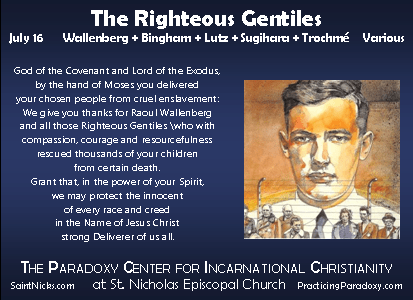
“The Righteous Gentiles
Raoul Wallenberg, 1947 | Hiram Bingham IV, 1988 | Karl Lutz, 1975
Chiune Sugihara, 1986 | André Trocmé, 1971 | Magda Trocmé, 1996
16 July

click here for books on the Righteous Gentiles


From the Satucket Lectionary

Although the phrase “Righteous Gentiles” has become a general term for any non-Jew who risked their life to save Jews during the Holocaust, it here appears to apply specifically to: Raoul Wallenberg [d. 1947, Swedish]; Hiram Bingham IV [d. 1988, American]; Karl Lutz [d. 1975, Swiss]; Chiume Sujihara [d. 1986, Japanese]; André Trocmé [d. 1971, French]; and Magda Trocmé [d. 1996, Italy].

Raoul Wallenberg passport photoRaoul Wallenberg (August 4, 1912 – July 17, 1947?) was a Swedish humanitarian who worked in Budapest, Hungary, during World War II to rescue Jews from the Holocaust. Between July and December 1944, he issued protective passports and housed Jews, saving tens of…

View original post 1,263 more words

St. Benedict’s Day

Saint_Benedict's_Abbey_

Today is the feast day of my newest friend in the Cloud of Witnesses: St. Benedict of Nursia. I was deeply privileged last spring to spend a week at St. Gregory’s Abbey, a Benedictine monastery in Three Rivers, Michigan. While I was there, I came to realize that many of the elements, people, and practices that have shaped my spiritual journey thus far are not random bits that I’ve thrown together, but are all, in fact, Benedictine in origin. I am thinking specifically of the Divine Office, Lectio Divina, and Centering Prayer. I also discovered that one of my heroes in the faith, Dorothy Day of the Catholic Worker movement, was a Benedictine Oblate. It seems that St. Benedict has been stalking me for quite some time. I must say that it feels good to finally be caught. Below I have re-blogged an article that is a reflection on the personality of St. Benedict, written by Abbot Andrew Marr of St. Gregory’s Abbey.

andrewmarrosb's avatarImaginary Visions of True Peace

BenedictChurchStatue1In his Dialogues, Pope Gregory I said that Benedict could not “otherwise teach than he himself lived.” Taking Gregory at his word, I will celebrate our holy father Benedict by drawing out of the Rule what we can glean about the kind of man he was.

The way Benedict carefully outlined the way the Divine Office should be done, listing what psalms should be done when, shows an ordered man who appreciated discipline and having everything and everyone in place. We see the same care in the way Benedict outlined the daily schedule for a balanced life. However, Benedict showed flexibility when he said that one can rearrange the office psalms if that should be deemed expedient. Although he wanted his monastics to be on time for the office, he cut some slack by allowing them to come before the Venite (Psalm 95) is recited, for which reason it…

View original post 585 more words

The Deeper Yes

I find it to be a matter of common sense that you and I live in a fragmented world. We’re divided and scattered. Relationships are broken: between nations and neighbors, between races and religions, between partners and parties. Why, we’re even fragmented within ourselves: doing what we don’t want to do and unable to do what we most deeply want to do, as we heard St. Paul say in this morning’s reading from his letter to the Romans. We’re fragmented. Things are complicated. We don’t quite know what to make of it. We’re lost and we need to find our way again. We need to get our bearings, so to speak. We need context: we need to understand where it is that we are, how we got here, and how we can get to where we ought to be as individuals, as families, as communities, and as nations. This is the state of our generation on planet earth: fragmented, lost, Paul calls us “wretched.”

Into this maelstrom, enter Jesus. To quote Paul once again: “Who will rescue me from this body of death? Thanks be to God through Jesus Christ our Lord!” And Jesus shows up in our gospel reading this morning with his usual wit and insight that cuts to the core of who we are and lays our souls bare for the healing. Here, Christ the great physician (Doctor Jesus) is practicing a kind of spiritual surgery in order to get inside us and expose what we are so that we might become what we ought to be.

And his surgeon’s tools, the scalpel and forceps he uses to simultaneously wound and heal his patients, are twofold: Questions and Stories. Anytime Jesus asks a question or says “Let me tell you a story…” smart people will head for the hills because they know it isn’t going to be pretty. And in today’s passage, Jesus does both. He asks his listeners, “To what will I compare this generation?”

He’s making a comparison: using the rhetorical art of analogy to provide insight and context. He’s showing us how to recognize the patterns of thought and behavior that we have become so unconsciously accustomed to by force of repetition and reinforcement by societal values.
And here is his comparison: “It is like children sitting in the marketplaces and calling to one another”.

Children sitting in the marketplaces. Can you imagine anything more out of place? What if the New York Stock Exchange on Wall Street had an annual “Bring your kids to work Day”? What would it be like to have kids playing games and chasing each other around the trading floor? What would it be like to have a bunch of whiny babies throwing temper tantrums on the floor of the U.S. House of Representatives? It would be chaotic and disruptive. They would constantly be under foot. Nothing could get done.

“Children sitting in the marketplaces and calling to one another”. According to Jesus, that’s the fragmented state we’re in as individuals and as a society. We’re tripping over ourselves, getting in our own way, and disrupting the divine plan with all sorts of mindless chaos and petty selfishness.

Jesus said that we’re “calling out to one another.” What is it that we’re calling out? “We played the flute for you, and you did not dance”.
That’s an interesting one to me, especially in this consumerist, hedonistic, entertainment-addicted society. The world is always “playing the flute for us” in one way or another, isn’t it? We are bombarded with advertisements from the moment we get up in the morning to the moment we close our eyes at night. Every single product and service promises a long and happy life, but none can actually deliver on that guarantee. Sensationalist media headlines are specifically designed to get our attention and provoke a reaction from us. They force our emotions out of us by making each new experience faster, funnier, sexier, scarier, or more intense than the last one. They keep us on the hook. The world plays the flute and we are expected to dance like puppets.

What else are we, as a society of “children in the marketplace” calling out to each other? “We wailed, and you did not mourn.”

This one is the mirror image of the last disruptive cry. Once again, the world is trying to provoke a reaction from us, trying to throw us off of our spiritual center of gravity. But this time, they’re using pain instead of pleasure, the stick instead of the carrot. If you follow current events (from either the right or the left), you’re probably familiar with this “wailing” tactic: there’s no such thing as a small problem in Washington. When is the last time you can remember either Republicans or Democrats sitting down together around a piece of proposed legislation and saying, “I guess we have a few minor disagreements about this bill” or “I’m sure we can figure out some kind of compromise”? Does that ever happen? No. Every little problem is an apocalyptic crises. Every opponent is a demon and every ally is an angel. It’s all just another form of sensationalism and manipulation.

When the world isn’t playing the flute for us, it’s wailing at us. It wants to provoke a reaction in us so that we’ll keep on playing these little games and sending our money to the big shots on Wall Street, or in Washington, or in Hollywood. Their game is simple: if we play, they win.
So, what’s the solution? Don’t play. That’s what Jesus said. He said: “John came neither eating nor drinking”.
Here Jesus is speaking, of course, of his cousin, St. John the Baptist. John was a prophet: the greatest of prophet who ever lived, according to Jesus. John was kind of like a monk: he lived a very simple, ascetic life in the desert and people would come to be baptized and listen to him teach.

The thing about John the Baptist is that he didn’t play the world’s game. He said “No” to the flutes and “No” to the wailing. He didn’t participate. He boycotted. He was a resistor. He was a fiery preacher who wasn’t afraid to call a spade a spade. He criticized the religious establishment and he called out political leaders.

And what did the dominant powers-that-be do to him? They demonized him. They arrested him. In the end, they killed him.

His experience reminds me of the Civil Rights movement: people marching in the streets, speaking truth to power, boycotting the bus system, sitting in at lunch counters. They said “No” to racism, segregation, and inequality. Like John, many were arrested and some were killed. They too were demonized with the worst possible insult one could think of in the 50s and 60s: “Communist.”

If St. John the Baptist had lived during the 1960s, they would have called him a Communist too. John said “No” to the world’s childish games and they said, “He has a demon.”

Saying “No” is an important step in the prophetic ministry. We have to do it if we ever hope to regain our moral and spiritual footing in this life. We have to say “No” to what the world is offering in order to say a deeper “Yes” to what God is offering us instead. And what is that deep “Yes” that we are called to say with our whole hearts?

Jesus shows us: “The Son of Man came eating and drinking”. Notice the dichotomy with John’s ministry: “John came neither eating nor drinking” (he said “No”) but “The Son of Man (Jesus’ favorite name for himself, it really just means “human being”) came eating and drinking” (Jesus is saying “Yes”).

Jesus, if you remember, got his start by working with John in his ministry. John baptized Jesus and Jesus’ message, in the early days of his ministry, is almost indistinguishable from John’s: Both of them baptized people and told them to “repent and believe the good news, for the kingdom of heaven is at hand.”

But then a shift began to happen after John was arrested and killed. Jesus branched out on his own and took the movement in a new direction. As John himself said, “He (Jesus) must increase and I must decrease.”

Rather than disengaging from society and staying out in the desert, Jesus ventured back into the city streets. He got involved in people’s lives, loving without judgment. He scandalized the dominant powers of this world in a different way: by practicing such open acceptance, he defied their nicely defined ideological categories and the boxes into which they so conveniently put people and God.

As a result, they reduced him to the lowest common denominator and called him “a glutton and a drunkard, a friend of tax collectors and sinners.” Ironically, they couldn’t be more right. The reality of God’s love in Christ was far deeper and broader than they could imagine. Jesus envisioned a community where all people would be welcome at heaven’s table, not just those who passed theological or ethical muster. This was more than the powers of this world could handle. They just couldn’t imagine sharing heaven with such pathetic riff-raff.

During this time, the disciple’s eyes were gradually opened to the truth that this Son of Man is also the Son of God. The Church, after reflecting on this reality for centuries, came to affirm that Christ is both “fully human” and “fully divine”. The theological term for this is Incarnation – the belief that God has taken on flesh, that through Christ, God is present with us in the very stuff of this universe. Therefore, the stuff of this universe is sacred. Christ is the Alpha and Omega, the beginning and the end, the Source from which all things come and the Destiny toward which all things are going.

In Christ, the universe itself finds healing and wholeness. Our broken world is fragmented no more. We are free to eat and drink once again, having overcome the clatter of this world’s childish wailing and flute-playing. We are now able to approach life with new eyes, the eyes of faith, strengthened by Christ’s Word and Sacraments, which point us back to the deeper truth of hidden wholeness beneath the fragmented surface of the world. All things come from Christ and return to Christ by way of Christ.

With that knowledge, we are able to put our worried minds at ease and our weary souls at rest, as Jesus himself said, “Come to me, all you that are weary and are carrying heavy burdens, and I will give you rest. Take my yoke upon you, and learn from me; for I am gentle and humble in heart, and you will find rest for your souls. For my yoke is easy, and my burden is light.”

Trust that Triumphs Over Wrong

Our Community Garden

Yesterday (July 2) was the feast of Social Gospellers Walter Rauschenbusch, Washington Gladden, and Jacob Riis in the Episcopal Church’s most recent calendar of saints (Holy Women, Holy Men).

Gladden and Rauschenbusch were both pastors. The former supported labor rights and opposed racial segregation. The latter served a small Baptist congregation in the aptly named “Hell’s Kitchen” area of New York and was inspired to activism after officiating for so many funerals for babies. His care for these suffering families led him to ask why the infant mortality rate was so high to begin with.

According to Rauschenbusch, the goal of Christianity was to “substitute love for selfishness as the basis of human society”.

I had these words ringing in my ear yesterday as I attended a meeting at the Vine Neighborhood Association, where a group of us residents have been making dramatic improvements to our streets. A crack house down the block from me was finally torn down earlier this year. In its place, we have erected a community garden on the empty lot.

From crack house to community garden… sounds like the reign of heaven to me.

But now a local developer has hopped on board to buy the lot from the city and turn our garden into a parking lot.

From community garden to parking lot… sounds like a step in the opposite direction.

Having met with the neighborhood association and the city land bank, it seems that our options are limited and chances are slim that they will succeed. It is too late for the property to be taken off the auction block for communal use (something the land bank is loathe to do, because the land then produces no tax revenue). This developer is reportedly well-resourced, knows how to work the system, and has a reputation for being difficult to work with.

It appears that selfishness may reign over love, when it comes to salvaging this particular project.

Selfishness is what this is. Legal perhaps, but not morally right. The garden lot does not belong to this developer (yet). We the people of the Vine neighborhood have given our time and energy to each other and to this land for months, even before the abandoned crack house was taken down. Selfishness is blinding the developer to the truth that transcends legality and profiteering.

After I left that discouraging neighborhood meeting, I went to the midweek Eucharist at St. Luke’s Episcopal. There I was fed by the Bread of Heaven and the Cup of Salvation. I drew strength from the Source of Life that connects me:

  • to the ground of my being,
  • to everyone else in the room,
  • to all saints of future, present, and past,
  • to bakers of bread and makers of wine,
  • to wheat and grape that grow from the earth.

I am connected. I am part of the whole. And once again, Christ substitutes love for selfishness in me.

After Communion, the congregation sang this hymn by Washington Gladden, one of the Social Gospel saints we remembered yesterday:

Teach me thy patience; still with thee,
in closer, dearer company
in work that keeps faith sweet and strong,
in trust that triumphs over wrong,

in hope that sends a shining ray
far down the future’s broadening way,
in peace that only thou canst give,
with thee, O Master, let me live.

No matter what happens next, may we not lose hope in the vision. May we keep faith with God and one another, even if friendships, rather than tomatoes, are the most lasting fruit this garden produces.

Church, Interrupted

https://i0.wp.com/upload.wikimedia.org/wikipedia/commons/f/f7/Rembrandt_Abraham_en_Isaac%2C_1634.jpg

When you come to church, what kinds of things do you expect to do?

Sing hymns? Say prayers? Read from the Bible? Hear a sermon? Receive Communion?

In our denomination’s Book of Order (part of the Constitution of the Presbyterian Church), we have a list of ‘the Elements of Worship’ and they are:

  • Prayer,
  • the reading and proclaiming of Scripture,
  • Baptism,
  • the Lord’s Supper,
  • Self-offering, and
  • Relating to each other and the world.

All of these things are pretty normal things to have happen during church services. We’ve come to expect them. If there was a church somewhere that said, “We’re not going to pray or read the Bible anymore during our services,” we would wonder about that church (*Side Note: I’m particularly delighted to see that more and more Protestants are including the Eucharist in their list of things that are central to Christian worship).

If there was a church somewhere that didn’t do any of the above things, most of us would probably want to ask, “What then, makes this gathering a Christian church?”

It might be a perfectly good social group, activist organization, or educational institution, but most of us would have a hard time seeing it as a church (as people typically understand the term) unless there was some part of its communal life that was specifically devoted to worship.

It was that way in the ancient world too. People in that culture expected certain elements to be part of their worship experience. One of those elements was sacrifice.

It was widely believed in the ancient world that deities fed off of the sacrifices offered by the people. These sacrifices could be things like bread, wine, animals, or even people. The general idea was: the more precious the thing sacrificed, the more pleased the deity would be. If you really wanted to get on a particular deity’s good side, you sacrificed something really valuable to you. In return, that deity would then grant you favors related to his or her sphere of influence (e.g. fertility, harvest, war, etc.).

To the ancient mind, that’s just how religion worked. They could no more imagine worship without sacrifice than we could imagine a church service without hymns.

Human sacrifice, in particular, was just one of those accepted elements of worship. It sounds horrifying to our 21st century ears, but the idea that God would ask someone to sacrifice their firstborn child was not all that unusual for people in Abraham’s culture. That’s why we don’t hear Abraham raising a fuss when God asks him to sacrifice his son Isaac in this morning’s reading from the book of Genesis. Asking for the life of his firstborn would have sounded like a perfectly normal request for God to make.

Yet, this is a very shocking passage, to ancient ears as well as our own. The shock, for Abraham and the early Jews, was not that God would ask Abraham to sacrifice Isaac, but that God would stop the sacrifice from happening at the last second.

“Wait a minute,” they would have said, “do you mean to tell me that God didn’t want Abraham to sacrifice Isaac in the end? Do you mean to tell me that God actually interrupted the sacrifice and asked for a ram instead? What kind of God would do such a thing?!

It would have been amazing and unheard of for them. It would have upset all their conventional religious ideas in favor of something new that had never been seen before. People in that culture might have even had a hard time imagining how such a religion would work; for them, it would be like church without hymns, or prayers, or the Bible, or Communion: it just wouldn’t feel like church.

Abraham stood at the forefront of a revolution: a radical shift in his culture’s understanding of God. His God would no longer demand human blood in exchange for favors. Only animals would be sacrificed from that point on. This move was a step in a particular direction.

Later on, the early Christians would do away with the practice of animal sacrifice as well, proclaiming that the death of Jesus had put an end to the need for sacrifice altogether. That was a step.

In the sixteenth century, our Protestant ancestors, Martin Luther and John Calvin (among others), started another revolution when they proclaimed that membership in the Church of Christ depended on one’s personal faith, rather than loyalty to the Pope. As we already know, this idea blew people’s minds and shattered their cultural expectations of what church was all about. That was another step.

All of this leads me to wonder: What is our revolution? In what ways is God calling us to be radicals? How will history look back at us and say, “Wow, those really stood at the forefront of a new understanding of God/church/religion”?

Let me be clear that I really do believe they will. I really do think that we live at one of those turning points in history: one of those moments that influences the shape of things to come for centuries. Just like the ancient and medieval ages before it, our modern world is now coming to an end. We’re entering what many academics are calling the postmodern era of history.

As we make this shift and the world is changing around us, we Christians are asking some pretty big questions about things like church, God, and religion. Some of us are questioning old patterns and forms of worship; some of us are questioning old dogmas and concepts of God that were based in assumptions about the universe that people in the 21st century no longer hold; at the end of the iconoclastic modern era, some of us are returning to more ancient and medieval practices with a new set of spiritual eyes. Most of these questions are bound to make us uncomfortable. Like most of our ancestors who lived at similar turning-points of history, people in the postmodern world will probably end up keeping some things from the past while they change other things. That’s just the way life works: nothing stays the same forever, and nothing is totally independent of that which came before it.

Time will not permit for me to talk about all the different questions and changes that might be coming our way in the near-future (I highly recommend the books of theologians like Stanley Grenz and Brian D. McLaren, if you yourself are interested), but there is one current shift that I would like to briefly touch on:

The Christian Church, ever since the days of the Roman emperor Constantine in the 4th century, has long been at the center of Western European and North American society. Even where Christianity wasn’t established as the official state religion, the church (as an institution) nevertheless enjoyed the benefits that come with considerable money and power. Church membership was culturally expected as part of what it meant to be a person of a particular nationality (e.g. English, Italian, or American).

In the past half-century, all of that has begun to change. Our society is becoming more secular. People no longer assume that their neighbors go to church anymore. Neither our pews nor our offering plates are as full as they used to be. The Church has gone from being at the center of society to being out on the edge. Christianity exists in the margins of society at this point in history.

Many people are saddened or even frightened by this shift. Looking at the empty buildings and smaller budgets, they long for the “good old days” when the Church was more culturally central and enjoyed the money and power that came with such privileged status. Some folks even think they might be able to re-create that imaginary Golden Age, if only their church had the right kind of pastor or Sunday School program.

But I don’t think that’s going to happen. Just like Abraham, Jesus, and Calvin, I think we’re living in a time when ideas about God and Church are changing on a radical level. The Church of the future will look very different from the Church of the past.

I see Christianity becoming a religion that exists at the margins, made up of people who live at the margins. I see us becoming a Church of the poor, for the poor, and by the poor: a home for the homeless, a family for the outcast, friends of sinners, a community of prophets that critiques the values of the dominant culture instead of underwriting them.

When I imagine the future, I see a Church full of people like Abraham, who was so open to hearing God’s voice that he was able to stop the sacrifice of his son Isaac at the last possible second. He looked instead at the ram caught in the thicket and imagined, under the guidance of the Holy Spirit, a new way of doing things, a new way of practicing religion, a new way of being Church, and a new way of understanding God that had never been conceived before.

I believe that we, at North Church, already have a head-start on that future. We are already a small church of the poor that exists on the edge of society. I believe we have something special to offer our brothers and sisters in the mainline churches. We are showing them where they are going. In our life together, we are living proof that the future is not all doom and gloom, but light and hope as the Church-at-large returns with its whole to heart, not to the good old days of money and power, but to that which really makes us the Church: our passionate love for God and one another in Jesus Christ our Lord.

The Varieties of Religious Blogging

This blogger admits that he has been guilty of all of the above at one point or another…

aredstatemystic's avatarA Red State Mystic

Meh

We here at A Red State Mystic* believe in taking the work out of blogging. Sure, you could still aggregate and like Facebook pages and follow on Twitter, but you don’t have time for that. You’re busy writing a screenplay. Being a mother. You know, stuff. We understand. That’s why we’ve decided to boil down ninety-five percent of contemporary religious blogging into five categories. Now you can go back to doing the important stuff, like not caring when internet people internet. Hashtag: urwelcome.

The Let’s Get Real, Guys:
Exemplar: Rachel Held Evans.

Let’s face it. A lot of Evangelicals think x. I’m tired of arguing about x. Forty years ago, everybody else decided was okay. I might feel better if I just let it go. But, I won’t. I won’t even. I won’t even stop writing simple sentences. I won’t even stop bolding the important ones so you can skim. I won’t even…

View original post 555 more words

Should death await us…

Worthwhile article by Sheldon Steen from Helping My Unbelief…

Sheldon Steen's avatarhelping my unbelief

The Presbyterian Church (U.S.A.) made headlines last week at its 221st General Assembly. At this weeklong gathering the body made a number of decisions, most of which are overshadowed by the two biggest issues: same-sex marriage and divestment. These are obviously watershed moments for the denomination. One publication described the decision on same-sex marriage as a “denomination-altering moment.” And it certainly is that.

I was not at GA, but I did watch a good bit of the live stream and I followed the conversations on Twitter rather closely. What fascinated me most was not so much that these things passed (I expected the same-sex overtures to pass and figured the divestment vote would be close — seven votes!), but that so much of the dialogue and debate, at least on Twitter, had to do with how people would view the church if these things passed and how many people we might lose.

View original post 1,074 more words

A Peaceable Hope

Excellent book review from Abbot Andrew of St. Gregory’s Abbey, Three Rivers, MI.

andrewmarrosb's avatarImaginary Visions of True Peace

KatrinaCrossAbraham1The strongest tension in the New Testament is that between the teachings of non-retribution and forgiveness on the one hand and eschatological retribution threatened for those who fail to follow the way of forgiveness and non-retribution on the other. The first problem is that it sets up a double standard between God and humans. We should be meek and mild but God will throw the bad guys into unquenchable fire where there will be wailing and gnashing of teeth. The second problem is that Jesus’ accepting death on the cross turns out not to be the ultimate revelation of God that Christianity usually teaches; violent retribution at the end of time is the last word. The third problem is that if violent retribution on the part of God is the last word, the hard practice of non-retribution doesn’t seem to be worth it.

David Neville’s fine book A Peaceable Hope

View original post 336 more words

The Well in the Desert

File:Adi Nes 004.jpg

Have you ever experienced rejection?

If you’ve ever been a sixth-grader at a school dance, chances are you have.

“Eww, I’m not gonna dance with you, you dweeb!”

It’s a hard thing to go through, especially when you’re a kid. Those painful memories stay with you forever. Those of us who have kids of our own or care for other people’s kids know that crestfallen look in their eyes when they come home from school. We remember what it was like to be that age and experience rejection. It’s like our body still remembers the feeling of that knot in the stomach. We didn’t know how to fix it then and we don’t know how to fix it now. The best that any of us can say is that, by the grace of God, we got through it. So, when we see the kids we care about going through it right now, our heart goes out to them. Knowing that we don’t have any way to fix it (or even answers as to why it’s happening), all we can do when we see that look in their eyes is put our arms around them and say, “I’m so sorry.” We know that it’s just puppy love, but it’s real to the puppy. We know that our love for them can’t take away the shame of rejection, but we hope that somehow, it will help them get through it.

If we’re honest, we grown-ups can admit that we still feel that same pain sometimes. It might not come from the same sources (e.g. a twelve-year-old calling me a dweeb today will not phase me much), but there are certain things that other people can say or do that take us right back to feeling like that sixth grader at the middle school dance. It’s like the worst kind of time-travel. People can say things to us like: “I don’t have room in my life for a relationship with you… We don’t feel like you are a good fit for this position… Not tonight, I have a headache.”

It hurts, doesn’t it? And even though we are now adults facing adult situations, the pain we feel is still rooted in that childhood experience of rejection. Our brains may know the difference, but our bodies and our hearts do not. That old pain is still with us: the pain of not being chosen or wanted.

In our first reading this morning, from the book of Genesis, we heard the story of Hagar and her son Ishmael, two of the Bible’s most famous underdogs. They were two people who understood better than most what rejection feels like; what it feels like to be “not chosen” in ways that really matter.

Hagar and Ishmael are not “main characters” in the biblical story by any stretch of the imagination. They are the supporting cast, they are “extras” in someone else’s story. In this part of the book of Genesis, Sarah and Abraham are the main characters; they are God’s “chosen people.” God appeared to Abraham and said to him, “You shall be called the father of many nations. I will bless you and make you a blessing to all the nations of the world.”

Now, there was a problem with this arrangement because Abraham and his wife Sarah were already too old to have kids. And Sarah, being a very rational and practical person, came up with a solution: “I have this slave-girl, Hagar. She’s young enough to bear children. Here, Abraham, you go ahead and have a baby with her, so that God’s promise can come true.”

And this is where things get complicated. At this point, the biblical story almost starts to look like a “reality TV” show. Jealousy and rivalry set in quickly. Hagar and Sarah never seem to get along after this point.

First, Hagar does have a baby with Abraham and names him Ishmael. And Sarah is jealous of Hagar for this. Later on, after Sarah does have a baby against all conceivable odds, she decides that she doesn’t need Hagar anymore, so she tells Abraham to break up with Hagar and send her packing.

It’s interesting to note that Hagar never has a say in anything that happens to her. She is Sarah’s slave: an object who just gets passed around and used like a piece of property that can then be disposed of when she is no longer needed. Sarah and Abraham were the chosen people, but Hagar and Ishmael were leftovers… afterthoughts.

Sarah comes across as pretty heartless in this passage. Abraham fares a little better, but not much. The text says that he is “distressed” (we might say “stressed out”) by Sarah’s demands. After all, Ishmael is his firstborn son. He loads them up with as many supplies as they can carry, but it’s not much: a loaf of bread and a bottle of water. And then he sends them out into the desert, knowing that he will never see them again and they will most likely die there.

Out in the desert, Hagar’s water runs out pretty quickly. And here she is: all alone in the desert with a baby and no water. She’s been used, abused, and eventually abandoned by the people who were supposed to take care of her.

She keeps going for a little while: as long as she can, which is obviously not long in a place like that. But eventually her strength gives out. She knows what will happen next: she and her son will die out here and their bones will probably never be found.

If there is anyone in this story who is lower-down and worse off than Hagar, it’s Ishmael. He is just a baby at this point. He owes his very existence to this twisted situation. He didn’t ask for any of this. You could say that he never even had a decent shot at life. The playing field of opportunity was never really level for him. And now, because Sarah and Abraham, God’s chosen people, were acting so petty and hard-hearted, he was going to die.

This is where Hagar reaches her breaking point. She can’t go on, so she gives up and throws in the towel. Above all, she can’t bear to watch Ishmael die, so she abandons him: she sets him down under a bush and walks away. She can hear him crying behind her, but she won’t turn around. It’s too late for them. It’s over.

And then… in that moment… the moment after all hope is lost, hope finally begins to dawn. That’s when God finally decides to show up in this morbid scene: not alongside the chosen people, but with the rejected ones; not in the city or the camp, but out in the desert; not with the rugged, faithful, positive-thinking overcomers who soldier on no matter what, but with those who have given up and given in to the worst parts of their humanity. As G.K. Chesterton once wrote, “It is only for those who hold on for ten minutes after all hope is gone that hope begins to dawn.”

God shows up in the least likely places. In this story, there is a definite hierarchy among characters: At the top there is Sarah, who just doesn’t care. Next you have Abraham, who is caught in the middle of his two wives and sons. The text tells us that he is “distressed” by what is happening. After that, you have Hagar, who is rejected, abandoned, and heartbroken. And finally, at the very bottom, there is Ishmael, who never asked for any of this. This baby is going to die because God’s chosen people are too hard-hearted to see past their own petty issues. (Sounds like the Church sometimes, doesn’t it?)

And where is God in all this? Sitting on heaven’s throne, objectively evaluating the situation? Does God make excuses for the chosen people, justifying their selfishness, no matter what the cost?

Whose voice does God listen to in the end? Not Sarah’s, not Abraham’s, not the chosen people’s, not even poor Hagar’s. Genesis tells us that “God heard the voice of the boy.” Ishmael. The voice that mattered least. The voice that no one else wanted to hear (not even his own mother, in the end). Ishmael was the least of the least in this situation, the one who even the rejects rejected. He didn’t even have words to form, much less a theology for calling out to God and arranging salvation. The only thing that came out of him was the wordless wail of a child who has just been abandoned by his mother.

Rejection. Ultimate rejection which, in his case, meant certain death. And God heard the voice of the boy. God shows up where the pain is greatest and the hope is gone. In spite of the sacred covenant established with Abraham and continued through Isaac and Sarah, God cannot help but reach out to be with these forgotten folk, particularly this baby boy.

God speaks to Hagar his mother and says, “Don’t be afraid. I’m here. I’m listening. Go, pick up your son and hold him close, because this kid has a future. I will make a great nation of him.”

And then, according to the text of Genesis, God opened Hagar’s eyes and she saw something: a well of water in the desert. Not just a bottle, like Abraham had given her, but a full-on well where she and her son could drink and drink to their hearts’ content.

According to the text and history, God made good on that promise to Hagar and Ishmael. They learned how to survive out in the desert. They made a life for themselves. Ishmael grew up, got married, and became a great bow-hunter.

He even became “a great nation,” as God promised he would: our Muslim neighbors trace their ancestry to Abraham through Ishmael, just as Jews and Christians trace their lineage through Isaac, Abraham’s son by Sarah.

What I take away from this story is God’s special love for the least of the least of the least. God really does seem to have a thing for underdogs. Church teaching has historically referred to this as “the preferential option for the poor.”

God is not neutral or objective when it comes to injustice. God sides with the poor and powerless people of the earth in their suffering. It’s not that God loves some people more than others; it’s that some people need God’s love more than others. God stands in solidarity with the oppressed peoples of this world, therefore we, as God’s people are called to do the same.

I believe the Church is called to be a safe haven for our outcast sisters and brothers. We’ve all heard stories of faith communities rejecting certain people, sending them packing, or kicking them out for one reason or another, perhaps sending them off with a single bottle of water to sustain their faith in the spiritual deserts of this world…

I believe the Church’s call in those moments is to be present with those rejected people, like Hagar and Ishmael in the desert. Rather than turning our heads and walking away because we can’t bear to see their suffering, I believe we are called to hold each other close in the darkest hours, to open the eyes that are blind, and inspire our hurting neighbors to believe in a future for themselves that they would not even dare to imagine.

We are not meant to pass out little bottles of water and then send people on their way. We care called to be that well in the desert, where exhausted travelers and fellow rejects can find rest and build a new life together out of the ashes of their rejection.

This is the kind of ministry that North Church has been doing for over a generation. We are the well in the desert. We stand together today, poised at the brink of an unknown-but-promising future, facing new challenges, ready to pursue new opportunities, and certain of this: that God is with us. We know this because we are the poor, we are the homeless, we are the addicts, we are the disabled, we are the mentally ill, we are often overlooked and outcast, we are the freaks and the geeks, we are the queer, like Hagar and Ishmael, we are the rejected ones: and that’s where God lives. Amen.