You Are What You Eat: Communion as Living Sacrifice

Sermon for the Feast of the Presentation of Our Lord.

Delivered at St. Mark’s Episcopal Church in Coldwater, MI.

Click here for the readings.

The other day, I realized something unusual about narcissism: It’s the only illness in the world that you’re happy to have.

This is true: Psychologists don’t even do clinical tests for narcissism anymore; they just ask, “Are you a narcissist?” If they say, “Yes,” believe them! That doesn’t happen with any other disease. Can you imagine someone coming back from the doctor like, “What’s got two thumbs and Stage IV Cancer? This guy!” It just doesn’t make sense.

Clinical narcissists, on the other hand, lack the basic self-awareness to realize that their condition is debilitating. They are so pathologically focused on their own needs, they don’t even realize it’s a problem. They act like the biggest jerks while pretending to be the greatest person who has ever lived. They wind up alone when what they really want is to be loved.

Very few people are narcissists at the clinical level, but all of us have that tendency within us. We all have moments of selfishness. So, before I go labeling other people as narcissists, I need to take a look in the mirror and realize: Sometimes it’s me.

What I miss, when I’m acting selfish, is the fundamental truth that I cannot create a full and meaningful life for myself if my only goal is to create a full and meaningful life for myself. My life, and yours, only has meaning when we look at it in context, as one small part of a greater whole. That fundamental truth resides at the heart of today’s gospel.

Today, we celebrate the Feast of the Presentation. In today’s gospel, we heard about the infant Jesus undergoing the Jewish rite of Pidyon Haben, also known as, “Redemption of the Firstborn.” This custom, commanded in the Torah (see Exodus 13, Numbers 3:40-51), serves a reminder to the Jewish people that our lives are not our own, but belong to Adonai our God. Forty days after the birth of a firstborn male baby, the parents would present themselves, with the child, in the Jerusalem Temple. In ancient times, they would offer an animal sacrifice or monetary donation as a symbolic payment for the child, who belongs to God.

When the infant Jesus underwent this ritual, two mysterious elders appeared, Anna and Simeon, who began to proclaim wondrous things about this child’s Messianic destiny as “the consolation of Israel” and “the redemption of Jerusalem.” Joseph and Mary came to present their baby at the Temple, according to custom, but they left with something much greater: confirmation that this baby was the long-expected Messiah of the Jewish people.

Human sacrifice, as we typically understand that term, has never been a normative practice of Jewish or Christian religion. It was fairly common, however, in various cultures during biblical times. When God initially commands Abraham to sacrifice his son Isaac in Genesis 22, it would have seemed normal to people in the Ancient Near East. They would say, “Yeah, that’s what gods do: They demand that you sacrifice your children in exchange for prosperity.” It seemed normal to them. The shocking part of that story, for the people of that time, is the part where Abraham’s God stops the sacrifice before it happens. This would have seemed like a revolutionary new idea to them. Later on, in the New Testament era, St. Paul continued this line of thinking in his epistle to the Romans: “I appeal to you, therefore, brothers and sisters, by the mercies of God, to present your bodies as a living sacrifice, holy and acceptable to God, which is your spiritual worship” (Romans 12:1).

The term “sacrifice,” as understood in the Jewish and Christian traditions, is not about physical killing. The Latin roots of the word, sacra ficia, literally mean “to make holy.” When something is sacrificed, its individual existence takes on new meaning in the context of a greater whole. That is exactly what happened with the infant Jesus in today’s gospel, and it is what happens with all of us when we are called upon to make sacrifices in our own lives.

In our liturgy of the Eucharist, we have a regular part called, “The Offertory.” In some churches, they call it, “passing the plate.” In practical terms, this is where we all chip in to keep the lights on and programs running at the church, but it’s also much more than that. The spiritual meaning of the Offertory is that we are presenting the fruits of our life and labor to the Lord, who is the original source of these good gifts. In some parishes, it is still common practice for the people to say together the words of I Chronicles 29:14 when the Offering is presented at the altar: “All things come of thee, O Lord, and of thine own have we given thee.”

More important than the collection plate are the elements of bread and wine, which are brought to the altar at this time. Wheat and grapes are fruits of the Earth, which have been shaped by human labor into bread and wine. Our monetary offerings are a symbolic addendum to these primary elements. Really, it is the Earth itself, and our own selves, that we place on the altar as a living sacrifice to God. Standing in the place of Christ, the priest receives these offerings, blesses and consecrates them, and offers them back to us as the Body and Blood of Christ, which we then receive into our own bodies. In this act of Communion, we come into a deeper awareness of the true meaning of our lives. Because of the wheat and the grapes, we are in Communion with the Earth; because they have been shaped into bread and wine, we are in Communion with all human labor; because all people are welcome around this altar, rich and poor, black and white, male and female, gay and straight, cis and trans, Republican and Democrat, native and immigrant, we are in Communion with each other; because these consecrated elements are the Body and Blood of Christ, we are in Communion with God.

Dieticians are fond of saying to their patients, “You are what you eat.” This statement is never more true than when you come forward to receive Communion in Church. Whenever I administer Communion, I always give an opportunity for eye-contact (NOTE: Some people are not comfortable with that, and that’s perfectly okay; just know that it’s there, if you want it). I hold up the consecrated host between us and say, “The Body of Christ, the bread of heaven.” Notice that I do not say, “This is the Body of Christ,” but just, “The Body of Christ.” Question: Am I talking about the bread or the person whose eyes I am looking into? It’s intentionally ambiguous. The answer, of course, is, “Both.” You are what you eat.

Through this act of sacrifice, we too are “made holy” and sent forth to be the hands and feet of Jesus in the world. We say, in our Post-Communion Prayer, “Loving God, we give you thanks for restoring us in your image and nourishing us with spiritual food in the Sacrament of Christ’s Body and Blood. Now send us forth a people, forgiven, healed, renewed; that we may proclaim your love to the world and continue in the risen life of Christ our Savior.”

What we receive back, in Communion, is infinitely greater than that which we give up. We offer bread and wine; we receive Christ’s Body and Blood. We offer ourselves; we receive God. Our lives take on new meaning when we set aside our narcissistic desires and see them instead as part of the greater whole.

Kindred in Christ, I invite you this day to consider your lives from a Eucharistic point-of-view. When you gather with your neighbors around this altar to receive the Sacrament, meditate on these words of St. Paul in Scripture: “It is no longer I who live, but it is Christ who lives in me” (Galatians 2:20). “Let the grace of this Holy Communion make us one body, one spirit in Christ” (BCP 372), overcoming our narcissistic tendencies, petty squabbles, and unhappy divisions. May we, through Christ, and with Christ, and in Christ, come to understand our individual lives as parts of the greater whole of God’s life. And, in so doing, may we become the fulfillment of Christ’s prayer, that we all “may be one, as [he and his Father] are one” (John 17:22).

Amen.

The Amazing Grace People

Sermon for the Third Sunday after the Epiphany.

St. Mark’s Episcopal Church,
Coldwater, MI

The biblical text is Luke 4:14-21. Click here to read.

In the 2001 movie Shrek, the titular ogre tries to explain to his friend, the donkey, how ogres are complex beings.

“Ogres are like onions,” says he.

The donkey replies, “Why? Because you smell bad?”

Shrek: “No.”

Donkey: “Because you make people cry?”

Shrek: “No… because we both have layers. Onions have layers; ogres have layers. You get it.”

Just like ogres and onions, today’s gospel also has layers. Specifically, it has three layers: Jesus, Isaiah, and Jubilee. We are going to have to unpack each of those layers in order to fully appreciate what Jesus is saying in this passage of Scripture.

In the first layer, we have Jesus preaching a sermon at the synagogue in his hometown of Nazareth. This would have been very exciting for the people of that town. Many of our parishioners at St. Mark’s will remember the late Bishop Tom Shaw, who grew up in this parish and later became a monk, a priest, and a bishop in The Episcopal Church. We still keep a candle burning in his memory between the pulpit and the altar. Imagine how exciting it would be for Bishop Shaw to come back and say Mass here, at the parish church where he grew up. That’s how big a deal it would have been for the people of Nazareth when Jesus came home to preach.

This story is also a big deal in the gospel according to Luke because the author uses it as Jesus’ inaugural address at the beginning of his ministry. In the same way that a president’s inaugural address sets the tone for that president’s term of office, this sermon is Luke’s way of setting the tone for the rest of Jesus’ ministry.

So, what is the tone that Luke is trying to set? To understand that, we need to look at the second layer of this passage: Isaiah.

The passage of Scripture that Jesus read in the synagogue comes from the book of Isaiah, chapter 61. The prophet, in this section of Isaiah, is writing to the Jewish people as they return from a half-century of exile. In 587 BCE, the Babylonians invaded the southern kingdom of Judah and hauled their leaders away as slaves. During the next 50 years, the Babylonians tried to do to the Jewish people what white settlers did to indigenous tribes in North America: They displaced the people from their homeland and tried to erase their culture by outlawing the speaking of their language and the practice of their religion.

Thankfully, the early Jews resisted this attempt at forced assimilation. They pushed back against their enslavers, wrote down their ancestral stories in the Torah, taught those stories to their children, and went on strike once a week, on the Sabbath, to remind themselves and their captors that they were not the property of the Babylonians, but beloved children of God. After two generations of resistance, the Persians conquered the Babylonians and allowed the Jews to return home and rebuild.

Isaiah 61 was written as the Jews were beginning that process of rebuilding after the Babylonian Exile. During this time, the people were looking for some kind of inspiration to guide them in that process. The prophet provided that inspiration by looking even further back into Israel’s history. When Isaiah talks about “good news to the poor,” “release to the captives,” and “the year of the Lord’s favor,” he is talking about the year of Jubilee, which leads us to the third and final layer of this story.

The year of Jubilee was prescribed as one of God’s laws in the Torah. It appears in chapter 25 of the book of Leviticus. According to this law, there was to be a general amnesty of debts, once every fifty years. All debts would be forgiven, all enslaved people would be freed, and all land would return to its original owners. Practically, this would mean doing a hard reset on the economy. It would interrupt patterns of generational poverty and allow a fresh start, so that grandchildren were not still paying for the mistakes of their grandparents. Spiritually, the year of Jubilee communicated to the ancient Israelites that their God was a God of fresh starts and new beginnings. The God of Israel is, not just a God of law, but also a God of mercy. Compassion and forgiveness were established as foundational principles in the Torah, which is why Isaiah pointed to them as foundational principles of the new society that Jews were rebuilding after their return from slavery and exile in Babylon. The people had just been through a horrible period of collective trauma, so the prophet wanted to ensure that their new society would be a safe place to heal from that trauma. That’s why Isaiah pointed to the year of Jubilee as the model for what this new society would look like. The ancient prophet Isaiah understood what the 21st century prophet, Archbishop Desmond Tutu, also understood: that “there is no future without forgiveness.”

This brings us back to the first layer of our story: the layer of Jesus. Jesus appeals to the prophet Isaiah, who appeals to the year of Jubilee, to establish the fact that the foundational principle of God’s kingdom on Earth is the principle of mercy.

Mercy is the driving force behind everything that Jesus says and does. He demonstrated mercy by healing the sick and feeding the hungry. He showed mercy by welcoming tax collectors and sinners. He taught mercy by saying, “Blessed are the merciful, for they will receive mercy” (Matthew 5:7) and “Truly I tell you, just as you did it to one of the least of these brothers and sisters of mine, you did it to me” (Matthew 25:40). Finally, Jesus embodied mercy in his death on the cross, praying for his executioners, “Father, forgive them, for they do not know what they are doing” (Luke 23:34).

The reason why the author of Luke’s gospel has Jesus quote this passage from Isaiah, who refers to the year of Jubilee, in his first sermon, is to establish the fact that mercy is foundational principle of Jesus’ ministry on Earth. Therefore, if mercy is the driving principle behind Jesus’ ministry, then it ought to be the driving principle behind the Church’s mission as well.

Mercy is, and ought to be, an unsettling topic. Mercy takes away any sense of power from those who need and receive it. Mercy is shocking to those who still cling to their illusions of control. Mercy is offensive to the self-righteous, but, in the words of the late author (and Episcopalian) Rachel Held Evans, “What makes the gospel offensive is not who it keeps out, but who it lets in.”

Scripture and history are rife with examples of people for whom the mercy of Jesus became the central fact of their life. St. Paul the Apostle was transformed, by God’s mercy, from a persecutor of the Church to its first theologian. He writes, “I am the least of the apostles, unfit to be called an apostle, because I persecuted the church of God. But by the grace of God I am what I am, and his grace toward me has not been in vain” (I Corinthians 15:9-10). In the same way, the Rev. John Newton, who began his career as the captain of a slave ship, later experienced the mercy of God, repented of his sin, and became an Anglican priest. He dedicated the remainder of his life to ending the Atlantic slave trade and penned the most famous hymn in all of Christian history: “Amazing grace! How sweet the sound, that saved a wretch like me! I once was lost but now am found, was blind but now I see.”

According to Luke, in today’s gospel, mercy lies at the heart of everything Jesus does, therefore it ought to lie at the heart of everything the Church does in his Name. As receivers and conduits of God’s mercy, we are, and ought to be, the “Amazing Grace People.” The world ought to look at us with shock and awe when they see how indiscriminately we lavish the mercy of God upon those who deserve it least. As sinners, saved by grace, we ought to be offensive in our witness to the mercy of our Lord and Savior Jesus Christ.

Mercy was the driving force behind the year of Jubilee in Leviticus 25; mercy was the foundational principle of the new society that the prophet was rebuilding in Isaiah 61; mercy was the theme of Jesus’ ministry in the gospel according to Luke; and mercy is the Church’s reason for existing today.

Kindred in Christ, we have opened the Scriptures and examined Church history to wrap our minds and hearts around this overarching theme of God’s mercy. One question still remains: Where does this leave us, today? Will we be Christians or not? Will we risk everything to be conduits of God’s shocking and offensive mercy or not?

Thankfully, because of you “Amazing Grace People,” I don’t have to look very far to find an answer to that question.

Last Friday, I had the privilege of touring and speaking with the staff of Tommy’s House, which you may already know as a transitional residence for women recovering from the disease of addiction. The director of Tommy’s House, a parishioner in our congregation, explained to me how Tommy’s House provides a safe and supportive environment for its residents, helps them get back on their feet, and empowers them to begin new lives, beyond the shackles of chemical dependency.

During the tour, one of the staff members (who had previously been a resident in their program), asked me, “Why is it that, wherever we go, we always find that it’s the Episcopal churches in a city that open their doors to our Twelve Step recovery meetings?”

What a great question! There are two answers.

First, Episcopalians were there when the Twelve Steps were invented. Bill Wilson, the original author of the Twelve Steps, had a spiritual mentor named Fr. Samuel Shoemaker, who was an Episcopal priest. Bill W. often referred to Fr. Shoemaker as “the co-founder of Alcoholics Anonymous.” Fr. Shoemaker, of course, denied this allegation and gave full credit back to Bill. The fact remains, however, that The Episcopal Church was there when it happened and continues to be recognized as a safe space for Twelve Step recovery meetings.

The second, and more spiritually significant, reason why Episcopal churches are frequently known as reliable hosts for AA and NA meetings is because we are an “Amazing Grace People.” We believe that God is a God of second chances. We understand that a finite sinner cannot out-sin the mercy of an infinite God, therefore we are “the Amazing Grace People.”

Friends, I send you into the world this week in full assurance of the infinite mercy of God, which easily overwhelms the finite number of your sins. May the mercy of God be the foundation of your new life, from this day forward, just as it was for Isaiah, Jesus, and all who continue to minister in his holy Name. And “May the grace of our Lord Jesus Christ, and the love of God, and the fellowship of the Holy Spirit, be with us all evermore. Amen” (II Corinthians 13:14).

What Can Love Do?

Holy Eucharist for Sunday, Proper 25, Year A
St. Luke’s Episcopal Church, Kalamazoo, MI

Matthew 22:34-46

The culture of Jesus’ time and place, much like our own, was no stranger to the perils of partisan conflict. Today’s gospel opens in the middle of an argument between two established schools of Jewish thought: the Pharisees and the Sadducees.

These two communities offer alternative interpretations of Judaism, in much the same way that different denominations offer alternative interpretations of Christianity today. Additionally, because there was no “separation of church and state” in the ancient world, the Pharisees and Sadducees also functioned as something like political parties in Judea. Imagine, if you will, a messy situation where The Episcopal Church functions as the primary meeting of the Democrats, while the Southern Baptists set the platform for the Republicans.

The Sadducees were a smaller group of wealthy elites who centered their worship on the sacrificial rituals of the Jerusalem Temple. Theologically, they accepted only the Torah, the first five books of the Hebrew Scriptures, as divinely inspired and authoritative. They did not believe in destiny, angels, or an afterlife. Politically, they sought friendly and peaceful relations with the occupying Roman government.

The Pharisees, on the other hand, were a somewhat larger group of the lower classes. Their worship emphasized the study of the Torah in synagogues under the tutelage of learned rabbis. In addition to the five books of the Pentateuch, Pharisees also accepted the oracles of the prophets, collections of wisdom literature, and the oral interpretations of rabbinical scholars. They believed that moral purity would reform their national life and convince God to send the Messiah, an anointed king who would liberate their people from foreign occupation and influence. The Pharisees went on to form the foundation of Judaism, as it is practiced today.

Together, the Pharisees and Sadducees were both thoroughly Jewish movements. As joint religious denominations and political parties, they advocated competing agendas for “God and country” in Judea during the time of Jesus.

Our gospel reading for today begins as Jesus is ending a debate with one member of the Sadducee party. A nearby Pharisee, a legal scholar, listens with great interest to this argument. “If Jesus is obviously opposed to the Sadducees,” he thinks, “then maybe he is a member of our party?” With this question in mind, he decides to put Jesus to a little theological test about the Jewish Scriptures.

“Rabbi,” he says, “which mitzvah (commandment) in the Torah is the greatest?”

Jesus responds by ushering his interlocutor into the heart of their shared tradition by referencing the Shema.

The Shema, in Judaism, is the foundational faith statement of monotheism:

“Shema Yisrael:” (Listen, O Israel:)

“Adonai Eloheinu,” (The Lord is our God,)

“Adonai Echad.” (The Lord is ONE.)

This declaration of oneness represents not only the heart of Jewish tradition, but the heart of reality itself, as Jesus and his fellow Jews understand it: That, beneath the unfathomable diversity of beings and events in the universe, is Sacred Oneness.

Mystics, from many different religious traditions, affirm this Oneness in ways that are remarkably similar to one another. Lao-Tzu, the Buddha, Rumi, and Meister Eckhart all describe a state of Non-Duality that includes and transcends all separations: self and other, left and right, light and dark, spiritual and secular. Spirituality, it seems, is the art of unifying opposites in transcendent wonder.

Neurologists have identified those parts of the human brain that allow us to lump together separate objects as parts of a unified whole. Their studies of dedicated monks and nuns have demonstrated that those parts of the brain are particularly active during periods of intense meditation, thus explaining those experiences of peace and unity that mystics have tried to express for millennia.

Physicists, in their study of the beginning of time, have likewise affirmed that the universe seems to have had its beginning in a Singularity of time, space, matter, and energy that exploded some 13.8 billion years ago in a cataclysmic event to which we now refer as the Big Bang.

Jesus’ response to the Pharisee in today’s gospel makes reference to this same Sacred Oneness at the heart of reality itself. The only appropriate response to Sacred Oneness, Jesus declares in the words of the Torah, is Love.

The greatest commandment in the Torah, according to Jesus, is to “love the Lord your God with all your heart, and with all your soul, and with all your mind.” These words, adapted from Deuteronomy 6:5, appear in the Torah immediately after the verse which lays out the Shema for the first time. “The Lord is one,” Jesus says in effect, “and the only appropriate response to Sacred Oneness is love.”

But Jesus doesn’t stop there. For Jesus, love is not just the sappy feeling sensationalized in pop songs and rom-coms. For Jesus, love is not something you feel, but something you do. Love is action. Love is a verb.

This creates a problem: How does one show love to Love Itself? What could mere mortals possibly offer to a God who, by definition, already has and holds everything in the tender embrace of the Divine Self? The answer, according to Jesus, is simple: “You shall love your neighbor as yourself.”

This commandment comes from the Torah as well, from Leviticus 19:18. It comes on the heels of Moses’ teaching about vengeance: “You shall not hate in your heart anyone of your kin… You shall not take vengeance or bear a grudge against any of your people, but you shall love your neighbor as yourself.”

This commandment to love one’s neighbor speaks directly to the problem of partisan conflict, which was as active in Jesus’ day as it is in our own. Mahatma Gandhi famously said, “An eye for an eye and eventually the whole world goes blind.” Desmond Tutu, the Anglican Archbishop of South Africa (who has worshiped in this very church), said similarly, “There is no future without forgiveness.”

The commandment to love receives its most explicit and biting explication later in the New Testament, in the first epistle of St. John, chapter 4:

“God is love, and those who abide in love abide in God, and God abides in them… Those who say, ‘I love God,’ and hate their brothers or sisters, are liars; for those who do not love a brother or sister whom they have seen, cannot love God whom they have not seen. The commandment we have from him is this: those who love God must love their brothers and sisters also.”

Brothers and sisters, I put it to you today that the commandment to love God and to love one’s neighbor are not separate, but a single commandment from our Lord Jesus Christ himself. The Way of Love moves at heart of everything Jesus said and did in his life on Earth. In the venerable words of Presiding Bishop Michael Curry, “If it ain’t about love, it ain’t about God.”

Notice that neither Jesus nor John, neither Mahatma Gandhi nor Archbishop Tutu, neither the Torah nor the Presiding Bishop puts any provisos or exceptions on their joint commandment to love.

I am as aware as each and every one of you that we have the misfortune of living in a moment when love seems more powerless and the people of this country seem more divided than ever.

What can love do when our elderly and most vulnerable neighbors are being stalked by an invisible predator that steals the air from their lungs while their families watch in horror from the other side of a reinforced glass window?

What can love do when the beautiful bodies of our black brothers and sisters are left bleeding in their beds and on the streets, full of bullet holes?

What can love do when temperatures rise and songs of praise to the Author of Life are silenced at the rate of a species every single day? What can love do?

Brothers and sisters, this is the very question that I put before this morning: What can love do?

The answer we give to this burning question is the only response that God is interested in hearing from us. It is the only offering we can make that is worthy of the name Worship.

Love, in all its living and active forms, is the embodied reality that has the power to overcome all the partisan divisions of Jesus’ day and our own. Love is the only appropriate response to the Sacred Oneness that gave birth to the universe.

Let us return to the biblical exhortations of St. John the Beloved, in chapter 3, verse 18 of his first epistle: “Little children, let us love, not in word or speech, but in truth and action.”

As we go out into the world this week, let us honor that Sacred Oneness. In the words of St. John, “let us love, not in word or speech, but in truth and action.”

As we catch ourselves in the mirror while shaving or brushing our teeth, “let us love, not in word or speech, but in truth and action.”

As we relate to family and friends, “let us love, not in word or speech, but in truth and action.”

As we interact with coworkers and classmates, “let us love, not in word or speech, but in truth and action.”

As we converse with neighbors and enemies alike, “let us love, not in word or speech, but in truth and action.”

As we read the news headlines and prepare to head to the polls next week, “let us love, not in word or speech, but in truth and action.”

I close, once again, with these memorable words from Presiding Bishop Curry, which he borrowed from Jesus, who borrowed them from the Torah of his ancestors: “Brothers and sisters: love God, love your neighbor, and while you’re at it… love yourself!”

Listening to One Woman’s Voice

The subject of abortion is once again topping headlines, with the recent passage of restrictive legislation in several states. Much is now being written and said about this, by voices in all sides.

One of my current spiritual heroines, The Rev. Tawnya Denise Anderson (Co-Moderator of the 222nd General Assembly of the PCUSA), wrote on Facebook: “FWIW, I’m super okay with men not talking right now, just for a little while.”

To honor Pastor Denise, I would like to shut up and welcome this guest post on the subject by another one of my spiritual heroines: The Rev. Sarah Schmidt-Lee (Co-Moderator of the Schmidt-Lee household from 2004-present… my partner).

The following words are Sarah’s, slightly edited for continuity and shared with her permission, from a private online conversation we had with an evangelical seminary classmate.

SARAH: I grew up pro-life and I’m still inclined toward treating conception as the beginning of life, mostly because I want to affirm to women who have experienced miscarriages and still births that their loss is real and their motherhood counts. So all the debate over when life begins and how we read passages of the Bible about breath=life or being known in the womb, etc, are not particularly interesting to me.

Where I come down is that no human life trumps the bodily autonomy of another person.

Now, I know that some people turn this around and say a pregnant woman’s life shouldn’t trump the bodily autonomy of a fetus growing in her body, and that because of their vulnerability/voicelessness, the woman should not have the right to cause them harm.

But that fetus does not yet have the ability to exist independently of the woman.

And there is no other situation in which we would force a person to make huge donations of their time, energy, health, future, and risk their own lives to save the life of someone who was unconscious, unable to communicate, and medically dependent upon their organ donation, blood or plasma donation or other donation.

As a Christian pastor, I would counsel a person asked to donate blood marrow or a kidney to a dying family member in the hopes they would make the choice to donate and save another human life, but I would still consider it a choice.

And I would never support legislation that would make such a donation required, or the refusal to donate a crime punishable by incarceration.

In a similar way, I would (and do) work with pregnant women to find ways for them to continue their pregnancy and bring a human being into the world who can live independently from their bodies. But I consider it the woman’s choice whether to offer her body in that way.

Now, my father, for instance, makes the case that a pregnant woman is responsible for the existence of this completely dependent life in a way that the organ donation illustration does not parallel.

Because, presumably, she chose to have sex, knowing that conceiving life was a possible outcome.

But, 1) that’s presuming a lot. It doesn’t take into account rape, lack of sufficient sex education, inadequate education in how to effectively use contraception, or those cases when the contraception fails.

2) There is also a man who is, presumably, equally responsible for the creation of this new life, but who cannot share in the donation of his own body and risk of his own health in the nine months necessary to nurture that life to independent existence. It is absolutely unjust for the woman to be legally required to bear sole responsibility for that shared decision.

I think the only piece I have to add is that criminalizing abortion is not (and has never been) effective at curtailing abortion rates. It does, however have a profound impact on mortality rates among women seeking abortion. And poverty of women and children. I found out a couple years ago that in the decades before Roe v Wade, there was a national network of safe, vetted abortion providers, and the network was led by mainline clergy. It was called the Clergy Consultation Service, and was formed by clergy in urban settings who were tired of finding out that poor women in their outreach ministries and congregations were dying from sepsis and other complications from backalley abortions. They were hearing horror stories of doctors who would charge women huge sums of money and perform illegal abortions, but then rape the women at the same time and the women could not report the assaults because they would get in trouble for seeking an abortion. These clergy ended up working with women in their churches to visit known abortion providers, going undercover to test their safety, sanitation, and ethics. And they would help women travel across the whole country to get to providers they could ensure were safe. You can learn more about this network through this book, among other resources: https://offercompassion.com/author/offercompassion/

I posted a couple days ago about shifts in state laws and federal law about fetal personhood that mean that the overturning of Roe v Wade (or “chipping away” at it, as some politicians suggest) would leave already vulnerable women in our society far worse off than they were prior to Roe v Wade.

And concerned clergy across the country are already beginning to organize in case something like the Clergy Consultation Service becomes necessary again.

Do I believe life begins at conception? Yes. Do I value unborn life as fully human? Yes. But legislation that prioritizes the rights of unborn lives over the bodily autonomy of women only causes harm to women and children, and I believe, our society as a whole.

One of Us

sermon – what if god was one of us?

When Rev. Rachel invited me to speak this morning, she jokingly said that I could be her “token Christian” and talk about Jesus. So, that’s what I intend to do today.

In a Unitarian Universalist context, it would be easy to talk about Jesus as a teacher of wisdom or the leader of a movement, but I decided to take a slightly more interesting path and talk about one of the distinctive theological principles of the Christian spiritual tradition: the divinity of Christ.

Before I jump into this subject, I think a certain disclaimer is in order. Something I have long admired about you, my Unitarian Universalist friends, is the way that you create a safe haven for so many people who struggle with and/or experience exclusion from other religious communities. This “love beyond belief” is an amazing gift that you offer to the interfaith community, and I heartily thank you for it. The fact is not lost on me that many who find their way to a Unitarian Universalist congregation come as religious refugees from Christianity, the very tradition I represent here today. I stand before you with a sorrowful awareness that Christians have deeply wounded some of you in the name of Jesus. Speaking as a Christian, I am ashamed and angry at these injustices that continue to be heaped upon others in the name of my religion. The greatest threat to Christianity in the world today is not Islam, secular humanism, or Communism, but Christians who refuse to practice the principle of unconditional love taught by our Lord and Savior.

For many of you, it is entirely possible that the path of healing is dependent on this faith community, where the acceptance of traditional Christian dogma is not a requirement for membership. I want to reassure you, at the outset of this talk, that this cherished aspect of your church is not about to change. I am not here this morning to convert or convince anyone toward any doctrinal position, Christian or otherwise. What I intend to do today is explore one way that the Christian spiritual tradition might be able to provide useful tools in the joint, interfaith cause of justice and compassion in this world. I hope these words of mine will be helpful to people from any or no religious background, including Unitarian Universalism.

In the song we just listened to, Joan Osborne asks a significant question: “What if God was one of us?” This is the very question Christians have been asking for almost two thousand years. Since the beginning of our movement, we have sought to take the idea of the Divine out of the heavens and give it flesh and blood on earth. In the theological language of our tradition, we call this attempt the mystery of the Incarnation.

For Christians, Jesus Christ is more than just an historic teacher and leader. Whether or not we take literally the biblical claims about his life, death, and resurrection, Jesus is, for Christians, the eternally living embodiment of the Divine. Christians call him “God incarnate,” which literally translates as “God in-the-flesh.”

One of the most well-known titles for Jesus in the Bible and early Church is Son of God. This Messianic title, far from being a commentary on the historical Jesus’ parentage, is a statement about who Jesus is and what he reveals to us. Christians call Jesus the “Son of God” in the same way that others might look at a child and see reflections of the parent in that child’s face or personality. When I look at my seven-year-old’s features, I see my father-in-law staring back at me. When I hear my nine-year-old shout, “Look at me!” during a performance, I say to myself, “She is her mother’s daughter!” In the same way, Christians look into the loving eyes of Jesus and understand what God must be like. That is why we call him the Son of God.

This, I think, is the unique contribution that Christianity can make to interfaith dialogue: We find God in a person. Other religions encounter the Divine in sacred books and rituals. The prophet Muhammad (pboh) was the vessel through which the Qur’an was revealed; the Buddha taught the Eightfold Path; Lao Tzu wrote the Tao Te Ching. But Christianity is unique among the world’s religions insofar as we believe that Jesus Christ was not simply God’s messenger, but also the message itself.

Why is it important that Christians find God in a person? It’s important because you relate differently to a person than you do to a text or ritual. You can agree or disagree with a text; you can observe a ritual or not; but a person must be loved in an intimate way. I married my wife in a ritual; I abide by the limits set by the rules of monogamy; but the real substance of our marriage is in the love that is shared between us, as persons.

It is the same for Christians in our spirituality: we look into the eyes of a person and find there the embodiment of everything that is good and true. We look at Jesus of Nazareth and find in him the meaning of life.

One does not need to be a Christian, or even believe in God, to benefit from this kind of spiritual practice. Jesus himself never criticized someone for their theology, but thanked them for their trust. In the words of Jesus himself, the true measure of our faith is not in our religious observance, but in the way we treat one another.

Jesus’ followers once asked him,

Lord, when was it that we saw you hungry and gave you food, or thirsty and gave you something to drink? And when was it that we saw you a stranger and welcomed you, or naked and gave you clothing? And when was it that we saw you sick or in prison and visited you?

And Jesus said to them, in Matthew 25:40 (look it up): “Truly I tell you, just as you did it to one of the least of these who are members of my family, you did it to me.”

Later in the New Testament, Jesus’ biological brother James, a bishop in the early Church, said to his congregation:

What good is it, my brothers and sisters, if you say you have faith but do not have works? Can faith save you? If a brother or sister is naked and lacks daily food, and one of you says to them, “Go in peace; keep warm and eat your fill,” and yet you do not supply their bodily needs, what is the good of that? So faith by itself, if it has no works, is dead… Show me your faith apart from your works, and I by my works will show you my faith (James 2:14-17, 18b NRSV).

Christians believe the meaning of life was revealed through a person, therefore real people out to matter to us; Christians believe God took on material flesh, therefore matter ought to matter to us. Jesus taught us that the way we treat one another is a reflection of the way we treat God, therefore we are honor-bound to show our neighbors the kind of respect and sacredness we would show to God’s own self.

I would invite you this morning to turn to the person next to you, whether that person is your spouse, or a stranger, or anything in between. Look deeply into that person’s eyes. Try to imagine in that person what the early Christians saw in Jesus Christ. See in your neighbor’s eyes the meaning of life itself. Try to see in them everything that is good, or noble, or true. Continuing to look into that person’s eyes, hear in your ears the great wisdom of Jesus: “You shall love your neighbor as yourself (Matthew 22:39).”

Friends, this is the great contribution that Christianity can make to the world around us, whether people follow the Christian religion or not: that God (or the meaning of life) can be found in people. Each of us carries a spark of the Divine within us, and therefore deserves to be treated with respect, dignity, and compassion.

As a Christian, I look at the seven Principles of Unitarian Universalism and find in them a helpful guide for living the faith that Jesus taught:

The inherent worth and dignity of every person;

Justice, equity and compassion in human relations;

Acceptance of one another and encouragement to spiritual growth in our congregations;

A free and responsible search for truth and meaning;

The right of conscience and the use of the democratic process within our congregations and in society at large;

The goal of world community with peace, liberty, and justice for all;

Respect for the interdependent web of all existence of which we are a part.

Whether or not you consider yourself a Christian, I hope that you are able to leave this place today and find in the eyes of your fellow human beings the source of goodness, truth, and meaning for life. I hope that our time together today has inspired you to treat your fellow “strangers on the bus” with all the respect and dignity they deserve. And finally, if you can accept the term (in whatever way makes sense to you), I hope you have found the faith to answer Joan Osborne’s question in the affirmative: “Yes, God is one of us.”

Your Greatest Gift is You

Preaching on the Feast of the Holy Name of Our Lord at St. Luke’s Episcopal Church, Kalamazoo, MI.

Click here to read Luke 2:15-21

Your greatest gift to the world is you.

Do you hear me in that?

Your greatest gift to the world, the Church, or your family is you.

This is an important truth that we are in grave danger of losing in the world. We live in a world that measures the “worth” of human beings in terms of the money they earn, the possessions they own, the positions they hold, or the degrees on their wall.

In a negative sense, this world judges people based on categories like race, ethnicity, nationality, gender identity, and sexual orientation. We dismiss the ideas of our fellow human beings because they come from someone of a different political party or religious tradition. We project all our self-hatred and insecurity onto people who live with a disability, mental health diagnosis, or criminal record.

When we meet new people at cocktail parties, our first question is usually something like: “So, what do you do?” I would be far more interested to ask, “So, who are you, really? What makes you tick? What thrills/hurts you? What brings you enough hope to get out of bed in the morning?” (And that’s probably the reason why I don’t get invited to many cocktail parties…)

Truth is always inconvenient. Someone has said, “The truth will make you free, but not before it’s done with you.” As broken people living in a broken world, we are not predisposed to face the honest truth about who we really are. We are afraid that we are nobody, or that we are so ugly, stupid, and boring that no one could possibly love us, if they were to see us as we really are. So, we hide. We try to cover ourselves with the paltry fig leaves of our accomplishments and failures, thinking that we have successfully tricked the world into believing that this nobody is somebody, but secretly fearing that the truth about our inner nothingness might one day be found out.

Brothers and sisters, I come to you this morning with good news that these deep fears of ours are entirely unfounded. Beneath the tattered rags of the false identities we have constructed for ourselves is not an ugly emptiness, but the glory of the Divine Image that has been revealed and redeemed for us by our Lord Jesus Christ.

Today the Church celebrates the Feast of the Holy Name of our Lord. Today’s gospel recalls the eighth day after the Nativity, when the infant Messiah was brought to be initiated into the community of God’s chosen people through the rite of circumcision. Today is the day when the name of Jesus was first spoken out loud to the world.

There is tremendous power in a name. Names tell us something about who we are. Doctors put a lot of energy into diagnosis: accurately naming an illness in order to treat the patient. Parents know that if you raise a child, calling names like “bad, stupid, ugly, and worthless”, that child will grow up believing those things about him/herself and acting accordingly. In the Bible, names are of the utmost importance: the patriarch Jacob is given the new name Yisrael, meaning “he wrestles with God” after struggling all night for a blessing from an angel. Avraham, the exalted ancestor of Jews. Christians, and Muslims, is so-named because he is “the father of many nations.” Jesus names his disciple Petros because he is the “rock” upon which the Church will be built.

In today’s gospel, our Lord is given the name Jesus, Yeshua in Hebrew, which means “salvation, deliverance, or liberation” because he is destined to free God’s people from slavery to sin. The name of Jesus was not an arbitrary label attached to this person after-the-fact, but was first whispered into the Blessed Virgin Mary’s heart at the Annunciation by the angel Gabriel. At that time, the angel said of Jesus:

“He will be great, and will be called the Son of the Most High, and the Lord God will give to him the throne of his ancestor David. He will reign over the house of Jacob forever, and of his kingdom there will be no end.” (Luke 1:32-33 NRSV)

The Holy Name of our Lord is a statement about who Jesus is. Behind and beyond the rough exterior of an uneducated, working-class carpenter, born in the parking lot of a Motel 6, in a backwater town of an occupied country, deeper than all of that: we can see with the eyes of faith the Son of God, the Savior of the world.

As millennia have gone by, the Church has continued to ponder the full meaning of Jesus’ identity. Bishops and theologians have met repeatedly in great Councils, endlessly tossing the question back and forth while the answer eludes them. After two thousand years, all the Church can really say is that the mystery of Jesus’ identity is a question that can never be answered. He is fully human and fully divine in a way that transcends human understanding. Anytime people have stood up and claimed to have the final solution to this problem, the Church has been quick to tell them they are wrong. Christian orthodoxy is not a matter of holding tightly to unquestionable answers; Christian orthodoxy is a matter of standing in reverent awe before unanswerable questions.

Even after all these years, the unanswerable question of Jesus’ identity continues to haunt and bless the Church on earth. We can never claim to fully understand it, but we can give testimony to our experience of it. And we express this experience in poetry, story, ritual, and song: that in the Incarnation of Jesus Christ, eternity has become embodied in time, heaven has taken up residence on earth, and divinity and humanity are now one.

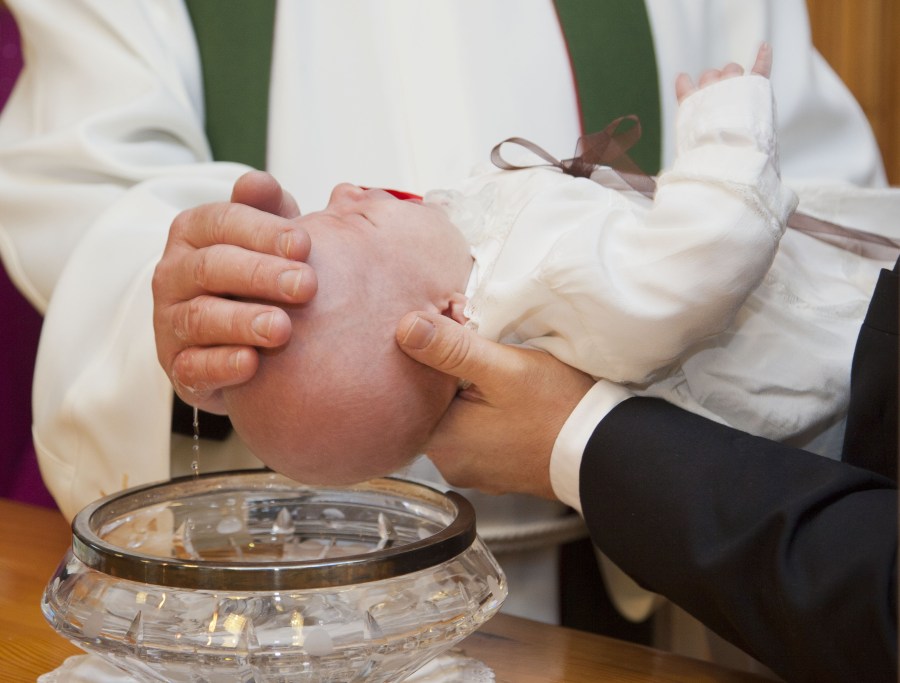
Jesus reveals the mystery of his identity to us by entering into full solidarity with the human condition. In today’s gospel, Jesus enters into solidarity with the people of Israel through the rite of circumcision, which Jews today call a bris. The closest equivalent to this rite of initiation in the Christian tradition is the sacrament of baptism, which Jesus would also receive later in life, at the hands of his cousin John.

In baptism, we Christians receive our identity. That is, we learn who we really are in Christ. The water is an outward and visible sign of the washing away of the false identities we construct for ourselves. In the Church, we are no longer presidents or panhandlers, no longer grad students or gangstas, no longer trust-fund babies or crack babies, no longer doctors or drag queens. In baptism, all of these constructed identities are washed away: “We renounce them.”

In baptism, we are stripped of our fig leaves and stand naked before our Creator.

And this, brothers and sisters, is the Good News: that underneath the stained and tattered rags of ego is not the ugly nothingness we feared. In the moment of baptism, we stand beside the font, dripping and shivering like a toddler fresh out of the bathtub, and hear the voice from heaven saying to us what it said to Jesus at his baptism: “You are my Son (Daughter), the Beloved, with you I am well pleased.” (Luke 3:22)

Brothers and sisters, this is the truth about who we really are. This is the truth that God reveals to us by taking on our humanity and dwelling among us in the life, death, and resurrection of Jesus Christ. I dare you today to allow this truth to soak into the marrow of your bones. Allow it to transform you from the inside out. Allow it to turn upside-down the way you look at the world.

In baptism, Jesus liberates us from all our false, constructed identities. If you wash away everything you have, every one of your accomplishments and failures, everything you’ve ever done, everything that’s ever been said about you, what would be left? Only a mysterious voice from heaven saying, “You are my Child, the Beloved.”

The poet Gerard Manley Hopkins once wrote, “The world is charged with the grandeur of God.” Jesus gives us eyes to see it. Jesus gives us the ability to see ourselves and our world through the eyes of God. This is how St. Paul is able to say, in his second letter to the Church in Corinth:

“From now on, therefore, we regard no one according to the flesh; even though we once knew Christ according to the flesh, we know him no longer in that way. So if anyone is in Christ, there is a new creation: everything old has passed away; see, everything has become new!” (2 Corinthians 5:16-17)

This is why we make the promise, in our Baptismal Covenant, to “seek and serve Christ in all persons” and “respect the dignity of every human being”. We promise this because Christ is in all persons and every human being has an eternal dignity that deserves to be respected. You reflect the image and likeness of God in a way that is utterly unique, that has never been seen before in all of history, and never will be again. Without you, and without each and every person around you today, some small part of God would remain unknown forever.

And that is why I tell you today, brothers and sisters, that your greatest gift to the world is you.

Fully Human

Preaching this week at First Presbyterian Church of Paw Paw, MI.

Click here to read the biblical text.

There are two great mysteries that are central to the Christian faith, as it has been handed down to us from the Apostles. As mysteries of the faith, they cannot be proved by philosophical reasoning, but can be experienced directly and expressed through intuition and imagination in the stories and practices of our tradition.

The first is the mystery of the Trinity: we believe in one God who exists co-eternally as three persons, traditionally referred to as Father, Son, and Holy Spirit. The main thing we learn from the mystery of the Trinity is that God is relational. God exists, not as a monolithic object in space, but as network of relationships between individual persons. It would not be too much to say that God is a relationship. This is how Christians are able to say, in the words of 1 John 4:16, “God is love, and those who abide in love, abide in God, and God abides in them.”

The second great mystery is the mystery of the Incarnation, which we are gearing up to celebrate during Advent and Christmas. Christians believe, in the words of John 1:14, that God “became flesh and lived among us” in the person Jesus Christ. In other words, God is one of us. Jesus Christ, according to the Church, is both fully human and fully divine, at the same time. According to the mystery of the Incarnation, everything Jesus is, God is. Jesus Christ reveals the Divine to us. If we want to understand what God is like, we look at the human person Jesus.

These two mysteries, the Trinity and the Incarnation, are central to the Christian faith. They are also central to understanding today’s Gospel reading from Matthew 25.

In this passage of Scripture, Jesus tells us a story of the Final Judgment. At the end of the age, the Son of Man (literally “the Human One”, Jesus’ favorite title for himself) will come to Earth in all his glory and divide the people of the world into two groups. One group, whom he calls “sheep”, and another, called “goats”. The “sheep” will “inherit the kingdom prepared for [them] from the foundation of the world” while the “goats” will “depart… into the eternal fire prepared for the devil and his angels.”

The basis for this final judgment, contrary to what we tend to hear from popular “evangelists” in the media, is not a test of theological doctrine or church attendance, nor is it a question of whether one has received the Sacraments of the Church or “accepted Jesus as their personal Lord and Savior.” The basis of this final judgment, according to Jesus himself in Matthew 25, is how we treated the most vulnerable people among us in this life.

Jesus said, “I was hungry and you gave me food, I was thirsty and you gave me something to drink, I was a stranger and you welcomed me, I was sick and you took care of me, I was in prison and you visited me.”

With a look of confusion on their faces, the righteous ask when it was that they did all these things, and Jesus replies, “Truly I tell you, just as you did it to one of the least of these who are members of my family, you did it to me.”

What Jesus says here is firmly rooted in the central mystery of the Trinity and the Incarnation.

From the mystery of the Incarnation, we learn that God is fully human, so Jesus asks us, “Are you fully human?”

From the mystery of the Trinity, we learn that God is relational, so Jesus asks us, “Are you relational?”

Much of the imagery that Jesus uses in this story comes from chapter 7 in the book of the prophet Daniel, in the Hebrew Scriptures. In that chapter, Daniel has a vision of four empires, which he envisions as vicious monsters that destroy and devour people with their violence. But then, Daniel says, “I saw one like a human being (literally “a Son of Man”…get it?) coming with the clouds of heaven.” And this “Son of Man” will repeal and replace the monstrous empires with the kingdom of heaven-on-earth. And Daniel says, “His dominion is an everlasting dominion that shall not pass away.”

According to Jesus and Daniel, this is God’s ultimate vision for the human species: for a truly human kingdom to replace the monsters and empires that have the power on earth for now.

So, how did we get into this sad state of affairs? What happened?

Well, the Gospel tells us that our Triune, relational God created a relational universe and invited human beings to take our part in harmonious relation to the whole of creation, but we were not satisfied with this gift. We humans wanted to be the center of our own little worlds. We were ambitious to become gods, but became monsters instead. We destroyed and devoured one another in our lust for power, and set up exploitative systems that oppress our fellow creatures in the name of “law and order”.

God kept trying to reach out to us, to show us that there is another way, but we were unwilling to listen. So, God “took on flesh and lived among us” in the person Jesus Christ, showing us that to be fully human is to be fully divine. Jesus loved us, bringing healing, wisdom, and forgiveness into our midst.

But we were still unwilling to listen. Clinging to our old delusions of grandeur, we rejected Jesus and turned on him with all the monstrous might of imperial power. We crucified and killed this God-made-flesh in a final, desperate attempt to shut him up.

But Jesus wouldn’t take No for an answer: he rose from the grave on Easter morning, conquering the power of death and hell, and declaring peace and forgiveness to his deniers and betrayers.

After his resurrection, Jesus gathered his community of followers once again and breathed into their hearts the Holy Spirit, the very presence and power of God. Jesus made the Apostles into little incarnations of the Divine.

These Apostles were sent out to say and do the same things that Jesus said and did: gathering communities of lost and broken people, blessing the little ones, teaching, healing, forgiving; baptizing, confirming, and ordaining, human beings to be the hands and feet of God in the world.

These gathered communities, the Church, gradually spread and grew to the ends of the earth, continuing the Apostles’ mission, right up to this very day in Paw Paw, Michigan, where we have been gathered together by the Holy Spirit as the apostolic people of God in this place and time.

All of us have come here today to hear God’s Word and be fed with the Sacrament of Christ’s Body and Blood, to give thanks, to pray, to give, and to be sent back out into the world, that we might take our part in the advancing kingdom of heaven on earth, saying and doing the very same things Jesus said and did when he walked among us in the flesh.

We are called upon today to live as citizens of the kingdom of the One who is fully human (and therefore fully divine).

This kingdom of heaven-on-earth is advancing here and now, just as Jesus and Daniel said it would. The kingdom’s advance is not always readily apparent, but it is real. In every age, women and men have risen up to demonstrate to the monstrous empires of this world the truth that there is another way to be human. We call these people “Saints”. But saints are nothing more than further examples of what life in this world could be, if we would but set aside our selfish, ego-driven agendas and pledge allegiance to God’s kingdom of heaven-on-earth.

The marching orders of Jesus, our commander-in-chief, are clear: Feed the hungry, slake thirst, welcome foreigners, care for the sick, and visit incarcerated criminals.

The quality of our spirituality (and our divinity) is measured, not by our religious observance or theology, but by the quality of our relationships with hurting, broken, and vulnerable human beings, without stopping to ask whether they are worthy. This is what it means to live in this world as citizens of the kingdom of the truly human one, the kingdom of heaven-on-earth, which is our clear and present hope.

Jesus asks these things of us, not because they work as effective policy in this world, but because they are right. Jesus asks these things of us because they make real to us the presence and power of our fully human and relational God. As a bonus, this strategy happens to make God real to others, as well.

Jesus asks these things of us because the kingdom of heaven is real and advancing across the broken terrain of this Earth. In every age, the saints of God have taken their place in this kingdom, living on Earth as if they were already in Heaven. Today, we are invited to take our place in this kingdom as well.

Our God is relational, therefore Jesus’ question to us is: “Are you relational?”

Our God is fully human, therefore Jesus’ question to us is: “Are you fully human?”

To the extent that we can answer Yes to those questions, we can honestly say that we are living in the kingdom of heaven-on-earth, and we are finally fulfilling humanity’s oldest and greatest ambition: To become divine.

Sharing the Keys

One of the blessings that Christian faith brings in a person’s life is a sense of purpose. God has created, chosen, and called each and every one of us. Some are called to do this as bishops, priests, and deacons. Some are called to serve ministries within the Church, such as the Vestry, the Choir, or the Sunday School. Some are called to serve the community outside the walls of our parish. All of us are called to be the hands and feet of Christ in the world today.

To fulfill this calling, we need the Church to raise us up “to the full stature of Christ” (Eph. 4:13 NRSV). Through the Church, Christ baptizes and confirms us, reconciles us and heals us, enlightens us with the Word, feeds us in the Eucharist, and empowers us for ministry.

When new people come into the Church, they aren’t interested in simply being consumers of a product, nor are they interested in filling a pre-defined slot on a committee. They want to discover and realize that deep sense of purpose that God has placed in their hearts.

Christ understood this truth and used it to empower his apostles for ministry. He said to St. Peter, “I will give you the keys of the kingdom of heaven” (Mt. 16:19). Do you remember getting the keys to your first car? Your home? Your office? With keys comes power. By giving away the keys of the kingdom of heaven, Christ is willingly stepping aside to make room for others. He shares his divine power so that others can participate in building God’s kingdom “on earth as it is in heaven” (Mt. 5:10). We, as members of Christ’s Body in the world today, must do the same.

This can seem like a scary thing for long-time parishioners. We wonder, “What if the person with whom I share power proves to be inept or irresponsible? What if their vision for the Church’s worship and ministry differs widely from my own? What if my own parish becomes unrecognizable to me?”

These are indeed frightening questions, but the alternative is even more terrifying. We might ask instead, “What if our parish ceases to be a dynamic force for good in our community? What if there are people in my neighborhood who do not yet know the love of Christ, or the deep sense of purpose that life in Christ can bring? What if one such soul were to visit us and find only a stagnant institution that is wedded to its own comfort, rather than invested in the gospel of Jesus Christ?”

Questions like these should chill us to the bone. To be sure, there are many parishes in the world today that fit this sobering description. I remember speaking once with an older parishioner (not at St. Thomas) who had a moment of clarity during a congregational crisis, when no new leaders could be recruited to continue the basic functioning of the parish. She was in her late 70s, speaking to a clergyman in his 30s. She observed, “When I was younger in the Church, I remember the older generation intentionally stepping aside to let us lead the Church in a new direction. It occurs to me now that my generation has not done the same thing for yours.”

To be clear, I don’t think the situation in our parish is nearly that dire. We are already making room for newer and younger people in leadership. The word “Youth” appears prominently on our signage, not because we have a large program for teenagers or young adults, but because we invite younger people to be present in all areas of parish life: Staff, Vestry, Altar Chapter, Choir, Sunday School, and Summer Breakfast Program can all point to persons under the age of 40 in their leadership. This is a great start. The next step is to learn from them, listen to them, and let their ideas and concerns challenge our status quo.

There is no competition here. We need each other. The solution is not for older or longtime members to go away or stop serving, but for those who currently have the power to share it willingly with those who do not. What we need from learned, experienced, and wise elders is mentorship.

Younger and newer members need the wisdom of their elders to guide them along the right path. Longtime parishioners need the dynamic energy of the young to drive them forward. If the Church was a car, the young would be the engine and the elders would be the steering wheel. Lose the steering and you have a dangerous wreck; lose the engine and you have a useless hunk of metal.

Christ taught his apostles saying, “You know that the rulers of the Gentiles lord it over them, and their great ones are tyrants over them. It will not be so among you; but whoever wishes to be great among you must be your servant” (Mt. 20:25-26).

Let us lead by becoming servants to one another in Christ. Let us make room for one another in the leadership of the Church. Let us share with one another “the keys of the kingdom of heaven,” as Christ did with St. Peter. Let us set aside our power, our privilege, and our preferences and invite one another to fulfill the high calling that God has placed in our hearts.

you want it darker: on race, Trump, apocalypse, and the need for more prophets than priests. (reblog)

The demonic that is being manifest in America right now has been here since the beginning. But these spirits are uniquely acting out. Perhaps the best thing we can hope for, in such dark times, is that these are the convulsions of a spirit that, now that it is in the open, can yet be exorcised from our collective consciousness.

Click here to read the full article