
The Winnowing Wind

Sermon for the Second Sunday of Advent, Year A

Click here to read the biblical passages.

So, we are now into that time of year when everybody hunkers down to watch their favorite holiday movies. Some people like It’s a Wonderful Life. Some people like the Hallmark Channel, but I only count that one as one movie because they all have the same plot. (No offense, I’m just preaching the truth.) Some people like Die Hard with Bruce Willis. Instead of deck the halls, he likes to deck the terrorists. But for me personally, there can be only one. And it’s The Muppet Christmas Carol. If you haven’t seen it, I highly recommend it. Because not only is it absolutely hilarious because of the Muppets, but Michael Caine, as Ebenezer or Scrooge, is just (*) chef’s kiss perfection. And finally, it’s actually one of the more faithful renditions of the classic novel by Charles Dickens. Most of us know the story already. Ebenezer Scrooge is a grouchy old miser, who gets visited by three spirits on Christmas Eve. The ghosts of Christmas past, present, and future. And through these visits, Ebenezer comes to a greater understanding of himself in order to make some necessary changes in his life. It’s a story about personal transformation, and that’s the exact same theme we find in today’s gospel.

The passage focuses on the ministry of St. John the Baptist, and as you may know, John could be more than a little intense, like camping. He walks in screaming,

“Repent, for the kingdom of heaven has come near,”

calling people names, and talking about pitchforks and unquenchable fire. That’s why he’s called John the Baptist (because if he was John the Episcopalian, he would have been much more polite about the whole thing). But he wasn’t polite. He was a prophet. And the message that God spoke through this prophet was a pretty direct one.

I think it might help if we were to unpack that message just a little bit. So, first of all, we hear that word repent, which makes a lot of us think about those angry preachers we see screaming and waving a Bible around on TV. We think that to repent means to feel guilty or ashamed, but that’s not actually what it means. In Greek, the word is metanoia, coming from meta, meaning “change,” and noia, meaning “mind.”

So in the language in which the New Testament was written, the word repent actually means, “to change your mind.” Anybody here ever change your mind about something? It happens.

It makes sense to change your mind when you get new information. The poet Maya Angelo said it beautifully,

“Do the best you can until you know better. And then, when you know better, do better.”

That’s what repent means. It’s not easy, but it also has nothing to do with guilt or shame. And that’s the core of John the Baptist’s prophetic message.

He tells people to

“bear fruit worthy of repentance.”

This has to do with how they live their lives. This is what Maya Angelou was talking about: “When you know better, do better.” No need to wallow and shame. Just learn from your mistakes.

After that, John starts to get really deep, but we miss what he’s saying if we get stuck on that idea of punishment and shame. John says,

“I baptize you with water for repentance, but one who is more powerful than I is coming after me. I am not worthy to carry his sandals. He will baptize you with the Holy Spirit and fire.”

Okay. I want you to remember those words: “Holy Spirit and fire.” They’re important. Specifically, I want you to remember that the Greek word for spirit is the same word they use for wind. So what John just said to the people is that the one coming after him (that’s Jesus) will baptize them with sacred wind and fire. I know that sounds weird, but stay with me because it’s about to become important.

John says,

“his winnowing fork is in his hand, and he will clear his threshing floor and will gather his wheat into the granary, but the chaff he will burn with unquenchable fire.”

Couple of unfamiliar terms in that sentence. They are agricultural terms, and I’ll deal with them in reverse order. First for us, and second for John, is the term chaff.

Chaff is a part of the wheat plant. It’s a kind of husk that protects the grain while it’s still growing on the stalk. It’s very important, because without it, the grain would be vulnerable to predators and the elements. So the chaff isn’t bad, it’s necessary.

The only problem is that it’s not very tasty or nutritious. So, if you want to harvest that wheat and bake bread, you have to get rid of the chaff first. That’s where winnowing comes in.

Winnowing is another agricultural term. After the farmers would harvest the wheat, they would heat it up over a fire, which would crack open the husks that surrounded and protected the grain. And then the farmers would take their winnowing forks and sift the wheat by tossing it up into the air, letting the wind blow the tough husks away and allowing the delicious and nutritious grain to fall back to the earth, where it could then be collected into baskets, and later baked into bread.

So, the thing to remember about chaff is that it’s the part of the plant that protects the grain while it’s still growing, but no longer serves the purpose of what the grain is meant to become. That’s the winnowing process, if we’re talking about wheat, and it’s also the repentance process if we’re talking about us, and using the word repent in the way that it was originally intended.

That’s what I see happening in Ebenezer Scrooge, throughout the story of A Christmas Carol. Our friend Ebenezer was taken on a journey through his childhood and youth where he saw how he had used study, work, and money as a shield to protect himself from the rejection that he experienced from his family and friends.

His skills made him very successful as a financial manager, but they left him empty when it came to the really important and valuable things in life. Miserliness for Ebenezer was like the chaff that protected the grain while it was still growing, but it was also the very thing that kept him from becoming the person he was meant to be. The work of the Holy Spirit in his life, the wind and the fire, was to help him let go of his old protective shell and embrace the truth of who he really was in God’s eyes, and I think the same thing is true for each and every one of us.

We all have old habits or beliefs that hold us back from living authentically as our truest and best selves. We might think that staying thin and beautiful is the key to a long and happy marriage. We might believe that next drink might make us the life of the party. We might wonder whether we will finally feel acceptable in God’s eyes if we could just pray the gay away. But none of these things are true. They are all chaff, and the work of the Holy Spirit in your life is the work of God, helping you to like yourself just the way you are and living that truth boldly and bravely in the world, just as God intended for you.

That’s what winnowing means. That’s what repentance means. And that is the message of St. John the Baptist for us in today’s gospel and in this season of Advent.

Kindred in Christ, I pray that you will come to know this message more fully for yourself during this holiday season, and that you will bear fruit worthy of changed minds by loving yourself, your neighbors, and God more authentically. When we finally come to that blessed celebration of Christmas, I pray that you will see the light of Christ being born in you in a new way, so that you can be that light for others and let your light shine for all to see.

God Don’t Make No Junk

Sermon for Proper 16, Year C

Click here for the biblical readings

Once upon a time, there was a big family, who all lived together in a big house. Each member of this family had a special, magical gift. One was very strong, one could talk to animals, another had powers of healing, and another could control the weather. But then there was another member of the family, Bruno, who could see visions of the future that no one else wanted to see. His gift made people uncomfortable, so the rest of the family banished him from the family. Whenever anyone asked about him, the family would say, “We don’t talk about Bruno.”

But here’s the thing: Poor Bruno didn’t just go away when he was banished; he stayed in the house and lived in the walls, where no one could find him. Eventually, his ominous visions of the future started coming true. Finally, the family realized that they needed Bruno’s help because his visions provided the wisdom they needed to fix their problems. In the end, they saved their family and their house, not by getting rid of Bruno, but by bring him out of the walls and reintegrating him into the life of their family.

The story I have just told you is the plot of the Disney movie Encanto. You may or may not have seen it. But even if you haven’t seen it, I think its story rings true for most of us in the real world.

Many of us, in our families or neighborhoods, can think of people who we would rather not acknowledge or talk about. They make us feel awkward or angry with their unusual ways. We would rather just pretend that they didn’t exist at all, but the thing is that we can’t ever really get rid of them. We can push them out of sight and out of mind, but they are never truly gone.

If we’re honest, we can admit that the reason why such people make us so uncomfortable is that they remind us of truths within ourselves that we would rather not acknowledge. But if we’re truly honest, we can even admit that each one of us has a “Bruno” within ourselves: Some part of us that we wish wasn’t there, because it makes us uncomfortable.

These unwelcome parts of ourselves often get pushed to the side, or even banished into the unconscious parts of our minds, because we would simply rather not deal with the inconvenient truths that they present us with. But the fact is, for us just as much as for the family in the movie Encanto, we can never truly be set free until we recognize these banished parts of ourselves and welcome the truthful message they bring us. This is a story about every single one of us, and it is also the story of today’s gospel.

The woman that Jesus encounters in today’s gospel is a person who knows what it’s like to be pushed aside and forgotten. As a woman, she was already banished to the far corners of the synagogue. The men were the ones who could stand in the center and lead the assembly in singing praises to God.

In addition to her gender, this woman also had some kind of psychosomatic ailment that kept her “bent over” and “quite unable to stand upright” for almost twenty years. On a metaphorical level, this illness made the woman present herself to the world as something less than what she truly was. Her story makes me think of people I know who feel like they are defective or less than their peers because of some quality about themselves that they think will be perceived as unacceptable to the people around them. Her story makes me think also about those parts of myself that I would rather hide from the world because they make me feel ashamed. Like the family in Encanto, I would much rather push those parts of myself out of sight and out of mind, hoping that the world will never find out about the secret that I am so desperately trying to hide. But Jesus doesn’t play that game.

When Jesus encounters this woman, he invites her to come stand in the center of the synagogue. He proclaims to her, “Woman, you are set free from your ailment,” and then reaches out and lays his hands upon her. It is not lost on me that this laying on of hands is the same gesture that a bishop performs during the ordination of a priest. Jesus is ordaining and empowering this woman to stand up and claim her true identity in the midst of the people of God. I think it is no coincidence, therefore, that the woman in this story immediately straightens up to her full stature and begins praising God.

It is also no surprise, at that point, that the managers of that religious institution suddenly become indignant and begin to argue about the petty minutiae of religious law, even though they have literally just witnessed a miracle taking place. But Jesus is having none of their hypocrisy; he calls it out for what it is. Jesus would rather risk blasphemy by breaking the rules than keep the rules and sacrifice the real needs of human people. This is the kind of Savior that Jesus Christ is: with us, for us, in us, and through us. He breaks religious rules for the sake of human needs, and he invites us to do the same.

I remember a time, early in my ministry, when I was the pastor of First Presbyterian Church of Boonville, New York. It was a small, traditional church in a small, traditional town. At that time, the Presbyterian denomination was in the process of revising its official stance on the ordination and marriage of LGBTQ+ people in the church. One prominent member of the church, a man named Rick, came to me and told me that he was gay. He said that, in light of the changes happening in their denomination, he wanted to come out of the closet to his church family. Whether they loved him or hated him, he wanted them to know him as he truly was.

I told Rick that, since I was still new at the church, I couldn’t predict how the parishioners would respond, but I would proudly stand beside him as his pastor, no matter what. So, we planned a church supper to discuss the changes that were then happening in our denomination. At the end of the conversation, I invited Rick to the front of the room to tell his story.

After he finished talking, there was a long moment of silence. I held my breath as I waited to hear how the church would respond. You could have heard a pin drop in that room.

The first person to speak up was a longtime member of the church who very rarely said a word, good or bad.

“Well,” she said, “God don’t make no junk!”

What happened next, I can only describe as a “Tidal Wave Group Hug.”

The entire mob of people of the church rushed to the front of the room, covering Rick with their tears and their love. His elderly aunt said, “I’m so proud you’re my nephew!”

And I was never so proud to be their pastor as I was in that moment.

From that day on, First Presbyterian Church of Boonville became a bastion of civil rights for LGBTQ+ people in upstate New York. They embodied the all-inclusive and unconditional love of Jesus Christ in a way that I would not have thought possible for such a small church in such a small town. They did it because they loved their friend Rick, and because they followed their Lord and Savior Jesus Christ, who called them to love their neighbors as themselves.

Kindred in Christ, this is what it looks like when a community of believers lives out the call to be the hands and feet of Jesus Christ in this world. This is what it looks like when the Church, following in the footsteps of her Lord, invites marginalized people into the center of our collective life, lifts them up, and empowers them to sing God’s praises in our midst.

My question to you today is this: What happens when it’s your turn? What happens when those parts of yourself that you have ignored, repressed, or banished get invited to stand up straight in the center of the room and lead the chorus of God’s praise? What happens then?

[QUICK DISCLAIMER: To my wonderful and beautiful introverts in the room: I know you feel terrified by what I just said. I just heard all of your blood pressures go up simultaneously. Please don’t worry; I won’t make you stand at the front of the room. To you, I would ask the following: What happens when that one person you love the most feels so invigorated by your presence that THEY go to the front of the room and sing God’s praise? Afterwards, they turn to you with a subtle wink and silently mouth the words, “Thank you.” What happens then?]

Well, I’ll tell you what happens then: The kingdom of God comes on Earth, as it is in Heaven. The followers of Jesus begin to act more and more like their Lord and Savior. “The power of love overcomes the love of power,” as Jimi Hendrix once said, and the world understands anew the meaning of those old words: “Jesus loves me, this I know…”

Kindred in Christ, the Spirit of Jesus is among us today, just as the physical Jesus was present with that woman in today’s gospel, setting you free to stand up straight and sing God’s praises. Let us sing those praises together and empower our neighbors to stand and sing with us, so that they too might know the love that sets us free.

Amen.

Pardon Our Dust

Sermon for the Tenth Sunday after Pentecost.

Click here for the biblical readings.

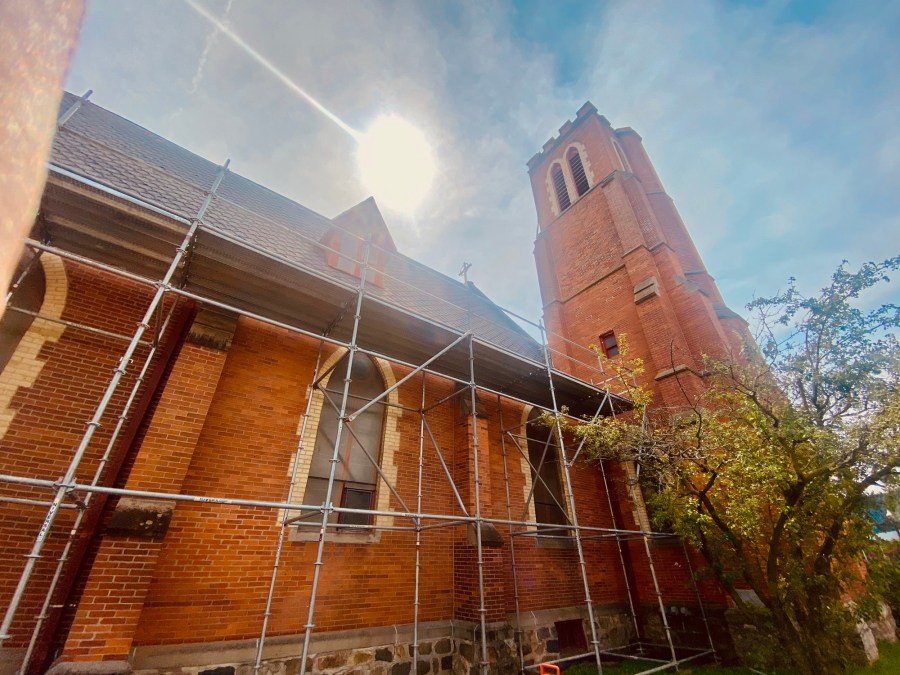
If you’ve been at the church building at all for the past couple of weeks, you’ve probably noticed that things have been a little different: You can see the scaffolding and the workers walking around on top of it. You can hear the sound of hammers and machinery. I’ve received multiple phone calls from people asking where to park or which entrance to use. There is no getting around the fact that this roof restoration process has been disruptive to our normal routines, as a church.

And yet… it’s absolutely necessary. Our building is more than just a lovely addition to the downtown historic district; this building is a tool that God has lent our church, so that we can do the work of ministry: Loving and serving our Coldwater neighbors in the name of Christ. Restoring the roof is practicing good stewardship over that which we have borrowed from God, just like we might take extra good care of a car or a book that we had borrowed from a friend.

Nevertheless, the process of caretaking has been especially disruptive to our normal routines for these past few weeks…

People tend to not like disruption in their daily routines. It’s inconvenient (we are creatures of habit, after all). It gets in the way of our plans (although, as they used to say, “If you want to give God a good laugh, tell him your plans”).

Disruption can come to our lives in many forms: the loss of a job, the breakup of a relationship, accidents, illness, or death. Sometimes, it’s even a happy occasion, like getting married, having a baby, graduation, or retirement. It’s good stuff, but it’s still disruptive to our regular routines.

As creatures of habit, we tend to see disruption as a problem and peace as a solution, but Jesus (in today’s gospel, at least) seems to see it the opposite way.

Jesus asks his disciples, “Do you think that I have come to bring peace to the earth?” And then, he answers his own question, “No, I tell you, but rather division!”

Now, this is where we might say, if we were present at this conversation, “Now wait just a minute, Jesus! Aren’t you supposed to be the Prince of Peace? At Christmastime, aren’t we supposed to say, ‘Peace on Earth and goodwill to all’?”

And Jesus would respond, “Yes, but what exactly do you mean by ‘Peace’?”

Peace is a good thing, but it is often misunderstood by those who would rather settle for normalcy than challenge the status quo. We sometimes try to “keep the peace” by avoiding uncomfortable conversations, inconvenient truths, and important decisions. That kind of “peace” is no peace at all, according to Jesus. That kind of (so-called) peace is toxic.

Dr. Martin Luther King, Jr. said that peace, “is not the absence of conflict, but the presence of justice.” Justice, as Dr. King meant it, is fair and harmonious relationships between people. It has less to do with punishment and more to do with what St. Paul meant by the word “righteousness” in his epistle to the Romans. Peace, as Jesus meant it, is what happens when people address old patterns of behavior, become aware of unconscious habits of thinking, and seek to make amends for the mistakes of the past. Peace upends our lives and refuses to leave us as it found us. Peace asks something of us. Peace, as Jesus Christ intends it, is disruptive.

That’s why Jesus says, in today’s gospel, that he has not “come to bring peace to the earth… but rather division.” Jesus disrupts our false illusions of peace in order to bring us closer to true peace, which can be found in right relationships between God, our neighbors, and ourselves. Sometimes, disruption is necessary in order to bring us into the good life that God intends for us.

Here’s the thing I want us to carry away from this sermon today:

When Jesus stirs up the dust in our lives, it’s not to tear us down; it’s to make us stronger, so we can join him in building something even better.

The mess in our lives, just like the mess in our church building this week, is not a sign of failure; it is a sign of God at work.

I have found this principle to be true in my own life:

When I was a kid, my Uncle Hutch was a spiritual leader in our family. He was a United States Army chaplain who served in the first Gulf War and later as a commercial chaplain for truck drivers in South Carolina. He is a very tall, wise, and kind-hearted man who I have always looked up to, both literally and figuratively.

Whenever we would gather at his house for Thanksgiving dinner, Uncle Hutch would lead the prayer. Whenever someone in the family was getting married, Uncle Hutch would officiate the service. Whenever one of us needed spiritual counsel, we would call Uncle Hutch.

In recent years, Uncle Hutch’s health has begun to decline. Now in his eighties, his spirit is stronger than ever, but his physical body is showing the inevitable signs of age. As this has happened, without anyone making an official proclamation, I have noticed the family roles that were previously assigned to Uncle Hutch now gradually falling to me.

I have to admit that this prospect is daunting. First of all, I am keenly aware that my personal views on various matters differ somewhat from those of my family. Lastly, and far more significantly, how could I possibly fill the shoes of a man of God that I have admired since the day I was born?

The task seems impossible to me.

When I called my Aunt Faith to ask permission to share this story today, she told me that none of us can ever “fill the shoes” of another person. The best we can do is to “follow in their footsteps” in our own particular way, even if our way differs somewhat from the way in which the original person would walk it.

The shift in family roles has certainly been disruptive, to say the least, but I must also admit that it has led to some of the most deep and honest conversations with my family that I have ever had. Whenever significant events happen, good or bad, I have become the one that my family members call to seek comfort and advice. I still don’t feel up to the challenge, but I try my best to meet it to the best of my limited ability. I can only trust God’s Holy Spirit to fill in the blanks where my personal wisdom is most definitely lacking.

It is in moments like these that I ask the age-old question, “What would Jesus do,” or, secondarily, “What would Uncle Hutch do,” to respond to the problems that are presented to me.

The shift in family roles has most definitely been disruptive to my felt sense of peace, but I can also see how it has been part of God’s work in the life of my family.

Kindred in Christ, I put it to you today that the disruptions in our lives are not problems, but the very solutions that we have been seeking to the questions that beset us. The God we believe in, revealed through the person of Jesus Christ, is a God who asks tough questions and leads us through the desert of conflict, in order to bring us to the true peace that consists of right relationship between God, our neighbors, and ourselves.

Let us not shy away from tough questions and gravitate toward easy answers, but sit in the tension that leads to “the peace that passeth all understanding.” Let us hang upon our hearts a sign that says, “Pardon our dust” while we wait in the confidence that God is not done with us yet, but is still working to bring us to the fullness of peace in Christ Jesus our Lord.

As a tangible sign of our faith in God’s work in our lives, I would like to invite to the front of the church Mr. Mike Woodhouse, manager of Sheriff Goslin Roofing Company, and any members of his crew who are present with us today.

These people have been hard at work on the roof of this historic building. I would like to introduce them to you so that you can thank them and join me in a special blessing over their work, as well as a prayer for their safety while they lovingly restore the roof of this building.

Let us pray.

Loving God, you have gifted these workers with the skill and the will to work for the restoration of this church building, which you have lent to us for the purpose of continuing the work of Jesus Christ on this Earth, by loving you with our whole heart, soul, mind, and strength, and loving our neighbors as ourselves. In Christ’s most holy Name, we bless the labors of these workers and pray for their safety from dangers seen and unseen, that the goodness they create with their hands may be matched by the sincerity of our hearts. We ask these things and bless these workers in the Name of the Father, and of the Son, and of the Holy Spirit. Amen.

Kindred in Christ, these workers are a symbol to us of the good work that God is doing in each of our lives. May each and every one of us come to acknowledge this work and bless the disruptions, not as a problem to be solved, but as the means through which God is bringing each of us, in our own time, to the fullness of peace that can be found in Jesus Christ our Lord.

Amen.

Fire and Fruit

Sermon for Proper 8, Year C

Click here for the biblical readings.

Sometimes I walk into a conversation ready for a fight.

Like, I’ve been rehearsing my speech all day, muttering in the car, working up just the right balance of righteous indignation and devastating logic. I am locked, loaded, and ready to fire…

And then the other person just says,

“Oh gosh! I’m really sorry. Thanks for telling me how you feel. I had no idea.”

And now I’m standing there like,

“Ugh… Now I’ve got to rearrange my tone, because you were supposed to argue with me. I was all set for a fight…

And now I have to figure out how to be a reasonable human being…”

That’s more or less what happens to James and John today.

They’re ready to go scorched earth on a Samaritan village—and Jesus… doesn’t let them.

No fire. No fight. Just a rebuke, and a long walk to Jerusalem.

And maybe the most uncomfortable part is:

He’s still walking that way.

And we’re still being invited to follow.

I’ve been thinking this week about Inspector Javert, the relentless police officer from Victor Hugo’s novel Les Misérables. He’s a man of uncompromising principle, obsessed with justice. For him, the law is sacred—it orders the universe, separates good from evil, and gives people what they deserve. No exceptions. No second chances.

Then comes the moment that undoes him: Jean Valjean, the escaped convict Javert’s been been hunting, has an opportunity to kill him, but spares his life instead. And suddenly, Javert doesn’t know who he is anymore.

If I’m honest—there are times when I’ve recognized a bit of Javert in myself.

Moments when I felt sure I was standing up for what was right… only to realize later that what I really wanted was to feed my own ego.

I wanted fire.

Jesus offered fruit.

And that kind of grace isn’t cheap. It’s a costly grace. It doesn’t just change you—it undoes you, and makes you new.

In today’s Goslel, Luke tells us that Jesus has “set his face toward Jerusalem.”

That’s more than a GPS update. It’s a theological turning point in the story—a shift from healing and teaching in Galilee to a deliberate, unflinching journey toward the cross.

And the disciples are not ready.

They still want results. They want clarity. They want to win.

When the Samaritans won’t welcome Jesus, the disciples don’t just shrug and move on.

They say, “Lord, do you want us to call down fire from heaven?”

That’s not just hyperbole. It’s a reference to Elijah, who once called down fire on the enemies of God. These disciples think they’re following in a great prophetic tradition.

And in one sense—they are.

But they’ve misunderstood the spirit of the prophet, and more importantly, the Spirit of the Christ.

So Jesus turns and rebukes them.

Luke doesn’t tell us exactly what he said, but the Church has long remembered his tone: not fury, but love.

Some Bible translations insert an extra verse here. Biblical scholars call it a “textual variant” (in case you want to sound impressive at your next dinner party). The extra verse recalls Jesus saying:

“You do not know what spirit you are of.

For the Son of Man came not to destroy lives, but to save them.”

Whether those were his exact words or not,

they sound like Jesus.

They feel like him.

And they land like truth.

Jesus turns and rebukes them.

Not because the Samaritans were right.

Not because the disciples’ feelings were invalid.

But because they didn’t know what Spirit they were of.

That phrase lingers for me:

It’s as if Jesus is saying:

That’s not how we do things. That’s not what I’m about. That’s not who we are.

And Jesus is still saying the same thing to the Church today.

Fire is easy.

Fruit is harder.

Fire is fast.

Fruit takes time.

We reach for fire.

Jesus gives us fruit.

St. Paul knew this struggle well. Writing to the Galatians, he’s speaking to a community splintered by judgment and suspicion.

They’re fighting about circumcision and law observance.

They’re drawing lines. Picking teams. Measuring holiness. Reaching for fire.

And Paul says: No.

“If you bite and devour one another, take care you don’t consume each other.”

Instead—live by the Spirit.

And what does that look like? Paul tells them that the Fruit of Spirit is:

Not rage. Not rivalry.

But:

Love that listens. Joy that lingers. Peace that roots.

Patience. Kindness. Generosity. Faithfulness. Gentleness. Self-control.

These aren’t achievements.

They’re not the result of trying harder.

They grow naturally from following the way of Jesus and desiring in our hearts to be the kind of person that he is.

Fruit doesn’t come by force.

It ripens slowly.

It grows from staying rooted.

Let me tell you a story about a pastor I once knew. His name is Buck Roberts.

His two young kids had been arguing one day, when the older one lost his cool and smacked the other.

Buck saw it happen and took his son aside to give him a stern talking-to. But when he got down on the kid’s level and looked him in the eye, something in the back of Buck’s mind told him to take a different approach. Instead of scolding or punishing his son, he just reached out and hugged him. The little boy immediately burst into tears and said he was sorry. The father’s mercy was able to inspire transformation more effectively than punishment ever could.

It was a small gesture.

But that moment—choosing to meet fire with something softer—has stayed with me.

I remember another time when I made a quick joke in the wrong tone and watched my friend’s face fall.

Words meant to be funny can land like fire.

I apologized later, and thankfully, my friend forgave me. But I carried it as a valuable learning experience.

Self-control isn’t just about big moral failings.

Sometimes, it’s about knowing when to speak.

Or when to stay silent.

Or when to say you’re sorry.

And that’s fruit too.

We might not be chasing someone across France with arrest papers, like Javert.

We might not be calling down fire from heaven.

But we know what it feels like to want to.

And we know what it feels like to choose something else.

To take a breath.

To stay rooted.

To begin again.

This is discipleship.

Not spectacular. Not showy.

But slow and faithful.

We reach for fire.

Jesus gives us fruit.

Let me be clear:

This isn’t about tone-policing.

It’s not about letting harm go unchallenged or injustice go unchecked.

Jesus got angry.

But even when he flipped tables, he didn’t burn down the temple.

His anger made space for healing.

Fire gets attention.

Fruit makes change.

So, kindred in Christ, here’s my invitation to you this week:

Take a look at the Fruit of the Spirit in today’s Epistle and pick one. Just one.

Let it live on your fridge or your phone or your dashboard.

Let it shape your prayer life.

Let it grow.

Let it ripen.

We reach for fire.

Jesus gives us fruit.

And maybe, just maybe, that’s how the kingdom comes.

Not in a blaze of glory.

But in a harvest.

Archbishop Desmond Tutu once said,

“Do your little bit of good where you are; it’s those little bits of good put together that overwhelm the world.”

That’s what fruit does.

It doesn’t go viral. It doesn’t make headlines.

But it transforms a landscape when enough trees bear it together.

So picture this:

Jesus turning to look at the angry disciples—not with fury, but with love.

Imagine him shaking his head gently, then setting his face forward again:

His eyes on Jerusalem.

On the cross.

On self-giving love.

And then imagine yourself there—following along with the group.

Not because you’re ready.

But because you’re willing.

In a few moments, we’ll come to this altar together. It’s a moment we’ve all been waiting for.

For the first time, we will come in a new way—as priest and parish.

And there—without fire or fury—Jesus will give himself to us again.

Not to punish us. 

Not to prove a point.

But simply… to love.

Jesus doesn’t just model mercy—he gives it.

In the Eucharist, he places it in our hands, into our bodies.

He makes us part of himself.

And from that grace, the fruit begins to grow.

It takes root.

It bears witness.

It begins again.

This is the Spirit we are of.

This is the fruit we are becoming.

Thanks be to God.

Amen.

My Sheep Hear My Voice

Sermon for the fourth Sunday of Easter (Good Shepherd Sunday)

Click here for the biblical readings.

Some of you may have seen the classic comedy film Monty Python and the Holy Grail, which came out exactly 50 years ago last month. There is a scene in this movie where King Arthur and his knights have to correctly answer three questions before they will be allowed to cross a bridge. Sir Lancelot the Brave goes first. The gate keeper asks him: “What is your name? (Sir Lancelot.) What is your quest? (To seek the Grail.) What is your favorite color? (Blue.)” After answering correctly, he is sent on his way. Next comes Sir Robin the Not-quite-so-brave-as-Sir-Lancelot. The gatekeeper asks him: “What is your name? (Sir Robin.) What is your quest? (To seek the Grail.) What is the capital of Assyria?” When Sir Robin responds, “I don’t know that,” he is immediately yeeted into the ravine. 

Obviously, having quick, clear, and certain answers was beneficial to King Arthur and his knights in this situation. There are times in life when the same is true for us, as well. Sometimes, it’s just convenient (What’s 5 times 2?). Sometimes, it’s important for solving an immediate problem in a crisis (When your clothes catch fire, what do you do? Stop, drop, and roll). But then there are some questions which simply do not lend themselves to quick, clear, and certain answers. 

For example, let’s consider a philosophical question about the nature of good and evil. The Bible clearly says, “Thou shalt not murder.” Did God command this because murder is wrong, or is murder wrong because God commanded it? (The philosopher Plato explored this question in his dialogue Euthyphro.)

If we say that God forbade murder because it is wrong, then we must admit that there is a force in the universe that is more powerful than God, because God cannot go against what is right. Therefore, God is not almighty. 

But if we then turn around and say that murder is wrong because God commanded it, then God’s will is arbitrary. God could have just as easily commanded, “Thou shalt murder,” and we would be morally obliged to obey it. Therefore, God is not good. 

I won’t get us bogged down in this philosophical question because it’s not the point of this sermon. I only mention it to point out the fact that there are some big questions that do not lend themselves to quick, clear, and certain answers.

Today’s gospel presents us with just such a question. 

The religious authorities come to Jesus and ask, “”How long will you keep us in suspense? If you are the Messiah, tell us plainly.” This is a very big and complicated question.

The concept of a Messiah was actually a fairly recent development in Judaism at the time of Jesus. The word itself simply means “Anointed” and could refer to any prophet, priest, or king who was chosen by God. It was only in the years leading up to Jesus that the title of the Anointed came to refer to a coming leader who would liberate the Jewish people from foreign occupation.

It made sense that the religious leaders of Judea would be wondering about the Anointed in this passage because the text tells us that this conversation takes place during “the festival of the Dedication.” The word “Dedication,” in Hebrew, is “Hanukkah.” 

So, this conversation is happening during the holiday season. [By the way: This fact is worth remembering the next time you hear a fellow Christian getting upset that not everyone says “Merry Christmas” in December. You can tell them that, in John 10:22, Jesus Christ himself celebrates Hanukkah, so we Christians should gladly say “Happy Hanukkah” to our Jewish neighbors.]

The festival of Hanukkah celebrates a time when God raised up the Maccabee brothers to liberate the Jewish people from oppression and genocide. That’s why it makes sense that the religious leaders of Jesus’ time were pressing him to tell them plainly whether he was the Messiah. 

In response to their question, Jesus says, “I’ve already been telling you, but you haven’t been listening.” He goes on to say, “Look at the things I do; my actions speak for themselves.” After that, Jesus says, “My sheep hear my voice.”

We have to unpack that sentence a little bit. First of all, the word “sheep” is a bit of a loaded term these days. Jesus uses the term “sheep” to describe his “flock,” which is the community of believers. There are some ornery people on the internet these days, a few of them claiming to be Christians, who use the word “sheep” to describe docile people who lack critical thinking skills. Given Jesus’ use of the term, I think “sheep” is an inappropriate insult for Christians to use. Also, and much more importantly, I think that insults are an inappropriate thing for Christians to use. So, maybe let’s not do that.

Second of all, there’s the issue of what Jesus meant by, “hear my voice.” 

Obviously, the people physically standing around Jesus in that moment could understand the words that were coming out of his mouth. They could “hear his voice,” in the literal sense, but I think Jesus was talking about a different kind of hearing. 

The kind of hearing that Jesus was talking about is a hearing with the ears of the heart. When we listen closely to someone that we know well, we can sometimes hear the deeper meaning of what’s not being said. My wife can sometimes communicate with me by simply giving me a particular look. I can sometimes figure out when my kids are lying to me, just by looking at their faces. That’s the kind of communication that can happen when two people know each other intimately, and that’s the kind of “hearing” that I think Jesus is talking about in this passage.

Hearing the voice of Jesus is a complicated thing. Some of us imagine that it happens like it does in the movies, when the clouds part, a beam of light shines down from heaven, and a booming voice tells the main character exactly what they’re supposed to do.

The truth is much more subtle that that. Allow me to give a personal example of a time when I think that I may have heard the voice of Jesus.

It happened several years ago, when I was working at a job that I did not particularly enjoy, and to which I was not particularly suited. The voice came, not as a direct command, but as a question.

I kept at the job, day after day, because I thought that I, as a husband and a father, needed to be a provider for my family. One day, as I pulled back into the parking lot after my lunch break, I was trying to steel myself up to back into the office. I kept repeating to myself, like a mantra, “I have to provide for my family! I have to provide for my family!”

It was in that moment, as I sat in my car with my forehead on the steering wheel, that I heard an imaginary voice pop up in the back of my head. I was still repeating, “I have to provide for my family,” and the voice said, “Provide what, exactly?”

That was a really good question. My job was providing a paycheck to my family, but it was also robbing them of my presence and my peace. 

To make a long story short, I decided to leave that job before I had found another. The financial cost was certainly significant to my family, but the fact is that, for the next year when I was out of work, my wife and kids got the best of me. That year changed the way I parent. I went from being an authoritarian rule-maker to the kind of father who listens to the emotional needs of his children. I learned how to cook and clean around the house. My wife began to grow, personally and spiritually, in ways that led to us saying that we are now “in our second marriage to the same person.” 

By the end of that year, I had run a half-marathon, been confirmed as a member of the Episcopal Church, and enrolled in a chaplain training program that shaped my career for the next six years. It was not at all easy, but it was worth it.

The voice I heard was just a simple question in the back of my mind, but the effect was life-transforming. Looking back, I truly believe that I heard the voice of Jesus speaking to me as I rested my head on the steering wheel of my car that day.

The voice of Jesus is not merely contained to the recorded words of a man who lived two thousand years ago. The voice of Jesus is the voice of our risen and living Lord, who continues to speak to us by the power of the Holy Spirit. As the old Sunday School hymn says: 

“He lives! He lives! Christ Jesus lives today! 
He walks with me and talks with me, along life’s narrow way. 
He lives! He lives, salvation to impart. 
You ask me how I know he lives? 
He lives within my heart!”

Kindred in Christ, I want you to know today that Christ Jesus lives today, within your heart. He walks with you and talks with you. The risen Christ is always with us and is always speaking. The only question is: Are we listening? Truly listening with the ears of our hearts?

There is no formula for how to listen to the voice of Jesus with ears of your heart. Each person’s relationship with the risen Christ is deeply personal, therefore it takes as many different forms as there are people in the world. Nevertheless, there are some tips that many have found helpful across the ages, and I would like to share them with you today.

First and foremost, I want to encourage you all to read your Bible and pray every day. There is no better way to grow in your faith, as a Christian. In the Episcopal Church, we have a wonderful resource for doing this well: in the Daily Office of Morning and Evening Prayer, as it is found in the Book of Common Prayer. This systematic way of praying touches on all the major points of the faith and leads you through most of the Bible, once every two years. If you don’t have a Bible or prayer book, please come to see me and I will get you one for free. There are also many online apps and podcasts that do the heavy lifting for you, so all you have to do is press play and listen. 

The Daily Office is a most excellent way to grow in your ability to hear the voice of Jesus, but it isn’t the only one. There are a number of other devotional guides, like Forward Day by Day for example, that provide a way for us to slow down and focus on what matters most. If you have found another source of insight that speaks to you, then by all means, use that. 

There are also several meditation techniques, like mindfulness practices or centering prayer, that can help us to slow down, quiet our racing thoughts,and pay attention to what is happening within us and around us.

Keeping a journal can be a way for us to sort through the scattered events of our days, organizing our thoughts and feelings into a coherent whole. Recording our dreams can provide insight into what is happening in our subconscious mind.

Mutual support groups, like Twelve Step recovery programs, book groups, or Bible studies, can provide us with the opportunity to hear God speaking to us through other people. Likewise, a trusted therapist, spiritual director, mentor, or clergyperson can be a vessel for God to speak truth into your life.

All of these are just suggestions and ideas. The way that God speaks to you will not be exactly like the way God speaks to anyone else. The main thing is that you trust that God is indeed speaking to you, and that you do the best you can to listen to that voice. 

You will never do it perfectly; I promise you that you will mess it up on a daily basis, just as I do, but I also want to encourage you to keep trying. In time, you will learn to hear God’s voice more and more clearly, which will remind you of the promise of Jesus, who said, “My sheep hear my voice,” and “Remember, I am with you always, to the end of the age.”

Post-exilic Prophets and the Church Today – Covenant

In the Church today, the instruction I keep hearing is simply to keep moving forward. Do not despise the day of small things. The day of small things is to visit someone in a hospital, to teach a Bible study, or to celebrate the Holy Eucharist — about which a dear friend used to say, it’s never a bad time tohave Communion with Christ. I’m not suggesting the church be like Candide, pretending that misfortune is beneficial or enjoyable. As Christians we have to walk by faith because there is no other alternative. In doing this, we have to draw on the old patterns of fidelity that will fill out the life of the Church in this new social and cultural context. To paraphrase Meyers and Meyers, if this seems revolutionary, it is because there is no turning back. While we don’t get to see what is around the next bend of the Church’s history, perhaps this is because it is not necessary information for us to do the work that is before us.
— Read on livingchurch.org/covenant/2019/03/14/post-exilic-prophets-and-the-church-today/

This article offers a very helpful biblical analysis of the current situation for mainline Christianity in North America.

By Ozma1981 - Own work, CC BY-SA 3.0, https://commons.wikimedia.org/w/index.php?curid=9986942

Of Rocks and Pointy Hats

This is now the umpteenth time I have tried to write this article and started over. It always ends up being too long, too abstract, or too complicated to communicate its message effectively. We’ll see if this one works, so here goes…

What I want to do here is set out, as plainly as possible, the convictions that led me to the point of being confirmed in The Episcopal Church. This is a risky career move for me. I have served as a minister of Word and Sacrament in the Presbyterian Church (USA) for several years. Being confirmed by the bishop is regarded by the Presbyterian Book of Order as an “act of renunciation”, whereby my ordination in that denomination is rendered null and void. In other words, confirmation was a point of no return for me. If things didn’t work out, I could not simply turn around and seek another pastoral call in a Presbyterian congregation. Therefore, I had to be sure that this was the right move for me.

And I eventually came to the conclusion that it was.

My journey to The Episcopal Church began fifteen years ago, during my senior year at Appalachian State University. I had recently fallen out with the charismatic fellowship that I had attended through my undergrad years. I loved the immediate experience of the divine that the charismatic movement emphasizes, but became disillusioned with the theological narrowness and lack of scholarly depth I found there.

I knew I loved liturgical worship, based on my experience of the Jewish Siddur and semi-regular attendance at Roman Catholic Mass, but each of those traditions presented me with a theological gap I could not cross with integrity. Around that time, I picked up a copy of The Book of Common Prayer from a local religious bookstore and fell in love. I visited the local Episcopal parish and finally felt like I had found what I was looking for.

At this point, I had already set in motion my plans to attend an evangelical seminary in western Canada. While there, I would meet, fall in love with, and marry a woman who was preparing for ministry in the Presbyterian Church. Her little congregation welcomed me with open arms and quickly adopted me into the family. It wasn’t the church I had planned on joining, but I figured it was the best way to support my new wife in her ministry.

There’s a lot that I will skip over at this point, for the sake of brevity, but I eventually joined my wife in the Presbyterian ministry. I figured the Reformed tradition was “pretty close” to Anglicanism and intended to make the best of things as an unusually high church Presbyterian. The nineteenth century Mercersburg theologians, John W. Nevin and Philip Schaff, were most helpful to me in this endeavor. I considered Mercersburg theology my “Rosetta stone” for translating what I believe about the Gospel into terms that Reformed Protestants could understand. At the time, I thought the differences between Reformed and Anglican Christianity were mainly cosmetic and political in nature, but I eventually came to realize that those surface variations overlie two related-but-distinct theological structures in the hearts and minds of believers.

In academic terms, the primary difference between the Reformed and Anglican traditions is ecclesiological. Translation for those who speak plain English: Presbyterians and Episcopalians have very different ideas about the definition of the word Church.

To illustrate the difference, let’s look at a particular passage of Scripture that has great import for Reformed and Anglican Christians alike, but is interpreted in vastly different ways by each of the two traditions.

The passage in question is Matthew 16:13-20:

“Now when Jesus came into the district of Caesarea Philippi, he asked his disciples, “Who do people say that the Son of Man is?” And they said, “Some say John the Baptist, but others Elijah, and still others Jeremiah or one of the prophets.” He said to them, “But who do you say that I am?” Simon Peter answered, “You are the Messiah, the Son of the living God.” And Jesus answered him, “Blessed are you, Simon son of Jonah! For flesh and blood has not revealed this to you, but my Father in heaven. And I tell you, you are Peter, and on this rock I will build my church, and the gates of Hades will not prevail against it. I will give you the keys of the kingdom of heaven, and whatever you bind on earth will be bound in heaven, and whatever you loose on earth will be loosed in heaven.” Then he sternly ordered the disciples not to tell anyone that he was the Messiah.”

Presbyterians and other Reformed Protestants come from a confessional tradition. Christians in the Reformed tradition believe that Simon Peter’s confession of faith in Jesus as “the Messiah, the Son of the living God” is the “rock” on which Christ builds his Church. The Church, according to Reformed theology, is the spiritual fellowship of all believers who make the same confession of faith in Jesus Christ and are thereby reborn to new life by the power of the Holy Spirit.

Roman Catholic theologians, on the other hand, are adamant that the “rock” referred to in this passage is Peter himself, whose name translates literally as “rock”. They have gone so far as to carve the words of this passage into the dome above the altar of St. Peter’s Basilica in Vatican City: “TU ES PETRUS”. This passage forms the bedrock of Roman arguments for Apostolic Succession and Communion with the bishop of Rome as essential marks of the Catholic Church.

Anglicans, in true via media fashion, have declared that the truth lies somewhere in the middle. The Catechism in the 1979 Book of Common Prayer describes the apostolic nature of the Church as consisting of “the teaching and fellowship of the apostles” (p.854). We affirm the importance of Peter’s confession, but also acknowledge that person-to-person fellowship with the apostles themselves (through their successors, the bishops) forms a vital part of our communion with the Catholic Church.

Concerning Peter himself, Anglicans see him as a spokesperson and stand-in for the rest of the apostles. We stand with Eastern Orthodox Christians and early patristic testimony that the bishop of Rome deserves a certain honor as primus inter pares (“first among equals”) in the collegial fellowship of bishops, but does not exercise “universal jurisdiction” over other dioceses or bear the charism of personal infallibility when speaking ex cathedra.

For Anglicans, the importance of the episcopal office is firstly sacramental, not governmental. The bishop, as a successor to the apostles in college with other bishops, is a symbol of the unity of the Church across space and time. At confirmation, baptized believers make their public profession of faith in the presence of their bishop and receive the laying on of hands as a way of expressing the unity of the Catholic Church as God’s means for extending the kingdom of heaven on earth and transmitting the anointing of the Holy Spirit within the ecclesial community. For the same reason, bishops are further entrusted with the ministry of ordaining priests and deacons.

Anglicans, along with Orthodox and Roman Catholic Christians, insist that exercise of episcopal ministry within the Church must be personal because God’s redemption of the world in Jesus Christ is likewise personal. About this personal quality, and its importance to the Christian gospel, I will say more in the next article…

Sharing the Keys

One of the blessings that Christian faith brings in a person’s life is a sense of purpose. God has created, chosen, and called each and every one of us. Some are called to do this as bishops, priests, and deacons. Some are called to serve ministries within the Church, such as the Vestry, the Choir, or the Sunday School. Some are called to serve the community outside the walls of our parish. All of us are called to be the hands and feet of Christ in the world today.

To fulfill this calling, we need the Church to raise us up “to the full stature of Christ” (Eph. 4:13 NRSV). Through the Church, Christ baptizes and confirms us, reconciles us and heals us, enlightens us with the Word, feeds us in the Eucharist, and empowers us for ministry.

When new people come into the Church, they aren’t interested in simply being consumers of a product, nor are they interested in filling a pre-defined slot on a committee. They want to discover and realize that deep sense of purpose that God has placed in their hearts.

Christ understood this truth and used it to empower his apostles for ministry. He said to St. Peter, “I will give you the keys of the kingdom of heaven” (Mt. 16:19). Do you remember getting the keys to your first car? Your home? Your office? With keys comes power. By giving away the keys of the kingdom of heaven, Christ is willingly stepping aside to make room for others. He shares his divine power so that others can participate in building God’s kingdom “on earth as it is in heaven” (Mt. 5:10). We, as members of Christ’s Body in the world today, must do the same.

This can seem like a scary thing for long-time parishioners. We wonder, “What if the person with whom I share power proves to be inept or irresponsible? What if their vision for the Church’s worship and ministry differs widely from my own? What if my own parish becomes unrecognizable to me?”

These are indeed frightening questions, but the alternative is even more terrifying. We might ask instead, “What if our parish ceases to be a dynamic force for good in our community? What if there are people in my neighborhood who do not yet know the love of Christ, or the deep sense of purpose that life in Christ can bring? What if one such soul were to visit us and find only a stagnant institution that is wedded to its own comfort, rather than invested in the gospel of Jesus Christ?”

Questions like these should chill us to the bone. To be sure, there are many parishes in the world today that fit this sobering description. I remember speaking once with an older parishioner (not at St. Thomas) who had a moment of clarity during a congregational crisis, when no new leaders could be recruited to continue the basic functioning of the parish. She was in her late 70s, speaking to a clergyman in his 30s. She observed, “When I was younger in the Church, I remember the older generation intentionally stepping aside to let us lead the Church in a new direction. It occurs to me now that my generation has not done the same thing for yours.”

To be clear, I don’t think the situation in our parish is nearly that dire. We are already making room for newer and younger people in leadership. The word “Youth” appears prominently on our signage, not because we have a large program for teenagers or young adults, but because we invite younger people to be present in all areas of parish life: Staff, Vestry, Altar Chapter, Choir, Sunday School, and Summer Breakfast Program can all point to persons under the age of 40 in their leadership. This is a great start. The next step is to learn from them, listen to them, and let their ideas and concerns challenge our status quo.

There is no competition here. We need each other. The solution is not for older or longtime members to go away or stop serving, but for those who currently have the power to share it willingly with those who do not. What we need from learned, experienced, and wise elders is mentorship.

Younger and newer members need the wisdom of their elders to guide them along the right path. Longtime parishioners need the dynamic energy of the young to drive them forward. If the Church was a car, the young would be the engine and the elders would be the steering wheel. Lose the steering and you have a dangerous wreck; lose the engine and you have a useless hunk of metal.

Christ taught his apostles saying, “You know that the rulers of the Gentiles lord it over them, and their great ones are tyrants over them. It will not be so among you; but whoever wishes to be great among you must be your servant” (Mt. 20:25-26).

Let us lead by becoming servants to one another in Christ. Let us make room for one another in the leadership of the Church. Let us share with one another “the keys of the kingdom of heaven,” as Christ did with St. Peter. Let us set aside our power, our privilege, and our preferences and invite one another to fulfill the high calling that God has placed in our hearts.

Not Even One Stone

I delivered this sermon this morning just after announcing to the congregation our session’s decision to leave our building and move our church’s ministry to a new physical location after almost a century at the corner of Burdick & Ransom. I don’t think it was a coincidence that today’s gospel reading in the lectionary is the story of Jesus predicting the destruction of the Jerusalem temple. Some weeks, the Holy Spirit makes more work for me…

The text is Mark 13:1-8.

If you knew that you only had a week, month, or year to live, how would you choose to spend that time? What do you want your life to stand for? When other people look back at your life, what would you want them to remember about you? These are the questions that a wise person asks in the face of mortality.

The truly wise among us realize that life cannot last forever, therefore the truly wise among us also realize that each life must be lived for something larger than itself. Every mortal life, it seems, is a means to an end.

Each of us has probably known, met, or heard about at least one person who made his or her mortal life meaningful by dedicating it to something larger than himself or herself. We tend to respect or admire such people when we meet them. Their examples might even inspire us to look more deeply at our own lives, face our mortality in new ways, and discover meaningful possibilities within us that we hadn’t noticed before. It’s a beautiful thing when that happens.

As it is with individuals, so it is with groups of people. These groups might last much longer than we do, but they too will one day fade from existence. Families are mortal. Surnames and lineages come to an end through a lack of offspring. Churches and other faith communities are mortal. There comes a point when dwindling membership and a lack of funds causes an institution to close its doors. Nations are mortal. The Roman Empire was once the dominant superpower in the world, unlike anything else that had come before it. Where is the great Roman Empire today? Buried under the rubble of history and preserved in ruins frequented by tourists in Bermuda shorts. Finally, even the planets and stars are mortal. One day, our very own sun will burn up all of its hydrogen fuel and explode into a violent supernova, momentarily becoming the brightest star in some distant sky.

If coming to grips with our own individual mortality is difficult, accepting the mortality of families, churches, species, and stars feels almost impossible. Yet, the same truth applies to these larger mortal beings that first applied to mortal human beings: it is in facing mortality that we find meaning.

Let’s look at this idea in relation to this morning’s reading from Mark’s gospel. The story opens as Jesus and his disciples are leaving the great Jerusalem temple, the epicenter of Jewish worship in the first century CE. Jesus, as usual, is storming out in a huff after yet another fight with the established religious authorities.

It’s at this point that Jesus’ disciples, in their usual tactless and somewhat dimwitted manner, decide to stop and admire the lovely architecture of this religious icon and national monument of Judaism. They say of the temple, “Teacher, look! What awesome stones and buildings!”

Jesus is unimpressed. He says, “Do you see these enormous buildings? Not even one stone will be left upon another. All will be demolished.”

He’s talking about mortality of the temple: this central symbol of religious and national identity for the Jewish people. They were under the impression that this sacred building would stand forever under divine protection. For them, the temple was immortal. It was an end in itself as a center of worship. The idea had never occurred to them that it might not be there one day.

As it turns out, Jesus’ prediction was spot-on. The Jerusalem temple, like any human being, was mortal. It was eventually burned to the ground by the Romans during an uprising in the year 70 CE. It was never rebuilt. The site where it once stood is now occupied by the Dome of the Rock, one of the most sacred places in Islamic religion.

The destruction of the temple was unthinkable to the average Jew, but to Jesus it was inevitable. The wisdom of Jesus did not stop with an awareness of his own individual mortality, but extended to embrace the mortal and finite nature of all things. Just as it was for individuals, so it is for temples, religions, countries, species, planets, and stars: to face mortality is to find meaning.

If our great struggle in life is limited to ensuring the continued existence of particular people, places, institutions, or things, then we have already doomed ourselves to failure. Nothing lasts forever. We need to accept that. What Jesus said about the Jerusalem temple, we could say about anything: “Do you see these enormous buildings? Not even one stone will be left upon another. All will be demolished.” All things are mortal.

The sooner we realize this truth, the sooner we can get on with the business of asking the really important questions about existence in reality. Concerning our individual selves, we can ask: “What am I living for? What will people remember about me when I’m gone? What will be my lasting contribution to the world around me or the universe as a whole? What is the meaning of my life?”

The day will come when we, along with our families, our church, and our country, will only exist as a chapter in a history book. Accepting the inevitability of this fact, we need to ask ourselves: “When that day comes, what will we want that chapter say?”

As a congregation, we’ve been asking ourselves some very hard questions this year. We’ve been participating together in the New Beginnings assessment and discernment process. Throughout this process, the biggest and most pressing question we’ve had to ask ourselves is: “What is the church?”

Is the church a building? Is it an institution?

Or is it a community of people on a mission? A community of people, called together by Jesus Christ, living together in Christ, and following Christ into the world to live that mission?

Our final answer has been that third option: the church is a community of people on a mission.

Because we believe this, we have been able to make a bold new decision this week. We have decided to leave the building where we have worshiped for almost a century in order to continue the ministry of our church in a new location. The session, the presbytery, and I are currently working together on the details, and we will call a congregational meeting in a few weeks to let you know what the plan is.

This new move is not a death, but a resurrection.

We are not doing this because the church is dying; we are doing this because Jesus is alive.

We are honoring the heritage of the ministry that has been passed down to us, not by preserving it, but by continuing it.

We are doing this because:

The Spirit of the Lord is upon [us],
because the Lord has anointed [us].
He has sent [us] to preach good news to the poor,
to proclaim release to the prisoners
and recovery of sight to the blind,
to liberate the oppressed,
and to proclaim the year of the Lord’s favor.”

We are doing this because Jesus said:

“I’ve received all authority in heaven and on earth. Therefore, go and make disciples of all nations, baptizing them in the name of the Father and of the Son and of the Holy Spirit, teaching them to obey everything that I’ve commanded you. Look, I myself will be with you every day until the end of this present age.”

Our ancestors in the faith (and in this church) believed this, I believe it, and the session believes it. Brothers and sisters, do you believe it?

Let’s go follow Jesus.