Your Faith Has Made You Whole

Sermon for Proper 23, Year C

Click here for the biblical readings.

Navigating the diverse world of religious beliefs can be an enlightening, if tricky, experience, even when one is already an active participant in a particular faith community. Visiting another community for the first time can feel disorienting. Up until last week, I had been to Protestant, Catholic, and Orthodox church services. I had visited a synagogue and even served as a guest preacher in Unitarian Universalist services, but until recently, I had never been to a mosque.

That changed a little over a week ago when I attended Friday prayer services at the American Muslim Society of Coldwater with my friend, Pastor Scott Marsh, of the Coldwater United Methodist Church. Pastor Scott and I meet regularly for mutual support and to discuss joint ministry opportunities in service to the wider Coldwater community.

One concern that we share is for our Muslim neighbors in our beautiful city, most of whom are also Yemeni immigrants. In spite of the fact that there are differences of skin color, religion, and language between these, our neighbors, and the predominantly light-skinned, Christian, and English-speaking population of Coldwater, Pastor Scott and I wanted to send a message of friendship and support from the Christian clergy of this town.

We were concerned that the negative and hostile rhetoric against immigrants and Muslims that seems to predominate in present-day news media was causing our neighbors to feel unsafe and unwelcome in our community. What we discovered instead surprised us greatly, but I will return to that in a moment.

What I want to emphasize right now is the sense of awkwardness that Pastor Scott and I felt as newcomers in a religious space, even though both he and I are trained professionals in the sphere of religion. For once, we did not stride into the room with the confidence of leaders, but with the tentativeness of visitors. We were unaccustomed to the practice of taking off our shoes at the door. We didn’t understand a word of the sermon or the liturgy, which was entirely in Arabic. We were vulnerable outsiders, cut off from the usual trappings of familiarity that make us feel comfortable in the religious spaces where we lead.

This experience of isolation and fragmentation is common in modern society. We, the people of the digital age, for whom the traditional structures of faith and family seem to be eroding away in the relentless stream of data that comes through the internet, are frequently left feeling like strangers in a strange land. We feel cut off from the sources of meaning that sustained our ancestors for generations. In the wake of constant change, this sense of alienation is understandable—and it relates directly to today’s gospel.

In the story that we read this morning, Jesus encounters a group of similarly alienated people. The text tells us that they were lepers, although that term is a bit of a misnomer. Leprosy, in the modern sense, refers to a condition known as Hansen’s disease, but in the ancient world it could refer to one of any number of infectious skin diseases that required those who suffered from them to be quarantined from the general population. Their isolation from the rest of society was not a matter of moral purity but of public health.

The Torah required that people suffering from skin disease keep their distance from everyone else and loudly announce their condition whenever an uninfected person drew near. This was the isolated state of the ten people whom Jesus encountered in today’s reading. Moreover, the reading particularly focuses on one person who was even more isolated than the rest because he was a Samaritan—and thus regarded as a heretic and a half-breed by his Jewish neighbors.

So this person, like many of us in the modern age, was cut off from all the familiar sources that gave life meaning in the ancient world. These ten people, and this one Samaritan in particular, cried out to Jesus for mercy from the depths of their isolation and despair.

Jesus, in turn, reconnected them to the roots of their tradition, where they might find meaning. He said, “Go, show yourselves to the priest.” And the text says that as they went, they were made clean. This was all well and good for most of them, but not for the Samaritan. For him, there was no option of showing himself to the priest because he was not Jewish but a Samaritan, and thus unable to enter the temple and complete the ritual of purification prescribed by the Torah.

So what was he to do? He did the only thing he could think of—he turned around, returned to the presence of Jesus, fell at his feet, and thanked him. Upon seeing this, Jesus asked a very interesting series of questions. He said, “Were not ten made clean? But the other nine—where are they? Was none of them found to return and give praise to God except this foreigner?”

I find those to be very interesting questions. Upon hearing them, many of us consider them to be rhetorical questions. The answer, we think, is obviously no. No, no one but this foreigner returned to give praise to God. But that doesn’t sit well with a careful reading of the text.

After all, Jesus had told the ten to go show themselves to the priests, hadn’t he? Presumably, they were doing exactly what Jesus had asked them to do—visiting the priests in the temple and giving thanks to God for their healing, as prescribed in the Torah that their ancestors had followed for generations. The only reason one of them came back to thank Jesus personally was because that person was legally unable to enter the temple under the traditional laws of the Torah.

What I wonder is whether Jesus’s question was not rhetorical but authentic. What if he actually wanted us to consider where the other nine had gone? What if Jesus wanted to show us that there is more than one way to give thanks to God when we are grateful for the good things that God has done for us? What if the diversity of praise is the very thing that Jesus wants to highlight for us in today’s gospel?

Kindred in Christ, I believe that is exactly what is happening in today’s reading. After asking these three poignant questions, Jesus turns to the Samaritan ex-leper and says, “Get up and go on your way. Your faith has made you well.”

The first thing I notice about this sentence is the part where Jesus says, “Go on your way.” It reminds me of the Fleetwood Mac song from the 1970s: You Can Go Your Own Way. He doesn’t tell the Samaritan to convert to Judaism or to start following the laws of the Torah. He says, “You can go your own way.”

And immediately after this, I find it most fascinating that he refuses to take credit for his own miracle. He doesn’t say, “I have made you well.” He says, “Your faith has made you well.” He gives credit not to the giver of the gift but to the receiver. Isn’t that interesting?

To me, that says that Jesus isn’t interested in building a name for himself because Jesus doesn’t have an ego to bruise. I mean, come on—the guy works a miracle and then refuses to take credit for it. Who does that? Only the kind of person who is more interested in helping people than getting credit for it.

Jesus said to the man, “Your faith has made you well.” And there’s something else that’s interesting to me about that. Our translation, the New Revised Standard Version, renders that last phrase as “Your faith has made you well,” but other translations have rendered it differently. Some say, “Your faith has saved you,” or “Your faith has healed you.” But this is one of the very rare instances where I think the 17th-century King James Version actually renders it best. The King James Version says, “Thy faith hath made thee whole.”

And I really like that, because that’s what faith actually does for us. Whether or not faith can cure people of physical ailments or preserve their immortal souls for bliss in the afterlife, faith, we know, has the power to make us whole.

Humans are meaning-making machines. Evolution has hardwired us to look for patterns and connections in the world around us. When we see two unrelated events that seem to be related to one another, we instinctively look for some kind of causal connection between them. We can’t help it—it’s just the way we were made.

Our faith is not a system of beliefs that we cannot prove scientifically, but the means through which we are able to put together the fragmented pieces of our lives into one coherent whole. Like Jesus said to the man in today’s gospel, our faith makes us whole.

Kindred in Christ, that is the good news coming to us through today’s gospel. That is how we can take the fragmented parts of our life and the alienated people in our society and weave them together into one coherent unit—not because we look alike or talk alike or pray alike, but because we have been brought together into one family by the God who loves us all, regardless of our skin color, or ethnic background, or language, or even our religious beliefs. Our faith has made us whole.

When Pastor Scott and I went to the mosque on the Friday before last, we entered that building as strangers and outsiders. We didn’t speak the language. We didn’t share their specific beliefs. And these two white guys didn’t even look like anyone else in that room. But I want to tell you how we received a welcome of radical hospitality and joy and love. We got a tour of the beautiful new facility that they are building for the worship of God and for service to our community.

They spoke to us about members of their faith community who have been in Coldwater longer than either Pastor Scott or I have been on this earth. Kindred in Christ, I want to tell you today, with both embarrassment and joy, that Pastor Scott and I went to that mosque to extend hospitality, but instead we received it. We went there to offer welcome, but instead we were welcomed.

They surrounded us with the loving arms of Allah, which is simply the Arabic word for God. Friends, Pastor Scott and I learned something that day. We discovered, like the Samaritan in today’s gospel, that our faith has made us whole—not an Episcopal faith, or a Methodist faith, or a Muslim faith, but faith in that mystery which transcends all names and categories, including the categories of existence and nonexistence. Faith in God, or Allah, or love, or any other name that you may choose to give this mystery.

It was faith that brought us together. It was faith that united us across the boundaries of our many differences. It was our faith that made us whole.

Amen.
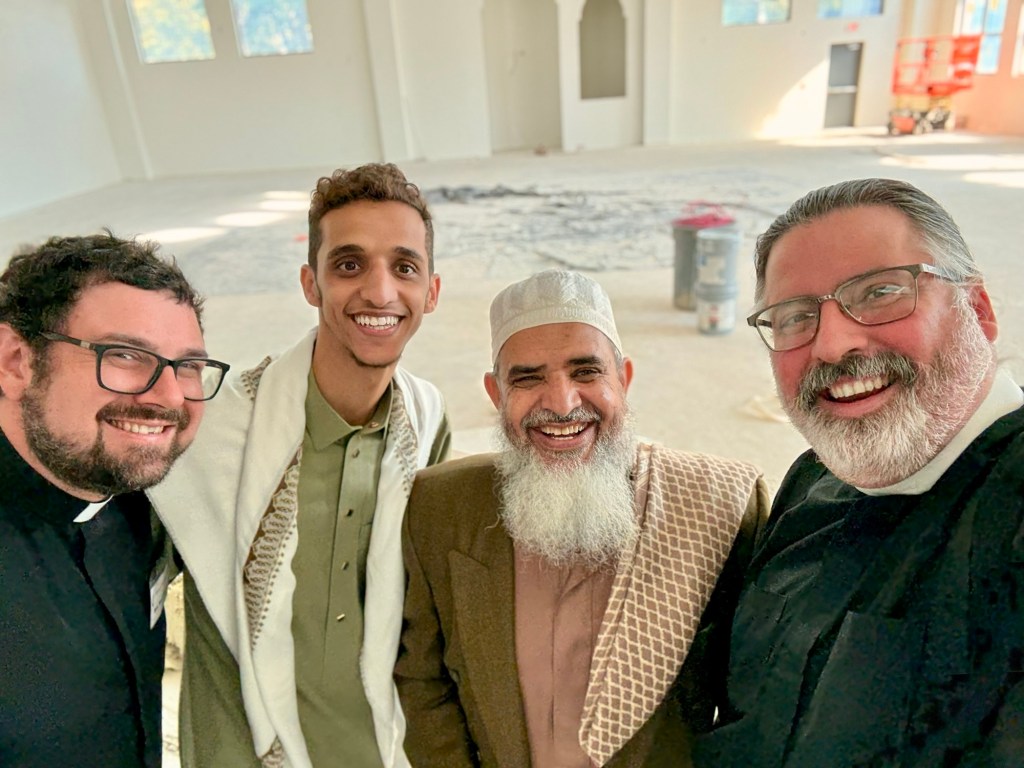
Fr. Barrett, Pastor Scott, Dr. Ali, and a longtime member of AMS Coldwater (also named Ali)

(Youtube) ‘What Would You Do?’ – Anti Muslim Harassment

http://www.youtube.com/watch?v=ueT79ZPY9IM

From ABC News via Upworthy.com
On the anniversary of 9/11, two years after the death of Osama bin Laden, this is what ‘never forgetting’ should look like. If we let Islamophobia, racism, and fear of terrorism conquer our souls and turn our country into the worst version of itself, then the forces that promote evil and terrorism have already won. As one of the participants in the video said, “We have to be better than that.”

The Face of Humanity in Libya

Many of us are horrified by the awful news and images of Chris Stevens, the US Ambassador to Libya, being assassinated and dragged through the streets.  As happens so often in this world, rage begets rage begets rage…

It was Mahatma Gandhi who said: “An eye for an eye and eventually the whole world goes blind.”

However, there is always more to the human story.  I know that the Sacred Spirit still lives in our hearts, working miracles of reconciliation.  I can hear the joyful laughter through Her tears when I see pictures like the ones I found on Facebook.  If you are angry about what has happened, meditate on these images and let the peace of God reign in your heart:

Seeds of Peace

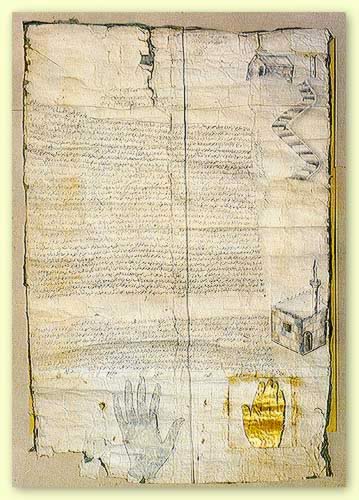
The Achtiname (Charter of Privileges) of the Prophet Muhammad, given to the monks of St. Catherine's monastery.

Last Sunday, I preached against Islamophobia from the pulpit of Boonville Presbyterian Church.  As a supportive addendum to that message, I offer this post in hopes of fostering greater goodwill and understanding between Christians and Muslims.

The purpose of this post is to lead readers from all religions toward more peaceful coexistence.  If that’s not something you want, then don’t read or comment on this article.  All offensive comments will be deleted.  I’m telling you now so that you don’t take it personally when it happens. 

The following verses from the Qur’an and the English translation of the Achtiname of Muhammad were found in an article by Dr. Zakir Naik in the online magazine Islamic Voice.  You can visit their website at: www.islamicvoice.com

Passages from the Qur’an on violence and forced conversions:

  • “Let there be no compulsion in religion: Truth stands out clear from error” [Al-Qur’an 2:256]
  • “Invite (all) to the way of thy Lord with wisdom and beautiful preaching; and argue with them in ways that are best and most gracious.” [Al-Qur’an 16:125]

The Achtiname (Charter of Privileges) is a document produced by the Prophet Muhammad himself for the monks of St. Catherine’s monastery on Mt. Sinai.  The document provides a beautiful insight on the Prophet’s attitude toward Christians.  The document has been preserved by the monks for centuries and stands as a memorial to interfaith respect.

Charter of Privileges

This is a message from Muhammad ibn Abdullah, as a covenant to those who adopt Christianity, near and far, we are with them. Verily I, the servants, the helpers, and my followers defend them, because Christians are my citizens; and by Allah! I hold out against anything that displeases them. No compulsion is to be on them.

Neither are their judges to be removed from their jobs nor their monks from their monasteries. No one is to destroy a house of their religion, to damage it, or to carry anything from it to the Muslims’ houses.

Should anyone take any of these, he would spoil God’s covenant and disobey His Prophet. Verily, they are my allies and have my secure charter against all that they hate.

No one is to force them to travel or to oblige them to fight.

The Muslims are to fight for them. If a female Christian is married to a Muslim, it is not to take place without her approval. She is not to be prevented from visiting her church to pray. Their churches are to be respected. They are neither to be prevented from repairing them nor the sacredness of their covenants.

No one of the nation (Muslims) is to disobey the covenant till the Last Day (end of the world).

The Hour Has Come

Today’s sermon from Boonville Pres.

The texts are John 12:20-33, Jeremiah 31:31-34, and Psalm 87.

Click here to listen to this sermon at fpcboonville.org

Whenever my friends and acquaintances find out that I’m a minister, it usually opens up some very interesting avenues of conversation.  This will sound weird, but the very first thing that most people do is apologize.  I haven’t quite figured out why they do that, but it happens about seven times out of ten.

Once that’s out of the way, the conversation usually gets interesting.  I don’t know of any other job that generates the kind of small talk that this one does.  When accountants meet people at parties, I doubt that folks immediately start talking about their bank account balance.  When teachers meet people in public, I doubt that folks immediate start talking about their high school GPA.  However, when I meet people out in the world, I find that many folks almost immediately want to talk about their personal beliefs and practices.

I get to learn a lot that way.  I learn about peoples’ individual life stories.  I learn about the way they see the world.  I learn about the importance that spirituality holds for most people, even those who don’t go to church.  Most of all, I learn about the way we Christians are perceived by the rest of the world.  I find that a lot of people admire us for our commitment to a particular way of faith but don’t want to limit their own spiritual journey to such a small circle of beliefs and morals.

We Christians have done plenty of things throughout our two-thousand-year history to establish the idea that ours is a small-minded and judgmental faith.  Even today, in the twenty-first century, those who most loudly and proudly broadcast their Christianity to a national audience tend to be rather one-sided in their view of the world.  It makes me sad sometimes that the incredible depth and diversity of our tradition seems to have become lost in all the hubbub.  I really can’t blame people who reject Christianity on the grounds that being Christian (from their point of view) means being like these big-time televangelists or members of the Religious Right.  I don’t blame them.  If I hadn’t met certain people or read certain books at just the right moment in my life, I would probably think as they do.

More and more, I’m also finding Christians within the church who operate with a similar mentality.  They value their Christian faith but wish there was some way they could practice it that is more thoughtful and less judgmental.  They hate feeling like they have to close their hearts and minds to the world in order to be faithful believers but don’t know of any other way to be truly Christian.  Some of these folks slog it out, longing for something better.  Others eventually give up and just leave altogether, thinking there’s no place for people like them in church.

I want to tell you today that I think there is another way.  Whether you’re sitting in church this morning, hanging on in quiet desperation, or listening to me on the radio at home, thinking the roof would cave in if you ever tried to walk through the door of a church building, I want you to know that, whoever you are, there is room for you to be you in Christ’s church.

If the church has failed to send that message clearly, it’s our own fault.  We need to learn how to be more like Jesus and do the kinds of things he did, like the one we heard about earlier in this service in our reading from the gospel according to John.

The story opens as Jesus is visiting Jerusalem with massive throngs of pilgrims on their way to celebrate the Jewish holiday of Passover.  Mixed in with this group are a number of Greek people.  They weren’t Jewish by blood, but they had come to believe in and respect the monotheistic faith of Judaism rather than the many gods worshiped by their own people.  These Greek folks wanted to take part in the Passover festivities as well, but they were only allowed to go so far.  Jewish law prevented them from entering the great Jerusalem temple because of their race.  There was one, single area set aside for them at the very farthest back end of the temple.  We would call the nosebleed section.  They called it the Court of the Gentiles.  Unfortunately, even this one distant space had been taken away from them and filled up with all kinds of vendors exchanging foreign currency and selling animals for the ritual sacrifices.  Feeling like the odd ones out, these Greek folks were definitely getting the message that there was no place for people like them in the “church” of their day.

In the midst of all this going on, these Greek people somehow managed to hear that there was this remarkable new rabbi named Jesus who happened to be in Jerusalem for the festival.  They were intrigued by what they heard and wanted to meet him, so they tracked down someone from Jesus’ entourage.  They found Philip and said, “Sir, we wish to see Jesus.”  I can’t imagine what the look on Philip’s face must have been in that moment.  Why would these foreigners want anything to do with Jesus, the Jewish Messiah?  Philip was confused enough that he thought he needed a second opinion, so he went and talked to Andrew, another one of Jesus’ disciples.  Even together, they still couldn’t figure out what was going on, so they decided to bring the issue to Jesus himself.  Jesus’ reaction to this news probably shocked them even more.  He said, “The hour has come.”

What does that mean?  Well, there’s a lot of talk about Jesus’ “hour” in John’s gospel.  Early on, when Mary asks Jesus to show his power by changing water into wine at a wedding, Jesus refuses (at first) saying, “My hour has not yet come.”  Later on, when people try to get Jesus to use another Jewish holiday as a publicity platform, Jesus again refuses (at first) saying, “My hour has not yet come.”  Finally, when he had enraged one crowd to the point where they tried to kill him, the text notes that they were unsuccessful because “his hour had not yet come.”  It was like the whole book had been building toward something big that was about to happen.  What would it be?  Maybe when his hour came, Jesus would finally confront the corrupt religious and political leadership in Jerusalem.  Maybe when his hour came, he would go kick Pontius Pilate and his Roman thugs out of the holy city once and for all.  Maybe when his hour came, Jesus would restore the nation of Israel to the glory of its golden age under King Solomon.

But no, it turns out that Jesus’ hour came when these no-account foreigners came looking for him.  Greek people.  What’s the matter with Jesus?  Didn’t he realize who he was?  Didn’t he remember where his loyalties lay?  He was Jewish.  He belonged to his own people.  His mission, as the Jewish Messiah, was to be with other Jews and help them, not these foreigners.  Yet, when these Greek people seek him out, Jesus says, “This is it.  The hour has come.  This is why I’m here.  This is what it’s all about.”

Huh?  Don’t be ridiculous, Jesus.  What about us?  What about our people?  Our security?  Our prosperity?  Our survival?  When times get tough, human beings tend to think like that.  We want to batten down the hatches and circle the wagons.  We instinctively want to protect what’s ours.  Look out for number one.  Be responsible.  This is how evolution has hard-wired us.  Truthfully, it has allowed to survive as long as have.  But, Jesus says, there comes a time, a moment, an hour, when all of that needs to be set aside.  There is an hour for opening up, reaching out, and taking risks.  These are the moments when evolution actually happens and we take small steps or giant leaps toward our destiny.  In such moments, ironically, it is our evolutionary instinct for survival that may actually be killing us.  Jesus said it like this, “Very truly, I tell you, unless a grain of wheat falls into the earth and dies, it remains just a single grain; but if it dies, it bears much fruit. Those who love their life lose it, and those who hate their life in this world will keep it for eternal life.”

We, as individuals, churches, institutions, communities, countries, a planet, are meant to be so much more than single grains.  We are meant to bear much fruit.  We are meant to grow and evolve beyond what we have been.  For Jesus himself, this meant pursuing a vision of the kingdom of God as a spiritual community that was multi-national and multi-ethnic.  Even though he was a faithful Jew, he realized that God’s activity in the world was bigger than Judaism and the special interests of his own nation.  We take it for granted today that God’s “got the whole world in [God’s] hands,” but that was still a relatively new idea in Jesus’ day.  It got him and the early Christians in a lot of trouble.  Some, like Jesus, even paid for that vision with their lives.

Jesus said, “I, when I am lifted up from the earth, will draw all people to myself.”  He didn’t say all Jews, Presbyterians, Protestants, Americans, or Christians.  Jesus said all people.  This meshes pretty well with what we heard earlier today in our Old Testament reading from the prophet Jeremiah.  Jeremiah talked about his vision of a new covenant that God would make with people.  He said, speaking in God’s name, “I will put my law within them, and I will write it on their hearts; and I will be their God, and they shall be my people. No longer shall they teach one another, or say to each other, “Know the Lord,” for they shall all know me, from the least of them to the greatest, says the Lord; for I will forgive their iniquity, and remember their sin no more.”  Jeremiah said that, under this new covenant, we will all know the Lord and the essence of the Bible will not be carved in stone or printed in books but written on our hearts.  Whose hearts?  The hearts of all people, from the least to the greatest, for we will all know the Lord.  Christians have believed for thousands of years that this new covenant is exactly what Jesus came to accomplish.  This theme also appears in Psalm 87, which we read from this morning as well.  That poem describes how all kinds of foreign nations, like Egypt, Babylon, and Ethiopia will one day be counted as citizens of Zion and included among God’s people.  You could say, based on these prophetic visions, that the kingdom of God is meant to be an all-inclusive trip.

So, this is why I think, as I mentioned earlier, that there is another way to be Christian in this world.  We are not obligated to sell out to narrow, one-sided interpretations of our religion.  There is room in this church for everyone.  Whoever you are and however you are hearing this today, I want you to know there is room in this church for you.

I think there’s also a challenge for all of us in Jesus’ words.  I think it’s worth continually asking ourselves whether our “hour has come.”  Are we currently, in our personal or collective lives, at a point where, in order for evolution to happen, we need to let go of our evolutionary instinct for survival and takes risks?  Back in Jesus’ day, it was a moment for reaching out beyond one’s ethnic and national identity to grab hold of a religious vision for a spiritual community that was open to Greeks as well as Jews.  During the millennia since then, the Christian church has continued to wrestle with other issues.  We have worked to build a church where people of different races are welcome to worship side by side as equal partners.  We have opened our doors to acknowledge members of other churches and denominations as friends in Christ.  We have opened our pulpits for women to preach the gospel and administer the sacraments.  Each of these developments involved a certain amount of risk in its day, and there were those along the way who resisted, often citing Scripture to justify their fear, but I think we can all agree that each leap of faith was one more positive step in the direction of evolution and we are a richer church today for having taken those steps.

What challenges are we now facing as a church?  Once again, we’ve fallen on hard times.  It’s true that church attendance in this country is not what it used to be.  Many churches are tightening their belts and trying to do the best they can with shrinking financial resources.  A lot of folks are worried for our future and our survival.  They think we should circle the wagons and batten the hatches.  Some think mission and service projects should take second place to institutional survival.  Some have shut their ears to new ideas or new interpretations of ancient truths.

There are two particular areas where I think the hour has come for us as Christians in this generation.  In these two areas, I believe we are being called to open our hearts, minds, and doors just as Jesus opened his to those Greek foreigners who came looking for him in Jerusalem.

The first is one you’ve heard me mention before and will hear me mention again.  I don’t mind admitting that I am personally passionate about this issue.  I’m talking of course about the full-inclusion of gay, lesbian, bisexual, and transgendered people in the life of our church.  Last year, the Presbyterian Church voted to open the doors for these folks to be ordained as pastors, elders, and deacons in our denomination.  This summer, our General Assembly will decide whether or not these same people are allowed to get married in our churches.  I think this issue, in particular, holds a key to growing our little congregation here in Boonville.  For lack of a better term, I think we have a niche market here.  There are plenty of churches in Boonville who have bigger budgets and flashier programs than we do, but there are not very many who share our convictions about the full and equal inclusion of people of all sexual orientations.  Believe it or not, there is a gay community in our neck of the woods and there are people in it who are longing to find a spiritual home where they know they will be fully loved and accepted for who they are.

The second area where I think our hour has come is in our relationship toward people of other religions or no religion at all.  We live in a society of unparalleled diversity and interconnection.  Our neighbors aren’t just Protestant, Catholic, or Jewish anymore.  They’re Buddhist, Hindu, Atheist, Taoist, and Muslim.  We have the opportunity to learn and grow by listening to one another and casting our neighbors in a positive light.

For the last ten years, we’ve struggled with a particularly strong bout of Islamophobia in this country.  The fear and anger generated in the wake of 9/11 has spread beyond the fanatics of Al Qaida and tainted our perception of all Muslims.  We need to unstop our ears to the voice of progressive Muslim clerics like Feisal Abdul Rauf of Cordoba House (aka the Ground Zero Mosque) in New York.  Leaders like him are calling for peace among their own people and opening the doors to dialogue, respect, and learning.  When we hear the Muslim call to prayer from the minarets, let’s respond by adding our Christian ‘Amen’ to their ‘Allahu Akbar.’

The way to fuller and greater life for ourselves, our church, and our country does not lie in circling the wagons and battening the hatches.  We need to realize that the hour has come for us to take risks and reach out in the name and Spirit of Jesus, who has promised to draw all people to himself in the all-inclusive kingdom of heaven-on-earth.